


The journey to obtaining a Green Card, or permanent residency, in the United States is a significant milestone for countless individuals and families. For many, this path culminates in a crucial step: the Green Card interview. This interview, conducted by U.S. Citizenship and Immigration Services (USCIS), is designed to verify the information provided in your application and ensure you meet all eligibility requirements. While it can feel daunting, proper preparation is key to navigating this process successfully.
At Imigrar, an immigration law firm based in Orlando, Florida, we understand the anxieties and questions that arise during this critical phase. Our mission is to "Keep Families Together" by providing expert legal guidance and unwavering support to immigrants nationwide. This comprehensive guide is designed to equip you with the knowledge, tips, and confidence needed to ace your Green Card interview.
The reporting that sparked this guide
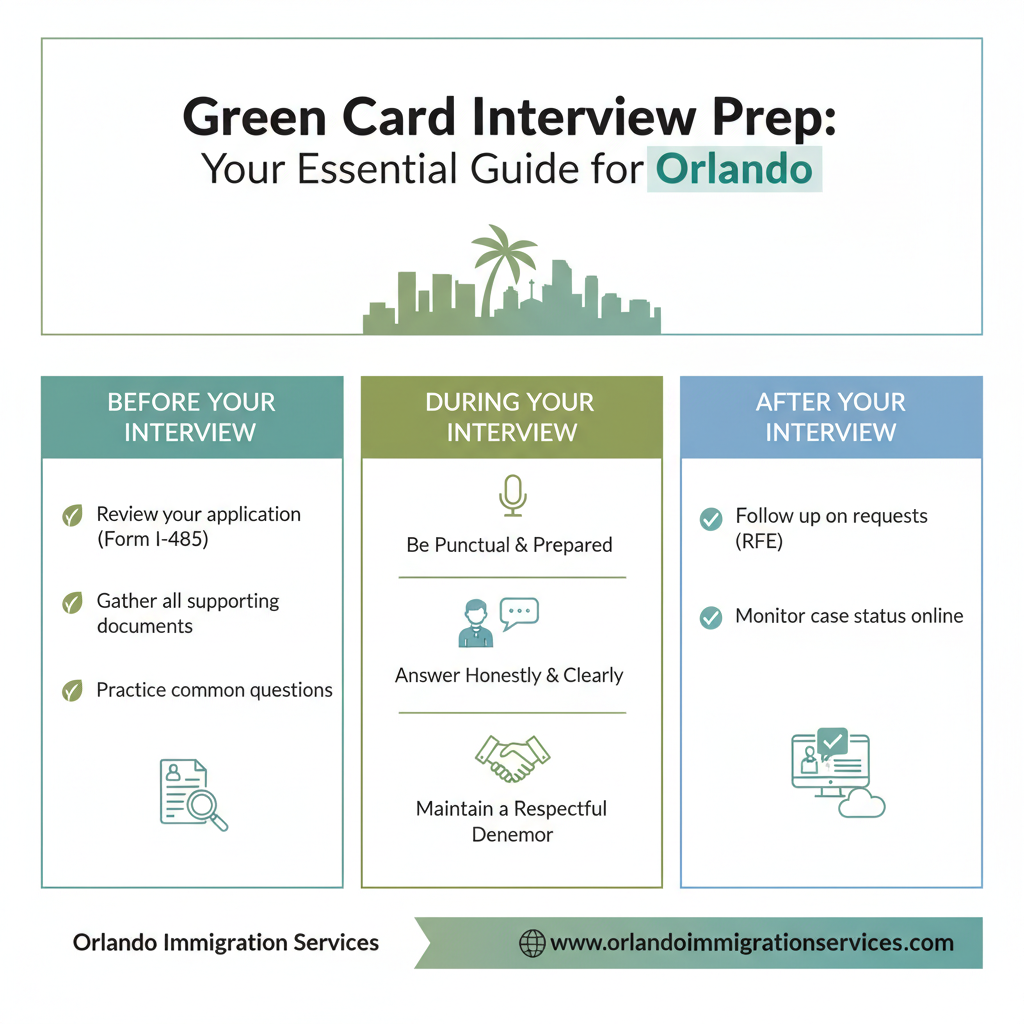
The importance of thorough preparation for your Green Card interview is a perennial topic in immigration law discussions. Recent reports and ongoing conversations within the immigration community highlight the consistent need for applicants to be meticulously prepared. Our insights are informed by the latest trends and advice compiled from various sources, including:
Green Card Interview Preparation Tips (Immigration Law)
What This News Means for Immigrants in Orlando and Across Florida
Understanding the significance of the Green Card interview is paramount for all applicants, especially those residing in a vibrant, diverse state like Florida.
Why this news is showing up now
The emphasis on Green Card interview preparation is not new, but it consistently resurfaces due to several factors:
- Evolving Immigration Policies: While the core interview process remains stable, USCIS policies and priorities can subtly shift. This might lead to increased scrutiny in certain areas, updated document requirements, or a renewed focus on specific types of cases. Staying informed is crucial.
- Increased Complexity: Immigration law is inherently complex. As applicants navigate various visa categories, adjustment of status, and consular processing, the need for clear, actionable guidance on the interview stage becomes more pronounced.
- High Stakes: A successful interview is the final hurdle for many to achieve permanent residency. The consequences of an unprepared or poorly handled interview can range from requests for additional evidence (RFEs) to delays, or even denial, making thorough preparation a constant priority.
- Applicant Anxiety: The interview process naturally generates anxiety. News and guides focusing on preparation help alleviate this by demystifying the process and providing a roadmap to success.
How it can affect Florida residents
For immigrants living in Florida, and particularly in the Orlando area, the importance of interview preparation has specific local relevance:
- Orlando USCIS Field Office: If you are applying for Adjustment of Status from within the U.S., your interview will likely take place at the Orlando USCIS Field Office. Familiarity with local procedures, typical interview styles, and common questions asked by officers in this specific office can be advantageous.
- Diverse Population: Florida is home to a vast and diverse immigrant population. This means the Orlando office processes a wide array of cases, from family-based petitions to employment-based applications. While the core requirements are federal, the volume and variety of cases mean officers are highly experienced, and applicants must be equally prepared.
- Traffic and Logistics: The Orlando area, with its bustling I-4 corridor, requires careful planning for your interview day. Arriving late due to traffic or parking issues can negatively impact your interview experience.
- Access to Legal Support: Central Florida, including Orange County, offers access to experienced immigration attorneys like those at Imigrar. Leveraging local legal expertise can provide a significant advantage in preparing for your specific interview.
Need Expert Guidance? Navigating your Green Card interview can be complex. Our Orlando immigration team provides personalized support to ensure you're fully prepared. Call +1 786-791-3106 for a free consultation, or message us online. Se Habla Español.
What Green Card Interviews Are (and Why They Matter)
The Green Card interview is a critical step in the journey to becoming a lawful permanent resident of the United States. It's not just a formality; it's an opportunity for USCIS to verify the authenticity of your application and your eligibility.
A plain-English definition
Simply put, a Green Card interview is a meeting with an immigration officer who will ask you questions about your application for permanent residency. This officer's job is to ensure that all the information you've provided is truthful, that you meet all legal requirements for a Green Card, and that there are no reasons why you should be denied. For family-based petitions, especially marriage-based cases, the interview also serves to verify the authenticity of your relationship.
Key terms you need to know
Familiarity with immigration terminology will help you understand the process better:
- Green Card: Official document (Form I-551) that proves you are a lawful permanent resident of the United States. It grants you the right to live and work permanently in the U.S.
- USCIS: U.S. Citizenship and Immigration Services. This is the government agency responsible for processing immigration benefits, including Green Cards. Their official website is USCIS official website.
- Adjustment of Status (AOS): The process of applying for a Green Card from within the United States. If you are already in the U.S. on a valid visa and meet certain criteria, you can "adjust" your status to that of a lawful permanent resident. This typically involves filing Form I-485.
- Consular Processing: The process of applying for a Green Card from outside the United States, typically at a U.S. embassy or consulate in your home country. This involves working with the U.S. Department of State (U.S. Department of State).
- Petitioner: The U.S. citizen or lawful permanent resident who files an immigration petition (e.g., Form I-130) on behalf of an eligible family member.
- Beneficiary: The foreign national who is seeking an immigration benefit, such as a Green Card, and for whom the petition is filed.
- Affidavit of Support (Form I-864): A legally binding document filed by the petitioner (or a joint sponsor) to demonstrate that the beneficiary will not become a public charge in the U.S.
- Request for Evidence (RFE): A letter from USCIS asking for additional documents or information to support your application.
- Notice of Intent to Deny (NOID): A letter from USCIS indicating their intention to deny your application, providing you an opportunity to respond and address their concerns.
- Priority Date: The date USCIS receives your immigration petition (e.g., Form I-130). This date is crucial for tracking your place in line for visas in certain categories.
- Grounds of Inadmissibility: Specific reasons under U.S. immigration law why a foreign national may be denied entry into the U.S. or a Green Card (e.g., certain criminal convictions, health issues, misrepresentation).
Current Immigration Law: The Foundation for Your Green Card Interview
The Green Card interview process is governed by the Immigration and Nationality Act (INA), which outlines the eligibility requirements and grounds of inadmissibility for permanent residency. Understanding these legal foundations is essential for comprehensive preparation.
Federal requirements
The core requirements for a Green Card are established at the federal level by the INA. While specific eligibility depends on your visa category (e.g., family-based, employment-based, asylum), some universal principles apply:
- Eligibility for the Green Card Category: You must meet the specific criteria for the Green Card category you are applying under. For example, in family-based petitions, you must demonstrate a qualifying relationship (e.g., spouse, parent, child) with a U.S. citizen or lawful permanent resident. This is initiated by filing Form I-130, Petition for Alien Relative.
- Admissibility: You must be "admissible" to the United States. This means you must not fall under any of the grounds of inadmissibility outlined in INA § 212(a). Common grounds include certain criminal offenses, health-related issues, national security concerns, prior immigration violations, and the likelihood of becoming a public charge.
- No Misrepresentation: All information provided in your application and during your interview must be truthful. Any material misrepresentation or fraud can lead to severe consequences, including permanent bars from immigration benefits.
- Financial Support: For most family-based and some employment-based Green Cards, the petitioner (or a joint sponsor) must file Form I-864, Affidavit of Support, demonstrating they can financially support the beneficiary and that the beneficiary will not become a public charge.
- Proper Documentation: All required forms and supporting documents must be filed correctly and completely. This includes your primary application for Adjustment of Status (Form I-485, Application to Register Permanent Residence or Adjust Status), biographical data forms (Form G-325A, if applicable), medical examination results (Form I-693), and various identity and civil documents.
You can find more detailed information on forms and requirements on the USCIS official website and their dedicated USCIS Forms page.
Florida-specific considerations
While immigration law is federal, certain practical aspects can be influenced by your location:
- Orlando USCIS Field Office Procedures: If your interview is in Orlando, the specific procedures, wait times, and even the types of questions asked can sometimes reflect the local office's focus. The Orlando Field Office handles a high volume of family-based cases, particularly marriage-based ones, so officers are well-versed in scrutinizing relationships.
- Local Resources: For Central Florida residents, understanding the local resources available, such as accredited medical examiners for Form I-693, can streamline your preparation.
- Legal Expertise: Engaging an immigration attorney in Orlando, like those at Imigrar, provides you with legal counsel familiar with the nuances of the local USCIS office and state-specific considerations, ensuring your application meets all federal and practical requirements.
Worried About Legal Requirements? Our Orlando immigration lawyers are experts in federal immigration law and local procedures. Don't risk your future; get professional help. Call +1 786-791-3106 for a free consultation. Se Habla Español.
How to Prepare for Your Green Card Interview: A Complete Step-by-Step Guide
Thorough preparation is the bedrock of a successful Green Card interview. This detailed guide will walk you through the essential steps to ensure you're ready for every aspect of the process.
1) Understand Your Case and Review Your Application
Before anything else, you must have a complete understanding of your own application. This sounds simple, but many applicants forget the details they submitted months or even years ago.
- Review All Submitted Forms: Go through every form you submitted to USCIS, especially Form I-130 (if applicable), Form I-485, Form I-864, and any supplementary forms. Make sure you remember all the dates, addresses, and answers you provided.
- Understand Your Eligibility Basis: Be clear on the specific legal basis for your Green Card (e.g., marriage to a U.S. citizen, parent of a U.S. citizen, employment sponsorship). The interview questions will largely revolve around confirming your eligibility under this category.
- Identify Potential Red Flags: Think about any potential issues in your history that might raise questions (e.g., past immigration violations, criminal history, gaps in employment, previous marriages). Be prepared to explain these honestly and thoroughly.
- Read the Interview Notice: Your interview notice (Form I-797C) will specify the date, time, and location (e.g., Orlando USCIS Field Office) of your interview, as well as a list of required documents. Read it carefully.
Required Documents for this Step:
- Copies of all forms previously submitted to USCIS (Form I-130, Form I-485, Form I-864, etc.)
- Copy of your interview notice (Form I-797C)
2) Gather and Organize All Required Documents
This is arguably the most critical step. USCIS officers expect you to bring a comprehensive set of original documents and copies. Organize them neatly in a folder or binder, clearly labeled.
- Originals and Copies: For almost every document, you should bring the original AND a clear photocopy. USCIS will typically keep the copies and return the originals.
- Translations: Any document not in English must be accompanied by a certified English translation. The translator must certify that they are competent to translate and that the translation is accurate.
- Proof of Identity and Eligibility:
- Your passport and all previous passports (if applicable)
- Birth certificate (yours and petitioner's/spouse's)
- Marriage certificate (if applicable)
- Divorce decrees or death certificates for any previous marriages (yours and petitioner's/spouse's)
- Current work authorization document (EAD card, Form I-766)
- Travel document (Advance Parole, Form I-512), if used
- Medical examination report (Form I-693) in a sealed envelope (if not already submitted or if it has expired)
- Two passport-style photos, taken within 30 days of the interview
- Official police clearances from all countries where you lived for 6 months or more since age 16 (for consular processing, or if requested for AOS)
- Financial Documents (for Form I-864, Affidavit of Support):
- Petitioner's (and joint sponsor's, if any) most recent 3 years of federal income tax returns (IRS transcripts preferred)
- Proof of current employment (e.g., recent pay stubs, employment verification letter)
- Proof of assets (bank statements, property deeds, stock certificates) if relying on assets to meet income requirements
- Relationship Evidence (for family-based, especially marriage-based): This is paramount for proving a bona fide marriage. Bring as much as possible to demonstrate your life together.
- Joint bank account statements
- Joint lease agreements or property deeds
- Utility bills in both names
- Health, life, or auto insurance policies showing both names
- Birth certificates of children born to the marriage
- Photos of your wedding, family gatherings, vacations (with dates/context)
- Affidavits from friends/family attesting to the relationship
- Correspondence (emails, texts, cards) that shows an ongoing relationship
- Joint credit card statements
- Any other evidence that shows you share a life together.
- Petitioner's Documents: U.S. birth certificate, naturalization certificate, or U.S. passport to prove U.S. citizenship. Or Green Card (Form I-551) to prove LPR status.
Important: Do not bring more original documents than necessary for proof of identity and core eligibility. Copies are usually sufficient for supporting evidence like photos or joint bills, but be prepared to show originals if requested.
3) Prepare for Interview Questions
The interview questions will vary based on your case type, but generally cover your application, personal history, and eligibility. Practice answering these questions honestly and clearly.
- General Questions:
- Confirming biographical information (name, date of birth, addresses, parents' names)
- Questions about your immigration history (how you entered the U.S., previous visas, any deportations)
- Questions about criminal history, even minor infractions
- Questions about membership in certain organizations
- Questions related to grounds of inadmissibility (e.g., public charge affidavit, health issues)
- Marriage-Based Specific Questions: These are designed to ascertain the authenticity of your marriage.
- How and where did you meet?
- When did you decide to get married?
- Details about your wedding ceremony.
- Where do you live? What's your daily routine like?
- Who pays the bills? Do you have joint accounts?
- What are your spouse's hobbies, favorite foods, family members' names?
- What did you do last holiday?
- Review the N-400 Questions: Even if you're not applying for citizenship yet, many Green Card interview questions mirror those on the N-400 (Application for Naturalization) regarding your moral character, criminal history, and loyalty to the U.S.
Warning: Never lie or provide inconsistent information. Immigration officers are trained to detect fraud. If you don't know an answer, it's okay to say so. If you made a mistake on your application, explain it truthfully.
4) Practice Your English (or Arrange for an Interpreter)
Your ability to communicate effectively is crucial for a smooth interview.
- English Proficiency: If you are fluent in English, speak clearly and confidently.
- Interpreter: If you are not fluent in English, you have the right to bring a qualified interpreter to your interview. This interpreter cannot be your petitioner, a family member, or your attorney (though your attorney will be there to represent you, not interpret). USCIS may also provide an interpreter, but it's often safer to bring your own trusted, qualified interpreter. Inform USCIS in advance if you will be bringing an interpreter.
5) Dress Professionally and Arrive Early
First impressions matter, and punctuality is non-negotiable.
- Dress Code: Dress as you would for a job interview – clean, neat, and professional attire. This shows respect for the process and the interviewing officer.
- Arrive Early: Plan to arrive at the Orlando USCIS Field Office at least 30-45 minutes before your scheduled time. This allows for security checks, finding parking, and settling in. Being late can lead to your interview being rescheduled or even canceled.
- What to Bring: Only bring essential documents, your attorney (if applicable), and your interpreter (if needed). Leave large bags, unnecessary electronics, and other distractions at home or in your car.
6) During the Interview: Be Honest and Respectful
Your demeanor during the interview can influence the officer's perception.
- Be Truthful: Always answer questions honestly. If you don't understand a question, ask for clarification.
- Be Respectful: Address the officer respectfully. Maintain eye contact.
- Listen Carefully: Pay close attention to each question before answering. Don't volunteer information that isn't asked for, but be thorough in your answers.
- Consult Your Attorney: If you have an attorney present, they can clarify questions, object to inappropriate questions, and ensure your rights are protected. They cannot answer for you, but they can guide you.
- Provide Documents When Asked: Only present documents when the officer specifically requests them.
- Sign Documents: You may be asked to sign documents or reaffirm statements under oath.
7) After the Interview: Follow Up and Next Steps
The interview isn't always the final step.
- Decision at Interview: Sometimes, the officer will tell you on the spot that your Green Card is approved. You might receive a stamp in your passport as temporary proof of status.
- Request for Evidence (RFE): If the officer needs more information, they will issue an RFE. Respond to this promptly and completely within the given deadline (usually 30-90 days).
- Notice of Intent to Deny (NOID): If USCIS intends to deny your case, they will send a NOID, giving you a chance to address their concerns. This is a critical stage where legal counsel is invaluable.
- Waiting for Decision: If no immediate decision or RFE is issued, you will typically receive a decision by mail within a few weeks to a few months. You can check your case status online using your receipt number on the USCIS Case Status Online tool. You can also check average processing times for the Orlando office on the USCIS Processing Times page.
- Green Card Mailed: If approved, your physical Green Card (Form I-551) will be mailed to you.
Practical Steps You Can Take Today for Interview Success
Don't wait until the last minute. Start preparing now with these actionable steps.
- 1. Review Your Entire Application Package: Gather all copies of the forms and supporting documents you submitted to USCIS. Read them thoroughly. Are there any inconsistencies? Any gaps? Refresh your memory on every detail. This includes Form I-130, Form I-485, and Form I-864.
- 2. Create a Master Document Checklist: Based on your interview notice and the type of Green Card you're seeking, make a detailed list of every single document you need to bring (originals and copies). Tick them off as you gather them.
- 3. Organize Your Documents Systematically: Use a binder with dividers or a folder system. Label each section clearly (e.g., "Identity Documents," "Financial Evidence," "Relationship Proof," "Translations"). This will make it easy to retrieve documents quickly during the interview, showing the officer you are organized and prepared.
- 4. Practice Common Interview Questions: Have a friend or family member (not your petitioner in a marriage-based case) quiz you. Practice answering truthfully, concisely, and consistently. For marriage-based cases, practice both individual and joint questions with your spouse.
- 5. Schedule a Consultation with an Immigration Attorney: Even if you filed your application yourself, a final review with an experienced immigration lawyer can be invaluable. An attorney can spot potential issues, advise on how to present your case, and prepare you for specific questions relevant to your situation. This is especially true for residents of Orlando and Central Florida who can benefit from local expertise.
- 6. Check USCIS Processing Times: While not directly interview preparation, knowing the current processing times for the Orlando Field Office can help manage expectations about when to expect a decision after your interview. Visit USCIS Processing Times.
- 7. Plan Your Interview Day Logistics: Map your route to the Orlando USCIS Field Office. Identify parking options. Account for potential traffic on the I-4 corridor. Ensure you have proper identification for entry.
Document Preparation Guidance:
- Originals vs. Copies: Always bring the original of any civil document (birth certificate, marriage certificate, divorce decree, passport, etc.). Bring a clear photocopy of each original for USCIS to keep. For supporting evidence like photos or joint bills, copies are usually sufficient, but have originals accessible if asked.
- Translations: If any document is not in English, it MUST be accompanied by a complete and accurate English translation, certified by the translator. The certification must state that the translator is competent to translate from the foreign language into English and that the translation is complete and accurate.
- Photographs: Ensure your passport-style photos meet USCIS specifications (2x2 inches, white background, no glasses, recent).
Timeline Expectations:
- Interview Notice: You typically receive your interview notice (Form I-797C) by mail several weeks to a few months before the actual interview date.
- Interview Length: Most Green Card interviews last between 20 minutes to an hour, but complex cases can take longer.
- Decision Time: Some officers may approve your case on the spot. Others may take weeks or months to issue a final decision. If an RFE is issued, you usually have 30 to 90 days to respond.
Ready to Take Action? Let Imigrar guide you through every step of your Green Card interview preparation. Our Orlando team is here to help. Call +1 786-791-3106 for a free consultation. Se Habla Español.

How Imigrar Helps Immigrants in Orlando Prepare for Their Green Card Interview
At Imigrar, our commitment is to "Keep Families Together." We understand that the Green Card interview is a pivotal moment, and our experienced legal team is dedicated to providing comprehensive support to ensure your success.
Our experience and expertise
Based in Orlando, Florida, Imigrar serves clients nationwide, bringing a wealth of knowledge and experience to every immigration case. Our attorneys specialize in family-based immigration, adjustment of status, and consular processing, areas where the Green Card interview is often the final hurdle. We have successfully guided countless individuals and families through this complex process, understanding the unique challenges that can arise.
When you choose Imigrar, you benefit from:
- Personalized Case Review: We thoroughly review your entire application package, identifying potential weaknesses or areas that might require additional evidence or explanation. This includes a meticulous examination of your Form I-130, Form I-485, and Form I-864.
- Tailored Interview Preparation: We conduct mock interviews, simulating the questions you might face from a USCIS officer, particularly those common at the Orlando Field Office. We provide specific feedback on your answers, demeanor, and how to best present your case.
- Comprehensive Document Organization: Our team assists you in organizing your supporting documents, ensuring you have all required originals, copies, and certified translations. We help you create a clear, accessible binder for your interview.
- Legal Representation at the Interview: An Imigrar attorney can accompany you to your Green Card interview at the Orlando USCIS Field Office. While we cannot answer questions for you, our presence ensures your rights are protected, we can clarify complex legal issues, and address any procedural irregularities. For Central Florida residents, having local counsel familiar with the office can be a significant advantage.
- Proactive Problem Solving: If there are any complexities in your case, such as prior immigration issues, criminal history, or gaps in documentation, we help you prepare explanations and gather additional evidence to address these concerns proactively, minimizing the risk of an RFE or NOID.
- Ongoing Support: From the moment you engage our services until you receive your Green Card, we are here to answer your questions, ease your anxieties, and provide continuous legal guidance.


