What This News Means for Immigrants in Orlando and Across Florida
The journey to obtaining a Green Card, or lawful permanent residency, is a pivotal moment for many individuals and families seeking to build a life in the United States. A critical step in this process is the Green Card interview, a face-to-face meeting with an immigration officer designed to verify the information in your application and determine your eligibility. The ongoing discussion and "trending news" around Green Card interview preparation highlight its enduring importance and the constant need for applicants to be thoroughly ready.Why this news is showing up now
The need for comprehensive Green Card interview preparation is not a new phenomenon, but rather a perpetually trending topic in immigration law. Every day, thousands of individuals nationwide are called for their interviews, making the pursuit of accurate, up-to-date guidance a constant priority. This "news" reflects the continuous flow of Green Card applications through U.S. Citizenship and Immigration Services (USCIS) and the consistent challenge applicants face in understanding and meeting the rigorous requirements. As policies evolve and processing times shift, the core advice on how to prepare remains vital, yet its specific application often requires nuanced understanding. For many, the interview is the culmination of years of waiting and an extensive application process, making success paramount. Thus, resources like this guide are always in demand, reflecting the ongoing commitment of immigration law firms like Imigrar to "Keep Families Together" by providing clarity and support.How it can affect Florida residents
For immigrants residing in Florida, particularly those in the bustling Orlando metropolitan area, preparing for a Green Card interview carries specific considerations. Florida is home to a large and diverse immigrant population, and USCIS operates several field offices across the state, including key locations in Orlando, Miami, and Tampa. If your case is being processed through the Orlando USCIS Field Office, your interview will likely be scheduled there. This means understanding local procedures, potential wait times specific to Florida offices, and navigating the logistics of attending an interview in a major urban center like Orlando. Whether you're located near the I-4 corridor in Central Florida, along the coast, or in South Florida, the federal immigration laws and interview requirements are the same nationwide. However, the experience can be localized. For example, the volume of cases handled by the Orlando office might influence scheduling, and local attorneys are intimately familiar with the specific nuances of that particular office. Imigrar, based in Orlando, is uniquely positioned to assist Central Florida residents, offering localized expertise combined with a national reach to serve clients nationwide. Our proximity to the Orlando USCIS Field Office allows us to provide tailored support, from preparing you for your specific interview location to representing you on the day itself, ensuring you are well-equipped to present your case effectively to the immigration officer.Need Help? Our Orlando immigration team is ready to assist. Call +1 786-791-3106 for a free consultation, or message us online. Se Habla Español.
What Green Card Interviews Are (and Why They Matter)
A Green Card interview is a mandatory step for most individuals applying for lawful permanent residency in the United States. It's a formal meeting with a USCIS officer (or a Consular Officer if you are applying from outside the U.S. through consular processing) who will review your application, verify your eligibility, and ask questions to confirm the information you've provided. The primary goal is to ensure you meet all legal requirements for a Green Card and that there are no grounds of inadmissibility that would prevent you from becoming a permanent resident.A plain-English definition
Think of the Green Card interview as your final exam for permanent residency. After submitting extensive paperwork, this is your chance to directly communicate with an immigration official. The officer wants to confirm that everything in your application is true, that your relationship (if it’s a family-based application) is genuine, and that you don't pose any security or public charge risks to the U.S. It's a conversation, but a very important one, where honesty and thorough preparation are key. For family-based petitions, both the petitioner (the U.S. citizen or permanent resident spouse/relative) and the beneficiary (the immigrant seeking the Green Card) will typically attend.Key terms you need to know
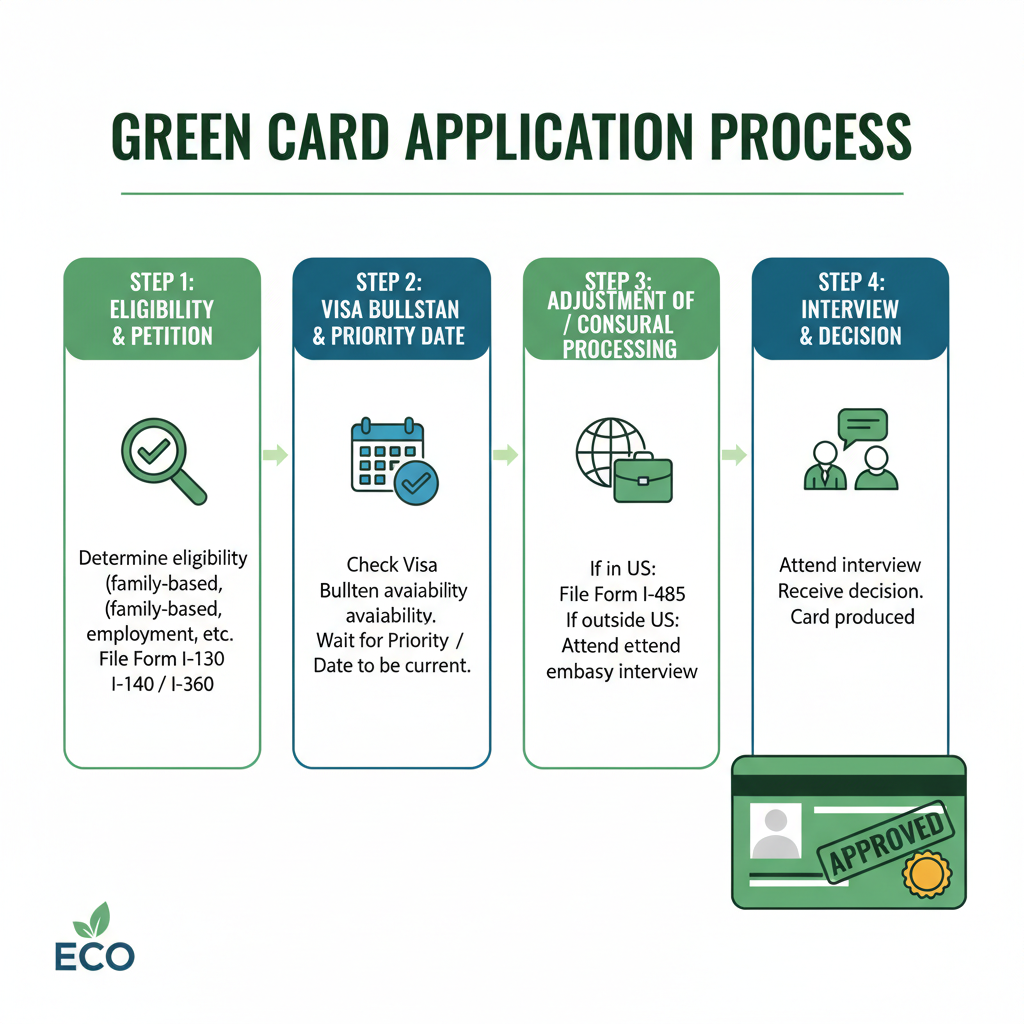
Understanding these terms will help you navigate the Green Card process and your interview: * **Green Card (Form I-551):** The official document that proves you are a lawful permanent resident of the United States. * **Adjustment of Status (AOS):** The process of applying for a Green Card while physically present in the United States. This is handled by USCIS. The primary form for this is Form I-485. * **Consular Processing:** The process of applying for a Green Card through a U.S. Embassy or Consulate abroad. This is handled by the U.S. Department of State. * **Petitioner:** The U.S. citizen or lawful permanent resident who files an immigration petition (e.g., Form I-130) on behalf of an eligible relative. * **Beneficiary:** The foreign national who is seeking an immigration benefit, such as a Green Card, based on a petition filed on their behalf. * **Priority Date:** The date USCIS receives your immigration petition (e.g., Form I-130). This date determines your place in the visa queue, especially for categories with annual limits. * **Affidavit of Support (Form I-864):** A legally binding document signed by a petitioner (sponsor) to accept financial responsibility for the intending immigrant. This ensures the immigrant will not become a "public charge." * **Public Charge Rule:** A legal standard used by immigration officials to determine if an applicant is likely to become primarily dependent on government assistance. The interview will often touch upon your financial stability and the sponsor's ability to support you. * **Notice of Interview (Form I-797C, Notice of Action):** The official letter from USCIS informing you of your interview date, time, and location. The Green Card interview is your opportunity to present your case clearly and answer any outstanding questions the officer may have. It truly matters because the outcome directly determines your ability to live, work, and build a future in the United States permanently. A successful interview brings you one step closer to achieving your American dream and, for many, keeping your family together.Current Immigration Law: The Foundation for Your Green Card Interview
The Green Card interview is deeply rooted in federal immigration law, primarily the Immigration and Nationality Act (INA). This comprehensive body of law dictates who is eligible for a Green Card, the procedures for applying, and the grounds on which an applicant may be deemed inadmissible to the United States. Understanding these legal foundations is crucial for successful interview preparation.Federal requirements
The eligibility for a Green Card is determined by specific provisions within the INA. Most Green Card applicants fall into one of several categories: * **Family-Based Immigration:** This is governed by sections of the INA related to family reunification. For instance, U.S. citizens can petition for immediate relatives (spouses, unmarried children under 21, parents), as outlined in INA Section 201(b)(2)(A)(i). Other family members (e.g., married children, siblings) fall into preference categories under INA Section 203(a). The interview focuses heavily on proving the authenticity of these relationships. * **Employment-Based Immigration:** This category, covered by INA Section 203(b), allows foreign nationals to obtain Green Cards based on their employment skills or investment. * **Refugee and Asylum Status:** Individuals granted asylum or refugee status may apply for a Green Card one year after their grant, under INA Section 209. * **Diversity Visa Lottery:** The annual lottery provides Green Cards to individuals from countries with historically low rates of immigration to the U.S., as per INA Section 203(c). Regardless of the category, all applicants must demonstrate that they are not "inadmissible" to the United States under INA Section 212(a). Grounds of inadmissibility can include: * **Health-related grounds:** Certain communicable diseases, lack of required vaccinations. * **Criminal grounds:** Convictions for certain crimes, drug trafficking. * **Security grounds:** Terrorism, espionage. * **Public Charge grounds:** Likelihood of becoming primarily dependent on government assistance (addressed by Form I-864, Affidavit of Support). * **Immigration violation grounds:** Prior deportations, misrepresentation to gain immigration benefits. The interview process is designed to thoroughly vet applicants against these and other inadmissibility grounds. The officer will review all submitted documentation, including your initial petition (e.g., Form I-130, Petition for Alien Relative), your application for adjustment of status (Form I-485, Application to Register Permanent Residence or Adjust Status), and any supporting documents. They will also verify your medical examination results (submitted via Form I-693, Report of Medical Examination and Vaccination Record). For detailed information on forms and requirements, always refer to the USCIS official website.Florida-specific considerations
While immigration law is federal, the administration of these laws occurs at a local level through USCIS field offices. For applicants in Florida, particularly those in Orange County and surrounding areas, your interview will most likely be scheduled at the Orlando USCIS Field Office. Other major field offices in Florida include Miami and Tampa. It's important to remember that the legal requirements for your Green Card remain the same whether you apply in Orlando, Miami, or any other state. There are no "Florida-specific" immigration laws that change Green Card eligibility. However, local field offices may have minor procedural differences or specific document preferences. An experienced Orlando immigration attorney, like those at Imigrar, will be familiar with the local office's practices, which can be invaluable in preparing your case. For example, knowing how the Orlando office typically handles certain types of evidence or questions can give you an edge. The immigration process requires meticulous attention to detail and a thorough understanding of federal statutes. Imigrar is dedicated to guiding our clients through these complex legal requirements, ensuring every aspect of their application and interview preparation adheres strictly to current immigration law.Need Help? Our Orlando immigration team is ready to assist. Call +1 786-791-3106 for a free consultation, or message us online. Se Habla Español.
How to Prepare for Your Green Card Interview: A Complete Step-by-Step Guide
The Green Card interview is a critical juncture in your immigration journey. Proper preparation can significantly increase your chances of a successful outcome. Here’s a detailed, step-by-step guide to help you navigate this important process with confidence.1) Understand Your Case and Its Specific Requirements
Before you do anything else, thoroughly understand the basis of your Green Card application. Are you applying through a family member (spouse, parent, child)? Through employment? As an asylee or refugee? Each category has specific eligibility criteria and types of evidence required. * **Review Your Petition (e.g., Form I-130):** If applying through a family member, understand the details provided in the initial petition. * **Review Your Application (Form I-485):** This is your core application for Adjustment of Status. Every answer must be consistent with your interview responses. * **Identify Potential Issues:** Are there any past arrests, immigration violations, or complex family situations? Acknowledge them and prepare explanations and supporting documentation. * **Consult an Attorney:** An immigration attorney can help you understand the specific legal framework of your case and identify any potential red flags.2) Gather and Organize All Required Documents (Originals & Copies)
This is perhaps the most crucial step. You must bring ALL original documents and a complete set of photocopies of everything you submitted, plus any new documents that have emerged since your initial filing. Organize them neatly in a binder or folder, clearly labeled. **Required Documents Checklist:** * **Official Interview Notice:** Your Form I-797C. * **Passports:** Valid passport for the beneficiary, and for the petitioner if they are a foreign national. * **Birth Certificates:** Original and copy for both petitioner and beneficiary. * **Marriage Certificate (if applicable):** Original and copy. * **Divorce Decrees/Death Certificates:** For any previous marriages of either spouse. * **Medical Examination (Form I-693):** If not already submitted, bring the sealed envelope from the civil surgeon. If you submitted it previously, bring a copy for your reference. * **Photos:** Two recent, passport-style color photographs for the beneficiary. * **Affidavit of Support (Form I-864):** Original and copy, with all supporting financial documents for the petitioner/sponsor: * Most recent federal tax returns (1040s, W-2s, 1099s). * Pay stubs for the last 6 months. * Employment verification letter. * Bank statements. * **Proof of Relationship (for family-based petitions):** This is vital for marriage-based cases and includes: * Joint bank accounts, credit cards. * Joint leases or mortgage statements. * Utility bills in both names. * Birth certificates of children born to the marriage. * Photos together (wedding, holidays, family events) – dated and labeled. * Letters from friends/family attesting to the relationship. * Life insurance policies, wills, or trusts naming each other as beneficiaries. * Travel itineraries for trips taken together. * **Proof of Legal Entry/Status:** * Form I-94 Arrival/Departure Record. * Copies of all previous visa stamps and immigration documents. * **Criminal Records (if applicable):** Certified copies of court dispositions for any arrests or convictions, even if expunged. * **Translations:** Any document not in English must be accompanied by a certified English translation. **Important:** Do not forget to bring the originals for verification!3) Review Your Submitted Applications Thoroughly
Read through every single form you submitted, especially Form I-485 and Form I-130, along with all supporting addenda. The interviewing officer will have these documents in front of them and will ask questions based on your answers. * **Know Your Dates:** Be familiar with dates of entry, marriage, previous addresses, and employment. * **Review All "Yes/No" Questions:** Understand why you answered each question the way you did, especially those pertaining to criminal history, immigration violations, and public charge. * **Ensure Consistency:** Your verbal answers during the interview must be consistent with the information written on your forms. Any discrepancies, even minor ones, can raise suspicion.4) Practice Answering Potential Interview Questions
While you can't predict every question, many common themes arise in Green Card interviews. Practice discussing your relationship (if applicable), your personal history, and your immigration journey. **Common Interview Question Areas:** * **Biographical Information:** Your name, date of birth, place of birth, parents' names. * **Relationship Details (for marriage-based cases):** * How, when, and where did you meet? * First date, proposal, wedding details. * Daily routines, household chores, shared meals. * Spouse's family members, friends. * Details about your home, bedroom, shared finances. * Future plans together. * **Immigration History:** Dates of entry, previous visas, any prior immigration applications or issues. * **Criminal History:** Any arrests, even if charges were dropped. Be prepared to explain. * **Public Charge:** Your ability to support yourself, and your sponsor's financial capacity. * **Medical History:** Questions related to your Form I-693. * **Security Questions:** Standard questions about terrorism, espionage, etc. **Tip:** Have a trusted friend or family member conduct a mock interview with you. Practice speaking clearly and confidently.5) Prepare for the Interview Day Logistics
The day of the interview can be stressful, so plan ahead to minimize anxiety. * **Dress Professionally:** Present yourself in a neat and respectful manner. This shows you take the process seriously. * **Arrive Early:** Aim to arrive at the Orlando USCIS Field Office (or your assigned location) at least 30-45 minutes before your scheduled appointment. This allows time for parking, security checks, and finding the correct waiting area. * **Bring an Interpreter (if needed):** If you are not fluent in English, you must bring a certified interpreter. They should be fluent in both English and your native language, be at least 18 years old, and not be the petitioner or a witness to your case. * **Stay Calm and Honest:** Answer all questions truthfully and to the best of your knowledge. If you don't understand a question, politely ask the officer to rephrase it. If you don't know an answer, say so; don't guess. * **Be Respectful:** Treat the officer with courtesy and respect at all times.6) Consider Bringing an Attorney
While not legally required, having an experienced immigration attorney from Imigrar accompany you to your Green Card interview can be immensely beneficial. * **Legal Guidance:** Your attorney can provide a final review of your documents, advise you on potential questions, and ensure you are fully prepared. * **Advocacy:** During the interview, an attorney can clarify complex legal points, object to improper questions, and ensure your rights are protected. * **Peace of Mind:** Knowing you have a legal expert by your side can significantly reduce stress and allow you to focus on answering questions clearly. * **Addressing Issues:** If the officer raises unexpected issues or asks for additional documentation, your attorney can provide immediate advice and assistance.7) What to Do After the Interview
The interview is not always the final step. * **Immediate Decision:** Sometimes, the officer will tell you on the spot that your application is approved, or that they need to review further. * **Request for Evidence (RFE):** If the officer needs more information or documents, they will issue an RFE, usually within a few weeks. Respond promptly and thoroughly. * **Notice of Decision:** You will typically receive a written decision by mail within a few weeks to a few months. You can check your case status online at USCIS Case Status Online. * **Conditional Green Card:** If you are married for less than two years at the time of approval, you will receive a 2-year conditional Green Card. You will need to file Form I-751, Petition to Remove Conditions on Residence, within the 90-day window before its expiration. **Warning:** Do not leave the interview location without understanding any instructions or requests from the officer. If you have an attorney, they can help clarify these for you.Practical Steps You Can Take Today for Interview Success
Preparing for your Green Card interview doesn't have to be overwhelming if you take proactive steps. Here's an actionable checklist and guidance to help you get started right away.Actionable Checklist for Today:
* **Confirm Your Appointment:** Double-check your interview notice (Form I-797C) for the correct date, time, and location. Make sure it's saved prominently in your calendar. * **Gather Existing Documents:** Start collecting all original documents you've previously submitted, such as birth certificates, marriage certificates, passports, and any previous immigration forms. * **Review Your Application Packet:** Sit down and read through your entire Form I-485 and Form I-130 (if applicable). Highlight any areas you feel unsure about. * **Identify Missing Documents:** Based on your review, make a list of any new or updated documents you'll need, especially for proving a bona fide relationship for marriage-based cases (e.g., recent joint bank statements, new photos). * **Schedule a Consultation:** Contact Imigrar today for a free consultation. Our experienced Orlando immigration attorneys can assess your case, identify potential challenges, and help you develop a comprehensive preparation strategy. * **Practice Your Story:** For family-based cases, verbally rehearse the story of your relationship with your spouse or petitioner. Focus on key dates, places, and shared experiences.Document Preparation Guidance:
* **The Power of Organization:** Create a dedicated binder or folder. Use dividers and labels for different categories (e.g., "Personal Documents - Beneficiary," "Personal Documents - Petitioner," "Financial Documents," "Relationship Evidence"). * **Originals vs. Copies:** Always bring the original of every document you submitted, along with a high-quality photocopy. The officer will review the originals and may keep the copies. * **Supplementary Evidence:** Don't underestimate the power of supplementary evidence, especially for marriage-based Green Cards. The more proof you have of a genuine, ongoing relationship, the stronger your case. This includes: * Recent utility bills in both names. * Joint health or auto insurance policies. * Letters from employers confirming joint health benefits. * Proof of shared childcare responsibilities. * Social media posts (if public and relevant). * **Translations:** Ensure all foreign language documents are accompanied by a complete, certified English translation. The translator must provide a statement certifying their competence and the accuracy of the translation. * **Medical Exam (Form I-693):** If you haven't submitted it, bring the sealed envelope from the civil surgeon. Do NOT open it yourself. If you submitted it, have a copy for your reference.Timeline Expectations:
* **Interview Notice:** After USCIS processes your Form I-485 and completes necessary background checks, you will typically receive your interview notice (Form I-797C) by mail. This usually happens several weeks to a few months before the actual interview date. You can check USCIS Processing Times for general estimates. * **Interview Duration:** Most Green Card interviews last between 20 minutes to an hour, though complex cases can take longer. * **Decision Timeline:** While some officers may give an immediate verbal indication, the official decision is usually mailed to you within a few weeks to a few months after the interview. If an RFE is issued, the timeline will extend until you respond and USCIS reviews the new evidence. * **Conditional Green Card:** If you are approved for a marriage-based Green Card and your marriage is less than two years old on the day of approval, you will receive a conditional Green Card valid for two years. You must file Form I-751 to remove conditions within the 90-day window before its expiration. **Reminder:** Timelines are estimates and can vary based on the specific USCIS field office (e.g., Orlando USCIS Field Office), case complexity, and current USCIS workload. Remaining organized and responsive is always key.