


The journey to obtaining a Green Card, or permanent residency, in the United States is a significant step for countless individuals and families. For many, this path culminates in a pivotal moment: the Green Card interview. This interview, conducted by a U.S. Citizenship and Immigration Services (USCIS) officer, is designed to verify the information submitted in your application, confirm your eligibility, and ensure you meet all legal requirements for permanent residency.
At Imigrar, an immigration law firm based in Orlando, Florida, we understand the immense importance of this interview. It can feel daunting, but with the right preparation, knowledge, and legal guidance, you can approach it with confidence. Our mission is to "Keep Families Together," and a successful Green Card interview is often a crucial part of that mission.
This comprehensive guide is designed to demystify the Green Card interview process, providing you with practical advice, detailed requirements, and actionable steps to prepare thoroughly. Whether you're in Orlando, elsewhere in Florida, or anywhere across the nation, these insights are vital for your success.
Need Help Preparing for Your Green Card Interview? Don't face this critical step alone. Our experienced Orlando immigration team at Imigrar is ready to assist you in preparing every aspect of your interview. Call +1 786-791-3106 for a free, confidential consultation, or message us online. Se Habla Español.
The reporting that sparked this guide
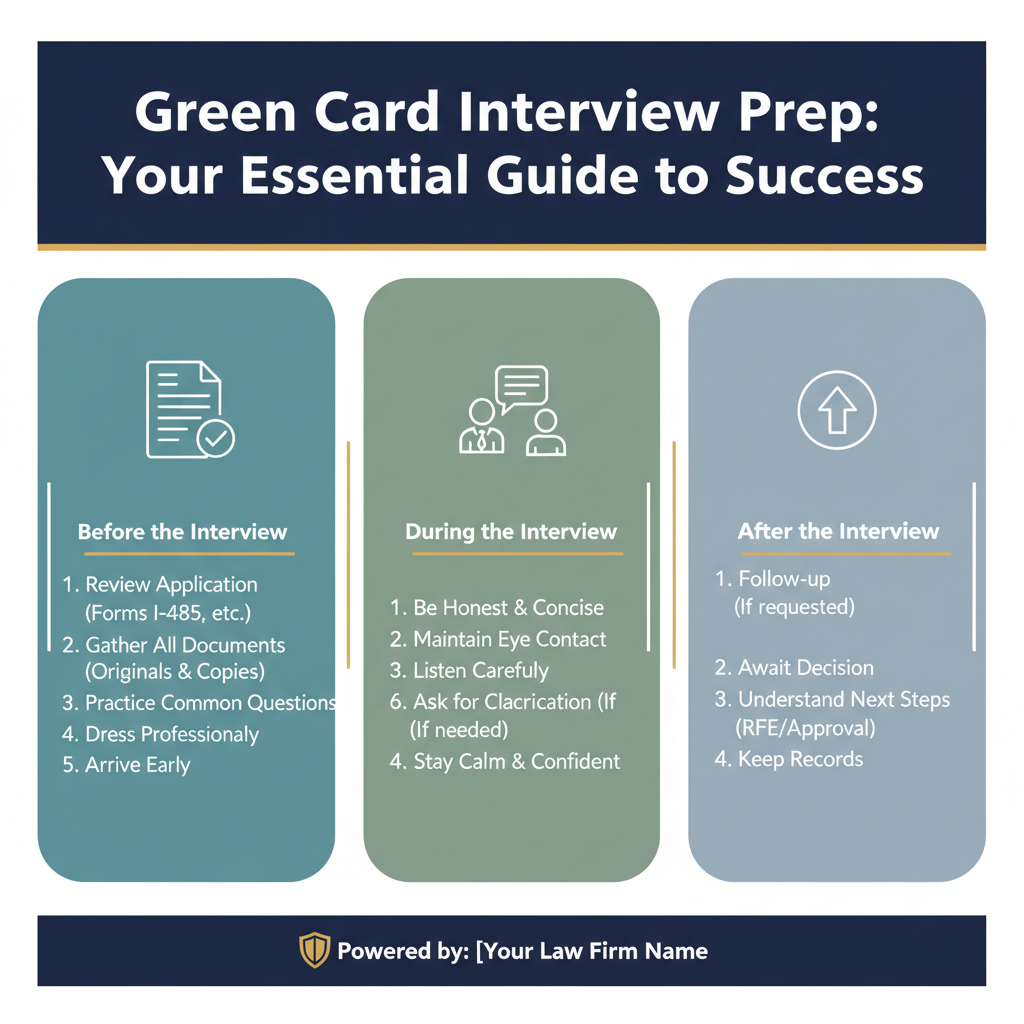
The ongoing discourse around immigration law and the processing of Green Card applications consistently highlights the critical role of the interview stage. Recent discussions, as reflected in various legal news outlets, frequently emphasize the need for applicants to be meticulously prepared to navigate this final hurdle effectively. The importance of understanding legal requirements, gathering comprehensive documentation, and presenting a coherent case cannot be overstated. This guide is directly inspired by the continuous need for clear, actionable advice on Green Card Interview Preparation Tips (Immigration Law), ensuring applicants are well-equipped for success.
What This News Means for Immigrants in Orlando and Across Florida
The focus on Green Card interview preparation is not new, but its consistent presence in immigration news underscores its enduring importance. For immigrants residing in Orlando and throughout Florida, this emphasis means that USCIS continues to prioritize thorough vetting through the interview process. It serves as a constant reminder that while the application process can be lengthy, the interview remains a critical, often decisive, component.
Why this news is showing up now
The news about Green Card interview preparation is not a fleeting trend but an evergreen topic. Its recurrence stems from several factors:
- Consistent USCIS Scrutiny: USCIS officers are continually trained to conduct comprehensive interviews to maintain the integrity of the immigration system. As policies evolve, so do the nuances of what officers look for.
- Applicant Anxiety: The interview is often the most anxiety-inducing part of the Green Card process. There's a constant demand for reliable information and guidance to alleviate this stress.
- Complexity of Cases: Each immigration case is unique. While some may appear straightforward, others involve complex histories, requiring diligent preparation to address potential concerns.
- Policy Changes and Updates: Although the fundamental purpose of the interview remains, procedural guidelines and specific areas of focus for USCIS can shift. Staying informed is always crucial.
- Increased Application Volume: With a continuous flow of immigration applications, the demand for clear preparation strategies remains high to ensure efficiency and fairness in processing.
How it can affect Florida residents
For individuals and families living in Florida, particularly in the vibrant and diverse Orlando area, the importance of Green Card interview preparation is acutely felt:
- Orlando USCIS Field Office: If your case is in Orlando, your interview will likely be scheduled at the Orlando USCIS Field Office. Understanding the local office's procedures and common practices can be beneficial. While federal law is universal, local offices can have slight variations in scheduling or officer demeanor.
- Diverse Applicant Pool: Florida is home to a vast and diverse immigrant population. This means a wide range of Green Card categories (family-based, employment-based, asylum-based) are processed, each with specific interview considerations.
- Access to Legal Support: Central Florida residents have access to experienced immigration law firms like Imigrar, which specialize in guiding applicants through the interview process. Utilizing local expertise can be a significant advantage.
- Travel and Logistics: For those along the I-4 corridor or in surrounding counties like Orange County, Seminole County, or Osceola County, planning for the interview day involves local travel considerations.
- High Stakes: For many Floridians, the Green Card represents the culmination of years of effort and hope for a stable future in the U.S. The interview is the final hurdle to securing that dream, making thorough preparation absolutely essential.
What Green Card Interview Preparation Is (and Why It Matters)
Green Card interview preparation refers to the comprehensive process of gathering documents, reviewing application details, understanding potential questions, and mentally preparing for the interview conducted by a USCIS officer. This interview is a mandatory step for most individuals seeking lawful permanent residency in the United States, particularly those applying for Adjustment of Status from within the U.S. or through Consular Processing abroad.
A plain-English definition
Think of the Green Card interview as a final, in-person check-up on your application. A government official (the USCIS officer) will sit down with you (and your sponsoring relative or employer, if applicable) to confirm that everything you've stated in your application is true, that you genuinely qualify for a Green Card under U.S. law, and that there are no red flags that would prevent you from becoming a permanent resident. It's their opportunity to ask questions, clarify information, and ensure the integrity of the immigration system.
Key terms you need to know
Understanding these terms is fundamental to navigating the Green Card process:
- Green Card: Official document (Form I-551) proving lawful permanent residency in the United States.
- USCIS (U.S. Citizenship and Immigration Services): The government agency responsible for processing immigration benefits, including Green Card applications and interviews. Link: USCIS official website.
- Adjustment of Status (AOS): The process of applying for a Green Card from *within* the United States, without having to return to your home country. This typically involves filing Form I-485.
- Consular Processing: The process of applying for a Green Card from *outside* the United States through a U.S. embassy or consulate in your home country.
- Petitioner: The U.S. citizen or lawful permanent resident who files an immigration petition (e.g., Form I-130) on behalf of a foreign national relative, or the employer who files for an employee.
- Beneficiary: The foreign national who is seeking immigration benefits (the Green Card) based on the petitioner's filing.
- Sponsor/Joint Sponsor: The person (usually the petitioner) who signs an Affidavit of Support (Form I-864), promising to financially support the beneficiary if needed.
- Priority Date: The date USCIS receives your immigration petition. This date determines your place in the visa queue, especially for categories with annual numerical limits.
- Affidavit of Support (Form I-864): A legally binding document where the sponsor agrees to support the immigrant financially, ensuring they do not become a "public charge."
- Medical Examination (Form I-693): A required examination by a USCIS-approved civil surgeon to ensure the applicant meets health-related admissibility requirements.
- Notice of Interview (Form I-797C): The official letter from USCIS notifying you of your interview date, time, and location, along with a list of required documents.
Confused by Immigration Jargon? Our team at Imigrar speaks your language, literally and figuratively. We'll simplify the complex legal terms and guide you through every step. Call +1 786-791-3106 for a free consultation. Se Habla Español.
Current Immigration Law: The Foundation
The Green Card interview process is rooted in the Immigration and Nationality Act (INA), the primary body of U.S. immigration law. The INA outlines who is eligible for a Green Card, the various categories, and the requirements for admissibility into the United States. The interview serves as the government's mechanism to ensure compliance with these laws.
Federal requirements
The core legal framework for Green Card eligibility and the interview process is federal. Key sections of the INA define:
- Eligibility Categories: Sections 201-204 of the INA establish the different categories for Green Cards, primarily family-based (e.g., immediate relatives of U.S. citizens, family preference categories) and employment-based (e.g., EB-1, EB-2, EB-3).
- Admissibility Standards: Section 212 of the INA details the grounds of inadmissibility, which are reasons an individual might be denied entry or a Green Card. These include health-related grounds, criminal grounds, security grounds, and the "public charge" rule. The interview assesses these factors.
- Proof of Bona Fide Relationship: For family-based petitions, the INA requires proof of a genuine relationship. For marriage-based Green Cards, this means demonstrating a bona fide marriage, not one entered into solely for immigration purposes. The interview is crucial for establishing this.
- Financial Sponsorship: Section 213A of the INA mandates financial sponsorship through Form I-864, the Affidavit of Support, to ensure the applicant will not become a public charge. The sponsor must meet specific income requirements.
The USCIS Policy Manual and federal regulations provide further detailed guidance on how these laws are applied and interpreted by immigration officers.
Florida-specific considerations
While immigration law is federal, its application can have local nuances. For Florida residents, particularly those interacting with the Orlando USCIS Field Office, it's important to know:
- Orlando Field Office Jurisdiction: The Orlando office serves a wide area of Central Florida, including Orange, Seminole, Osceola, Volusia, Brevard, Polk, and Lake counties. All interviews for Adjustment of Status applicants in this region will be scheduled here.
- Officer Demeanor: While all USCIS officers follow federal guidelines, the specific interviewing style can vary. Preparing for a range of questioning styles is always advisable.
- Local Resources: Florida has a robust network of community organizations and legal aid groups that can offer support, particularly for vulnerable populations. Imigrar is proud to be a part of this network, offering expert legal services to our neighbors.
Important: Always refer to the USCIS official website for the most current forms, instructions, and policy updates. The laws can change, and staying informed is crucial.
Common USCIS Forms relevant to your Green Card interview include:
- Form I-130, Petition for Alien Relative: Filed by a U.S. citizen or LPR to establish a relationship with a foreign national.
- Form I-485, Application to Register Permanent Residence or Adjust Status: The primary application for a Green Card if you are already in the U.S.
- Form I-864, Affidavit of Support: Filed by the financial sponsor.
- Form I-693, Report of Medical Examination and Vaccination Record: Completed by a USCIS-approved civil surgeon.
- Form I-765, Application for Employment Authorization: Often filed concurrently with I-485 to obtain work authorization while the Green Card application is pending.
- Form I-131, Application for Travel Document: Often filed concurrently with I-485 to obtain advance parole for travel abroad while the Green Card application is pending.
How to Prepare for Your Green Card Interview: A Complete Step-by-Step Guide
Preparing for your Green Card interview is a multi-faceted process that requires attention to detail, organization, and a clear understanding of what to expect. Follow these steps to maximize your chances of success.
1) Understand the Purpose and Type of Interview
Before diving into document gathering, understand *why* you're having an interview and what kind it will be. Most Green Card interviews fall into two main categories:
- Family-Based Adjustment of Status: This is the most common type for those already in the U.S. The interview aims to confirm the legitimacy of the family relationship (especially marriage), verify all information on Form I-485, and ensure no inadmissibility grounds exist. Both the petitioner (U.S. citizen/LPR) and the beneficiary (immigrant) typically attend.
- Employment-Based Adjustment of Status: Here, the focus is on confirming the job offer, the employer's ability to pay the wage, and the applicant's qualifications. Only the beneficiary usually attends, though the employer may be called upon if there are questions.
- Asylum/Refugee-Based Adjustment: These interviews focus on confirming the original asylum grant and ensuring continued eligibility.
Action: Review your Form I-797C, Notice of Interview. It will specify the type of application and often lists documents to bring.
2) Gather and Organize All Required Documents
This is arguably the most critical step. USCIS expects you to bring originals and copies of *all* documents related to your case, even if you submitted them previously. Organize them neatly in a binder or folder, clearly labeled.
Required Documents Checklist (General - always check your I-797C!):
- Interview Notice (Form I-797C): The original notice.
- Identification:
- Valid passport (original and copy)
- Driver's license or state ID (original and copy)
- Employment Authorization Document (EAD card, original and copy, if applicable)
- Advance Parole Document (original and copy, if applicable)
- Birth Certificates: Original and copy for both petitioner and beneficiary (and any children).
- Marriage Certificate: Original and copy (if applicable).
- Divorce Decrees/Death Certificates: Originals and copies for all prior marriages of both petitioner and beneficiary, proving their termination.
- Medical Examination (Form I-693): If not already submitted, bring the sealed envelope from the civil surgeon. If you submitted it more than two years ago, you might need an updated one.
- Affidavit of Support (Form I-864) Package:
- Original signed Form I-864 (and any joint sponsor Form I-864).
- Sponsor's most recent federal income tax returns (IRS transcripts preferred) and W-2s/1099s.
- Proof of U.S. citizenship or LPR status for the sponsor (e.g., passport, birth certificate, Green Card).
- Proof of assets (bank statements, property deeds, if used to meet income requirements).
- Proof of Relationship (for Family-Based):
- Marriage-based: Joint bank accounts, utility bills, leases/mortgages, insurance policies, birth certificates of common children, photos, affidavits from friends/family.
- Parent-child: Birth certificates, school records, photos.
- Police Certificates/Court Records: For any arrests or convictions, even if expunged.
- Immigration History Documents: I-20s (for F-1 students), I-797 Approval Notices for other petitions (e.g., H-1B), I-94 Arrival/Departure Record.
- All original application forms and supporting documents previously submitted.
Warning: Bring *all* original documents, even those you've submitted. The officer may want to see them.
3) Review Your Application Forms Thoroughly
You must be intimately familiar with every answer you provided on your Form I-485, Form I-130, and any other forms. The USCIS officer will refer to these documents and ask questions based on them. Any inconsistencies can raise red flags.
Action: Read through your entire application package. Highlight areas that might prompt questions. If you discover any errors or omissions, discuss them with your attorney. You may need to prepare an amendment or explanation.
4) Practice Answering Potential Questions
While you can't predict every question, many are standard. Practicing your answers helps you respond clearly, concisely, and truthfully.
Common Interview Questions:
- Personal History: "What is your full name and date of birth?" "Where were you born?" "What is your current address?"
- Immigration History: "When and how did you first enter the U.S.?" "Have you ever been out of status?" "Have you ever been arrested or convicted of a crime?"
- Marriage-Based (for both spouses): "How did you meet?" "When did you get married?" "Do you live together?" "What do you do for work?" "Tell me about your daily routine." "Who pays the bills?" "Do you have joint bank accounts?"
- Public Charge: "Do you have health insurance?" "Do you have any assets?" "Do you intend to work?"
Reminder: Always tell the truth. If you don't understand a question, ask the officer to rephrase it. Do not guess or provide false information.
5) Prepare for the Interview Day Logistics
The practical aspects of the interview day are important for reducing stress and ensuring you arrive prepared.
- Location: Confirm the exact address of the Orlando USCIS Field Office (10257 E Colonial Dr, Orlando, FL 32817). Plan your route, considering traffic, especially during peak hours along the I-4 corridor.
- Arrival Time: Aim to arrive at least 30 minutes before your scheduled appointment. Arriving late can lead to rescheduling, which significantly delays your case.
- Attire: Dress professionally, as you would for a job interview. This shows respect for the process and the officer.
- Interpreter: If you are not fluent in English, bring a professional, certified interpreter. Do not rely on a family member or friend unless specifically instructed by USCIS (which is rare for Green Card interviews). Imigrar can help arrange this, or our bilingual attorneys can serve as interpreters.
- Children: Unless specifically requested, avoid bringing children to the interview, especially young ones, as they can be a distraction.
6) Attend the Interview with Confidence
During the interview, maintain a respectful and composed demeanor. The officer will swear you in, asking you to affirm that your testimony will be truthful.
- Listen Carefully: Pay close attention to each question. If you don't understand, politely ask for clarification.
- Answer Truthfully and Concisely: Provide direct answers to the questions asked. Avoid volunteering unnecessary information or going off-topic.
- Be Respectful: Address the officer respectfully. Avoid arguing or becoming defensive.
- Provide Documents When Asked: Have your organized binder ready. When the officer asks for a specific document, hand them the original. They may make copies.
- Correcting Errors: If you realize an error was made on your application, inform your attorney *before* the interview or politely bring it to the officer's attention if it comes up.
7) Follow Up After the Interview
The interview doesn't always end with an immediate decision. The officer may inform you that a decision will be mailed to you.
- Request for Evidence (RFE): If the officer needs more information, they may issue an RFE. Respond promptly and comprehensively.
- Notice of Decision: You will receive a written decision by mail. If approved, your Green Card will be mailed to you.
- If Denied: A denial notice will explain the reasons. You may have options to appeal or refile, but it is crucial to consult with an experienced attorney immediately.
Feeling Overwhelmed by the Steps? Imigrar provides end-to-end guidance for your Green Card interview. From document preparation to mock interviews, we're here for you. Contact us today for a free consultation at +1 786-791-3106. Se Habla Español.
Practical Steps You Can Take Today
Even before you receive your interview notice, there are proactive steps you can take to ensure you are well-prepared.
Actionable Checklist (5+ items)
- Start a "Green Card Interview" Folder/Binder: Begin compiling all original documents and their copies. Organize them by category (e.g., personal IDs, birth certificates, marriage documents, financial documents, evidence of relationship).
- Request IRS Tax Transcripts: For your sponsor's Form I-864, IRS tax transcripts are often preferred over tax returns. You can request them for free from the IRS website.
- Order Police Records (if applicable): If you have any arrest history, obtain certified copies of all court dispositions, even for minor incidents.
- Review Your Initial Application: Get a copy of your submitted application (Form I-485, Form I-130, etc.) and read through every answer. Note any potential ambiguities or areas for clarification.
- Compile Relationship Evidence (Marriage-Based): Continuously gather evidence of your bona fide marriage, such as joint bank statements, utility bills, photos, leases, and insurance documents. The more current and comprehensive, the better.
- Check USCIS Processing Times: Regularly monitor the USCIS Processing Times for your specific field office (e.g., Orlando, FL) and form type (e.g., Form I-485) to get an idea of when to expect your interview notice.
- Consult an Immigration Attorney: Schedule a consultation with an experienced immigration lawyer. They can review your case, identify potential issues, and help you prepare a solid strategy.
Document preparation guidance
- Originals and Copies: Always bring both original documents and a complete set of photocopies. The officer may keep the copies and return the originals.
- Translations: Any document not in English must be accompanied by a certified English translation. The translator must provide a certification that they are competent to translate and that the translation is accurate.
- Chronological Order: For financial documents or relationship evidence, present them in chronological order to show continuity.
- Labeling: Use tabs or dividers in your binder to clearly label sections (e.g., "Petitioner's Birth Certificate," "Joint Bank Statements," "Photos"). This makes it easy for you and the officer to find specific documents quickly.
- Extra Copies: It's wise to bring an extra copy of your entire application package in case the officer's file is incomplete or if you need to refer to it.
Timeline expectations
The timeline for receiving an interview notice and having your interview can vary significantly based on the USCIS field office, the type of Green Card, and current processing backlogs. For residents of Central Florida, the Orlando USCIS Field Office processes a high volume of cases.
- Interview Scheduling: After your Form I-485 is filed and your biometrics appointment is completed, it can take anywhere from a few months to over a year (or even longer for some categories) to receive your interview notice. Check USCIS Processing Times regularly.
- Notice Period: USCIS typically sends the Form I-797C, Notice of Interview, about 3-6 weeks before the actual interview date. This gives you a crucial, albeit sometimes short, window to finalize your preparations.
- Post-Interview Decision: While some officers might give you an indication of approval at the interview, most decisions are mailed within a few days to a few weeks. In complex cases or if an RFE is issued, it can take longer.
- Green Card Mailing: Once approved, your physical Green Card (Form I-551) is usually mailed within 90 days of the approval date.
Reminder: If your case involves a conditional Green Card (e.g., marriage-based, married for less than two years at the time of approval), you will need to file Form I-751, Petition to Remove Conditions on Residence, within the 90-day window before your conditional Green Card expires.

How Imigrar Helps Immigrants in Orlando
At Imigrar, we understand that the Green Card interview is more than just a formality – it's a critical step that can determine your future in the United States. Our Orlando-based immigration law firm is dedicated to providing compassionate, expert legal representation to guide you through this process with confidence.
Our experience and expertise
Our team of experienced immigration attorneys has a proven track record of helping countless individuals and families successfully navigate their Green Card interviews. We offer:
- Personalized Case Review: We conduct a thorough review of your entire application package, identifying potential weaknesses or areas that might draw scrutiny from a USCIS officer.
- Comprehensive Document Preparation: We assist you in organizing all necessary documents, ensuring you have both originals and copies, and that


