


The journey to obtaining a Green Card, or lawful permanent residency, in the United States is a significant milestone for many immigrants and their families. While the process involves numerous forms and waiting periods, one of the most pivotal stages is the Green Card interview. This interview, conducted by a United States Citizenship and Immigration Services (USCIS) officer, is your opportunity to demonstrate your eligibility and provide clarity on your application.
For many, the thought of an interview can be daunting. Questions about what to expect, what documents to bring, and how to answer can create significant anxiety. However, with proper preparation, you can approach this critical step with confidence and increase your chances of a successful outcome.
At Imigrar, an immigration law firm based in Orlando, Florida, we understand the stakes involved. Our mission is to "Keep Families Together," and a successful Green Card interview is often a crucial part of that mission. This comprehensive guide is designed to demystify the Green Card interview process, providing you with the knowledge and practical tools you need to prepare effectively in 2026.
Let's dive into everything you need to know to ace your Green Card interview.
The reporting that sparked this guide:
This comprehensive guide to Green Card interview preparation is inspired by the ongoing and critical need for immigrants to be well-informed and prepared for their journey to lawful permanent residency. The constant flow of information and updates in Green Card Interview Preparation Tips (Immigration Law) highlights the enduring relevance of this topic and the continuous demand for clear, actionable advice.
What This News Means for Immigrants in Orlando and Across Florida
The consistent focus on Green Card interview preparation within immigration law news underscores its perennial importance. It’s not a new phenomenon, but rather a recurring theme that reflects the complexities and intricacies of the U.S. immigration system. For individuals and families navigating this system, especially those in Orlando and across Florida, understanding and preparing for this interview is paramount.
Why this news is showing up now
While the Green Card interview process itself is not new, its prominence in immigration news is often cyclical, driven by several factors:
- Ongoing Processing Volume: USCIS processes hundreds of thousands of Green Card applications annually. Each of these applications typically culminates in an interview, making it a constant point of interest and concern for applicants.
- Policy Changes and Enforcement Trends: Although the core requirements for Green Cards remain relatively stable, shifts in immigration policy or enforcement priorities can impact how interviews are conducted, the types of questions asked, and the level of scrutiny applied. This necessitates continuous vigilance and updated advice for applicants.
- Digitalization and Accessibility of Information: With more resources available online, both from official sources like USCIS and from legal experts, there's a growing awareness and search for information on how to best navigate these critical steps.
- Personal Stories and Experiences: As more individuals go through the process, their shared experiences and questions contribute to the ongoing discussion about interview preparation, highlighting common challenges and best practices.
- Attorney Insights: Immigration attorneys consistently advise clients on interview preparation, and their insights often form the basis of news and guides designed to help the broader immigrant community.
In essence, the "news" isn't about a sudden change in the interview requirement, but rather the evergreen, critical need for applicants to be thoroughly prepared for this crucial step in their immigration journey.
How it can affect Florida residents
For the diverse immigrant communities in Florida, particularly those in Central Florida and the greater Orlando area, the Green Card interview holds significant importance. Florida is a major hub for immigration, with a large foreign-born population and several active USCIS Field Offices. Here’s how this ongoing emphasis on interview preparation directly impacts residents:
- Local USCIS Field Offices: Florida is home to several USCIS Field Offices, including those in Orlando, Miami, and Tampa. If you reside in Orlando, Orange County, or anywhere along the I-4 corridor, your interview will most likely be scheduled at the Orlando USCIS Field Office. Being prepared means understanding the local office's procedures and potential interview styles.
- Diverse Case Types: Florida sees a wide array of Green Card applications, including family-based petitions (spousal, parent-child), employment-based petitions, asylum-based adjustments, and more. Each type of case has specific nuances that require tailored interview preparation.
- Economic Impact: Successful Green Card applications allow immigrants to work legally, contribute to the economy, and establish stable lives. Proper interview preparation is a direct pathway to achieving this stability, benefiting both individuals and the state's economy.
- Family Unity: A significant portion of Green Card interviews in Florida are for family-based petitions. The success of these interviews directly impacts the ability of families to remain together, aligning perfectly with Imigrar's mission to "Keep Families Together."
- Access to Legal Expertise: With a large immigrant population, Florida also has a robust legal community specializing in immigration law. Residents have access to experienced attorneys who can provide crucial guidance, mock interviews, and representation, significantly improving their chances of success.
For Florida residents, the message is clear: the Green Card interview is a critical hurdle, and being well-prepared is not just advisable, it's essential for a positive outcome and securing your future in the United States.
Need Help Preparing for Your Green Card Interview? Our Orlando immigration team is ready to assist. Call +1 786-791-3106 for a free consultation, or message us online. Se Habla Español.
What Green Card Interviews Are (and Why They Matter)
The Green Card interview is a cornerstone of the immigration process, serving as a crucial step for most individuals seeking lawful permanent resident status in the United States. It's an opportunity for USCIS to verify the information provided in your application, confirm your eligibility, and address any potential concerns.
A plain-English definition
Simply put, a Green Card interview is a formal meeting with a USCIS officer where you (and often your petitioner, if it's a family-based case) answer questions about your application for permanent residency. The officer's main goal is to ensure that you meet all the legal requirements for a Green Card and that the information you've submitted in your application forms and supporting documents is truthful and accurate. It's a chance for USCIS to put a face to the file, clarify ambiguities, and make a final determination on your eligibility.
Key terms you need to know
Understanding the jargon associated with the Green Card process will significantly aid your preparation:
- Green Card: Also known as a Permanent Resident Card, it proves you are authorized to live and work permanently in the United States.
- Lawful Permanent Resident (LPR): The official term for someone who holds a Green Card.
- USCIS: United States Citizenship and Immigration Services, the federal agency responsible for administering immigration and naturalization benefits.
- Adjustment of Status (AOS): The process of applying for a Green Card while physically present in the United States. This is contrasted with Consular Processing, where you apply for an immigrant visa at a U.S. embassy or consulate abroad.
- Petitioner: The U.S. citizen or lawful permanent resident who files an immigration petition (e.g., Form I-130) on behalf of an immigrant relative.
- Beneficiary: The immigrant who is seeking a Green Card through the petition filed by the petitioner.
- Immigrant Visa: A visa issued by a U.S. embassy or consulate that allows a foreign national to travel to the U.S. and become a lawful permanent resident upon entry. Used in Consular Processing.
- Affidavit of Support: A legal document (Form I-864) signed by a petitioner or joint sponsor to accept financial responsibility for the immigrant, ensuring they will not become a public charge.
- Priority Date: The date your immigration petition (e.g., Form I-130 or Form I-140) was properly filed with USCIS. This date determines your place in the visa queue, especially for categories with annual limits.
- Notice of Interview: The official letter from USCIS (Form I-797C) scheduling your interview, including the date, time, and location.
- RFE (Request for Evidence): A letter from USCIS asking for additional documents or information to support your application.
- NOID (Notice of Intent to Deny): A letter from USCIS indicating their intention to deny your application unless you provide specific information or explanation within a given timeframe.
The Green Card interview matters immensely because it's often the final hurdle before approval. It's the officer's last chance to scrutinize your case, and your last chance to present yourself and your evidence convincingly. A well-prepared applicant can clarify doubts, strengthen their case, and potentially expedite the decision-making process. Conversely, poor preparation or misrepresentation can lead to delays, Requests for Evidence, or even denial.
Current Immigration Law: The Foundation for Your Green Card Interview
The Green Card interview is not an arbitrary process; it is firmly rooted in U.S. immigration law, primarily the Immigration and Nationality Act (INA). Understanding the legal framework helps you grasp why certain questions are asked and what USCIS is looking for.
Federal requirements
The authority for conducting Green Card interviews stems from various sections of the INA and corresponding federal regulations. Key legal provisions include:
- INA Section 245 (8 U.S.C. § 1255): Adjustment of Status of Nonimmigrant to That of Person Admitted for Permanent Residence. This section outlines the general requirements for an individual to adjust their status to that of a lawful permanent resident while in the U.S. It mandates that the applicant be eligible for an immigrant visa, admissible to the U.S., and that an immigrant visa be immediately available. The interview is a mechanism to verify these conditions.
- INA Section 204 (8 U.S.C. § 1154): Procedure for Granting Immigrant Status. This section governs the filing and approval of immigrant petitions (like Form I-130 for family-based cases), which are the foundation for most Green Card applications. During the interview, the officer will confirm the bona fides of the relationship that forms the basis of the petition.
- INA Section 212 (8 U.S.C. § 1182): General Classes of Aliens Ineligible to Receive Visas and Ineligible for Admission; Waivers. This is a critical section that lists the various grounds of inadmissibility, such as health-related grounds, criminal grounds, security grounds, public charge grounds, and misrepresentation. The interview is designed to screen applicants for any potential inadmissibility issues. For example, questions about your criminal history, health, or past immigration violations directly relate to this section.
- INA Section 213A (8 U.S.C. § 1183a): Requirements for Sponsor's Affidavit of Support. This section mandates that most family-based immigrants and some employment-based immigrants have a financial sponsor who files Form I-864. The interview will verify the sponsor's ability to support the applicant and ensure the applicant will not become a "public charge."
During the interview, the USCIS officer acts as an adjudicator, ensuring compliance with these federal statutes. They will scrutinize your application forms, such as Form I-130, Petition for Alien Relative, and Form I-485, Application to Register Permanent Residence or Adjust Status, along with supporting documents like Form I-864, Affidavit of Support, Form I-693, Report of Medical Examination and Vaccination Record, and others. The goal is to confirm that you meet all eligibility criteria and are not inadmissible under any grounds.
For the most accurate and up-to-date information on federal requirements, always refer to the USCIS official website.
Florida-specific considerations
While federal law governs the fundamental requirements, the practical experience of a Green Card interview in Florida will involve interaction with a local USCIS Field Office. For Central Florida residents, this typically means the Orlando USCIS Field Office.
- Local Procedures: While core regulations are federal, individual field offices can have slight variations in their operational procedures, such as how they conduct interviews, handle walk-ins for minor issues, or communicate follow-up.
- Interview Environment: The physical environment of the Orlando USCIS Field Office will be where your interview takes place. Familiarizing yourself with the location, parking, and security protocols beforehand can reduce stress on the day.
- Officer Demographics: USCIS officers at the Orlando office are trained professionals adhering to federal guidelines. However, like any human interaction, individual officers may have different interviewing styles. Being prepared for a range of questioning approaches is key.
- Translation Services: The Orlando office, like others, will provide official interpreters if you indicate on your application (or through your attorney) that you require one. However, it's crucial that any interpreter is certified and independent, not a friend or family member (unless explicitly permitted for specific circumstances).
Understanding these local aspects, in conjunction with the federal legal framework, provides a comprehensive picture of what to expect during your Green Card interview in Florida.
Feeling Overwhelmed by Immigration Law? Imigrar's experienced attorneys can simplify the process for you. Contact us for a free consultation at +1 786-791-3106. ¡Hablamos Español!
How to Prepare for Your Green Card Interview: A Complete Step-by-Step Guide
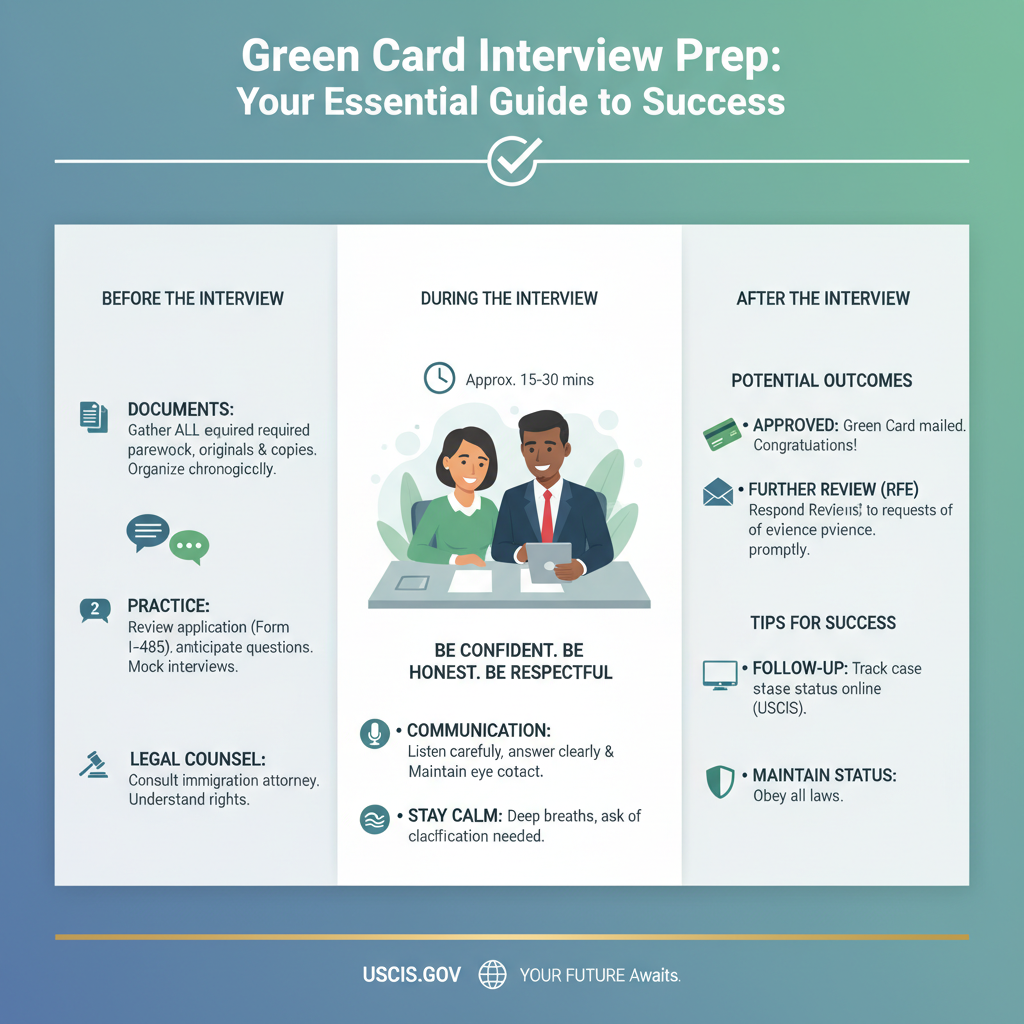
Preparing for your Green Card interview is arguably the most critical phase after submitting your application. Thorough preparation can alleviate anxiety and significantly improve your chances of a positive outcome. Follow this detailed step-by-step guide to ensure you're fully ready.
1) Understand Your Case and Review Your Application
The first and most fundamental step is to fully comprehend the specifics of your immigration case and meticulously review every document you’ve submitted to USCIS. Your interview will revolve around the information contained in these forms.
- Review All Submitted Forms: This includes your Form I-130 (if applicable), Form I-485, Form I-864, Form I-765 (Employment Authorization), Form I-131 (Advance Parole), and any other supporting documents. Make sure you remember every date, address, and detail you provided.
- Understand Your Eligibility Basis: Be clear on *why* you are eligible for a Green Card (e.g., marriage to a U.S. citizen, employment, asylum). The questions will be tailored to your specific category.
- Identify Potential Issues: If there are any discrepancies, past immigration issues, or criminal history, be prepared to discuss them openly and honestly. Do not attempt to conceal information.
- Know Your Story: For family-based petitions, especially marriage-based, you and your petitioner should know your relationship story inside and out: how you met, your engagement, marriage, daily life, and future plans.
Required Documents for this Step:
- Copies of your complete Green Card application package (all forms and supporting evidence)
- Your original birth certificate and any marriage/divorce certificates
- Any prior immigration documents (e.g., previous visas, I-94 records)
2) Gather and Organize All Required Documents
USCIS will send you an interview notice (Form I-797C) listing the specific documents you must bring. However, it's prudent to bring additional documents that could support your case.
- Originals and Copies: Always bring the original of every document, plus a complete set of photocopies. The officer will likely review the originals and keep the copies.
- Interview Notice: Your official Form I-797C notice is essential for entry and verification.
- Identification: Valid government-issued photo identification, such as your passport, state ID, or driver's license.
- Medical Examination Report: If you haven't already submitted it or if your previously submitted Form I-693 is expired, bring a sealed envelope from the civil surgeon.
- Updated Affidavits of Support: If circumstances have changed, or your previous Form I-864 is old, consider bringing an updated one with recent tax returns and employment letters for the sponsor.
- Proof of Relationship (Family-Based): This is critical for marriage-based cases. Bring joint bank accounts, utility bills, leases, insurance policies, photos together, travel itineraries, affidavits from friends/family, and any other evidence of a bona fide marriage.
- Proof of Employment/Financial Stability (Employment-Based): Recent pay stubs, employment verification letters, tax returns.
- Travel Documents: Any passports, visas, or travel history records.
- Police Records/Court Dispositions: If you have any arrests or convictions, bring certified copies of all court dispositions, even for minor incidents.
- Translations: Any document not in English must be accompanied by a certified English translation.
Important: Organize your documents neatly in a binder or folder, clearly labeled, so you can quickly retrieve them during the interview. For Orlando residents, expect the USCIS officer at the Orlando Field Office to be thorough in checking these documents.
3) Practice Answering Common Interview Questions
Anticipating the types of questions you might face can significantly boost your confidence. USCIS officers are looking for consistency and honesty.
- General Background Questions: Your name, date of birth, place of birth, parents' names, current address, and previous addresses.
- Application-Specific Questions: Details from your Form I-485 and Form I-130. Why you want a Green Card, how you entered the U.S., your immigration history.
- Relationship-Specific Questions (Marriage-Based): How you met, first date, proposal, wedding details, daily routines, shared responsibilities, future plans, family interactions. Be prepared for detailed questions that establish the legitimacy of your marriage. Your spouse (petitioner) will likely be asked similar questions separately or together.
- Inadmissibility Questions: Questions related to criminal history, health issues, past immigration violations, misrepresentation, or public charge concerns. Answer truthfully and calmly.
- "Yes/No" Questions: The long list of "Yes/No" questions on Form I-485 about criminal history, communist party affiliation, past deportations, etc., will be asked again. Ensure your answers are consistent with your application.
Tip: Conduct mock interviews with a friend, family member, or better yet, an experienced immigration attorney. Practice answering clearly, concisely, and truthfully.
4) Arrange for an Interpreter (If Needed) and Legal Counsel
Your ability to communicate effectively is paramount.
- Interpreter: If you are not fluent in English, indicate on your Form I-485 that you require an interpreter. USCIS will provide one at no cost. Do NOT bring a friend or family member to interpret unless specifically instructed or if they are a certified, neutral party.
- Legal Representation: Having an experienced immigration attorney from Imigrar accompany you to the interview is highly recommended. Your attorney can:
- Prepare you thoroughly with mock interviews.
- Clarify questions from the officer.
- Help you present documents efficiently.
- Intervene if the officer asks inappropriate or confusing questions.
- Offer immediate legal advice if an unforeseen issue arises.
- Provide moral support and reduce stress.
Important: An attorney cannot answer questions for you, but their presence ensures your rights are protected and the process is fair.
5) Dress Appropriately and Plan Your Logistics
First impressions matter, and punctuality is non-negotiable.
- Dress Code: Dress in clean, professional, and conservative attire, as if you were attending a job interview. This shows respect for the process.
- Punctuality: Plan to arrive at the Orlando USCIS Field Office at least 30-45 minutes before your scheduled appointment. Account for traffic, parking, and security checks. For those coming from beyond Orange County, consider staying overnight nearby if your interview is early.
- Transportation: Know your route, whether by car or public transport. Ensure you have enough gas or funds for your journey.
- Childcare: If possible, arrange for childcare. While children can attend, it's often better for you to focus without distractions.
6) During the Interview: What to Expect and How to Behave
When you are called in, remember these key points:
- Be Respectful and Polite: Address the officer as "Officer" and maintain a respectful demeanor.
- Listen Carefully: Pay close attention to each question. If you don't understand, politely ask the officer to repeat or rephrase it.
- Answer Truthfully and Concisely: Always tell the truth. Answer only the question asked, without volunteering unnecessary information. Elaborate only if requested.
- Maintain Eye Contact: This conveys honesty and confidence.
- Do Not Offer Documents Unless Asked: Have your documents organized, but wait for the officer to request them.
- Stay Calm: It's normal to be nervous, but try to remain composed. Take a deep breath if needed.
- Oath: You will be asked to swear to tell the truth. Take this seriously.
7) After the Interview: Next Steps and Follow-Up
The interview is not always the final step.
- Immediate Decision: Sometimes, the officer may approve your case on the spot, or tell you they need to review further.
- Request for Evidence (RFE): If the officer needs more information, they will issue an RFE, usually by mail. Respond promptly and thoroughly.
- Notice of Intent to Deny (NOID): In rare cases, if USCIS believes your application should be denied, they will send a NOID, giving you a chance to rebut their findings.
- Waiting Period: If no immediate decision is made, you will need to wait for a decision by mail. You can check your case status online at USCIS Case Status Online.
- Green Card Delivery: If approved, your Green Card will be mailed to you, usually within a few weeks.
Reminder: If you move after your interview, immediately update your address with USCIS using Form AR-11 online to ensure you receive all correspondence, including your Green Card.

Practical Steps You Can Take Today for Interview Success
The best time to start preparing for your Green Card interview is now. Here’s an actionable checklist to guide your immediate steps:
- Review Your Entire Application Package: Pull out copies of every form you submitted (Form I-130, Form I-485, Form I-864, etc.) and read through them carefully. Ensure you remember all dates, addresses, and details. This will prevent inconsistencies during the interview.
- Start Gathering Original Documents: Don't wait until the last minute. Begin collecting all original birth certificates, marriage certificates, passports, visas, medical exam results (if not already submitted or expired), and any other personal documents. Make clear, organized copies of everything.
- Collect Additional Proof of Relationship (for family-based): Continuously gather evidence of your bona fide relationship. This includes recent joint bank statements, utility bills, leases, insurance policies, updated photos, travel documents, and affidavits from friends/family. The more recent and diverse the evidence, the stronger your case.
- Practice Answering Questions Aloud: Go through common interview questions (see Step 3 above) and practice answering them clearly and concisely. If you have a petitioner, practice together to ensure consistency in your stories.
- Consult with an Immigration Attorney: This is arguably the most crucial step. Schedule a free consultation with Imigrar today. Our attorneys can identify potential issues, help you organize documents, conduct mock interviews, and discuss accompanying you to the interview. This proactive step can save you immense stress and prevent costly mistakes.
- Check USCIS Processing Times: While waiting for your interview notice, regularly check the USCIS Processing Times for your specific field office (e.g., Orlando Field Office) and form type (Form I-485) to get an estimated timeline.
- Plan Your Interview Day Logistics: Once you receive your interview notice, immediately plan your travel to the Orlando USCIS Field Office. Map your route, consider traffic patterns, and determine parking options. Ensure you know exactly how long it will take to arrive early.
- Arrange for an Interpreter (if necessary): If you haven't already, confirm that you will need a USCIS-provided interpreter if English is not your primary language.
Document preparation guidance
- Originals vs. Copies: Always bring *all* originals. The officer will want to see them. Have a complete set of *copies* ready to submit.
- Translations: Any document not in English must be accompanied by a complete and certified English translation. The translator must sign a statement certifying that they are competent to translate and that the translation is accurate.
- Affidavits: If you have affidavits from friends or family supporting your relationship (for marriage-based cases), ensure they are notarized and include the affiant's full contact information.
- Chronological Order: Organize documents chronologically or by category (e.g., "Joint Bank Statements," "Lease Agreements," "Photos") for easy access.
Timeline expectations
The timeline from filing your application to your interview can vary significantly


