


The reporting that sparked this guide
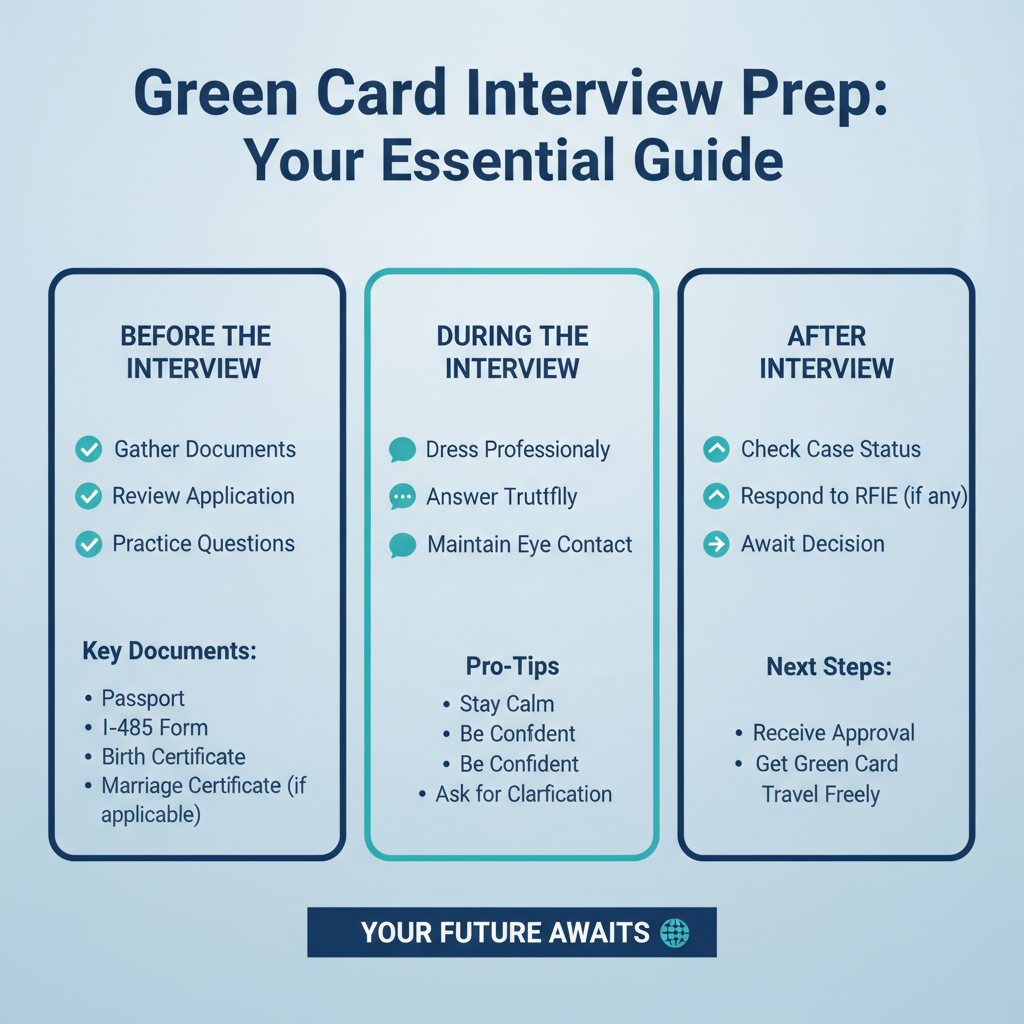
In the ever-evolving landscape of U.S. immigration, staying informed is paramount. Recent discussions and updates in Green Card Interview Preparation Tips (Immigration Law) highlight the critical importance of being thoroughly prepared for the final stage of your journey to permanent residency. This ongoing focus underscores the fact that while the legal framework for Green Cards remains stable, the nuances of the interview process and the need for meticulous preparation are constant topics of interest for applicants and legal professionals alike. At Imigrar, we understand that for many, the Green Card interview represents the culmination of years of effort, and this guide is designed to equip you with the knowledge and confidence to succeed.
What This News Means for Immigrants in Orlando and Across Florida
The consistent attention on Green Card interview preparation is not merely academic; it has profound implications for individuals and families pursuing permanent residency in the United States. For immigrants residing in Orlando, Central Florida, and indeed nationwide, this focus serves as a vital reminder that the interview is a pivotal, often final, step in the immigration process. It’s an opportunity to affirm the validity of your application and demonstrate your eligibility directly to a USCIS officer. Neglecting proper preparation can lead to delays, requests for additional evidence, or even denial, making comprehensive readiness absolutely essential.
Why this news is showing up now
While the Green Card interview itself is a long-standing component of the immigration process, its prominence in current immigration discussions can be attributed to several factors. Firstly, there's a continuous influx of new applicants who require guidance. Secondly, USCIS processing times and interview backlogs can fluctuate, leading to periods where interviews are scheduled more rapidly or after longer waits, prompting renewed interest in how to best prepare when the notice finally arrives. Thirdly, as immigration policies and priorities evolve, even subtle shifts in interview focus or questioning styles can spark renewed discussions among legal experts and immigrant communities. Furthermore, the digital age means that information, including tips and best practices, circulates widely, constantly refreshing the conversation around crucial stages like the Green Card interview. For many, the interview is the most nerve-wracking part of the process, making it a perennial topic of concern and advice-seeking.
How it can affect Florida residents
For individuals living in Florida, especially those in the greater Orlando area and along the I-4 corridor, the emphasis on Green Card interview preparation is particularly relevant. The Orlando USCIS Field Office is a primary point of contact for many adjustment of status applicants in Central Florida. Understanding the specific procedures, potential local officer approaches, and the importance of thorough documentation is crucial. Florida, with its diverse immigrant population, sees a significant volume of Green Card applications, particularly through family-based petitions. This means that many of our neighbors in Orange County and surrounding areas will eventually face this interview. Being well-prepared can significantly reduce stress, expedite the process, and increase the likelihood of a positive outcome, preventing the need for costly and time-consuming appeals or re-applications. Imigrar is strategically located in Orlando to serve these local needs, providing tailored advice and representation.
Need Help? Our Orlando immigration team is ready to assist. Call +1 786-791-3106 for a free consultation, or message us online. Se Habla Español.
What Green Card Interview Preparation Is (and Why It Matters)
The Green Card interview is a mandatory step for most individuals seeking lawful permanent resident status in the United States, whether through Adjustment of Status (applying while in the U.S.) or Consular Processing (applying from abroad). It is the U.S. Citizenship and Immigration Services (USCIS) or a Consular Officer’s opportunity to verify the information provided in your application, confirm your eligibility, and ensure that you are not inadmissible to the United States. For family-based petitions, especially marriage-based Green Cards, the interview also serves to determine the bona fides of the relationship.
Why does it matter so much? Because it's often the final hurdle. A successful interview typically leads to the approval of your Green Card. Conversely, poor preparation, inconsistencies, or a failure to present required evidence can lead to significant delays, requests for additional evidence (RFE), or even a denial of your application. This can be devastating, impacting your ability to live and work legally in the U.S. and potentially leading to removal proceedings. Proper preparation isn't just about answering questions; it's about presenting a clear, consistent, and compelling case that reinforces your eligibility and demonstrates your honesty and commitment to the process.
A plain-English definition
Think of the Green Card interview as a formal conversation with an immigration officer. Their job is to make sure that everything you've said in your application forms is true, that you meet all the legal requirements for a Green Card, and that there are no reasons you shouldn't be allowed to become a permanent resident. For couples, it's also about proving your marriage is real and not just for immigration purposes. It's your chance to directly explain your situation and provide any missing details or clarify aspects of your case.
Key terms you need to know
- Green Card: Formally known as a Permanent Resident Card, it proves your status as a lawful permanent resident of the United States.
- Adjustment of Status (AOS): The process of applying for a Green Card while physically present in the United States. This typically involves submitting Form I-485.
- Consular Processing: The process of applying for a Green Card through a U.S. embassy or consulate abroad. This involves the U.S. Department of State.
- Petitioner: The U.S. citizen or lawful permanent resident who files an immigration petition on behalf of another individual (e.g., Form I-130 for family members).
- Beneficiary: The individual for whom the immigration petition is filed and who seeks the Green Card.
- Affidavit of Support (Form I-864): A legally binding document signed by the petitioner (and sometimes a joint sponsor) to accept financial responsibility for the beneficiary.
- Priority Date: The date your immigration petition (e.g., Form I-130) was properly filed with USCIS. This date determines your place in the visa queue for certain categories.
- Inadmissibility: Legal grounds that prevent an individual from entering or remaining in the U.S., such as certain criminal convictions, health issues, or prior immigration violations.
- Request for Evidence (RFE): A letter from USCIS asking for more documentation or information to support your application.
- Notice of Intent to Deny (NOID): A letter from USCIS indicating their intention to deny your application unless you provide compelling reasons or evidence to overcome the grounds for denial.
- Bona Fide Marriage: A marriage entered into in good faith, not solely for the purpose of obtaining an immigration benefit. This is critical for marriage-based Green Cards.
Current Immigration Law: The Foundation
The legal framework governing Green Cards and their associated interviews is rooted primarily in the Immigration and Nationality Act (INA). While the specific types of Green Cards (family-based, employment-based, diversity lottery, etc.) operate under different sections of the INA, the interview process itself generally falls under the purview of the U.S. Citizenship and Immigration Services (USCIS) for Adjustment of Status cases and the U.S. Department of State for Consular Processing.
For family-based Green Cards, which are common for Imigrar's clients in Orlando, the process typically begins with a U.S. citizen or lawful permanent resident filing Form I-130, Petition for Alien Relative. Once this petition is approved and a visa becomes available (if applicable, based on the Priority Date), the beneficiary can then apply for a Green Card. If applying within the U.S., this involves filing Form I-485, Application to Register Permanent Residence or Adjust Status. The interview is a standard part of the adjudication process for Form I-485. For those applying abroad, the interview takes place at a U.S. embassy or consulate after the U.S. Department of State's National Visa Center (NVC) processes their case.
Federal requirements
At the federal level, the INA outlines the general eligibility criteria for various immigrant visa categories. For an interview, USCIS officers are tasked with ensuring that applicants meet these criteria. Key aspects they scrutinize include:
- Identity Verification: Confirming the applicant's identity and nationality.
- Relationship Verification: For family-based petitions, ensuring the relationship is genuine and legally valid (e.g., a bona fide marriage).
- Admissibility: Checking for any grounds of inadmissibility, such as criminal history, certain health conditions, prior immigration violations, or misrepresentations. Sections 212(a) and 237(a) of the INA detail these grounds.
- Financial Support: Verifying that the applicant will not become a public charge, often demonstrated through Form I-864, Affidavit of Support, filed by the petitioner and/or a joint sponsor.
- Truthfulness of Information: Ensuring all information provided in the application forms (e.g., Form I-130, Form I-485, Form I-765, Form I-131) is accurate and consistent.
Applicants are expected to bring all original documents and copies submitted with their application, along with any updated evidence. USCIS provides detailed instructions for each form, which serve as the primary guide for preparation. Always refer to the USCIS official website for the most current forms and instructions.
Florida-specific considerations
While the federal laws are uniform across the nation, the application of these laws can have local nuances. For residents of Central Florida, Green Card interviews are typically conducted at the Orlando USCIS Field Office. Officers at this office handle a high volume of diverse cases, meaning they are experienced in a wide range of scenarios. It's important to be punctual, professionally dressed, and prepared for a potentially busy environment. While state laws do not directly govern federal immigration processes, they can indirectly affect an applicant's case. For example, Florida's criminal laws dictate what constitutes a conviction, which USCIS then assesses for inadmissibility. Similarly, state-issued documents like marriage certificates, birth certificates, and driver's licenses are essential pieces of evidence. Imigrar, based in Orlando, is intimately familiar with the local USCIS office procedures and can provide specific guidance for our Florida-based clients.
How to Prepare for Your Green Card Interview: A Complete Step-by-Step Guide
The Green Card interview is a critical moment. Approaching it with thorough preparation can significantly increase your chances of a smooth and successful outcome. Here’s a comprehensive, step-by-step guide to help you get ready.
1) Understand Your Interview Notice (Form I-797C)
Your journey to the interview officially begins when you receive Form I-797C, Notice of Action, from USCIS, informing you of your interview date, time, and location (e.g., the Orlando USCIS Field Office). This notice is incredibly important. Read it carefully and completely.
- Date and Time: Mark your calendar immediately. Plan to arrive at least 30 minutes before your scheduled appointment.
- Location: Confirm the address. If you're in Orlando, it will likely be the local USCIS field office. Plan your transportation and parking in advance.
- Required Documents: The notice will list specific documents you must bring. This is not an exhaustive list; you should always bring *all* documents related to your application.
- Attendees: For family-based interviews, both the petitioner and beneficiary typically must attend. If you have an attorney, they should also attend.
Important: If you cannot attend your interview, you must notify USCIS immediately and request a reschedule. Unexcused absences can lead to your application being abandoned or denied.
2) Gather All Required Documents (Originals and Copies)
This is arguably the most crucial step. Organize your documents meticulously. Create a binder or folder with clearly labeled sections. You will need to bring both original documents and a complete set of copies for the officer to keep. Do not assume USCIS has everything on file; always bring your own copies.
- Interview Notice (Form I-797C): Your official invitation.
- Identification: Valid passport, driver's license (especially if you're a Florida resident), or other government-issued ID.
- Original Birth Certificates: For both beneficiary and petitioner (if applicable).
- Original Marriage Certificate: If applying based on marriage.
- Divorce Decrees/Death Certificates: For any previous marriages of either spouse.
- Medical Exam Results (Form I-693): If not already submitted or if expired. Ensure it’s in a sealed envelope from the civil surgeon.
- Financial Support Documents (Form I-864):
- Original signed Form I-864 from the petitioner and any joint sponsor.
- Most recent federal income tax returns (IRS transcripts preferred) and W-2s/1099s.
- Proof of current employment (employment verification letter, recent pay stubs).
- Proof of assets (bank statements, property deeds) if relying on assets to meet income requirements.
- Proof of Bona Fide Marriage (for marriage-based Green Cards): Gather as much evidence as possible to prove your marriage is real. This is vital, particularly for interviews at the Orlando USCIS Field Office where marriage fraud is carefully scrutinized.
- Joint bank accounts (statements).
- Joint leases or property deeds (e.g., for a home in Orlando or Central Florida).
- Utility bills in both names.
- Health, life, or auto insurance policies showing both names.
- Birth certificates of children born to the marriage.
- Photos of the couple together (over time, with family, at events).
- Affidavits from friends/family attesting to the marriage.
- Travel itineraries and tickets for trips taken together.
- Joint credit card statements.
- Correspondence (emails, texts, cards) that demonstrate an ongoing relationship.
- Prior Immigration Documents: Copies of all previous visa stamps, I-94 records, EADs (Form I-765), Advance Parole (Form I-131), and any prior USCIS notices.
- Police Records: Certified copies of any arrest reports, court dispositions, or conviction records, even if charges were dropped or expunged.
- Photographs: Two U.S. passport-style photos, taken within 30 days of the interview.
3) Review Your Application Forms (Form I-130, Form I-485, etc.)
It is absolutely essential to thoroughly review every form you submitted, including Form I-130, Form I-485, and Form I-864. Officers will refer to these forms and ask questions based on the information provided. Any inconsistencies or forgotten details can raise red flags.
- Read through every question and your answer: Ensure you remember what you wrote.
- Identify potential discrepancies: If there are any updates or changes since you filed (e.g., a new address in Orange County, a new job), be prepared to explain them clearly and provide updated evidence.
- Understand the "Why": For questions about your past, be ready to explain the context or circumstances if needed.
- Know your dates: Be familiar with important dates like your entry into the U.S., marriage date, and employment history.
Warning: Never lie or intentionally misrepresent facts. This can lead to severe immigration consequences, including a permanent bar from the U.S.
4) Practice Answering Potential Questions
While you can't predict every question, you can anticipate common lines of inquiry, especially for marriage-based cases. Practice with a friend, family member, or your attorney. The goal isn't to memorize answers but to be comfortable articulating your responses clearly and consistently.
- General Background: Name, date of birth, place of birth, parents' names, previous addresses (including those in Florida), education, employment history.
- Immigration History: How and when you entered the U.S., any previous visas, any prior immigration applications or denials.
- Marriage-Based Questions (for both spouses):
- How and when did you meet?
- Where was your first date?
- Who proposed? Where and when?
- When did you get married? Where was the ceremony? Who attended?
- Where do you live now? (e.g., "We live in Winter Park, a suburb of Orlando.")
- What are your daily routines like?
- What did you do last weekend?
- Do you have joint finances? What bills do you share?
- What are your spouse's family members' names?
- What gifts have you exchanged?
- Do you have pets? What are their names?
- How do you celebrate holidays?
- What are your future plans?
- Inadmissibility Questions: Be prepared to discuss any criminal history, prior immigration violations, or health issues openly and honestly, with supporting documentation.
Reminder: Answer truthfully and directly. If you don't understand a question, ask for clarification. If you don't know the answer, say "I don't know" rather than guessing.
5) Prepare for the Interview Day Logistics
The day of the interview can be stressful, so planning ahead minimizes anxiety.
- Dress Code: Dress neatly and professionally, as you would for a job interview. This shows respect for the process and the officer.
- Arrive Early: Aim to arrive at the Orlando USCIS Field Office at least 30 minutes before your scheduled time. This allows for security checks, finding parking (which can be challenging in busy areas), and settling in.
- Bring Essentials: Your interview notice, all organized documents, your attorney (if applicable), and a small bag with water or a snack if you anticipate a long wait.
- Remain Calm and Polite: Officers appreciate respectful and cooperative applicants. Answer questions clearly, maintain eye contact, and be patient.
- Bringing an Interpreter: If you are not fluent in English, you may bring a certified interpreter. Inform USCIS in advance if possible. Your attorney can also assist with interpretation if they are fluent in both languages, like our team at Imigrar (Se Habla Español).
6) Consider Legal Representation
While not legally required, having an experienced immigration attorney accompany you to the interview can be invaluable. An attorney can:
- Review your application: Ensure all forms are correctly filled out and all necessary documents are prepared.
- Prepare you for questions: Conduct mock interviews and provide specific advice based on your case.
- Identify potential issues: Proactively address any red flags or complex aspects of your case.
- Advocate for you: During the interview, an attorney can clarify misunderstandings, object to inappropriate questions, and ensure your rights are protected. They can also follow up with USCIS after the interview.
For Central Florida residents, having an Orlando-based immigration attorney from Imigrar, who is familiar with the local USCIS office, can provide an added layer of confidence and expertise.
Need Help? Our Orlando immigration team is ready to assist. Call +1 786-791-3106 for a free consultation, or message us online. Se Habla Español.
Practical Steps You Can Take Today
Preparing for your Green Card interview doesn't have to be a last-minute scramble. Here are practical steps you can start taking right now to ensure you're fully ready when your interview notice arrives.
Actionable Checklist:
- Organize Your Documents: Even if your interview isn't scheduled yet, start gathering and organizing all relevant documents. Use a binder with clear dividers for each category (e.g., personal IDs, marriage evidence, financial documents, previous immigration forms).
- Request Official Records: If you have any criminal history, immediately request certified court dispositions and police reports. Do not wait for the interview notice. The same applies to any previous immigration records you might need.
- Review Your Application Package: Obtain a copy of your entire submitted application (Form I-130, Form I-485, etc.). Read through it carefully. If you used an attorney, they should provide you with a copy.
- Start Gathering Marriage Evidence (if applicable): Begin collecting proof of your bona fide marriage continuously. This includes recent joint bank statements, utility bills, photos, and any new shared documents. Remember, the more evidence, the better.
- Check USCIS Processing Times: While not a guarantee, regularly check the USCIS Processing Times for your specific field office (e.g., Orlando) and form type (Form I-485). This can give you a general idea of when to expect an interview notice.
- Consult with an Attorney: Schedule a consultation with an experienced immigration attorney, like those at Imigrar. They can review your case, identify potential issues, and help you strategize.
Document Preparation Guidance
- Originals vs. Copies: Always bring both. USCIS will typically keep the copies and return the originals.
- Order and Labeling: Arrange documents in the order they appear on your interview notice or logically by category. Label each section clearly.
- Translations: Any document not in English must be accompanied by a certified English translation.
- Updates: If any information has changed since you filed your application (e.g., new address, new job, new baby), prepare updated documents to reflect these changes.
- Medical Exam: If your Form I-693 medical exam is nearing its expiration (it's generally valid for two years from the civil surgeon's signature date), be prepared to get a new one or confirm its validity with your attorney.
Timeline Expectations
The timeline for receiving an interview notice and having your Green Card approved can vary significantly based on several factors:
- Case Type: Immediate relatives of U.S. citizens (spouses, unmarried children under 21, parents) generally have faster processing times as there is no visa quota. Other family-preference categories are subject to the visa bulletin and can take years.
- USCIS Field Office Workload: The workload at the Orlando USCIS Field Office can influence local processing times.
- Completeness of Application: A well-prepared, complete application with all required initial evidence helps avoid RFEs, which can cause significant delays.
- Officer Discretion: Some cases may be approved on the spot, while others may require further review or additional evidence.
Generally, after filing Form I-485, it can take anywhere from 6 months to 2 years or more to receive an interview notice and final decision, depending on the category and current backlogs. Always check the USCIS Processing Times page for the most up-to-date information, but remember these are estimates, not guarantees. The most important thing is to be ready whenever the notice arrives.
How Imigrar Helps Immigrants in Orlando
At Imigrar, we understand that the immigration process can be complex, daunting, and incredibly stressful. Our mission, "Keep Families Together," drives everything we do. We are committed to providing expert, compassionate, and personalized legal representation to immigrants and their families in Orlando, throughout Florida, and nationwide.
Our experience and expertise: With years of dedicated practice in U.S. immigration law, our attorneys possess a deep understanding of the intricate federal regulations and USCIS procedures. We have successfully guided countless clients through the Green Card application and interview process, including those with complex histories or unique circumstances. We are intimately familiar with the requirements of the Orlando USCIS Field Office and can offer invaluable local insights.
We assist with every stage of your Green Card journey:
- Case Evaluation: Thoroughly assessing your eligibility and identifying the best immigration pathway.
- Application Preparation: Meticulously preparing and filing all necessary forms, including Form I-130, Form I-485, Form I-864, and supporting documents.
- Document Organization: Helping you compile, organize, and prepare all required original documents and copies for your interview.
- Interview Preparation: Conducting comprehensive mock interviews, reviewing potential questions, and ensuring you feel confident and prepared.
- Representation at Interview: Accompanying you to your interview at the Orlando USCIS Field Office to advocate on your behalf, clarify issues, and protect your rights.
- Responding to RFEs/NOIDs: Expertly responding to any Requests for Evidence or Notices of Intent to Deny, if they arise.


