


The journey to obtaining a Green Card, or lawful permanent residency, is a pivotal moment for countless immigrants seeking to build a life in the United States. A critical step in this process for many is the Green Card interview. This interview, conducted by a U.S. Citizenship and Immigration Services (USCIS) officer, is designed to verify the information provided in your application and ensure you meet all eligibility requirements.
While the prospect of an interview can feel daunting, proper preparation is your most powerful tool for success. At Imigrar, an Orlando-based immigration law firm serving clients nationwide, we believe in empowering our clients with the knowledge and support they need to navigate this process confidently. This comprehensive guide will walk you through every aspect of preparing for your Green Card interview, helping you understand what to expect, how to gather your documents, and how to present your case effectively.
NEWS SOURCE REFERENCE SECTION
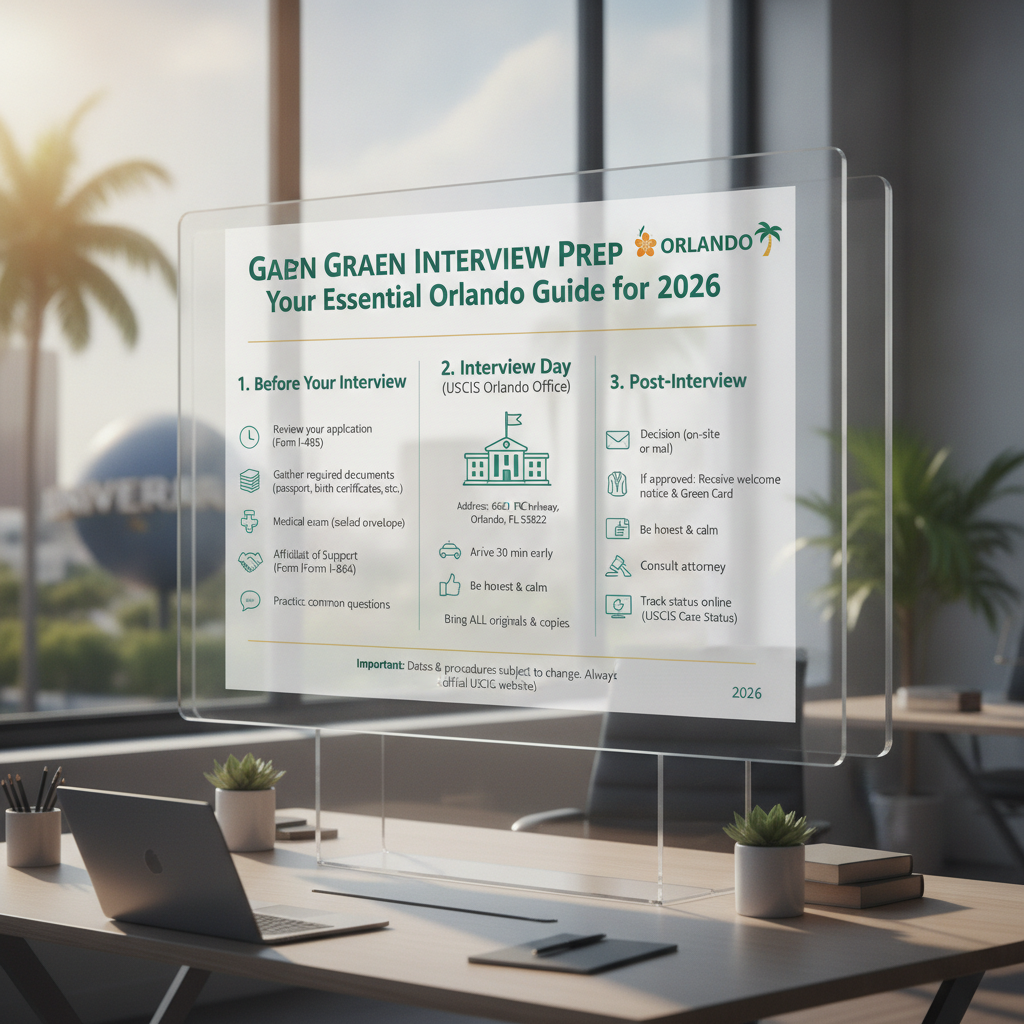
The reporting that sparked this guide: Green Card Interview Preparation Tips (Immigration Law)
What This News Means for Immigrants in Orlando and Across Florida
The continuous focus on Green Card interview preparation within immigration law news cycles highlights the enduring importance of this crucial step in the immigration process. For immigrants and their families, particularly those living in Orlando and throughout Florida, understanding the nuances of this interview is not just a recommendation—it’s a necessity for securing their future in the U.S.
Why this news is showing up now
While Green Card interviews are a long-standing component of the immigration system, the discourse around preparation tips remains consistently relevant for several reasons:
- Ongoing Application Volume: Every year, hundreds of thousands of individuals apply for Green Cards through various categories, ensuring a constant demand for clear, up-to-date guidance on the interview process.
- Policy and Procedural Updates: USCIS frequently refines its procedures, forms, and enforcement priorities. Staying informed about these changes is crucial, and legal news outlets often report on these shifts, prompting renewed discussions on best practices for interviews. For instance, increased scrutiny on marriage-based petitions or employment-based applications might lead to more in-depth interviews.
- Complexity of Cases: As immigration laws evolve and personal circumstances become more complex, applicants face more detailed questioning. This necessitates more thorough preparation, often highlighted by legal experts and news sources.
- Digital Information Age: The accessibility of information means that applicants are actively seeking guidance online. Legal content writers, like Imigrar, respond to this demand by providing expert, actionable advice based on the latest trends and legal interpretations.
- Impact of Processing Times: Fluctuations in USCIS processing times can create anxiety. When an interview notice finally arrives, applicants want to be absolutely ready, reinforcing the need for comprehensive preparation tips. For Orlando residents, monitoring the USCIS Processing Times for the Orlando Field Office is always a good idea.
How it can affect Florida residents
For individuals residing in Florida, particularly in a diverse and rapidly growing metropolitan area like Orlando, the emphasis on Green Card interview preparation holds specific significance:
- Local USCIS Field Office Operations: If you're applying for an Adjustment of Status (changing your status from a nonimmigrant to an immigrant while in the U.S.), your interview will likely take place at the Orlando USCIS Field Office or another field office within Florida. Understanding the local office's procedures, typical interview styles, and common challenges faced by applicants in the region can be highly beneficial.
- Diverse Applicant Pool: Florida is home to a vast and diverse immigrant population, including individuals from Latin America, the Caribbean, Europe, and Asia. This diversity means a wide range of Green Card categories are processed, from family-based petitions to employment-based and asylum-based applications. Each category has unique interview considerations.
- Marriage-Based Petitions: Given Florida's large population, a significant number of Green Card applications are marriage-based. These interviews often involve detailed questioning about the legitimacy of the marriage, requiring extensive documentation and consistent testimony. For couples in Orange County and surrounding areas, proving a bona fide marriage is paramount.
- Language Barriers: While USCIS provides interpreters, being prepared, understanding the questions in advance, and having a legal representative who can bridge language gaps (like Imigrar, where Se Habla Español) can significantly ease the interview process for many Florida residents.
- Access to Legal Expertise: The concentration of immigration attorneys in Florida, especially in cities like Orlando, means that residents have access to expert legal guidance. This news serves as a reminder to leverage that expertise to ensure thorough preparation and representation.
In essence, the ongoing discussion around Green Card interview preparation is a constant call to action for immigrants in Florida: be informed, be prepared, and seek professional guidance to navigate this critical step towards permanent residency.
What Green Card Interviews Are (and Why They Matter)
The Green Card interview is arguably the most critical step in the process of becoming a Lawful Permanent Resident (LPR) of the United States. It's the moment when a USCIS officer or a Consular Officer makes a final determination on your eligibility.
A plain-English definition
A Green Card interview is a formal meeting between you (and sometimes your petitioner, if applicable) and an immigration officer. Its primary purpose is to verify the information you submitted in your Green Card application, assess your eligibility for permanent residency under U.S. immigration law, and ensure that you are not inadmissible to the United States. The officer will ask questions about your background, your relationship (if it’s a marriage-based petition), your immigration history, and your intentions in the U.S. Think of it as a thorough background check and a conversation to confirm everything you've stated in writing.
Key terms you need to know
Navigating the Green Card process requires familiarity with specific terminology. Here are some key terms:
- Green Card: Also known as a Permanent Resident Card (Form I-551), it grants you official authorization to live and work permanently in the United States.
- Adjustment of Status (AOS): This is the process of applying for a Green Card while you are physically present in the United States. Your interview will typically be at a USCIS Field Office, such as the one in Orlando. The primary form for this is Form I-485.
- Consular Processing: If you are applying for your Green Card from outside the United States, your interview will be conducted at a U.S. Embassy or Consulate in your home country. This process is overseen by the U.S. Department of State.
- Petitioner: The U.S. citizen or lawful permanent resident who files an immigration petition on your behalf (e.g., a spouse filing Form I-130 for their foreign national spouse).
- Beneficiary: The foreign national who is seeking the Green Card. That's you!
- USCIS Officer: The official from U.S. Citizenship and Immigration Services who conducts your interview for Adjustment of Status cases.
- Consular Officer: The official from the U.S. Department of State who conducts your interview for Consular Processing cases.
- Bona Fide Marriage: A marriage entered into in good faith, not solely for immigration purposes. This is a critical concept for marriage-based Green Cards. The interview aims to verify the legitimacy and sincerity of the marital relationship.
- Inadmissibility: Grounds under U.S. immigration law that can prevent an individual from entering or remaining in the U.S. (e.g., certain criminal offenses, health issues, immigration violations).
- Priority Date: The date your petition (e.g., Form I-130) was filed. This date determines your place in the visa queue for certain family-sponsored and employment-based categories.
- Affidavit of Support (Form I-864): A legally binding document signed by a petitioner (sponsor) to accept financial responsibility for the immigrant. This ensures the immigrant will not become a "public charge."
Need Help? Navigating complex immigration terms and processes can be overwhelming. Our Orlando immigration team is ready to assist. Call +1 786-791-3106 for a free consultation, or message us online. Se Habla Español.
Current Immigration Law: The Foundation
The Green Card interview process is deeply rooted in U.S. immigration law, primarily the Immigration and Nationality Act (INA). Understanding the legal framework helps clarify the purpose and scope of the interview.
Federal requirements
The authority for Green Card interviews stems from various sections of the INA. For example:
- INA § 245 (8 U.S.C. § 1255): Adjustment of Status – This section outlines the eligibility requirements for individuals seeking to adjust their status to lawful permanent resident while in the U.S. It mandates that an interview be conducted to determine eligibility, unless waived by USCIS in certain clear-cut cases (which are rare for family-based petitions). The interview verifies that the applicant:
- Was inspected and admitted or paroled into the U.S.
- Is eligible for an immigrant visa.
- Has an immigrant visa immediately available.
- Is admissible to the U.S.
- Has not engaged in certain prohibited activities (e.g., unauthorized employment without specific exceptions).
- INA § 204 (8 U.S.C. § 1154): Procedure for granting status to spouses, children, or parents of citizens – This section governs the filing of immigrant petitions (like Form I-130) for family members. The interview serves to confirm the legitimate relationship between the petitioner and beneficiary, especially crucial for marriage-based petitions where a bona fide marriage must be proven.
- INA § 212 (8 U.S.C. § 1182): General Classes of Aliens Ineligible to Receive Visas and Ineligible for Admission – This section details the grounds of inadmissibility. During the interview, the officer will assess if any of these grounds apply to you (e.g., health-related grounds, criminal grounds, security grounds, public charge grounds). If a ground of inadmissibility exists, a waiver (e.g., Form I-601) may be required.
- INA § 213A (8 U.S.C. § 1183a): Requirements for Sponsor's Affidavit of Support – This section mandates the submission of Form I-864, the Affidavit of Support, to ensure that the immigrant will not become a public charge. The officer will review this document and may ask questions about the sponsor's income and assets.
The interview is a critical juncture where USCIS ensures compliance with these federal statutes and regulations. You can find more detailed information on these laws and requirements on the USCIS official website.
Florida-specific considerations
While federal law governs the fundamental requirements, the practical application can have Florida-specific nuances:
- Orlando USCIS Field Office: If your Green Card interview for Adjustment of Status is in Orlando, it will be conducted at the local USCIS Field Office. Familiarizing yourself with the location, parking, and general procedures of this specific office can reduce stress on interview day. The officers here are trained in federal immigration law but are also accustomed to the unique demographics and common case types seen in Central Florida.
- Local Legal Resources: Florida, particularly the Orlando area, has a robust community of immigration attorneys. Leveraging local expertise can provide an advantage, as these attorneys are familiar with the specific practices and expectations of the Orlando Field Office.
- Diverse Case Types: Given Florida's diverse population, the Orlando office handles a wide array of Green Card cases, including family-based (spouses, parents, children), employment-based, and asylum/refugee adjustments. While the legal framework is federal, the officer's experience with certain types of cases might vary.
Important: Always refer to the official USCIS forms and instructions. Key forms often involved in the Green Card process include:
- Form I-130, Petition for Alien Relative (filed by the U.S. citizen or LPR relative)
- Form I-485, Application to Register Permanent Residence or Adjust Status (the primary Green Card application if adjusting status in the U.S.)
- Form I-765, Application for Employment Authorization (often filed concurrently with I-485 to obtain a work permit)
- Form I-131, Application for Travel Document (often filed concurrently with I-485 to obtain Advance Parole for travel outside the U.S.)
- Form I-864, Affidavit of Support (financial sponsorship document)
- Form I-693, Report of Medical Examination and Vaccination Record (medical exam results)
You can download all official forms and instructions directly from the USCIS Forms page.
How to Prepare for Your Green Card Interview: A Complete Step-by-Step Guide
Thorough preparation is the cornerstone of a successful Green Card interview. Follow these steps meticulously to ensure you're ready for every aspect of the process.
1) Understand Your Interview Notice and Case Type
Your journey begins the moment you receive your interview notice (Form I-797C, Notice of Action) from USCIS. This document is crucial and contains vital information.
- Review the Notice Immediately: Check the date, time, and location of your interview. For Orlando residents, this will typically be the Orlando Field Office. Note any specific instructions or additional documents requested.
- Identify Your Case Type: Are you attending a marriage-based interview? An employment-based interview? An asylum-based adjustment? The type of Green Card you are seeking dictates the primary focus of the interview. For marriage-based cases, both the petitioner and beneficiary must attend. For other cases, generally only the beneficiary attends.
- Understand Who Needs to Attend: For marriage-based Green Cards (Form I-130 and Form I-485), both spouses must attend. For other family-based or employment-based Green Cards, typically only the applicant (beneficiary) attends. Your attorney should accompany you regardless of the case type.
Reminder: Do not miss your interview. If you have an unavoidable conflict, contact USCIS immediately to request a reschedule, though this can delay your case significantly.
2) Gather ALL Required Documents (Originals and Copies)
This is perhaps the most critical preparation step. The USCIS officer will need to review original documents and may keep copies. Organize everything meticulously.
- Your Interview Notice (Form I-797C).
- Government-Issued Identification: Valid passport, driver's license (especially important for Florida residents for local ID), or other official photo ID.
- All Original Documents from Your Application:
- Birth certificate (yours and petitioner's/spouse's).
- Marriage certificate (if applicable).
- Divorce decrees or death certificates for any previous marriages (yours and petitioner's/spouse's).
- Passports and travel documents (all current and expired, with all visa stamps and entry/exit records).
- Form I-94 Arrival/Departure Record (if applicable).
- Work permits (Form I-766) and travel documents (Form I-512 Advance Parole) if you have them.
- Medical Examination Report (Form I-693) in a sealed envelope, if not already submitted.
- Police clearances from all countries where you have lived for more than 6 months since age 16 (for consular processing) or if specifically requested by USCIS.
- Copies of all forms you submitted (Form I-130, Form I-485, Form I-864, etc.).
- Evidence of Bona Fide Marriage (for marriage-based Green Cards): This is crucial. Bring as much as possible to prove your shared life.
- Joint bank accounts (statements, voided checks).
- Joint leases or mortgage statements.
- Utility bills in both names.
- Joint credit cards.
- Health, life, or auto insurance policies showing both names.
- Photos together (dating, engagement, wedding, family, travel – with dates and locations).
- Children's birth certificates (if applicable).
- Affidavits from friends/family attesting to the marriage.
- Travel itineraries for trips taken together.
- Correspondence (letters, emails, text messages) showing ongoing relationship.
- Any other evidence demonstrating commingling of finances, cohabitation, and shared life.
- Financial Documents (for Form I-864):
- Petitioner's most recent federal tax returns (IRS transcripts preferred) and W-2s/1099s for the past three years.
- Proof of income (pay stubs, employment verification letters).
- Evidence of assets (bank statements, property deeds) if income alone is insufficient.
- If a joint sponsor is used, their tax returns, income proof, and a signed Form I-864A.
- Evidence of Employment/Education (if applicable): Diplomas, transcripts, employment letters, pay stubs.
- Any Documents Related to Past Immigration Issues: Previous visa applications, denial notices, court records, etc.
- Translations: Any document not in English must be accompanied by a certified English translation and a certificate from the translator.
Warning: Always bring original documents, even if you submitted copies. USCIS officers typically want to see the originals.
3) Review Your Application Forms Thoroughly
The officer will ask questions based on the information you provided in your Form I-130, Form I-485, and other supporting documents. It is vital that your answers are consistent with your submitted forms.
- Read Every Question and Answer: Go through your entire application package line by line.
- Memorize Key Dates and Details: Dates of entry, marriage, birth, previous addresses, employment history, etc.
- Identify Potential Discrepancies: If there are any discrepancies, understand why they exist and be prepared to explain them clearly and honestly. For example, a minor typo in a date should be acknowledged and corrected.
- Understand the Purpose of Each Question: Knowing why USCIS asks certain questions can help you provide relevant and complete answers.
4) Practice Answering Potential Questions
Familiarity with common interview questions can significantly reduce anxiety and help you articulate your answers clearly.
- General Biographic Questions: Name, date of birth, place of birth, parents' names, addresses, education, employment history, travel history.
- Immigration History: How you entered the U.S., previous visas, any past immigration violations, arrests, or detentions.
- For Marriage-Based Cases:
- How and when you met.
- Details of your proposal and wedding.
- Spouse's full name, date of birth, and parents' names.
- Daily routines, shared activities, living arrangements.
- Financial commingling, plans for the future.
- Questions about your spouse's family, friends, and work.
- Grounds of Inadmissibility: Questions about criminal history, health issues, involvement in certain organizations, past immigration fraud, or "public charge" concerns.
- Role-Playing: Practice with your spouse, a friend, or your attorney. Have them ask you questions as if they were the officer. This helps you formulate concise and truthful answers.
5) Dress Professionally and Plan Your Logistics
First impressions matter, and punctuality is non-negotiable.
- Dress Appropriately: Choose conservative, business-casual attire. This shows respect for the officer and the process.
- Plan Your Route to the Orlando USCIS Field Office: Allow ample time for traffic (especially on the I-4 corridor!), parking, and security checks. Aim to arrive at least 30-45 minutes before your scheduled interview time.
- Bring Comfort Items: A bottle of water, a light snack, and a book or magazine can be helpful, as wait times can be unpredictable.
- Childcare: If possible, arrange for childcare. While children can attend, it's often easier for you and your attorney to focus without distractions.
6) During the Interview: Be Honest, Calm, and Respectful
Your demeanor and responses during the interview are crucial.
- Be Truthful: Always answer questions honestly. Providing false information can lead to severe consequences, including denial and a ban from the U.S.
- Listen Carefully: Pay close attention to each question. If you don't understand a question, politely ask the officer to repeat or rephrase it. Do not guess.
- Answer Directly and Concisely: Provide direct answers to the questions asked. Avoid volunteering unnecessary information, but also don't be so brief that you appear evasive.
- Maintain Eye Contact and a Respectful Demeanor: Be polite, confident, and respectful.
- Bring an Interpreter if Needed: If you are not fluent in English, USCIS may provide an interpreter, or you may bring your own (who cannot be your attorney or petitioner in most cases). Your attorney can help arrange this.
- Let Your Attorney Speak: Your attorney is there to represent you. They will guide you, clarify questions, and object if necessary. Follow their lead.
- Sign Documents as Requested: The officer may ask you to sign certain forms or affirm your application under oath. Read carefully before signing.
7) After the Interview: Follow Up and Next Steps
The interview is over, but the process might not be.
- Decision at Interview: Sometimes, the officer will tell you on the spot that your Green Card is approved.
- Request for Evidence (RFE): If the officer needs more information or documents, they will issue an RFE (Form I-797E). Respond promptly and comprehensively with your attorney's help.
- Notice of Intent to Deny (NOID): If the officer intends to deny your application, they will send a NOID, giving you a chance to respond and overcome the grounds for denial. This is a serious situation where legal counsel is essential.
- Approval Notice: If approved, you will typically receive an approval notice, and your Green Card will be mailed within a few weeks.
Important: Keep copies of all correspondence and documents related to your case.
Practical Steps You Can Take Today
Don't wait until the last minute to prepare. Here are actionable steps you can start taking right now.
Actionable checklist with 5+ items
- Start a Dedicated Interview Folder: Create a physical and/or digital folder exclusively for your Green Card interview documents. Begin collecting originals and making copies immediately.
- Review Your Submitted Forms: Pull out copies of your Form I-130, Form I-485, and all supporting documents. Read through them carefully to refresh your memory and identify any areas that might require clarification.
- Begin Gathering "Proof of Life Together" (Marriage-Based): If applicable, actively collect and organize evidence of your bona fide marriage. This is an ongoing process. Don't just rely on what you submitted initially; continue to gather new joint documents, photos, and correspondence.
- Schedule a Medical Exam (if not already done): Ensure your Form I-693 is completed by a USCIS-approved civil surgeon and remains valid. It's often best to bring the sealed envelope to the interview, even if you submitted it earlier, as validity periods can expire.
- Consult with an Immigration Attorney: A free consultation with Imigrar can clarify your specific situation, identify potential challenges, and provide tailored advice. This is especially crucial for complex cases or if you have any past immigration issues.
- Practice Your English (if needed): If English is not your first language, practice discussing your life and application details in English. While interpreters are available, understanding and responding directly can be beneficial.
- Check USCIS Case Status Online: Regularly check your case status using the receipt number provided on your interview notice. This can help you anticipate next steps and spot any issues.
Document preparation guidance
- Organize Methodically: Use dividers, labels, and tabs in a binder or folder. Group documents by type (e.g., identity, marriage, financial, medical).
- Originals vs. Copies: Always bring ALL original documents. Keep a separate set of copies for the officer and another set for your own reference.
- Translations: For any document not in English, you MUST provide a complete and accurate English translation, along with a certification from the translator stating their competency and the accuracy of the translation.
- Digital Backups: Consider scanning all your documents and keeping a digital backup on a secure cloud service or external drive.
Timeline expectations
Understanding the timeline can help manage expectations:
- Interview Scheduling: After USCIS receives your application, it can take several months to over a year to schedule an interview, depending on the case type, USCIS workload, and the specific field office (e.g., Orlando Field Office). Check USCIS Processing Times for current estimates.
- Interview Notice: You typically receive your interview notice (Form I-797C) 3-6 weeks before the actual interview date.
- Decision After Interview:
- Immediate Approval: In straightforward cases, the officer might approve your Green Card on the spot or notify you of approval within a few days.
- Further Review/RFE: More commonly, the officer will state that they need to review the case further. You might receive an RFE (Request for Evidence) within a few weeks to a few months.
- NOID: A Notice of Intent to Deny (NOID) is less common but can be issued if significant issues arise. You usually have 30 days to respond to an RFE or NOID.
- Green Card Mailing: Once approved, your physical Green Card is usually mailed within 2-4 weeks.
Reminder: Processing times are estimates and can change. Patience and consistent follow-up (through your attorney) are key.
Need Help? Our Orlando immigration team is ready to assist. Call +1 786-791-3106 for a free consultation, or message us online. Se Habla Español.

How Imigrar Helps Immigrants in Orlando
At Imigrar, we understand that the Green Card interview is more than just a formality; it's a life-changing event. Our mission is to "Keep Families Together" by providing unparalleled legal support and guidance throughout this critical process.
Our experience and expertise
Our team of dedicated immigration attorneys


