


The journey to obtaining a Green Card, or Lawful Permanent Resident (LPR) status, is a significant milestone for many immigrants and their families in the United States. While the application process can be complex, one of the most critical steps for many applicants is the Green Card interview with U.S. Citizenship and Immigration Services (USCIS). This interview is your opportunity to present your case directly to an immigration officer, answer questions about your application, and demonstrate your eligibility for permanent residency.
For individuals and families in Orlando and throughout Florida, preparing thoroughly for this interview is not just recommended—it's essential. A well-prepared applicant can navigate the interview with confidence, reduce stress, and significantly improve their chances of a positive outcome. At Imigrar, we understand the stakes involved and are dedicated to providing the guidance and support needed to "Keep Families Together."
This comprehensive guide is designed to equip you with the knowledge, strategies, and practical advice necessary to approach your Green Card interview with peace of mind. We'll cover everything from understanding the legal framework to organizing your documents and knowing what to expect on interview day.
The reporting that sparked this guide
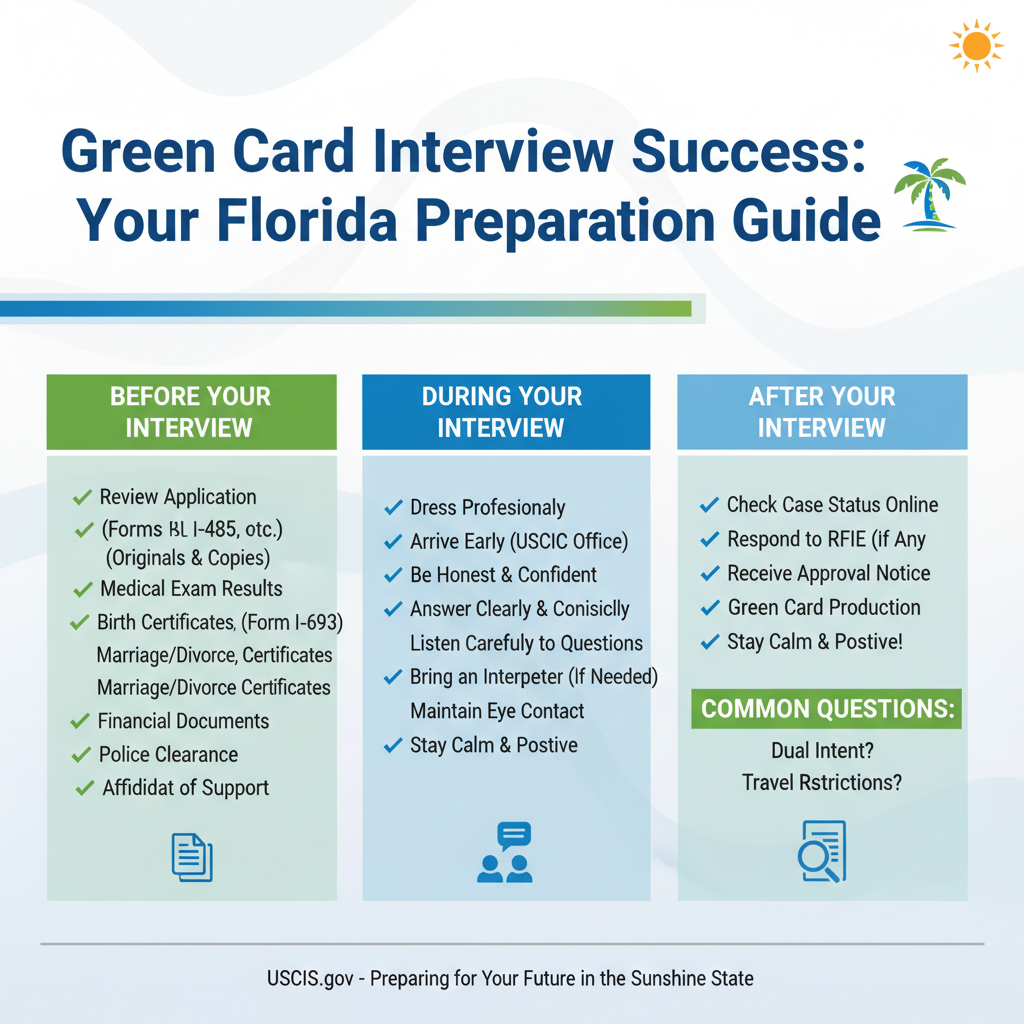
The consistent focus on the Green Card interview process in immigration news underscores its perennial importance. While specific policies and processing times may evolve, the fundamental requirement for applicants to undergo an interview and demonstrate eligibility remains a cornerstone of U.S. immigration law. The ongoing discussion around Green Card Interview Preparation Tips (Immigration Law) highlights the continuous need for reliable, up-to-date guidance for immigrants navigating this crucial stage.
What This News Means for Immigrants in Orlando and Across Florida
For immigrants residing in Orlando, Central Florida, and indeed, throughout the entire state, the emphasis on Green Card interview preparation is particularly relevant. Florida is home to a vibrant and diverse immigrant community, and thousands of individuals and families pursue permanent residency here each year.
Why this news is showing up now
The topic of Green Card interview preparation is not new, but its prominence in immigration news cycles is often tied to several factors:
- Consistent Processing Volumes: USCIS continues to process a high volume of Green Card applications, meaning interviews are a constant reality for many. The need for clear preparation guidelines is ongoing.
- Evolving Policies and Procedures: While the core interview purpose remains, USCIS may periodically update its procedures, leading to renewed discussions about best practices for applicants.
- Increased Scrutiny: Depending on the prevailing immigration climate, there can be periods of increased scrutiny on applications, especially for marriage-based petitions. This elevates the importance of thorough preparation and robust evidence.
- Public Interest and Demand for Information: Immigrants and their families are always seeking reliable information to navigate the complex system. News outlets and legal resources respond to this demand by offering timely advice.
Essentially, the news isn't necessarily about a sudden change, but rather a consistent reminder of the critical nature of this step in the immigration journey and the timeless need for applicants to be fully prepared.
How it can affect Florida residents
For individuals and families living in Florida, especially those interacting with the Orlando USCIS Field Office, this consistent focus on interview preparation has direct implications:
- Local Processing: Many Green Card interviews for Florida residents, particularly those undergoing Adjustment of Status, are conducted at the Orlando USCIS Field Office, or other field offices in Miami or Tampa. Understanding the general interview environment and expectations set by USCIS is crucial for a smooth experience at these local offices.
- High Volume of Applicants: Florida has a significant immigrant population. This means that many families in Orlando, Kissimmee, Sanford, and along the I-4 corridor are actively going through this process. The collective experience reinforces the need for meticulous preparation to stand out and avoid unnecessary delays.
- Family Unity Focus: Florida is a state where family-based immigration is particularly common. For marriage-based Green Cards, which involve a significant number of interviews, the emphasis on proving a bona fide marriage is paramount. Proper preparation ensures that families can effectively demonstrate their genuine relationship and achieve permanent residency.
- Stress Reduction: Knowing that thorough preparation is key can empower Florida residents to take proactive steps, thereby reducing anxiety associated with the interview. This can be especially true for those who might feel overwhelmed by the legal complexities.
By staying informed and preparing diligently, Florida immigrants can confidently approach their Green Card interview, moving closer to securing their future in the United States.
Need Help? Our Orlando immigration team is ready to assist. Call +1 786-791-3106 for a free consultation, or message us online. Se Habla Español.
What Green Card Interview Is (and Why It Matters)
The Green Card interview is a critical step in the process of becoming a Lawful Permanent Resident (LPR) of the United States. It is a mandatory meeting with an immigration officer from U.S. Citizenship and Immigration Services (USCIS) for most individuals applying for a Green Card, particularly those seeking Adjustment of Status from within the U.S. or through consular processing abroad.
A plain-English definition
Think of the Green Card interview as a conversation where you and, if applicable, your sponsor (petitioner) meet face-to-face with a government official. The purpose of this meeting is for the officer to:
- Verify the information you provided in your application forms (like Form I-130 and Form I-485).
- Confirm your eligibility for a Green Card under U.S. immigration law.
- Ensure there are no grounds of inadmissibility that would prevent you from becoming a permanent resident (e.g., certain criminal history, past immigration violations, or health issues).
- For marriage-based Green Cards, determine if your marriage is genuine and not solely for immigration purposes (a "bona fide" marriage).
It's not meant to be an interrogation, but rather an opportunity for you to clarify any ambiguities, present additional evidence, and answer questions directly. It is a fundamental part of the government's due diligence to ensure the integrity of the immigration system.
Key terms you need to know
Understanding the terminology will help you navigate the process more effectively:
- Green Card: The common name for the Permanent Resident Card, which proves you have been granted Lawful Permanent Resident (LPR) status in the United States.
- Lawful Permanent Resident (LPR): An individual who has been granted the privilege of permanently residing in the United States.
- Adjustment of Status (AOS): The process by which an eligible immigrant already in the United States can apply for LPR status without having to return to their home country for an immigrant visa. This is typically done by filing Form I-485.
- Consular Processing: The process by which an eligible immigrant who is outside the United States applies for an immigrant visa at a U.S. embassy or consulate in their home country. Upon approval and entry into the U.S., they become an LPR.
- USCIS: U.S. Citizenship and Immigration Services, the federal agency responsible for administering the country's lawful immigration system. Your interview will be with a USCIS officer.
- USCIS Field Office: A local office where interviews are conducted. For Central Florida residents, this is often the Orlando USCIS Field Office.
- Petitioner/Sponsor: The U.S. citizen or LPR who files an immigrant petition (e.g., Form I-130) on behalf of an eligible relative. They often also serve as the financial sponsor by filing Form I-864.
- Beneficiary: The immigrant seeking the Green Card, on whose behalf the petition is filed.
- Affidavit of Support (Form I-864): A legally binding document filed by the petitioner (and sometimes a joint sponsor) to demonstrate that the beneficiary has adequate means of financial support and is not likely to become a public charge.
- Priority Date: The date USCIS receives your immigrant petition (e.g., Form I-130). This date is used to determine when an immigrant visa becomes available, especially for categories with annual quotas.
- Request for Evidence (RFE): A letter from USCIS asking for additional documents or information to support your application. This can happen before or after an interview.
Understanding these terms will help demystify the process and prepare you for the language used by immigration officers and in official communications.
Current Immigration Law: The Foundation
The Green Card interview is conducted under the authority of the Immigration and Nationality Act (INA), which is the body of law governing immigration to the United States. Specifically, sections of the INA dictate who is eligible for permanent residency, the grounds for inadmissibility, and the procedural requirements for obtaining a Green Card.
Federal requirements
The primary legal framework for Green Card eligibility is found in various sections of the INA, including:
- INA Section 201-204: These sections define the categories of immigrants eligible for visas, including family-sponsored preferences, and establish the annual numerical limitations for certain categories.
- INA Section 212: This crucial section outlines the "grounds of inadmissibility." An applicant may be deemed inadmissible if they have certain health-related issues, criminal convictions, security concerns, a history of immigration violations, or are likely to become a public charge. The interview is designed to screen for these issues.
- INA Section 245: This section governs Adjustment of Status from within the United States. It specifies who is eligible to adjust their status and under what conditions. Most applicants who adjust status in the U.S. will undergo an interview.
During the interview, the USCIS officer's role is to ensure that you meet all statutory and regulatory requirements for the Green Card you are seeking and that none of the grounds of inadmissibility apply to your case. They will review all submitted documentation, including but not limited to:
- Form I-130, Petition for Alien Relative: Filed by a U.S. citizen or LPR relative to establish the qualifying relationship.
- Form I-485, Application to Register Permanent Residence or Adjust Status: The primary application form for the beneficiary seeking the Green Card from within the U.S.
- Form I-864, Affidavit of Support: Submitted by the financial sponsor to demonstrate they can support the beneficiary at 125% of the poverty guidelines.
- Form I-693, Report of Medical Examination and Vaccination Record: Completed by a USCIS-approved civil surgeon to ensure health requirements are met.
- Form I-765, Application for Employment Authorization: Often filed concurrently with Form I-485, though not directly part of the Green Card approval itself.
- Form I-131, Application for Travel Document: Also often filed concurrently, for Advance Parole, allowing travel outside the U.S. while Adjustment of Status is pending.
For more detailed information on forms and legal requirements, always refer to the USCIS official website.
Florida-specific considerations
While U.S. immigration law is federal, its application has local nuances. For Florida residents, the key considerations include:
- Orlando USCIS Field Office: If your case is in Orlando or the surrounding Central Florida region, your interview will likely be scheduled at the Orlando USCIS Field Office. Understanding the specific logistics, parking, and security procedures for this office can be helpful.
- Processing Times: While federal, processing times can vary by field office due to workload and staffing. You can check current processing times for the Orlando office on the USCIS Processing Times page.
- Language Services: Florida's diverse population means that many applicants may require an interpreter. USCIS allows you to bring your own interpreter if they are fluent in both English and your native language, are at least 18 years old, and are not your attorney or a witness in your case. You can also request a USCIS interpreter in advance.
Regardless of your specific location in Florida, the federal requirements remain the same, emphasizing the universal need for thorough preparation and adherence to legal standards.
How to Prepare for Your Green Card Interview: A Complete Step-by-Step Guide
Preparing for your Green Card interview is crucial for a successful outcome. This detailed guide will walk you through the essential steps, ensuring you are well-equipped for the big day.
1) Understand Your Case & Review Your Application
The first and most fundamental step is to fully understand every detail of your application. You should know your case inside and out, as if you were the one who prepared all the forms. This means reviewing every document you submitted to USCIS, including your initial petition and supporting evidence.
- Read through all forms: Go over your Form I-130, Form I-485, Form I-864, and any other forms you filed. Pay close attention to dates, addresses, employment history, and personal details. Ensure consistency with your memory and any new information.
- Know your immigration history: Be prepared to discuss past entries, visas, and any prior immigration applications or issues.
- For marriage-based cases: Both spouses should thoroughly review the application together. Discuss your relationship's timeline, how you met, key dates (marriage, first date, moving in together), and future plans.
Required Documents for this step (for review):
- Copies of all forms submitted to USCIS (e.g., Form I-130, Form I-485, Form I-864, Form I-765, Form I-131).
- Copies of all supporting documents previously submitted (e.g., birth certificates, marriage certificates, passports, financial documents, police records).
- Your personal statement or any affidavits you submitted.
2) Gather & Organize All Original Documents
You must bring the originals of every document you submitted as a copy, plus any new documents that have been requested or that you believe further strengthen your case. Organization is key here; a well-organized binder makes a strong impression and helps you quickly retrieve documents when asked.
- Originals of all civil documents: Birth certificates, marriage certificates, divorce decrees, death certificates (if applicable), adoption papers.
- Passports and travel documents: Your current passport, any expired passports with visas, and your Form I-94 Arrival/Departure Record.
- Medical Exam Results: If not already submitted or if you received an RFE for it, bring your sealed Form I-693, Report of Medical Examination and Vaccination Record, completed by a USCIS-approved civil surgeon.
- Financial Documents: Current income tax returns (from the last 3 years), W-2s, 1099s, pay stubs, employment verification letters for the sponsor and any joint sponsors.
- Police Records: Any court dispositions or police clearance certificates for arrests, even if charges were dropped or expunged.
- Interview Notice: Your official interview appointment notice (Form I-797C).
Important: Bring both the originals AND a full set of copies of everything. The officer may want to keep the copies.
3) Prepare Evidence of a Bona Fide Relationship (for Marriage-Based Cases)
For marriage-based Green Cards, proving your marriage is legitimate and not just for immigration purposes is paramount. The officer will be looking for evidence of commingled lives and shared responsibilities.
- Joint Financial Documents: Joint bank accounts, credit card statements, joint tax returns, joint mortgage or lease agreements, utility bills in both names, joint insurance policies (health, life, auto, home).
- Shared Property: Titles to jointly owned cars, property deeds.
- Photos: A wide range of photos from different times: wedding, holidays, family gatherings, vacations, daily life. Include dates and descriptions if possible.
- Correspondence: Cards, letters, emails, text messages, chat logs exchanged over time (select key examples).
- Affidavits from Friends/Family: Letters from people who know your relationship well, attesting to its authenticity. These should be notarized and include the writer's contact information.
- Children's Birth Certificates: If you have children together.
- Travel Records: Joint travel itineraries, flight tickets, hotel bookings.
Reminder: Quality over quantity. Organize your evidence logically, perhaps in sections, and choose compelling examples.
4) Practice Answering Questions
While you can't predict every question, you can anticipate common lines of inquiry. Practice with your spouse, a friend, or your attorney. Honesty and consistency are key.
- Personal History: Questions about your birth, parents, siblings, education, employment, and residences.
- Immigration History: How you entered the U.S., previous visas, any past immigration issues.
- Relationship Details (marriage-based): How you met, when you started dating, proposal, wedding details, daily life, spouse's habits, family members. Be ready for specific questions about your spouse's job, hobbies, or even what they ate for breakfast.
- Criminal History: Even minor arrests, traffic violations (beyond parking tickets), or encounters with law enforcement.
- Affidavit of Support: Questions about the sponsor's income, assets, and ability to support you.
Warning: Never lie or intentionally mislead an immigration officer. This can lead to a denial and severe future immigration consequences.
5) Understand the Interview Process
Knowing what to expect can significantly reduce anxiety. The interview will typically follow a structured format.
- Arrival and Check-in: Arrive at least 30 minutes early to allow for security screening and check-in at the Orlando USCIS Field Office or other location.
- Oath: You and your petitioner will be asked to swear an oath to tell the truth.
- Verification of Identity: The officer will verify your identity using your passport or other IDs.
- Review of Application: The officer will go through your application forms, confirming the information you provided. They may ask clarifying questions.
- Evidence Review: You will be asked to present original documents and any additional evidence.
- Questions: The bulk of the interview involves questions about your eligibility, background, and for marriage-based cases, your relationship.
- Decision or Follow-up: In some cases, a decision is made on the spot. More often, the officer will state that a decision will be mailed to you. They may also issue an RFE or a Notice of Intent to Deny (NOID).
Reminder: If you don't understand a question, politely ask the officer to rephrase it. Do not guess an answer.
6) Dress Professionally & Arrive Early
First impressions matter. While there's no strict dress code, dressing in professional or business-casual attire demonstrates respect for the process and the officer.
- Attire: Choose neat, clean, conservative clothing. Avoid overly casual wear like shorts, t-shirts, or ripped jeans.
- Punctuality: Arriving early allows you to find parking (which can be a challenge at some field offices, including potentially the Orlando USCIS Field Office), go through security, and check in without rushing. Being late can lead to your interview being rescheduled or even denied.
- Companions: Only the applicant(s), petitioner (if applicable), attorney, and interpreter are typically allowed into the interview room. Family members or friends who are not directly involved should wait outside or not accompany you to the building unless necessary for childcare.
7) What to Do After the Interview
The interview is not always the final step. Be prepared for potential follow-ups.
- Decision Notification: USCIS will mail you a decision. This could be an approval, an RFE, or a denial. Processing times vary; check the USCIS Processing Times for your specific office.
- Responding to RFE/NOID: If you receive an RFE (Request for Evidence) or a NOID (Notice of Intent to Deny), respond promptly and thoroughly with the requested information. This is where legal counsel becomes even more critical.
- Green Card Delivery: If approved, your Green Card will be mailed to you. Ensure your address is current with USCIS.
Feeling Overwhelmed? The complexities of Green Card interviews are easier with expert guidance. Contact Imigrar for personalized support. Call +1 786-791-3106 for a free consultation. Se Habla Español.
Practical Steps You Can Take Today
Don't wait until the last minute to prepare for your Green Card interview. Here are actionable steps you can start taking right now to ensure you're ready.
Actionable checklist with 5+ items
- Review Your Application: Print out all forms (Form I-130, Form I-485, Form I-864, etc.) you submitted to USCIS. Read them thoroughly, line by line, to refresh your memory on every detail. Note any discrepancies or new information.
- Create a Document Checklist: Based on your application and this guide, make a master list of every original document and every piece of supporting evidence you need to bring. Include personal documents, financial records, and relationship evidence (for marriage cases).
- Gather Originals & Make Copies: Start collecting all original civil documents (birth certificates, marriage licenses, passports). Once you have the originals, make at least two clear, legible copies of everything. Place originals in one folder and copies in another.
- Organize Your Evidence: Purchase a binder with dividers. Label each section clearly (e.g., "Personal Documents," "Financial Evidence," "Relationship Evidence," "Medical Exam"). Place your documents in the corresponding sections. This will make it easy to present them during the interview.
- Practice Your Story: Sit down with your spouse (if applicable) and review the timeline of your relationship. Practice answering common interview questions out loud. Focus on being clear, concise, and consistent with the information in your application.
- Check USCIS Processing Times: Regularly monitor the USCIS Processing Times page for the Orlando USCIS Field Office (or your local office) to get an idea of when to expect your interview notice and a final decision.
- Consult an Attorney: If you haven't already, schedule a consultation with an experienced immigration attorney at Imigrar. Even if you've filed on your own, having a lawyer review your case and prepare you for the interview can be invaluable.
Document preparation guidance
Effective document preparation is a cornerstone of a successful interview. Here’s how to do it right:
- The Binder Method: Use a three-ring binder with clearly labeled tabs for different categories of documents. This shows organization and professionalism.
- Logical Order: Within each section, arrange documents chronologically or by relevance. For example, for financial documents, put the most recent tax returns first.
- Highlight Key Information: For lengthy documents like tax returns, consider using sticky notes or light highlighting on key figures (e.g., income lines) to make it easier for the officer to find information.
- Photocopies vs. Originals: Always bring ALL originals. Have a complete set of photocopies ready to hand over if the officer requests them. Do not offer originals unless specifically asked.
- Translations: Any document not in English must be accompanied by a certified English translation. The translator must certify that they are competent to translate and that the translation is accurate.
Timeline expectations
The timeline for Green Card


