


The journey to obtaining a Green Card, or lawful permanent residency in the United States, is a significant milestone for countless individuals and families. For many, this path culminates in a pivotal moment: the Green Card interview. This interview, conducted by a U.S. Citizenship and Immigration Services (USCIS) officer, is a critical step designed to verify the information in your application, assess your eligibility, and ensure you meet all legal requirements for permanent residency. As of 2026, navigating this interview successfully requires thorough preparation, a clear understanding of immigration law, and often, expert legal guidance.
The reporting that sparked this guide
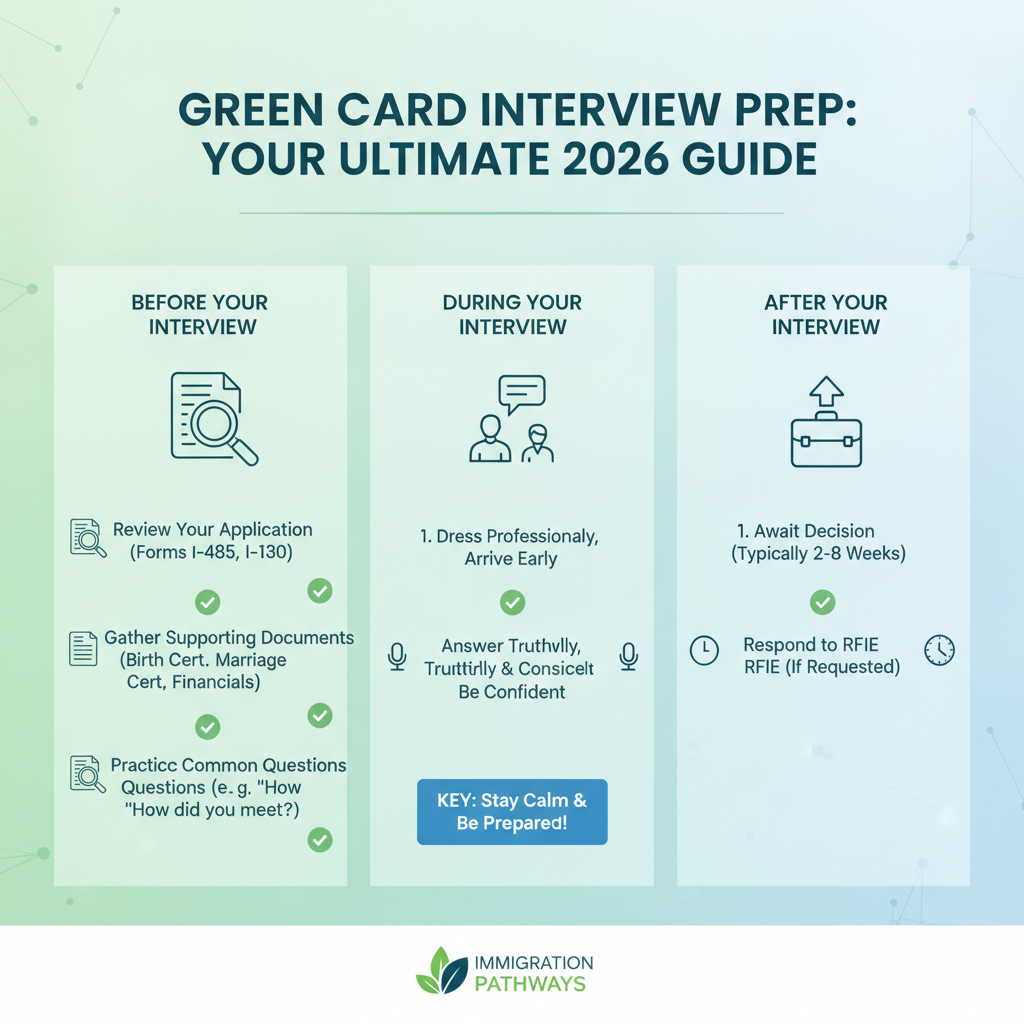
Recent discussions and news within the immigration law community continue to highlight the importance of meticulous preparation for the Green Card interview. Reports from various legal sources and immigrant advocacy groups consistently emphasize that while the interview process remains a standard procedure, applicants often underestimate its weight and complexity. The ongoing focus on interview preparation underscores the need for clear, actionable advice to help applicants confidently present their case. This guide is inspired by the continuous stream of information underscoring the critical nature of this interview stage, as seen in general discussions around Green Card Interview Preparation Tips (Immigration Law), which consistently ranks as a top concern for applicants.
Need Help? Our Orlando immigration team is ready to assist. Call +1 786-791-3106 for a free consultation, or message us online. Se Habla Español.
What This News Means for Immigrants in Orlando and Across Florida
For immigrants residing in Orlando, Central Florida, and throughout the Sunshine State, the continued emphasis on Green Card interview preparation is not just general news; it carries significant local relevance. Florida is home to one of the largest and most diverse immigrant populations in the United States, with a constant flow of individuals and families seeking permanent residency. Understanding the nuances of the interview process is paramount for those whose futures depend on a successful outcome.
Why this news is showing up now
The Green Card interview has always been a fundamental component of the immigration process for most applicants seeking Adjustment of Status (AOS) or completing Consular Processing. The renewed focus on preparation tips and strategies in 2026 reflects several ongoing trends:
- Increased Scrutiny: USCIS officers are often under pressure to thoroughly vet applications, particularly in an environment of enhanced national security and fraud detection efforts. This means interviews can be more detailed and probing than in previous years.
- Processing Backlogs and Efficiency Drives: While USCIS aims for efficiency, backlogs can lead to longer waiting times, increasing anxiety for applicants. When an interview is finally scheduled, it becomes an even more critical opportunity to make a strong case.
- Policy Changes and Updates: Immigration policy can evolve, leading to new areas of questioning or emphasis during interviews. Staying updated on these changes is crucial, and legal experts continually share insights to help applicants adapt.
- Applicant Awareness: Immigrants and their families are increasingly proactive in seeking information and preparing comprehensively, driving demand for detailed guides and professional assistance.
How it can affect Florida residents
For individuals living along the I-4 corridor, in Orange County, or anywhere in Central Florida, the implications of a well-prepared Green Card interview are direct and tangible. Your interview will likely take place at the Orlando USCIS Field Office (located at 6650 TPC Drive, Orlando, FL 32822) if you are adjusting status locally. Key considerations for Florida residents include:
- Local Processing Times: While federal, processing times can vary slightly by field office. Being prepared helps ensure your case moves forward smoothly without unnecessary delays from RFEs (Requests for Evidence) or follow-up interviews. You can check current times at USCIS Processing Times.
- Specific Field Office Nuances: While interview protocols are standardized, individual field offices and officers may have slight variations in approach. Local legal counsel familiar with the Orlando office can offer invaluable insights.
- Family Unity: Florida is a state built on strong community and family ties. A successful Green Card interview means keeping families together, allowing spouses, parents, and children to build a stable life here. Conversely, a denial can be devastating.
- Economic Impact: Gaining permanent residency allows individuals to fully participate in the state's economy, pursue careers, and contribute to local communities without immigration-related restrictions.
The news emphasizes that preparation is not merely advisable but essential. It directly impacts your ability to secure your future in Florida and fulfill your American dream.
What Green Card Interviews Are (and Why They Matter)
A Green Card interview is a mandatory step for most individuals applying for permanent residency in the United States. Its primary purpose is to allow a USCIS officer to personally review your application, verify the information you’ve provided, and determine your eligibility for a Green Card based on existing immigration law.
A plain-English definition
Think of the Green Card interview as your face-to-face meeting with a U.S. immigration officer who will ask you questions about your application, your background, and your relationship (if applicable). This is your opportunity to demonstrate that you qualify for permanent residency and that all the information you submitted in your application forms is true and accurate. It's the moment where all your paperwork comes to life through your personal testimony.
Key terms you need to know
Navigating the Green Card process involves understanding several key terms:
- Green Card: Formally known as a Permanent Resident Card, it is proof of your authorization to live permanently in the United States.
- Adjustment of Status (AOS): The process of applying for a Green Card while you are already in the United States. Most family-based and employment-based applicants who are present in the U.S. pursue AOS.
- Consular Processing: The process of applying for a Green Card through a U.S. consulate or embassy in your home country. This applies if you are outside the U.S. or ineligible for AOS.
- USCIS Field Office: A local office of U.S. Citizenship and Immigration Services where interviews for Adjustment of Status are typically conducted. For Central Florida residents, this is the Orlando USCIS Field Office.
- Petitioner: The U.S. citizen or lawful permanent resident who files an immigration petition (e.g., Form I-130) on behalf of a foreign national.
- Beneficiary: The foreign national who is seeking a Green Card based on the petition filed by the Petitioner.
- Affidavit of Support (Form I-864): A legally binding document signed by the Petitioner (and sometimes a joint sponsor) to accept financial responsibility for the immigrant, ensuring they will not become a public charge.
- Inadmissibility: Grounds under U.S. immigration law that can make an individual ineligible for a Green Card, such as certain criminal convictions, health issues, or prior immigration violations.
- Prima Facie Case: A case that is legally sufficient on its face, meaning that if all the evidence is believed, it would establish the right to the requested benefit. USCIS looks for this during your interview.
- Priority Date: The date your immigration petition (e.g., Form I-130) was properly filed with USCIS. This date determines your place in the visa queue for certain categories.
- Request for Evidence (RFE): A letter from USCIS asking for additional documents or information to support your application.
Need Help? Our Orlando immigration team is ready to assist. Call +1 786-791-3106 for a free consultation, or message us online. Se Habla Español.
Current Immigration Law: The Foundation for Your Green Card Interview
The Green Card interview process is strictly governed by the Immigration and Nationality Act (INA), which is the body of law that dictates immigration policy in the United States. Understanding the legal framework behind your application is crucial for your preparation.
Federal requirements
Most Green Card applications fall under specific sections of the INA, particularly for family-sponsored and employment-based categories. Key statutes include:
- INA § 245 (8 U.S.C. § 1255): This section governs Adjustment of Status, outlining the general requirements for an applicant to change their status to that of a lawful permanent resident while in the U.S. Key criteria often include lawful admission or parole, being eligible for an immigrant visa, and being admissible to the U.S.
- INA § 201 & 203 (8 U.S.C. § 1151 & 1153): These sections define immigrant visa categories, including immediate relatives of U.S. citizens (spouses, unmarried children under 21, parents of U.S. citizens 21 or older) and various preference categories (e.g., unmarried sons and daughters of U.S. citizens, spouses and children of permanent residents).
- INA § 212 (8 U.S.C. § 1182): This is a critical section outlining the Grounds of Inadmissibility. During your interview, the USCIS officer will assess whether you are inadmissible to the U.S. based on health-related grounds, criminal grounds, security grounds, public charge grounds, prior immigration violations, and more. Overcoming grounds of inadmissibility often requires a waiver.
- INA § 213A (8 U.S.C. § 1183a): This section establishes the requirement for an Affidavit of Support (Form I-864) for most family-based immigrants and some employment-based immigrants, ensuring that the applicant will not become a "public charge."
The interview is the officer’s final opportunity to ensure all these federal requirements are met and that no grounds of inadmissibility apply to your case. Honesty and consistency with your application are paramount.
Florida-specific considerations
While immigration law is federal, the practical application often takes place at a local level. For residents of Orlando and the broader Central Florida region, your Green Card interview will most likely be conducted at the Orlando USCIS Field Office. There are no Florida-specific immigration laws that directly impact your federal Green Card eligibility or interview process. However, local considerations might include:
- Familiarity with the Local Office: An attorney based in Orlando, like Imigrar, is often familiar with the administrative procedures and common practices of the local field office, which can be beneficial in preparing clients.
- Local Resources: Access to local notaries, medical exam providers (civil surgeons), and translation services are crucial for gathering necessary documents in Florida.
- Community Context: While not a legal factor, an officer may be interested in your ties to the local community in Florida, such as employment, family, or educational involvement, especially if questions arise about your intent to reside permanently in the U.S.
Applicants must file several USCIS forms, depending on their specific case type. The most common forms for Adjustment of Status are:
- Form I-130, Petition for Alien Relative: Filed by the U.S. citizen or lawful permanent resident to establish the qualifying relationship.
- Form I-485, Application to Register Permanent Residence or Adjust Status: The primary application for the Green Card itself, filed by the beneficiary.
- Form I-864, Affidavit of Support: Filed by the petitioner (and sometimes a joint sponsor) to demonstrate financial support.
- Form I-693, Report of Medical Examination and Vaccination Record: Completed by a USCIS-authorized civil surgeon to ensure you meet health-related requirements.
- Form I-765, Application for Employment Authorization: Often filed concurrently with Form I-485 to obtain a work permit while the Green Card application is pending.
- Form I-131, Application for Travel Document: Often filed concurrently with Form I-485 to obtain advance parole for international travel while the Green Card application is pending.
You can find all official forms and detailed instructions on the USCIS Forms page and the USCIS official website.

How to Prepare for Your Green Card Interview: A Complete Step-by-Step Guide
Preparing for your Green Card interview can feel overwhelming, but breaking it down into manageable steps makes the process clearer and less stressful. This guide provides a comprehensive approach to ensure you are fully ready.
1) Understand Your Case Type and Review Your Application
Before anything else, you must thoroughly understand the specifics of your immigration case. Are you applying for Adjustment of Status (AOS) from within the U.S., or are you undergoing Consular Processing abroad? The type of case dictates the forms, some required documents, and even the nuances of the interview itself.
Actionable Advice:
- Review Every Form: Go back and carefully read every single form you submitted to USCIS or the Department of State (e.g., Form I-130, Form I-485, Form I-864, DS-260 if consular processing). Ensure you remember every answer, date, and detail.
- Identify Potential Discrepancies: If you find any errors or omissions, discuss them immediately with your attorney. Minor inconsistencies can be explained, but major ones need careful handling.
- Understand Your Eligibility: Be clear on the legal basis for your Green Card application (e.g., marriage to a U.S. citizen, employment sponsorship). The officer will test your understanding of why you qualify.
Required Documents (for review):
- Copies of your entire submitted application package, including all forms and supporting evidence.
- Your personal notes or summaries from when you filled out the forms.
2) Gather and Organize All Required Documents
This is arguably the most crucial step. You must bring originals, copies, and often translations of every document relevant to your case. Missing or disorganized documents can lead to delays, an RFE, or even denial. For Orlando residents, ensure your documents align with the requirements of the Orlando USCIS Field Office.
Actionable Advice:
- Originals and Copies: Prepare one clear copy of every original document you plan to bring. USCIS officers usually review copies and return originals.
- Translations: Any document not in English must be accompanied by a certified English translation and a certification from the translator that they are competent and that the translation is accurate.
- Organize Methodically: Use a binder or accordion folder. Label each section clearly (e.g., "Passports," "Birth Certificates," "Marriage Certificate," "Financial Documents," "Medical Exam").
- Medical Exam (Form I-693): If you haven't already submitted your Form I-693, ensure it is completed by a USCIS-authorized civil surgeon and sealed in an envelope. Do NOT open this envelope yourself. Bring it to the interview.
Essential Documents to Bring (Originals and Copies):
- Interview Notice: The official letter from USCIS scheduling your interview.
- Passports: Your current passport and any expired passports.
- Birth Certificates: Your original birth certificate and, if applicable, your petitioner's birth certificate.
- Marriage Certificate: If applying based on marriage (original and copy).
- Divorce Decrees/Death Certificates: For any previous marriages of you or your petitioner.
- Medical Examination: Sealed Form I-693.
- Financial Documents:
- Original Form I-864, Affidavit of Support (if not already filed or if an updated one is requested).
- Petitioner's (and joint sponsor's, if applicable) federal income tax returns (IRS transcripts preferred) for the last three years.
- Proof of current employment (e.g., recent pay stubs, employment verification letter).
- Bank statements, property deeds, or other asset documentation.
- Proof of Relationship (for family-based cases):
- Joint bank accounts, utility bills, leases, mortgage statements.
- Photos together (wedding, holidays, family events) – Important: Organize them chronologically and label them.
- Letters, emails, social media communication.
- Children's birth certificates (if applicable).
- Police Clearances: From all countries you have lived in (if applicable to your case).
- Proof of Lawful Entry and Status: Form I-94 (Arrival/Departure Record), visa stamps, previous USCIS approval notices (e.g., I-797).
- Employment History: Employment verification letters, pay stubs.
- Education Records: Diplomas, transcripts.
- Prior Immigration Filings: Copies of any other petitions or applications you have filed (e.g., asylum, previous visa applications).
- Two Passport-Style Photos: Even if you submitted them, bring extra.
3) Practice Answering Common Interview Questions
This is where you build confidence. The officer will ask questions to verify information, assess your credibility, and confirm your eligibility. Consistency is key.
Actionable Advice:
- Review Your Application Again: Ensure your answers align perfectly with what you submitted on your forms.
- Anticipate Questions: Prepare for questions about your personal history, relationship (if applicable), employment, travel, and any potential issues (e.g., prior arrests, immigration violations).
- Mock Interview: Practice with your spouse, a friend, or ideally, your immigration attorney. Have them ask you challenging questions.
- Be Honest and Concise: Answer truthfully and directly. Do not volunteer unnecessary information, but do not withhold information asked for.
- Know Your Dates: Be familiar with important dates (birthdays, anniversaries, dates of entry/exit, dates of employment).
Common Question Areas:
- Personal Background: Name, date of birth, place of birth, parents' names, previous addresses.
- Immigration History: How you entered the U.S., previous visas, any prior immigration applications, any encounters with immigration officials.
- Relationship (for marriage-based cases): How you met, when you started dating, engagement, wedding details, daily life together, shared finances, future plans. The officer might ask very specific, sometimes intimate, questions to verify the bona fides of your marriage.
- Employment/Education: Current job, previous jobs, education history.
- Criminal History: Any arrests, citations, or convictions, even minor ones. Be prepared to discuss these openly with your attorney beforehand.
- Grounds of Inadmissibility: Questions related to health, security, public charge, or any other potential inadmissibility issues.
4) Dress Professionally and Arrive Early
First impressions matter. While your eligibility is based on law and evidence, presenting yourself professionally demonstrates respect for the process and the officer.
Actionable Advice:
- Professional Attire: Dress as you would for a job interview. Clean, neat, and conservative clothing is appropriate.
- Plan Your Route: For Central Florida residents, plan your drive to the Orlando USCIS Field Office. Account for traffic, especially during peak hours on the I-4 corridor.
- Arrive Early: Aim to arrive at least 30-45 minutes before your scheduled appointment. This allows time for parking, security checks, and finding the correct waiting area. Being late can lead to rescheduling or even denial.
- Bring Comfort Items: If bringing children (often required for family-based cases), bring snacks, books, or quiet toys to keep them occupied.
5) What to Expect During the Interview
Knowing the general flow of the interview can reduce anxiety.
Actionable Advice:
- The Oath: You will be asked to swear or affirm that your testimony will be truthful.
- Review of Application: The officer will typically go through your application forms, confirming details and asking clarifying questions.
- Specific Questions: Expect detailed questions about your eligibility, background, and relationship (if applicable).
- Documents Review: The officer will review your original documents and compare them to the copies you provide.
- Interpreters: If you are not fluent in English and requested an interpreter, ensure they are present and certified. Your attorney can often act as an interpreter if they are fluent in both languages and qualified.
- Your Attorney's Role: Your attorney can be present during the interview, offering legal advice, clarifying questions, and objecting to improper questioning. They cannot answer for you.
- Decision: Sometimes, the officer can make a decision on the spot. More often, they will inform you that a decision will be mailed to you within a few weeks or months.
Important: Maintain eye contact, speak clearly, and ask for clarification if you don't understand a question. If you don't know an answer, it's okay to say so. Do not guess.
6) Follow-Up Actions After the Interview
Your responsibility doesn't necessarily end when you leave the Orlando USCIS Field Office.
Actionable Advice:
- Await Decision Letter: If no immediate decision was made, patiently wait for the official notice.
- Respond to RFEs: If you receive a Request for Evidence, respond promptly and thoroughly with the requested documents, ideally with legal assistance.
- Consult Attorney for Denial: If your application is denied, immediately consult with an immigration


