


The reporting that sparked this guide: Green Card Interview Preparation Tips (Immigration Law)
What This News Means for Immigrants in Orlando and Across Florida
As an immigrant or family member navigating the complex U.S. immigration system, you're likely aware that information is power. The news and discussions surrounding immigration law, particularly regarding critical milestones like the Green Card interview, are always relevant. At Imigrar, we understand the anxieties and questions these updates can raise, especially for our vibrant community in Orlando and throughout Florida.
Why this news is showing up now
The Green Card interview, whether for Adjustment of Status within the U.S. or through Consular Processing abroad, remains a cornerstone of the immigration process. It’s the stage where U.S. Citizenship and Immigration Services (USCIS) or a Consular Officer verifies the information in your application, assesses your eligibility, and determines your admissibility to the United States. While the interview process itself isn't new, ongoing discussions in immigration law frequently highlight the importance of thorough preparation, changes in interview protocols, and evolving evidentiary standards. These conversations underscore the necessity for applicants to be meticulously prepared, honest, and well-represented. Furthermore, with processing backlogs and policy shifts, the interview can often feel like the make-or-break moment, making preparation tips perpetually trending and crucial.
How it can affect Florida residents
For individuals and families residing in Florida, particularly in the greater Orlando area, the Green Card interview is a very real and often imminent step. Florida is home to one of the largest and most diverse immigrant populations in the United States, meaning thousands of residents each year will attend interviews at the Orlando USCIS Field Office or other locations across the state. The implications of being unprepared can be severe, leading to delays, Requests for Evidence (RFEs), or even denial of a Green Card application. This news serves as a critical reminder for Central Florida residents along the I-4 corridor and beyond to approach their interview with the utmost seriousness and preparation. Understanding the nuances of the interview process can significantly impact the outcome of your application, ensuring your journey to permanent residency is as smooth as possible. Imigrar, based right here in Orlando, is dedicated to helping our neighbors navigate these vital steps, ensuring families can stay together.
Need Help Preparing for Your Green Card Interview? Don't leave your future to chance. Our Orlando immigration team is ready to assist you every step of the way. Call +1 786-791-3106 for a free consultation, or message us online. Se Habla Español.
What Green Card Interviews Are (and Why They Matter)
The Green Card interview is a pivotal moment in the journey towards becoming a lawful permanent resident of the United States. It is a formal meeting with an immigration officer or consular official whose primary role is to verify the information you’ve provided in your application and supporting documents, confirm your eligibility for a Green Card, and ensure you are not inadmissible to the U.S. This interview is not merely a formality; it’s a critical examination of your case.
A plain-English definition
Think of the Green Card interview as your opportunity to personally present your case to the government. You’ve submitted numerous forms and documents (like Form I-130, Petition for Alien Relative, and Form I-485, Application to Register Permanent Residence or Adjust Status). The interview is where an officer asks you questions about those forms, your background, your family, and your reasons for seeking a Green Card. For marriage-based Green Cards, it’s also where USCIS assesses the authenticity of your marriage. The goal is for the officer to confirm everything is truthful, accurate, and that you meet all the legal requirements for permanent residency.
Key terms you need to know
- Green Card (Form I-551): The common name for a Permanent Resident Card, which proves you are authorized to live and work permanently in the United States.
- Adjustment of Status (AOS): The process of applying for a Green Card while you are physically present in the United States. The interview for AOS usually takes place at a USCIS field office, such as the one in Orlando.
- Consular Processing: The process of applying for a Green Card through a U.S. embassy or consulate in your home country. The interview for Consular Processing takes place abroad.
- Petitioner: The U.S. citizen or lawful permanent resident who files an immigration petition (e.g., Form I-130) on behalf of an eligible family member.
- Beneficiary: The foreign national who is seeking a Green Card based on the petition filed by the petitioner.
- Sponsor/Joint Sponsor: The individual (usually the petitioner) who files an Affidavit of Support (Form I-864), promising financial support for the immigrant. A joint sponsor may be required if the primary sponsor doesn't meet income requirements.
- Inadmissibility: Grounds under U.S. immigration law that can make an individual ineligible for a Green Card, such as certain criminal convictions, health issues, or past immigration violations.
- Bona Fide Marriage: A legal term meaning a marriage entered into in good faith, not solely for immigration purposes. This is a crucial element for marriage-based Green Cards.
- Request for Evidence (RFE): A letter from USCIS asking for more information or documents to support your application. An RFE can delay your case significantly.
- Notice of Action (Form I-797C): A standard notification from USCIS, often used to inform you of your interview appointment date, time, and location.
Understanding these terms is fundamental to comprehending the Green Card process and preparing effectively for your interview. The interview's outcome directly determines your ability to obtain permanent residency, making it one of the most significant steps in your immigration journey.
Current Immigration Law: The Foundation
The framework for Green Card eligibility and the interview process is rooted deeply in federal immigration law, primarily the Immigration and Nationality Act (INA). This comprehensive body of law dictates who is eligible for a Green Card, the categories under which they can apply, and the procedures, including interviews, designed to ensure compliance and prevent fraud.
Federal requirements
The INA sets forth the overarching requirements for all Green Card applicants, regardless of where they apply or reside. Key provisions include:
- Eligibility Categories: Most Green Cards are granted through family-based petitions (e.g., U.S. citizens petitioning for spouses, children, parents, or siblings; lawful permanent residents petitioning for spouses or unmarried children) or employment-based petitions. Other categories include diversity visas, asylum/refugee status, and special immigrant programs. Each category has specific eligibility criteria.
- Admissibility Standards (INA § 212(a)): This section outlines various grounds of inadmissibility, which can prevent an applicant from receiving a Green Card. These include health-related grounds, criminal grounds, security-related grounds, public charge (dependency on government benefits), illegal entry or immigration violations, and misrepresentation. During the interview, the officer will assess if any of these apply to you.
- Bona Fide Relationship (INA § 204(c)): For marriage-based Green Cards, the law strictly requires the marriage to be legitimate, entered into for love and companionship, not solely to obtain immigration benefits. The interview is a primary tool for USCIS to evaluate the authenticity of the marital relationship.
- Financial Sponsorship (INA § 213A): Most family-based immigrants, and some employment-based immigrants, require a financial sponsor who files an Affidavit of Support (Form I-864). This ensures the immigrant will not become a "public charge" and is financially supported. The sponsor must meet specific income thresholds.
- Documentation Requirements: The INA and its implementing regulations specify the types of documents required to prove identity, relationships, financial solvency, and eligibility. These include birth certificates, marriage certificates, divorce decrees, passports, medical examination results (Form I-693), police clearances, and financial statements.
The interview serves as the federal government’s mechanism to ensure that every applicant strictly adheres to these legal requirements. Officers are trained to identify inconsistencies, fraud, and any grounds of inadmissibility.
Florida-specific considerations
While immigration law is federal, its application occurs at local levels. For residents of Orlando and the surrounding Central Florida region, your Green Card interview for Adjustment of Status will likely be conducted at the Orlando USCIS Field Office. There are no Florida-specific immigration laws that affect Green Card eligibility or the interview process itself. However, local factors can influence your experience:
- Processing Times: USCIS processing times can vary by field office. You can check estimated times for the Orlando office on the USCIS Processing Times website.
- Local Legal Resources: Having an experienced Orlando immigration attorney, like those at Imigrar, who is familiar with the local USCIS office and its procedures can be a significant advantage.
- Diverse Community Needs: Florida’s diverse population means officers are accustomed to interviewing individuals from various cultural backgrounds. However, clarity in communication, potentially with an interpreter provided by USCIS or brought by you (if approved), is paramount.
Important: Always refer to the official USCIS official website for the most current forms, instructions, and policy updates. Ensure you are using the latest versions of forms such as Form I-130, Form I-485, Form I-864, and Form I-693.
How to Prepare for Your Green Card Interview: A Complete Step-by-Step Guide
Preparing for your Green Card interview is crucial for a successful outcome. This comprehensive guide will walk you through the essential steps to ensure you are confident and ready.
1) Understand Your Interview Notice (Form I-797C, Notice of Action)
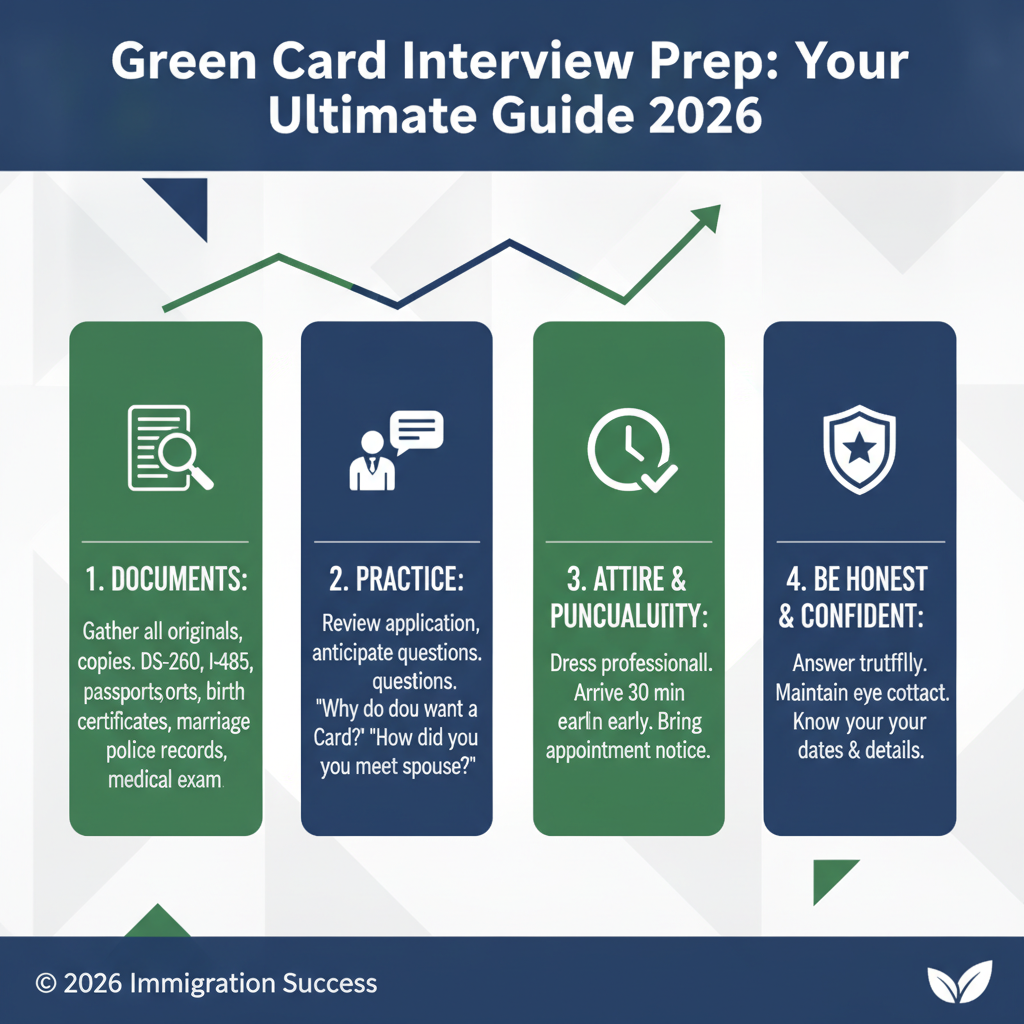
Your interview journey begins with receiving a Form I-797C, Notice of Action, from USCIS. This document will specify the date, time, and location of your interview, as well as a list of required documents you must bring.
- Review Immediately: Check the date and time. Mark it on your calendar and set reminders.
- Location: Confirm the address of the USCIS Field Office (e.g., Orlando USCIS Field Office) or the U.S. Embassy/Consulate. Plan your travel to arrive at least 30-45 minutes early.
- Required Documents List: The notice will list specific documents. This list is in addition to the general documents you should bring. Pay close attention to any originals versus copies requested.
2) Gather All Required Documents (Originals and Copies)
This is arguably the most critical step. You must bring all original documents submitted with your application, plus copies, and any new documents that have emerged since your submission.
- Interview Notice: The original Form I-797C.
- Identification:
- Valid passport (for both petitioner and beneficiary, if applicable).
- Driver's license or state ID.
- Any other government-issued identification.
- Birth Certificates: Original birth certificates for both petitioner and beneficiary.
- Marriage Certificate: Original marriage certificate (for marriage-based cases).
- Divorce Decrees/Death Certificates: Originals of any prior marriage terminations for both parties.
- Medical Examination Report: If you haven't already submitted it, bring your sealed Form I-693, Report of Medical Examination and Vaccination Record, completed by a USCIS-approved civil surgeon. Do NOT open the sealed envelope.
- Financial Support Documents:
- Original Form I-864, Affidavit of Support, signed by the sponsor.
- Sponsor's most recent federal tax returns (1040s) with W-2s, 1099s, and all schedules.
- Proof of sponsor's income (pay stubs, employment verification letter).
- Proof of assets (bank statements, property deeds) if relying on assets to meet income requirements.
- Police Records/Court Documents: Certified copies of any arrest records, court dispositions, or police reports, even for minor incidents.
- Immigration Documents:
- Current and expired passports with visas and entry stamps.
- Form I-94, Arrival/Departure Record.
- Any previous USCIS notices or receipts.
- Employment Authorization Document (EAD) and Advance Parole document, if applicable.
- Photos: Two passport-style photos, taken within 30 days of the interview, meeting USCIS specifications.
3) Organize Your Evidence of Bona Fide Relationship (for Marriage-Based Cases)
This is paramount for spousal Green Card applications. The officer needs to be convinced your marriage is real.
- Joint Financial Documents:
- Joint bank account statements.
- Joint credit card statements.
- Joint tax returns.
- Joint utility bills (electricity, water, internet).
- Joint leases or mortgage statements.
- Auto insurance showing both names at the same address.
- Shared Life Evidence:
- Photos together (over time, with family/friends, holidays, wedding photos).
- Travel itineraries and tickets from trips together.
- Letters, cards, emails, or chat logs demonstrating ongoing communication.
- Affidavits from friends and family attesting to the legitimacy of your marriage.
- Life insurance policies, wills, or trusts naming each other as beneficiaries.
- Children's birth certificates, if applicable.
- Any other evidence showing commingling of lives and assets.
4) Practice Answering Questions
You will be asked questions about your application, personal history, and (for marriage-based cases) your relationship.
- Review Your Application: Go through your Form I-130, Form I-485, and all supporting documents. Make sure you remember every detail you submitted.
- Anticipate Questions:
- About your background: Name, date of birth, place of birth, parents' names, previous addresses, employment history.
- About your immigration history: Dates of entry, visa types, previous applications.
- About your marriage (if applicable): How you met, when you started dating, proposal, wedding details, daily life together, spouse's family.
- About your sponsor: Relationship to sponsor, sponsor's employment, income.
- About inadmissibility grounds: Questions about criminal history, health issues, past immigration violations.
- Practice with a Friend/Attorney: Have someone ask you questions in a mock interview setting. Practice answering clearly, concisely, and truthfully.
- Consistency is Key: Ensure your answers are consistent with the information in your application forms. Discrepancies can raise red flags.
5) Dress Appropriately and Arrive Early
First impressions matter, and punctuality is non-negotiable.
- Professional Attire: Dress as you would for a job interview. Clean, neat, and conservative clothing demonstrates respect for the process.
- Arrive Early: Aim to arrive at the USCIS field office at least 30-45 minutes before your scheduled interview time. This allows for security checks, finding parking (which can be challenging around the Orlando USCIS office), and settling any nerves.
- Bring Comfort Items: A bottle of water, a light snack, and something to read in case of delays.
6) What to Expect During the Interview
Knowing the process can help reduce anxiety.
- Security Check: You'll go through airport-style security.
- Waiting Area: You'll wait until your name is called.
- Oath: The officer will ask you to raise your right hand and swear to tell the truth.
- Questioning: The officer will review your application forms and ask questions. For marriage-based cases, both spouses will be questioned, sometimes together, sometimes separately.
- Document Review: The officer will examine your original documents and may keep copies.
- Interpreter: If you need an interpreter and one was requested or approved, they will assist. Ensure your interpreter is fluent and understands legal terminology.
- Attorney Presence: If you have an attorney, they will be present to advise you, clarify questions, and ensure fair treatment, but they generally cannot answer for you.
7) Post-Interview Follow-Up
The interview is not always the final step.
- Decision: The officer may tell you a decision immediately, or they may state that a decision will be mailed.
- Request for Evidence (RFE): If the officer needs more information, they may issue an RFE. Respond promptly and thoroughly.
- Approval: If approved, you will typically receive a welcome notice by mail, followed by your Green Card.
- Denial: If denied, you will receive a written explanation. You may have options to appeal or refile, depending on the reason for denial. This is where legal counsel is absolutely critical.
Feeling Overwhelmed by the Steps? Imigrar is here to simplify the process. Our Orlando immigration lawyers provide personalized guidance for your Green Card interview, ensuring you're prepared for every stage. Call +1 786-791-3106 for a free consultation. Se Habla Español.
Practical Steps You Can Take Today
Don't wait until the last minute to prepare for your Green Card interview. Here are actionable steps you can start taking right now to build a strong case.
Actionable Checklist:
- Review Your Entire Application: Read through every form (Form I-130, Form I-485, Form I-864, etc.) and all supporting documents you submitted. Familiarize yourself with every detail, date, and answer.
- Start Gathering Originals and Copies: Don't just rely on the interview notice; proactively collect all original documents listed above and make high-quality copies. Ensure birth certificates, marriage licenses, and passports are current.
- Organize Your Evidence: Create a well-organized binder or folder for your documents. Use dividers and labels. Having your documents in order will make a positive impression and help you quickly retrieve anything the officer requests.
- Practice Your Story: For marriage-based cases, practice telling your love story, how you met, and details about your shared life. For all cases, be ready to discuss your immigration history and personal background clearly and concisely.
- Consult with an Immigration Attorney: Even if you started your application yourself, a consultation with an experienced attorney, like those at Imigrar in Orlando, can provide invaluable peace of mind. They can review your case, conduct a mock interview, and identify potential issues.
- Check USCIS Processing Times: Regularly monitor the USCIS Processing Times page for the Orlando Field Office to get an idea of when to expect your interview notice.
- Update Your Address: If you move, promptly update your address with USCIS using their online tool or Form AR-11. Missing an interview notice because of an outdated address can severely jeopardize your application.
Document Preparation Guidance:
- Create a Master List: Compile a comprehensive list of every document you need, checking them off as you gather them.
- Originals vs. Copies: Always bring both. The officer will want to see the originals but will usually keep the copies. Never submit your only original document unless specifically instructed.
- Translation: Any document not in English must be accompanied by a certified English translation. The translator must provide a certification that they are competent to translate and that the translation is accurate.
- Legibility: Ensure all documents are clear and legible. If a document is old or faded, try to obtain a new certified copy from the issuing authority.
- Medical Exam (Form I-693): Schedule your medical exam with a USCIS-approved civil surgeon well in advance. Remember, the sealed envelope is only valid for 2 years from the date of the civil surgeon's signature.
Timeline Expectations:
The Green Card process, including the interview, can vary significantly depending on the Green Card category, your country of origin, and the specific USCIS field office or consulate.
- Application Filing to Interview Notice: This can range from several months to over a year or even longer. For family-based petitions, the wait depends on visa bulletin availability if you are not an immediate relative.
- Interview Notice to Interview Date: Typically, you receive your interview notice 30-60 days before the actual interview date.
- Interview to Decision: In some straightforward cases, the officer might approve your case on the spot. More commonly, a decision is mailed within a few weeks to several months. If an RFE is issued, the timeline extends.
- Green Card Issuance: Once approved, your physical Green Card is usually mailed within 2-4 weeks.
How Imigrar Helps Immigrants in Orlando
At Imigrar, our mission is "Keep Families Together." We understand that navigating the U.S. immigration system, especially preparing for a Green Card interview, can be daunting and filled with uncertainty. Our dedicated team of immigration attorneys in Orlando is here to provide the expert guidance and support you need every step of the way.
Our experience and expertise
Our lawyers possess extensive experience in all facets of immigration law, with a particular focus on family-based petitions and adjustment of status cases, which often culminate in the Green Card interview. We regularly represent clients at the Orlando USCIS Field Office and are intimately familiar with local procedures and officer expectations. Our expertise includes:
- Comprehensive Case Review: We meticulously review your entire application package to identify any potential issues or weaknesses before your interview.
- Document Organization: We help you gather, organize, and present all necessary documentation in a clear and compelling manner, ensuring no critical piece of evidence is missed.
- Personalized Interview Preparation: We conduct mock interviews, providing you with realistic practice and coaching on how to answer questions truthfully, confidently, and consistently with your application.
- Addressing Complex Issues: If your case involves past immigration violations, criminal history, or other complexities, we strategize the best approach to present your case


