


The reporting that sparked this guide: Green Card Interview Preparation Tips (Immigration Law)
What This News Means for Immigrants in Orlando and Across Florida
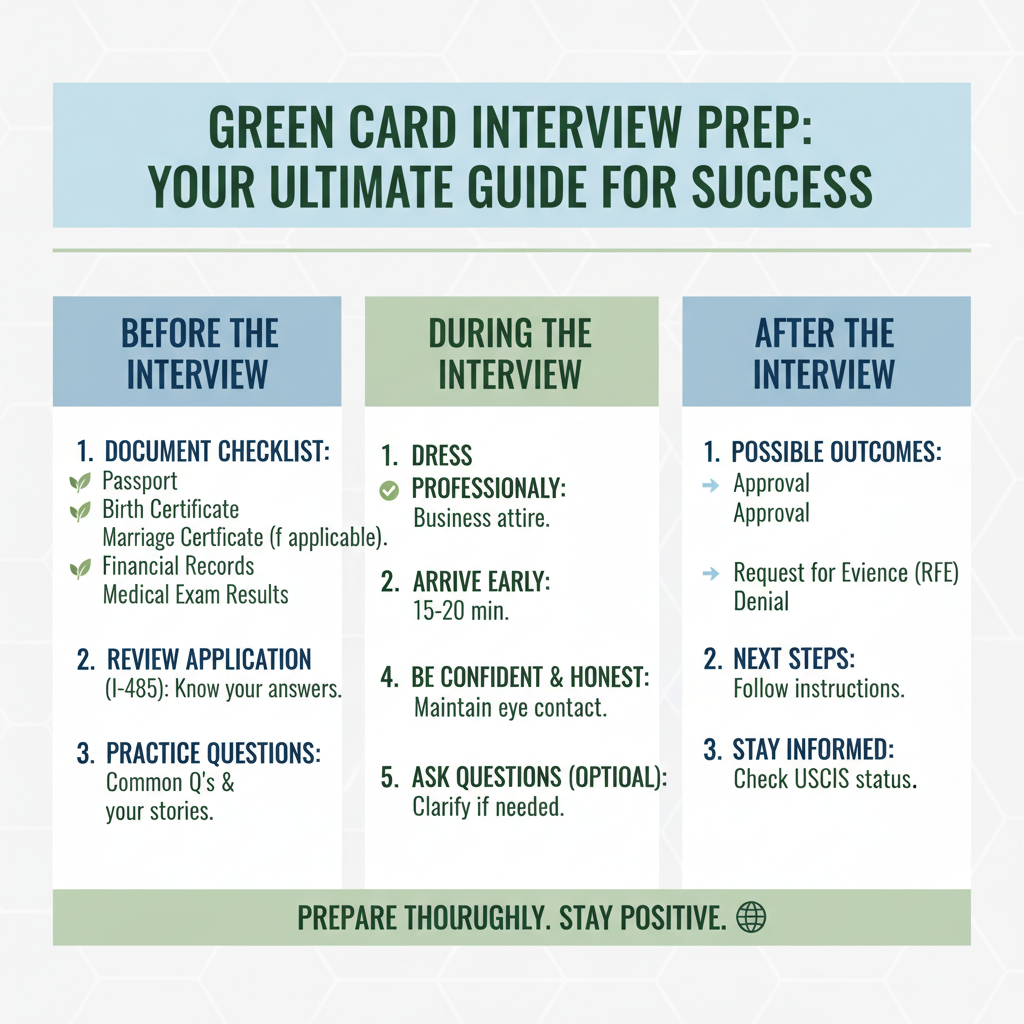
The Green Card interview is a pivotal moment for many individuals seeking permanent residency in the United States. While not every Green Card application requires an interview, a significant number do, particularly those involving family-based petitions or certain employment-based categories. Recent trends in immigration processing emphasize thoroughness and efficiency, making robust preparation more critical than ever.
Why this news is showing up now
Immigration law and policy are constantly evolving, and while the fundamental requirement of an interview for many Green Card applicants remains constant, the focus on its execution and the depth of scrutiny can shift. We often see an increased emphasis on interview preparation tips in immigration news sources because U.S. Citizenship and Immigration Services (USCIS) continues to refine its interview processes, aiming to enhance security and ensure the integrity of the immigration system. This often translates into more detailed questioning and a greater expectation for applicants to present a well-organized and consistent case. For those navigating the complex immigration landscape, staying informed about best practices for interviews is not just helpful; it’s essential for a successful outcome. The importance of demonstrating a bona fide relationship for family petitions, for example, is always a hot topic, leading to continued interest in how to best prepare for these crucial conversations.
How it can affect Florida residents
Florida, particularly Central Florida and the Orlando metropolitan area, is home to a vibrant and diverse immigrant community. For residents of Orlando, Kissimmee, Sanford, and other surrounding areas, the Green Card interview typically takes place at the Orlando USCIS Field Office. This means that local applicants must be acutely aware of the specific procedures and expectations of this office. The high volume of immigration cases in Florida, driven by its large immigrant population and economic opportunities, can sometimes lead to longer processing times or specific local requirements. Proper preparation can significantly alleviate the stress associated with these factors. Understanding the nuances of the interview process can help Florida residents avoid delays, ensure all necessary documentation is in order, and present their case clearly and confidently, whether they are adjusting status from within the U.S. or undergoing consular processing abroad. Imigrar, located right here in Orlando, understands these local dynamics and is uniquely positioned to assist.
What Green Card Interview Preparation Is (and Why It Matters)
The Green Card interview is often the final, and one of the most critical, steps in the journey to becoming a lawful permanent resident of the United States. It's a formal meeting with an immigration officer who will review your application, verify the information you’ve provided, and determine your eligibility for a Green Card. This interview is not just a formality; it’s an opportunity for you to present your case directly and clearly, and for the officer to address any questions or concerns they may have.
A plain-English definition
Simply put, a Green Card interview is a conversation with a U.S. immigration official. Its main purpose is for the officer to confirm that all the information in your application is true and accurate, that you meet all the legal requirements for a Green Card, and that there are no reasons why you should be prevented from becoming a permanent resident (known as "grounds of inadmissibility"). For family-based petitions, such as those filed by a U.S. citizen for a spouse, the interview is crucial for the officer to determine if the marriage is legitimate and not entered into solely for immigration purposes. For other categories, it might involve verifying your employment qualifications or ensuring you meet other specific criteria. It’s your chance to tell your story and demonstrate your eligibility.
Key terms you need to know
Navigating the immigration process requires understanding specific terminology. Here are some key terms related to your Green Card journey and interview:
- Green Card: Also known as a Permanent Resident Card, it proves you are authorized to live and work permanently in the United States.
- Adjustment of Status (AOS): The process of applying for a Green Card from within the United States. If you are already in the U.S. on a valid visa and meet certain criteria, you can "adjust" your status to that of a lawful permanent resident without having to leave the country. This typically involves filing Form I-485.
- Consular Processing: The process of applying for a Green Card through a U.S. embassy or consulate in your home country. This applies if you are living outside the U.S. or are not eligible for Adjustment of Status.
- Petitioner: The U.S. citizen or lawful permanent resident who files an immigration petition on behalf of an immigrant. For example, in a family-based case, the U.S. citizen spouse is the petitioner.
- Beneficiary: The immigrant who is seeking a Green Card based on a petition filed by another person (the petitioner).
- Priority Date: The date USCIS receives your immigration petition (e.g., Form I-130). This date determines your place in the visa queue, especially for categories with annual limits. You can only proceed with your Green Card application when your priority date becomes current according to the Visa Bulletin.
- Affidavit of Support (Form I-864): A legally binding document filed by the petitioner (or sometimes a joint sponsor) to demonstrate that they can financially support the immigrant and that the immigrant will not become a public charge in the U.S.
- Grounds of Inadmissibility: Specific reasons under U.S. immigration law that can make an individual ineligible for a Green Card or other immigration benefits. These can include certain health issues, criminal convictions, security concerns, or a history of immigration violations.
- USCIS: U.S. Citizenship and Immigration Services, the federal agency responsible for administering immigration and naturalization benefits.
Need Help? Our Orlando immigration team is ready to assist. Call +1 786-791-3106 for a free consultation, or message us online. Se Habla Español.
Current Immigration Law: The Foundation
Your Green Card interview is conducted under the framework of the Immigration and Nationality Act (INA), which is the primary body of U.S. immigration law. Understanding the legal basis of your application is crucial for successful preparation.
Federal requirements
The INA sets forth the eligibility criteria for various Green Card categories and also defines who is inadmissible to the United States. Key sections of the INA that are relevant to Green Card applicants include:
- INA § 201-204: These sections deal with immigrant visas, including family-sponsored and employment-based preferences, and the visa petition process (e.g., filing Form I-130 for family members).
- INA § 212: This critical section outlines the "grounds of inadmissibility," which are reasons an individual might be denied entry or a Green Card. These grounds cover health-related issues, criminal history, security threats, public charge concerns, misrepresentation, and prior immigration violations.
- INA § 245: This section governs Adjustment of Status, allowing eligible individuals already in the U.S. to obtain a Green Card without leaving the country.
- INA § 248: Pertains to change of nonimmigrant status, which can sometimes precede an adjustment of status application.
During your interview, the immigration officer's primary task is to determine if you meet the specific eligibility requirements for the Green Card category you applied under and if you are admissible to the United States. This involves reviewing all submitted forms, such as the initial petition (e.g., Form I-130, Petition for Alien Relative), the Green Card application itself (Form I-485, Application to Register Permanent Residence or Adjust Status), the financial support affidavit (Form I-864, Affidavit of Support), and the medical examination report (Form I-693, Report of Medical Examination and Vaccination Record). For detailed information and official forms, always refer to the USCIS official website.
Florida-specific considerations
While federal law dictates the overall requirements, the practical application often involves local USCIS Field Offices. For Central Florida residents, the Orlando USCIS Field Office conducts interviews for Adjustment of Status applicants. The specific interview procedures, officer demeanor, and even typical waiting times can vary slightly from one field office to another. For instance, the Orlando office handles a high volume of family-based petitions, which means officers are highly experienced in evaluating the authenticity of marital relationships or other family ties. Being prepared for common questions and documentation requests typical of the Orlando office can be a significant advantage. Imigrar is well-versed in the local practices and can provide tailored advice based on our experience with the Orlando Field Office.
How to Prepare for Your Green Card Interview: A Complete Step-by-Step Guide
Preparing for your Green Card interview is a multi-faceted process that requires meticulous attention to detail and thorough organization. Follow these steps to maximize your chances of a successful outcome.
1) Understand Your Case & Review Your Application
Before anything else, you must have a deep understanding of your own application. This means reviewing every form and document you submitted to USCIS from the very beginning. The immigration officer will have your entire file, and your answers must be consistent with the information already provided.
- Review Submitted Forms: Read through your Form I-130, Form I-485, Form I-864, and any other forms you or your petitioner submitted. Pay close attention to dates, addresses, employment history, and any "Yes/No" questions.
- Understand the Basis of Your Petition: Why are you eligible for a Green Card? Is it a family-based petition (e.g., spouse, parent, child) or an employment-based petition? Be clear about the specific requirements for your category.
- Identify Potential Issues: Did you have any past immigration violations? A minor criminal record? Gaps in employment? Be prepared to address these honestly and clearly, and gather any supporting documentation that explains or mitigates these issues.
2) Gather All Original Documents
This is perhaps the most critical step. You must bring originals of ALL documents submitted with your application, plus any new documents that have emerged since your submission. You should also bring copies of everything to leave with the officer if requested.
- Personal Identification:
- Passport(s) (current and expired)
- Birth Certificate (applicant and petitioner)
- Marriage Certificate (if applicable)
- Divorce Decrees or Death Certificates for any prior marriages (applicant and petitioner)
- National ID Card (if applicable)
- Any previous U.S. visas or entry stamps
- Immigration Forms & Receipts:
- Interview appointment notice
- Copy of your entire Green Card application package (Form I-130, Form I-485, Form I-864, Form I-693, etc.)
- USCIS receipt notices (Form I-797C) for all filed applications
- Employment Authorization Document (EAD) and Advance Parole document (if applicable)
- Financial Documents (for family-based petitions):
- Petitioner's most recent federal income tax returns (e.g., Form 1040, W-2s, 1099s) for the past three years
- Letter from employer verifying employment and salary (for petitioner)
- Pay stubs (most recent 6 months for petitioner)
- Bank statements (for petitioner and joint sponsor, if applicable)
- Evidence of assets (e.g., property deeds, stock certificates) if relying on assets to meet poverty guidelines
- Medical Examination:
- Sealed Form I-693 (if not already submitted or if it's expired)
- Police Records/Court Documents:
- Certified copies of any arrest records, court dispositions, or police reports (even if charges were dropped or expunged).
- Translations:
- Any document not in English must be accompanied by a certified English translation.
Important: Organize your documents meticulously in a binder or folder, clearly labeled, so you can quickly access them during the interview.
3) Prepare for Interview Questions
The questions asked will vary depending on your case type. However, some general themes apply to all interviews, while others are specific to family-based or employment-based petitions.
- General Questions:
- Your full name, date of birth, place of birth, current address.
- How you entered the U.S. and your current immigration status.
- Your education and employment history.
- Questions from the "Yes/No" section of Form I-485 (e.g., criminal history, past immigration violations, communist party affiliation).
- Family-Based (Spousal) Questions: These are designed to ascertain the bona fides of your marriage.
- How and when did you meet your spouse?
- Details about your wedding ceremony.
- Where do you live? Who pays which bills?
- What do you do together for fun?
- Details about your spouse's family, job, daily routine.
- Questions about children, joint finances, shared responsibilities.
- Employment-Based Questions:
- Details about your job duties, salary, and qualifications.
- Your employer's business and your role within it.
- Educational background relevant to the position.
Tip: Practice answering these questions aloud with your petitioner or a trusted friend. Ensure your answers are truthful, consistent, and clear.
4) Organize Your Evidence of Relationship (for family-based petitions)
For marriage-based Green Cards, compelling evidence of a bona fide marital relationship is paramount. You need to demonstrate that your marriage is real and not just for immigration purposes.
- Joint Financial Documents:
- Joint bank accounts (checking, savings)
- Joint credit cards
- Joint tax returns (most recent 3 years)
- Joint utility bills (electricity, water, internet)
- Joint lease agreements or mortgage statements
- Joint insurance policies (health, auto, life)
- Co-mingling of Assets and Responsibilities:
- Joint property ownership (e.g., car titles, house deeds)
- Beneficiary designations on life insurance or retirement accounts
- Shared memberships (gym, club, store loyalty programs)
- Proof of Shared Life:
- Photos together (dating, engagement, wedding, holidays, with family/friends) – organize chronologically with dates/captions.
- Travel itineraries, flight tickets, hotel bookings from trips taken together.
- Letters, emails, text messages, chat logs demonstrating ongoing communication.
- Cards or gifts exchanged.
- Affidavits from friends, family, or employers attesting to the bona fides of the marriage (Important: these should be notarized and include the affiant's contact information).
- Birth certificates of any children born to the marriage.
Reminder: Quality over quantity. A few strong, diverse pieces of evidence are better than a large stack of redundant documents.
5) Consider Legal Representation
While you are not legally required to have an attorney at your Green Card interview, having experienced legal counsel can be invaluable. An immigration attorney can:
- Review Your Case: Identify potential issues and help you gather necessary documentation.
- Prepare You Thoroughly: Conduct mock interviews and guide you on what to expect.
- Attend the Interview with You: Provide support, clarify questions, and address any legal issues that may arise during the interview. This is especially beneficial if there are complexities in your case or if English is not your first language.
For residents in Orlando and Central Florida, Imigrar offers comprehensive legal support for Green Card interviews, ensuring you walk in prepared and confident. Se Habla Español.
6) Practice and Plan Your Logistics
The days leading up to the interview should be focused on final preparations.
- Mock Interview: Practice with your attorney or a trusted person. This helps you get comfortable articulating your answers clearly and confidently.
- Review the "Yes/No" Questions: Go over the questions on Form I-485 again. Be prepared to answer them truthfully and explain any "Yes" answers with supporting documentation.
- Plan Your Attire: Dress professionally, as you would for a job interview. This shows respect for the process and the officer.
- Plan Your Route: Know exactly how to get to the Orlando USCIS Field Office. Aim to arrive at least 30 minutes early to allow for parking, security, and finding the correct waiting area. Bring your appointment notice and a valid photo ID.
- Arrange Childcare: If possible, avoid bringing young children to the interview unless they are also applicants or specifically requested by USCIS.
7) What to Expect on Interview Day
Knowing what to expect can help reduce anxiety.
- Arrival and Security: You will go through security, similar to an airport.
- Waiting Area: You will wait until your name is called.
- Oath: The officer will ask you to swear to tell the truth.
- Review of Application: The officer will go through your application forms, confirming details, and asking questions. They will also review your original documents.
- Petitioner's Role (if applicable): If your petitioner (e.g., spouse) is present, they will also be questioned to verify information and assess the relationship. In some cases, couples may be interviewed separately to check for consistency.
- Decision: Sometimes a decision is made on the spot, but often the officer will state that a decision will be mailed to you. They may issue a Request for Evidence (RFE) if more documentation is needed.
Need Help? Our Orlando immigration team is ready to assist. Call +1 786-791-3106 for a free consultation, or message us online. Se Habla Español.
Practical Steps You Can Take Today
Don't wait until the last minute to prepare for your Green Card interview. Taking proactive steps now can make a significant difference.
Actionable checklist:
- Review Your Entire Application: Pull out copies of all forms (Form I-130, Form I-485, Form I-864, etc.) you submitted to USCIS. Read them thoroughly, line by line, to refresh your memory and ensure you are familiar with all the information.
- Start a "Green Card Interview" Folder/Binder: Create a physical folder or binder dedicated solely to your interview documents. Begin collecting original documents and making copies. Label sections clearly (e.g., "Passports," "Birth Certificates," "Marriage Evidence," "Financial Docs").
- Identify Missing Documents: As you review your application, note any documents that were submitted as copies but for which you don't have the original, or any new documents (e.g., recent pay stubs, updated joint bank statements) that have emerged since your initial filing. Start gathering these immediately.
- Draft Answers to Common Questions: Write down potential interview questions relevant to your case (e.g., "How did you meet your spouse?", "What is your job?", "Have you ever been arrested?"). Jot down your truthful answers to ensure consistency and clarity.
- Consult with an Immigration Attorney: Schedule a consultation with an experienced immigration lawyer, especially if your case has any complexities or if you're unsure about the process. An attorney can provide personalized guidance and peace of mind.
Document preparation guidance
Proper document preparation is critical. Here’s how to approach it:
- Originals and Copies: Always bring the original document and at least one clear, legible photocopy of every document. The officer will typically review the original and keep the copy.
- Organization: Use dividers, tabs, and labels in your binder. Arrange documents logically – perhaps by the order they appear in your application, or by category (personal, financial, relationship evidence).
- Translations: Any document not in English must be accompanied by a complete and accurate English translation. The translator must certify that they are competent to translate and that the translation is accurate. The certification should include the translator’s name, address, and signature.
- Photos: For marriage-based cases, organize photos chronologically. Print them with dates and short captions on the back or on an accompanying sheet. Don't bring hundreds; select a diverse range of 20-30 meaningful photos.
- Medical Exam (Form I-693): If your medical exam was completed more than two years ago, or if you haven't submitted it yet, ensure you get a new one from a USCIS-approved civil surgeon. It must be submitted in a sealed envelope. You can find approved civil surgeons via the USCIS website.
Timeline expectations
The timeline for your Green Card interview can vary significantly based on your application type, the USCIS Field Office processing your case (like the Orlando office), and current processing backlogs.
- Interview Notice: You will typically receive an interview appointment notice (Form I-797C) by mail 4-6 weeks before your scheduled interview date.
- Processing Times: After your interview, a decision can be made immediately, or it may take weeks or even months. You can check estimated processing times for the Orlando Field Office on the USCIS Processing Times page.
- RFE (Request for Evidence): If the officer needs more information, they may issue an RFE, giving you a deadline (usually 30-90 days) to submit additional documents. This will extend your case processing time.
- Green Card Delivery: Once approved, your physical Green Card is usually mailed within 2-4 weeks.
Warning: These timelines are estimates and can change. Always monitor your case status online using your receipt number on the USCIS Case Status Online tool.
How Imigrar Helps Immigrants in Orlando
At Imigrar, we understand that the Green Card interview is a high-stakes event, and feeling prepared is key to success. Our dedicated team of immigration attorneys in Orlando is committed to "Keep Families Together" by providing comprehensive and compassionate legal support throughout your Green Card journey.
Our experience and expertise
With years of experience assisting immigrants in Orlando, across Florida, and nationwide, Imigrar has a proven track record in navigating the complexities of U.S. immigration law. We specialize in family-based petitions, employment-based Green Cards, adjustment of status, consular processing, and waivers of inadmissibility. Our attorneys are intimately familiar with the procedures and expectations of the Orlando USCIS Field Office and can provide invaluable insights tailored to your local context.
We don't just fill out forms; we provide strategic guidance, helping you understand the legal nuances of your case, anticipate challenges, and present the strongest possible application. Our support includes:
- Thorough Case Review: We meticulously review your entire application and supporting documents, identifying any inconsistencies or potential issues before the interview.
- Personalized Interview Preparation: We conduct mock interviews, preparing you for likely questions and guiding you on how to articulate your answers clearly and confidently.
- Document Organization: We assist in organizing your evidence, ensuring you have all required originals and copies, and that they are presented in a clear, accessible manner.
- Legal Representation at the Interview: Our attorneys can accompany you to your interview at the Orlando USCIS Field Office, providing legal counsel, clarifying questions, and advocating on your behalf if any issues arise.
- Follow-Up and RFE Response: Should USCIS issue an RFE or a Notice of Intent to Deny, we are here to help you formulate a timely and effective response.
Free consultation offer
We believe that everyone deserves access to expert legal advice. That's why Imigrar offers a free consultation to discuss your Green Card interview preparation needs. This is an opportunity for you to ask questions, understand your options, and learn how our firm can support you. Call us today at +1 786-791-3106 to schedule your consultation. Se Habla Español. Our team is ready to help you navigate this critical step with confidence.

Frequently Asked Questions
Q: Who needs a Green Card interview?
A: Most applicants for a family-based Green Card (e.g., spouses, parents, and unmarried children of U.S. citizens or permanent residents) will require an interview, whether they are adjusting status in the U.S. or undergoing consular processing abroad. Certain employment-based Green Card applicants may also be interviewed, especially if they are adjusting status or if there are specific concerns in their case. Exceptions exist, for example, for some children of U.S. citizens or certain employment-based categories, but it is always best to prepare as if an interview will occur unless specifically informed otherwise by USCIS.
Q: What if my immigration status changes before the interview?
A: If there are any significant changes to your immigration status (e.g., your nonimmigrant visa expires, you get married/divorced, you change employers for an


