


The journey to obtaining a Green Card, or lawful permanent residency in the United States, is a monumental step for countless individuals and families. For many, this journey culminates in a crucial interview with U.S. Citizenship and Immigration Services (USCIS). This interview is not merely a formality; it's a critical opportunity to affirm your eligibility, clarify your application, and demonstrate your commitment to becoming a permanent resident. While the prospect of an interview can be daunting, thorough preparation is your most powerful tool for success.
At Imigrar, an immigration law firm based in Orlando, Florida, we understand the anxieties and hopes tied to every step of the immigration process. Our mission, "Keep Families Together," drives us to provide comprehensive, compassionate, and effective legal guidance. This guide is designed to empower you with the knowledge and preparation strategies needed to approach your Green Card interview with confidence.
The reporting that sparked this guide: Green Card Interview Preparation Tips (Immigration Law)
What This News Means for Immigrants in Orlando and Across Florida
Why this news is showing up now
While the requirement for a Green Card interview isn't new, the emphasis on thorough preparation has gained increasing prominence in recent years. Immigration law and policy are dynamic, and USCIS continually refines its interview procedures to ensure the integrity of the immigration system. Current trends indicate a heightened focus on verifying the authenticity of relationships for family-based petitions, scrutinizing employment-based petitions for compliance, and ensuring applicants meet all legal requirements for **Adjustment of Status**. In an era where immigration processes can be complex and subject to varying interpretations, proactive and meticulous preparation is more critical than ever. News outlets often highlight the challenges and successes of immigrants navigating these interviews, bringing the topic to the forefront for anyone awaiting this pivotal moment.
How it can affect Florida residents
For immigrants residing in Florida, particularly those in Central Florida and the Orlando area, understanding the nuances of Green Card interview preparation is paramount. The **Orlando USCIS Field Office**, located at 5449 Forbes Pl, Orlando, FL 32812, serves a vast and diverse population. This means their interview dockets are often full, and interviewers are highly experienced in identifying inconsistencies or lack of preparation. Whether you're adjusting status from a non-immigrant visa (like a work visa or student visa) or completing the final steps of a family-based petition, your interview will likely take place at this office. Familiarity with the local office's procedures, combined with a comprehensive understanding of federal requirements, can significantly impact your outcome. Furthermore, Florida's large immigrant population means a vibrant community of support, but also a competitive landscape for legal services. Ensuring you have an experienced legal team like Imigrar by your side, familiar with the local context and federal law, is an invaluable asset.
What Green Card Interviews Are (and Why They Matter)
A Green Card interview is a mandatory step for most individuals seeking lawful permanent resident status in the United States, especially for those applying for **Adjustment of Status** from within the U.S. (as opposed to **Consular Processing** abroad). It is an in-person meeting with a USCIS officer who reviews your application, verifies the information you've provided, and asks questions to determine your eligibility for a Green Card. The interview's primary purpose is to confirm that you meet all legal requirements, that your application is truthful, and that you are not inadmissible to the U.S. under any grounds.
A plain-English definition
Think of the Green Card interview as your final exam for permanent residency. It's where you sit down with a government official to talk about your life, your application, and why you should be allowed to live permanently in the United States. For family-based petitions, it's often a conversation about your relationship with the U.S. citizen or lawful permanent resident who petitioned for you. For employment-based petitions, it's about your job offer and qualifications. It's a chance for USCIS to put a face to the name on the paperwork and ensure everything is legitimate.
Key terms you need to know
- Green Card: Officially known as a Permanent Resident Card, it proves your authorization to live and work permanently in the United States.
- Adjustment of Status (AOS): The process of applying for lawful permanent resident status (a Green Card) while physically present in the United States. This is the primary scenario where a USCIS interview occurs in the U.S.
- Consular Processing: The process of applying for an immigrant visa at a U.S. embassy or consulate in your home country. While it also involves an interview, the location and some procedural aspects differ from AOS.
- USCIS Field Office: A local office of U.S. Citizenship and Immigration Services where interviews are conducted. For residents of Central Florida, this is typically the **Orlando USCIS Field Office**.
- Petitioner: The U.S. citizen or lawful permanent resident who files an immigration petition (e.g., **Form I-130**, Petition for Alien Relative) on behalf of an immigrant.
- Beneficiary: The immigrant who is seeking a Green Card based on the petition filed by the **Petitioner**.
- Immigrant Visa: A visa issued to foreign nationals who intend to live permanently in the United States.
- Inadmissibility: Grounds under U.S. immigration law that can make an individual ineligible for a Green Card, such as certain criminal convictions, health issues, or past immigration violations.
- Affidavit of Support (Form I-864): A legally binding document signed by a **Petitioner** (and sometimes a joint sponsor) to accept financial responsibility for the **Beneficiary** to ensure they do not become a public charge.
- Priority Date: The date your immigration petition was filed. For some visa categories, this date determines when an immigrant visa becomes available.
Need Help? Our Orlando immigration team is ready to assist. Call +1 786-791-3106 for a free consultation, or message us online. Se Habla Español.
Current Immigration Law: The Foundation
The U.S. immigration system is governed primarily by the Immigration and Nationality Act (INA), a complex body of federal law that defines who can enter and remain in the United States. The Green Card interview is a procedural requirement derived from the INA, designed to ensure compliance with its provisions.
Federal requirements
The legal basis for Green Card applications and interviews stems from various sections of the **INA**. For most family-based **Adjustment of Status** cases, the key provisions are found in **INA § 245**, which outlines the eligibility requirements for adjusting status to that of a lawful permanent resident. This includes being inspected and admitted or paroled into the U.S., being eligible for an immigrant visa, and not being subject to any grounds of inadmissibility.
Specific requirements vary depending on the Green Card category:
- Family-Based Green Cards: Governed by **INA § 201** and **203**, which establish preference categories and numerical limitations. The **Petitioner** (U.S. citizen or lawful permanent resident) files **Form I-130**, Petition for Alien Relative, to establish the qualifying relationship. The **Beneficiary** then typically files **Form I-485**, Application to Register Permanent Residence or Adjust Status. The interview focuses heavily on verifying the authenticity of the relationship (e.g., marriage, parent-child) and ensuring the **Petitioner** can financially support the **Beneficiary** via **Form I-864**, Affidavit of Support.
- Employment-Based Green Cards: Governed by **INA § 203(b)**, which sets out various preference categories for workers. These often involve a **Form I-140**, Immigrant Petition for Alien Worker, filed by an employer. The interview for **Adjustment of Status** applicants focuses on verifying the job offer, the applicant's qualifications, and the employer's continued ability to pay the offered wage.
- Refugee/Asylee Adjustment: Individuals granted asylum or refugee status can apply for a Green Card one year after their grant. The interview confirms their continued eligibility and ensures no bars to **Adjustment of Status** exist.
During the interview, the USCIS officer will verify that all statutory requirements are met, including identity, background checks, medical examinations, and financial sufficiency. Any discrepancies or red flags can lead to further review, requests for evidence (RFEs), or even denial.
For official information on forms and regulations, always refer to the USCIS official website.
Florida-specific considerations
While immigration law is federal, the local context matters for your interview. The **Orlando USCIS Field Office** handles a high volume of cases from Orange County and surrounding areas along the I-4 corridor. This means officers are well-versed in the common types of applications they receive, as well as potential issues that arise in the Central Florida community. For example, if your case involves specific local businesses or community ties, the officers may have a deeper understanding of those contexts. It is crucial to remember that all interviews are conducted under federal law, but the procedural environment is local. Having an attorney familiar with the practices and expectations of the **Orlando USCIS Field Office** can provide a significant advantage in preparing your case.
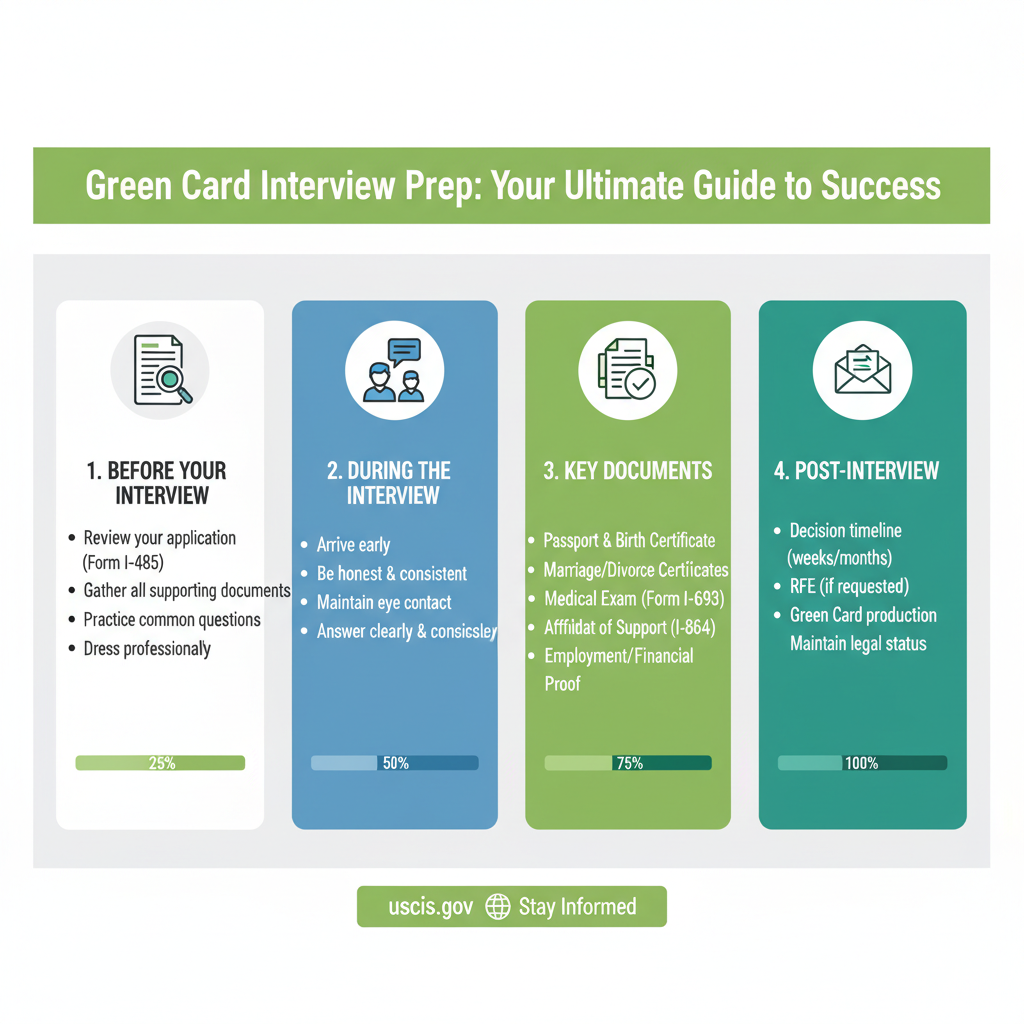
How to Prepare for Your Green Card Interview: A Complete Step-by-Step Guide
Preparing for your Green Card interview is an intricate process that demands meticulous attention to detail and a thorough understanding of what to expect. Here’s a comprehensive, step-by-step guide to help you navigate this critical stage.
1) Understand Your Interview Notice (Form I-797C)
The first step begins the moment you receive your interview notice, typically **Form I-797C**, Notice of Action, from USCIS. This document is extremely important. It will specify:
- Date and Time: Mark this on your calendar immediately. Plan to arrive at least 30-45 minutes early.
- Location: For Central Florida residents, this will likely be the **Orlando USCIS Field Office**. Confirm the full address.
- Required Documents: The notice will list specific documents you must bring. This list is not exhaustive and generally includes original documents you previously submitted as copies. It is crucial to read this section very carefully.
- Case Number: Keep this handy for any communication with USCIS.
Important: Do not lose this notice. You will need it to enter the USCIS facility.
2) Gather ALL Required Documents
This is arguably the most critical step. You must bring originals of all documents submitted with your application, plus copies, and any additional evidence that supports your case. Organize everything neatly in a folder or binder, clearly labeled. Separate originals from copies. For family-based cases, both the **Petitioner** and **Beneficiary** should bring their respective documents. This list provides a general overview, but always refer to your specific interview notice and consult with your attorney.
General Required Documents:
- Your interview notice (**Form I-797C**).
- Valid passport(s) and any previous passports.
- Original birth certificate(s) for both **Petitioner** and **Beneficiary**.
- Original marriage certificate (if applicable).
- Original divorce decrees or death certificates for any previous marriages (for both parties, if applicable).
- Two passport-style photos taken within **30 days** of the interview.
- Original **Form I-94**, Arrival/Departure Record (if applicable).
- Original employment authorization document (EAD) and advance parole document (if applicable).
- Original **Form I-765**, Employment Authorization Application, if you applied for it.
- Original **Form I-131**, Application for Travel Document, if you applied for it.
- Medical examination report (**Form I-693**) in a sealed envelope (if not already submitted or if it has expired).
- Original police clearances (if required for your country of origin).
- Original court disposition records for any arrests or convictions, even minor ones.
For Family-Based Petitions (e.g., marriage-based):
- Proof of Bona Fide Marriage: This is paramount. Bring extensive evidence that your marriage is genuine and not solely for immigration purposes. Examples include:
- Joint bank accounts statements (recent and historical).
- Joint lease agreements or mortgage statements.
- Utility bills in both names.
- Insurance policies (life, health, auto) listing each other as beneficiaries.
- Birth certificates of children born to the marriage.
- Photos together from different stages of your relationship (dating, engagement, wedding, family events, travel). Organize these chronologically with captions.
- Affidavits from friends, family, or employers attesting to the bona fides of the marriage.
- Shared credit card statements.
- Evidence of joint travel or vacations.
- Any other documents showing commingling of lives and assets.
- Petitioner's Documents:
- Original U.S. birth certificate, naturalization certificate, or U.S. passport.
- Proof of domicile in the U.S. (e.g., driver's license, utility bills).
- Proof of income and assets (most recent tax returns, W-2s, pay stubs, bank statements) to support **Form I-864**, Affidavit of Support.
For Employment-Based Petitions:
- Original job offer letter.
- Degree certificates, transcripts, and professional licenses.
- Letters of experience from previous employers.
- Evidence of employer's ability to pay the offered wage (e.g., tax returns, financial statements).
Warning: Never bring fake documents. Honesty is non-negotiable.
3) Review Your Application Forms Thoroughly
Go over every single form you submitted to USCIS (e.g., **Form I-130**, **Form I-485**, **Form I-864**) with a fine-tooth comb. Ensure you remember all the information you provided, especially dates, addresses, and employment history. The interviewing officer will have your entire file and will compare your verbal answers to your written application. Any inconsistencies, even minor ones, can raise red flags and prolong the process or even lead to denial. If you find an error, be prepared to explain it clearly and truthfully.
Reminder: It’s a good practice to have a copy of your complete application packet with you at the interview.
4) Practice Answering Potential Questions
While you cannot predict every question, you can anticipate common lines of inquiry based on your Green Card category. Practice answering these questions truthfully, concisely, and consistently.
Common Questions for Family-Based (Marriage) Interviews:
- How did you meet?
- When and where was your first date?
- What are your spouse's hobbies?
- Who handles the finances?
- Describe your daily routine together.
- What did you do for your last anniversary/birthday?
- Where do your in-laws live?
- Have you ever lived apart? If so, why and for how long?
- What are your plans for the future?
Common Questions for All Applicants:
- What is your full name and date of birth?
- Where have you lived since applying for your Green Card?
- What is your current employment?
- Have you ever been arrested or charged with a crime?
- Have you ever violated immigration laws?
- Have you ever been a member of any organization or political party?
- Do you understand that you must notify USCIS of any change of address within **10 days**?
Practice with a friend, family member, or your attorney. This will help you feel more comfortable and confident.
5) Dress Professionally and Arrive Early
First impressions matter. While there's no strict dress code, dressing in professional or business-casual attire shows respect for the process and the interviewing officer. Avoid overly casual clothing. Arrive at the **Orlando USCIS Field Office** at least 30-45 minutes before your scheduled interview time. This allows for potential traffic delays (especially common on the I-4 corridor), finding parking, passing through security, and checking in without feeling rushed. Being late can lead to your interview being rescheduled or even canceled, significantly delaying your Green Card process.
6) During the Interview: Be Honest, Calm, and Respectful
- Be Truthful: Always tell the truth, even if the information is unfavorable. Lying to a USCIS officer can lead to severe penalties, including a permanent ban from the U.S.
- Answer Directly: Answer only the question asked. Do not volunteer extra information unless specifically requested. If you don't understand a question, politely ask the officer to rephrase it.
- Maintain Composure: It's natural to be nervous, but try to remain calm and confident. Speak clearly and audibly.
- Be Respectful: Treat the USCIS officer with courtesy and respect. Avoid arguing or becoming defensive.
- Bring an Interpreter (if needed): If you are not fluent in English, you have the right to bring a certified interpreter. Inform USCIS in advance. Imigrar can assist with this, and we proudly state, **Se Habla Español**.
- Let Your Attorney Speak: If you have an attorney present, they are there to represent you. They can clarify questions, object to inappropriate inquiries, and ensure your rights are protected.
7) After the Interview: Follow Up and Next Steps
At the end of the interview, the officer may tell you if your case is approved, or they might indicate that further review is needed. Sometimes, they may issue a Request for Evidence (RFE) or schedule a second interview. If no immediate decision is made, don't panic. Many cases require additional processing. You can check your case status online using your receipt number on the USCIS Case Status website. If you receive an RFE, respond promptly and thoroughly with the requested information. If your case is approved, you will typically receive your Green Card in the mail within a few weeks. If denied, consult with your attorney immediately to explore options for appeal or refiling.
Need Help? Our Orlando immigration team is ready to assist. Call +1 786-791-3106 for a free consultation, or message us online. Se Habla Español.
Practical Steps You Can Take Today
The best time to start preparing for your Green Card interview is now. Even if your interview notice hasn't arrived, proactive steps can significantly reduce stress and increase your chances of success.
Actionable Checklist:
- Organize Existing Documents: Start gathering all original documents you have that were submitted as part of your application. Create a master checklist based on the forms you filed.
- Review Your Application Packet: Obtain a copy of your entire submitted application packet. Read through it carefully, familiarizing yourself with every answer you provided. Highlight any areas where you might need to refresh your memory or gather additional supporting evidence.
- Start Gathering New Evidence (Especially for Marriage-Based Cases): Begin collecting new evidence of your bona fide marriage that has accumulated since you filed your application. This includes recent utility bills, joint statements, new photos, or updated insurance policies. Continuous documentation is key.
- Request Official Records: If you have any criminal history, even minor arrests, start requesting certified court dispositions and police reports immediately. These can take time to obtain.
- Schedule Your Medical Exam (if needed): If your **Form I-693** medical exam report has expired or you haven't submitted one, schedule an appointment with a USCIS-approved civil surgeon. Ensure the report remains in its sealed envelope.
- Research Your Interview Location: Look up the **Orlando USCIS Field Office** online. Familiarize yourself with parking, public transport options, and security procedures. Plan your route to ensure you arrive early on interview day.
- Consult with an Immigration Attorney: This is arguably the most important step. An experienced attorney can review your entire case, identify potential issues, help you gather all necessary documents, conduct mock interviews, and even accompany you to the interview.
Document Preparation Guidance
Proper document organization is crucial. Here’s a simple system:
- Binder/Folder System: Use a binder with dividers or separate folders.
- Labels: Clearly label each section (e.g., "Original Birth Certificates," "Marriage Evidence," "Financial Documents," "Application Copies").
- Originals vs. Copies: Keep all original documents separate from photocopies. The officer will want to see originals but will usually keep copies. You should always retain your own set of copies.
- Chronological Order: Arrange documents, especially marriage evidence or financial statements, in chronological order.
- Photos: Place photos in a small album or on sheets with captions (dates, locations, people).
Timeline Expectations
The timeline for receiving an interview notice and a decision can vary significantly based on your Green Card category, the specific USCIS field office (e.g., **Orlando USCIS Field Office**), and current processing times. You can check average processing times on the USCIS Processing Times website.
- Interview Scheduling: After filing **Form I-485**, it can take anywhere from a few months to over a year to receive an interview notice.
- Notice Period: USCIS typically sends interview notices 4-6 weeks in advance of the interview date.
- Decision After Interview: Some cases are approved on the spot. Others may take weeks or even months for a final decision, especially if an RFE is issued or further background checks are needed.
Patience is essential, but proactive follow-up with your attorney can help if delays seem excessive.

How Imigrar Helps Immigrants in Orlando
At Imigrar, our commitment to "Keep Families Together" is at the heart of everything we do. We understand that the Green Card interview is a pivotal moment in your immigration journey, and we are dedicated to providing the highest level of legal support to ensure your success.
Our experienced immigration attorneys in Orlando offer comprehensive services tailored to your specific needs:
- Case Review and Strategy: We conduct a thorough review of your entire application packet, identifying any potential issues or areas that need stronger evidence. We develop a personalized strategy to present your case effectively.
- Document Preparation and Organization: We guide you through the process of gathering and organizing all necessary documents, ensuring you have both originals and copies, and that everything is presented clearly and professionally.
- Mock Interview Sessions: We conduct realistic mock interviews, asking questions similar to those you might face from a USCIS officer. This helps you practice your


