


The journey to obtaining a Green Card, or lawful permanent residency in the United States, is a significant milestone for countless individuals and families. While the application process itself involves extensive paperwork and waiting periods, the Green Card interview stands as a pivotal moment – often the final hurdle before achieving your American dream. For many, this interview can be a source of anxiety, but with proper preparation and expert guidance, it can be a smooth and successful experience.
At Imigrar, an immigration law firm based in Orlando, Florida, we understand the profound importance of this step. Our mission, "Keep Families Together," drives us to provide clear, actionable advice to help you navigate every stage of your immigration journey, including comprehensive preparation for your Green Card interview. Today, February 19, 2026, we're seeing an increased focus on the importance of thorough preparation for these crucial interviews, a trend we're addressing head-on.
The reporting that sparked this guide
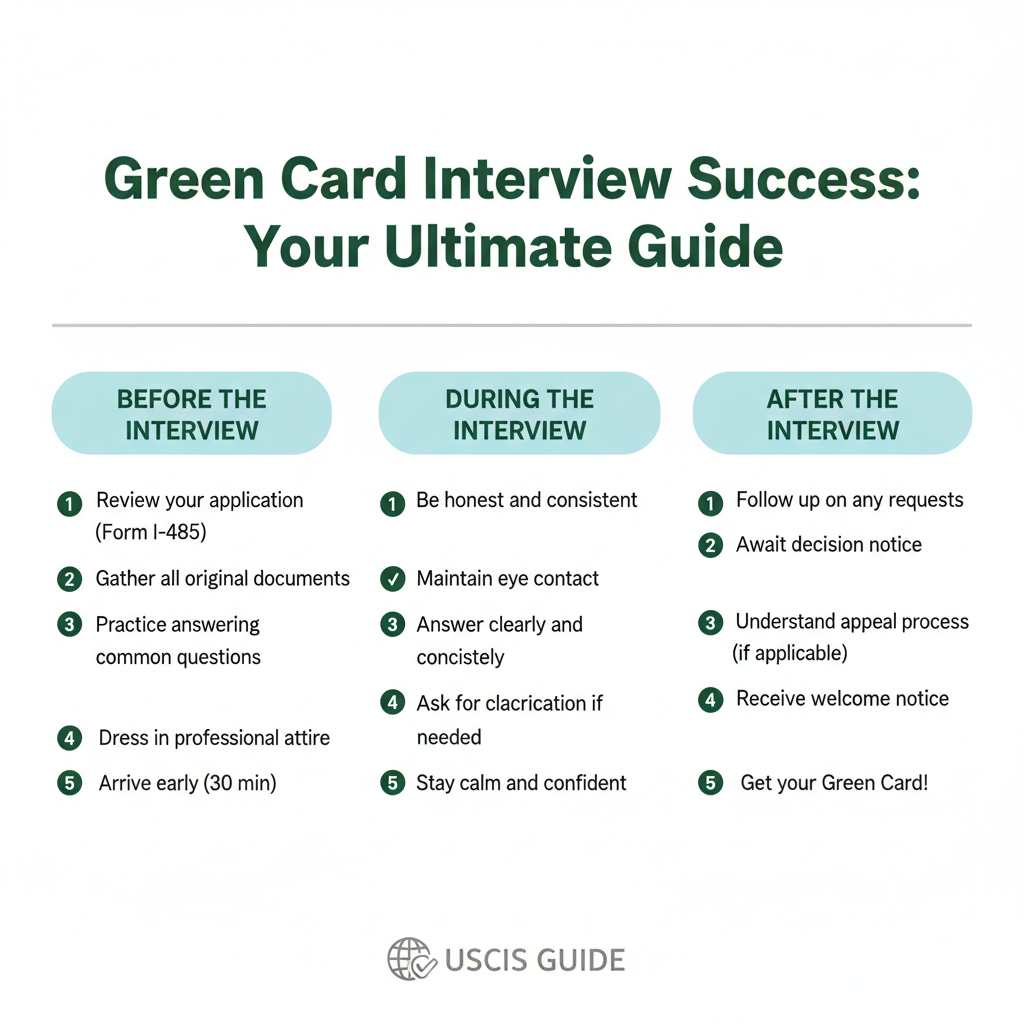
Our commitment to keeping you informed is paramount. This comprehensive guide is inspired by the ongoing discussions and reporting surrounding the critical nature of the Green Card interview process, highlighting the need for applicants to be meticulously prepared. You can find more general information on this topic through broader immigration law news by clicking here: Green Card Interview Preparation Tips (Immigration Law)
What This News Means for Immigrants in Orlando and Across Florida
The emphasis on Green Card interview preparation isn't just a national trend; it has direct implications for immigrants residing in Orlando, throughout Central Florida, and across the entire state. Understanding the nuances of this final step is crucial for anyone seeking permanent residency.
Why this news is showing up now
The renewed focus on Green Card interview preparation is a reflection of several factors within the immigration landscape. Firstly, as USCIS processing times fluctuate and caseloads evolve, the efficiency and thoroughness of interviews become even more critical. USCIS officers are under pressure to make accurate determinations, and a well-prepared applicant can significantly streamline this process. Secondly, with evolving immigration policies and enforcement priorities, the interview serves as a robust mechanism for USCIS to verify eligibility, detect potential fraud, and ensure national security. Therefore, applicants are increasingly expected to present a clear, consistent, and well-supported case. Finally, the digital age means more information (and misinformation) is readily available, prompting experts like Imigrar to provide authoritative, updated guidance to cut through the noise and deliver practical advice.
How it can affect Florida residents
For individuals and families living in Florida, particularly those in the Orlando metropolitan area and along the I-4 corridor, the Green Card interview is typically conducted at the Orlando USCIS Field Office. This local context means that understanding the specific procedures and expectations of this particular office, while adhering to federal guidelines, can be advantageous. Florida, with its large and diverse immigrant population, sees a significant volume of Green Card applications. This high volume can sometimes lead to longer processing times or a more rigorous interview process as officers work through their caseloads. Therefore, being exceptionally well-prepared can help your application stand out and potentially move forward more smoothly. Furthermore, local USCIS offices may have specific preferences for how documents are presented or questions are phrased, reinforcing the value of local legal counsel who are familiar with the Orlando office's practices. Whether your journey began with a family petition, an employment sponsorship, or another pathway, the final interview stage requires your full attention and, ideally, the support of experienced legal professionals.
Need Help? Navigating the complexities of immigration law can be daunting, especially when preparing for your Green Card interview. Our Orlando immigration team is ready to assist. Call +1 786-791-3106 for a free consultation, or message us online. Se Habla Español.
What a Green Card Interview Is (and Why It Matters)
The Green Card interview is a critical step in the process of becoming a Lawful Permanent Resident (LPR) of the United States. It's an opportunity for a U.S. Citizenship and Immigration Services (USCIS) officer to review your application, verify the information you've submitted, and determine your eligibility for permanent residency.
A plain-English definition
In simple terms, a Green Card interview is a meeting with an immigration officer who will ask you questions about your application, your background, and your eligibility for a Green Card. Think of it as the final check-up before you receive your permanent resident status. For most applicants, particularly those applying for Adjustment of Status (changing status from within the U.S.), this interview takes place at a local USCIS Field Office, such as the one in Orlando. For those applying through Consular Processing (applying from outside the U.S.), the interview takes place at a U.S. Embassy or Consulate abroad. The primary goal of the interview is to ensure that you meet all legal requirements, that the information in your application is accurate and consistent, and that there are no grounds for inadmissibility.
Key terms you need to know
- Green Card: Officially known as a Permanent Resident Card, it's an identification document showing that you are a lawful permanent resident authorized to live and work permanently in the United States.
- Adjustment of Status (AOS): The process of applying for lawful permanent resident status (a Green Card) while physically present in the United States. This is contrasted with Consular Processing, where one applies from abroad.
- USCIS: U.S. Citizenship and Immigration Services, the federal agency responsible for administering the country's naturalization and immigration system.
- USCIS Field Office: A local office where interviews and other in-person services are conducted. For Central Florida residents, this is typically the Orlando USCIS Field Office.
- Primary Applicant: The main person seeking a Green Card.
- Derivative Beneficiary: Family members (e.g., spouse, unmarried children under 21) who can obtain immigration benefits based on the primary applicant's petition.
- Petitioner: The U.S. citizen or lawful permanent resident who files an immigration petition (e.g., Form I-130) on behalf of an immigrant relative.
- Beneficiary: The foreign national for whom an immigration petition is filed.
- Affidavit of Support (Form I-864): A legally binding document signed by a petitioner (or co-sponsor) to accept financial responsibility for the immigrant, ensuring they won't become a public charge.
- Bona Fide Marriage: A marriage entered into in good faith, not solely for immigration purposes. This is a critical concept for marriage-based Green Cards.
- Priority Date: The date USCIS or the Department of State receives your immigration petition. It determines your place in the visa queue, especially for categories with annual limits.
- Grounds of Inadmissibility: Reasons under immigration law (e.g., criminal history, certain health issues, past immigration violations, public charge concerns) that can prevent someone from obtaining a Green Card.
Understanding these terms will not only help you navigate the interview process but also empower you to engage more effectively with your legal counsel and the immigration system as a whole.
Current Immigration Law: The Foundation for Your Green Card Interview
Your Green Card interview is conducted within the framework of U.S. immigration law, primarily the Immigration and Nationality Act (INA). The USCIS officer's role is to ensure that your application complies with these federal statutes and regulations.
Federal requirements
The legal basis for Green Card eligibility is complex and varies depending on the category under which you are applying (e.g., family-based, employment-based, asylum/refugee status). Key federal requirements typically involve:
- Eligibility for the Specific Green Card Category: This is established by laws such as INA § 201 (worldwide levels of immigration), INA § 203 (preference categories), and INA § 204 (petitioning procedure). For family-based petitions, the relationship must be legitimate and fall within the definitions of immediate relatives (spouses, unmarried children under 21, parents of U.S. citizens 21 or older) or preference categories (e.g., adult children, siblings). For employment-based petitions, the job offer and your qualifications must meet specific criteria defined by law.
- Admissibility: This is governed by INA § 212, which outlines various grounds that can make an individual inadmissible to the U.S. These include health-related grounds, criminal grounds, security grounds, public charge grounds (addressed by Form I-864, Affidavit of Support), illegal entry or immigration violations, and others. The interview is a primary means for the officer to assess if any of these grounds apply to you.
- Proper Application and Documentation: All required forms must be correctly filled out and supported by appropriate evidence, as mandated by USCIS regulations. This includes the initial petition (e.g., Form I-130, Petition for Alien Relative), the application to adjust status (Form I-485, Application to Register Permanent Residence or Adjust Status), the Affidavit of Support (Form I-864), and the Report of Medical Examination and Vaccination Record (Form I-693).
- Bona Fide Intent: Especially for marriage-based Green Cards, the law requires proof that the marriage was entered into for genuine reasons, not solely to obtain an immigration benefit. The interview delves deeply into the authenticity of the marital relationship.
For more detailed information on immigration laws and regulations, always refer to the USCIS official website and the U.S. Department of State.
Florida-specific considerations
It's important to clarify that immigration law in the United States is federal, meaning the laws and regulations governing Green Cards are consistent across all states. There are no "Florida-specific immigration laws" that dictate eligibility for a Green Card. However, as mentioned, the practical application of these federal laws occurs at local USCIS Field Offices. For Central Florida residents, this means your interview will likely be at the Orlando USCIS Field Office. While the legal standards are federal, the specific interview environment, the officer's approach, and logistical details (like parking or security procedures) are local considerations. Engaging with an Orlando-based immigration law firm like Imigrar can provide insights into these local practicalities, helping you feel more comfortable and prepared on interview day.
Considering your Green Card options? Imigrar offers personalized guidance to simplify the process. Contact us at +1 786-791-3106 for a free consultation. Our team is fluent in English and Spanish. Se Habla Español.
How to Prepare for Your Green Card Interview: A Complete Step-by-Step Guide
Thorough preparation is the single most important factor for a successful Green Card interview. Follow this detailed guide to ensure you're ready for every aspect of your meeting with USCIS.
1) Understand Your Case Type and Eligibility
Before anything else, be crystal clear about the basis of your Green Card application. Are you applying through a family member, an employer, asylum status, or another category? Each category has specific requirements and common interview questions. For example, a marriage-based Green Card interview will heavily focus on the authenticity of your relationship, while an employment-based interview will verify your qualifications and the job offer.
- Required Documents for this step (for your review, not submission):
- Original petition (e.g., Form I-130, Form I-140)
- Your Form I-485 application
- Supporting documents submitted with your initial petition
2) Gather and Organize All Required Documents
This is arguably the most crucial step. You must bring all original documents, along with a complete set of copies, that you submitted with your application, plus any new documents that have become available. Organize them neatly in a folder or binder, clearly labeled for easy access. Do not wait until the last minute!
- General Required Documents to Bring (Originals and Copies):
- Your interview notice (Important: You cannot enter the USCIS office without it!)
- Government-issued photo identification (passport, driver's license, state ID)
- Birth certificates (for all applicants and petitioner, if applicable)
- Marriage certificate (if applicable)
- Divorce decrees or death certificates for any previous marriages (for all parties)
- Medical Examination Report (Form I-693) in a sealed envelope, if not already submitted. Ensure it's current.
- Form I-864, Affidavit of Support, and all supporting financial documents (tax returns, W-2s, pay stubs, bank statements for petitioner and any joint sponsors).
- All travel documents (passports, visas, I-94 arrival/departure records)
- Employment Authorization Document (EAD) and Advance Parole (AP) cards, if you have them
- Notice of Approval for your underlying petition (e.g., Form I-797 for Form I-130 or Form I-140)
- Police clearances from any country you lived in for more than 6 months since age 16 (if required for your case type or consular processing)
- Additional Documents for Marriage-Based Cases (Proof of Bona Fide Marriage):
- Joint bank accounts, credit cards, leases/mortgages, utility bills
- Children's birth certificates (if applicable)
- Life insurance policies, wills, or trusts naming each other as beneficiaries
- Photos together (family, friends, vacations, wedding) with dates
- Letters, emails, social media communication (if relevant and illustrative of relationship)
- Affidavits from friends/family attesting to the relationship
- Additional Documents for Employment-Based Cases:
- Copies of all educational degrees, transcripts, certifications
- Letters of employment, job offer letters, pay stubs
- Professional licenses or memberships
3) Review Your Application Forms Thoroughly
Go through every single form you submitted (Form I-130, Form I-485, Form I-864, etc.) line by line. Be familiar with all the answers you provided. The USCIS officer will have these forms in front of them and will ask questions based on the information contained within. Any inconsistencies between your verbal answers and your written application can raise red flags. If there were any errors or changes since you filed, prepare an explanation and bring any new supporting documentation.
- Reminder: Consistency is key. Ensure your answers align with your submitted forms.
4) Prepare for Common Interview Questions
While specific questions vary by case type, many themes are universal. Practice answering potential questions clearly, concisely, and truthfully. Do not memorize answers, but be comfortable discussing your personal history, the basis of your application, and your future plans in the U.S.
- General Questions:
- What is your full name, date of birth, and place of birth?
- What is your current address?
- When did you last enter the U.S. and on what visa?
- Have you ever been arrested, charged, or convicted of a crime?
- Have you ever violated immigration laws?
- Do you support the U.S. Constitution and system of government?
- Marriage-Based Questions (for both spouses):
- How and when did you meet?
- When and where did you get married?
- Where do you live together? Describe your home.
- What do you do for work? What are your spouse's work hours?
- What did you do last weekend/holiday?
- Do you have joint bank accounts? What's your spouse's favorite food/color?
- Who pays the bills?
- Warning: Be honest. False statements or misrepresentations can lead to denial and severe immigration consequences.
5) Practice with Your Spouse/Petitioner (if applicable)
If your case is marriage-based, both you and your petitioner spouse will attend the interview together. It's crucial that your answers about your relationship are consistent. Practice discussing your relationship history, daily life, and future plans. This isn't about memorizing a script, but ensuring both of you have a shared understanding of your life together and can articulate it naturally. The officer may separate you and ask similar questions to check for consistency.
- Tip: Engage in mock interviews with your spouse, asking each other questions from your application forms and about your relationship.
6) Arrange for an Interpreter or Legal Counsel
If you are not fluent in English, you must bring a certified interpreter. The interpreter cannot be your petitioner, spouse, or a witness. It's often best to have your attorney act as an interpreter if they are fluent in both languages, or they can help you arrange for a professional. Even if you are fluent, having an immigration attorney accompany you is highly advisable. Your attorney can provide support, clarify questions, address legal issues, and ensure your rights are protected. For Central Florida residents, our Imigrar team is experienced with interviews at the Orlando USCIS Field Office and can provide invaluable assistance.
- Important: If you use an interpreter, ensure they are certified and professional.
7) Understand the Interview Day Logistics
Know exactly where and when your interview is. Plan your route to the Orlando USCIS Field Office (or other designated location), considering traffic and parking. Arrive at least 30 minutes early. Dress professionally, as you would for an important business meeting. Be polite and respectful to all USCIS staff, from security guards to the interviewing officer. Answer all questions truthfully and directly. If you don't understand a question, ask for clarification. Do not volunteer unnecessary information.
- Checklist for Interview Day:
- Interview notice
- All original documents and copies, organized
- Your passport and other photo IDs
- Attorney (if applicable)
- Interpreter (if applicable)
- Professional attire
- Confidence and honesty
Feeling overwhelmed by the interview process? Let Imigrar guide you. We offer personalized Green Card interview preparation services. Call +1 786-791-3106 today for a free consultation. Se Habla Español.
Practical Steps You Can Take Today for Interview Success
Don't wait until you receive your interview notice to start preparing. There are immediate steps you can take to put yourself in the best possible position for a successful Green Card interview.
Actionable Checklist (5+ items)
- Start a Dedicated Interview Folder/Binder: As soon as you file your Form I-485, begin a physical folder where you can collect all original documents and make copies. Label sections clearly (e.g., "Birth Certificates," "Marriage Evidence," "Financial Docs").
- Review Your Entire Application Packet: Pull out copies of every form and supporting document you submitted. Read through them carefully, noting any information you might need to update or clarify.
- Gather New Supporting Evidence: Life happens. Since you filed your application, you may have new joint bills, new photos, new tax returns, or a new job. Start collecting these immediately, especially for marriage-based cases to demonstrate the ongoing nature of your relationship.
- Check USCIS Processing Times: Regularly check the USCIS Processing Times website for the Orlando USCIS Field Office (or your relevant office) to get an estimate of when your interview might be scheduled. This helps manage expectations.
- Consult with an Immigration Attorney: This is arguably the most important step. A qualified attorney can review your case, identify potential issues, help you organize documents, conduct mock interviews, and accompany you to the actual interview.
- Understand Potential Issues: If you have any past immigration violations, criminal history, or complex elements in your case, discuss these with your attorney well in advance. These issues will almost certainly come up in the interview.
- Begin Practicing Your English (If Applicable): If English is not your first language, continue to practice speaking and understanding it. While an interpreter can be present, demonstrating some English proficiency can be beneficial.
Document Preparation Guidance
- Originals vs. Copies: Always bring both. The officer will want to see the originals and may keep the copies for their file.
- Translations: Any document not in English must be accompanied by a certified English translation. The translator must attest that they are competent to translate and that the translation is accurate.
- Organization: Use tabs, dividers, and labels. A well-organized binder makes a positive impression and makes it easier for you to find documents quickly when requested.
- Digital Backups: While not for the interview itself, having digital copies of all your documents stored securely can be a lifesaver for record-keeping.
Timeline Expectations
The timeline for receiving an interview notice and the interview itself can vary significantly. Once your Form I-485 is filed, USCIS will process it. You'll typically receive a receipt notice, then an appointment for biometrics (fingerprints). After that, the waiting period for an interview notice can range from a few months to over a year, depending on the USCIS Field Office workload, your case type, and the availability of visas (if applicable). Your interview notice will typically arrive a few weeks to a month before your scheduled date. This is why proactive preparation is so important – don't wait for the notice to start gathering your documents and reviewing your application.
After the interview, some cases are approved on the spot, while others may require further review. You might receive a decision notice by mail within a few weeks, or sometimes the officer may issue a Request for Evidence (RFE) or a Notice of Intent to Deny (NOID) if they need more information or have concerns. Again, checking USCIS Processing Times for the Orlando USCIS Field Office will give you the most current estimates.

How Imigrar Helps Immigrants in Orlando Prepare for Their Green Card Interview
At Imigrar, we understand that the Green Card interview is more than just a formality; it's a critical moment for your future. Our dedicated team of immigration attorneys in Orlando is committed to ensuring you walk into that interview room with confidence and clarity.
Our experience and expertise
With years of experience serving the diverse immigrant communities of Orlando, Central Florida, and clients nationwide, Imigrar has a proven track record of successfully guiding individuals through the Green Card interview process. Our expertise includes:
- Comprehensive Case Review: We thoroughly examine your entire application, identify any potential weaknesses or areas needing additional documentation, and help you prepare clear explanations for any discrepancies.
- Document Organization: We assist you in meticulously organizing all required documents, ensuring you have both originals and copies, correctly translated, and ready for presentation to the USCIS officer.
- Mock Interview Sessions: We conduct realistic mock interviews, asking questions similar to those you'll face. This practice helps you articulate your answers clearly, consistently, and confidently, reducing anxiety on the actual day.
- Strategic Advice: We provide strategic guidance


