


The journey to obtaining a Green Card is a significant milestone for many immigrants seeking to build a life in the United States. One of the most critical steps in this process is the Green Card interview with U.S. Citizenship and Immigration Services (USCIS). This interview is designed to verify the information in your application, confirm your eligibility, and ensure you meet all legal requirements for permanent residency. For many, it can be a source of anxiety, but with proper preparation and understanding, you can navigate it successfully.
At Imigrar, an immigration law firm based in Orlando, Florida, we understand the complexities and emotional weight involved in this process. Our mission is to "Keep Families Together," and we are dedicated to providing clear, accurate, and actionable guidance to immigrants and their families nationwide. This guide is crafted to demystify the Green Card interview process, offering you the knowledge and tools you need to prepare confidently.
Need Help? Our Orlando immigration team is ready to assist. Call +1 786-791-3106 for a free consultation, or message us online. Se Habla Español.
NEWS SOURCE REFERENCE SECTION
The reporting that sparked this guide: Green Card Interview Preparation Tips (Immigration Law)
What This News Means for Immigrants in Orlando and Across Florida
Why this news is showing up now
The topic of Green Card interview preparation is perennially relevant in immigration law. While there might not be a single breaking news event that fundamentally alters the interview process itself, ongoing discussions in immigration law frequently highlight the importance of thorough preparation, changes in USCIS policies affecting processing times, or evolving evidentiary standards. For example, in 2026, USCIS continues to prioritize efficiency and integrity in its adjudication processes. This means that interviews remain a cornerstone of ensuring applicants meet all eligibility criteria, especially in family-based petitions where the genuineness of the relationship is paramount.
Furthermore, as immigration policies adapt to global events and national priorities, the scrutiny applied during interviews can shift. News outlets and legal resources like "Immigration Law" consistently cover these nuances, reminding applicants and legal practitioners alike that preparation is not a static task but an ongoing commitment to understanding the current landscape. Our focus at Imigrar is to translate these ongoing discussions into practical advice, ensuring that our clients in Orlando and beyond are always equipped with the most current and effective strategies.
How it can affect Florida residents
For Florida residents, particularly those in the Orlando area, understanding and preparing for your Green Card interview is crucial. Florida is a melting pot of cultures and a significant hub for immigration, meaning the Orlando USCIS Field Office, and other offices across the state, handle a high volume of Green Card applications. This high volume can sometimes lead to varying processing times or specific regional considerations. While federal law governs the interview process, the local field office's practices can influence the interview experience.
For instance, residents of Orange County, Osceola County, Seminole County, and other Central Florida areas will typically have their interviews scheduled at the Orlando USCIS Field Office. Familiarity with the specific procedures and expectations of this office can be a distinct advantage. Additionally, Florida's diverse population means that interviews often involve applicants from various linguistic and cultural backgrounds, underscoring the importance of clear communication, accurate document translation, and, when necessary, the presence of a qualified interpreter or legal counsel. The news highlighting interview preparation serves as a vital reminder for our Florida community to not take this critical step lightly.
What Green Card Interviews Are (and Why They Matter)
A plain-English definition
A Green Card interview is a mandatory meeting with an immigration officer from U.S. Citizenship and Immigration Services (USCIS) or, if applying from outside the U.S., a consular officer at a U.S. embassy or consulate. The primary purpose of this interview is to verify the information you provided in your Green Card application (such as Form I-485, Application to Register Permanent Residence or Adjust Status, or consular processing documents), confirm your eligibility for permanent residency, and ensure that you are not subject to any grounds of inadmissibility. Think of it as a conversation where the officer gets to know you, understands your case, and reviews your supporting documents to make a final decision on your Green Card application.
Key terms you need to know
- Green Card: Officially known as a Permanent Resident Card, it is proof of your authorization to live and work permanently in the United States.
- Adjustment of Status (AOS): This is the process of applying for a Green Card while you are already in the United States. Your interview will typically be at a USCIS Field Office, like the one in Orlando.
- Consular Processing: This is the process of applying for a Green Card through a U.S. embassy or consulate in your home country. Your interview will be overseas.
- USCIS (U.S. Citizenship and Immigration Services): The government agency responsible for administering the country's lawful immigration system, including Green Card applications and interviews. Link: USCIS official website
- Petitioner: The U.S. citizen or lawful permanent resident who files an immigration petition (e.g., Form I-130, Petition for Alien Relative) on behalf of a foreign national.
- Beneficiary: The foreign national who is seeking an immigration benefit, such as a Green Card, based on a petition filed by a petitioner.
- Affidavit of Support (Form I-864): A legally binding document signed by a petitioner (sponsor) to accept financial responsibility for the immigrant. This ensures the immigrant will not become a public charge.
- Inadmissibility: Grounds under U.S. immigration law that can prevent an individual from entering the U.S. or obtaining a Green Card (e.g., certain criminal offenses, health issues, immigration fraud).
- Priority Date: The date USCIS receives your immigration petition. This date determines your place in the visa queue, especially for categories with annual limits.
Considering your Green Card options? Imigrar provides expert legal guidance to families in Orlando and across Florida. Contact us at +1 786-791-3106 for a free consultation. Se Habla Español.
Current Immigration Law: The Foundation for Your Green Card Interview
The Green Card interview process is firmly rooted in the Immigration and Nationality Act (INA), which is the body of law governing immigration in the United States. Understanding the relevant sections of the INA is crucial for appreciating the purpose and scope of your interview.
Federal requirements
The primary legal framework for obtaining a Green Card through an interview falls under several key sections of the INA:
- INA Section 245 (8 U.S.C. § 1255): Adjustment of Status
This section outlines the eligibility requirements for individuals physically present in the United States to "adjust" their nonimmigrant status to that of a lawful permanent resident. During the interview, the USCIS officer will verify that you meet criteria such as lawful admission or parole, maintaining a lawful immigration status (though some exceptions apply, particularly for immediate relatives), and not being subject to any bars to adjustment. The interview is a critical step to ensure all conditions under INA 245 are met.
- INA Section 212 (8 U.S.C. § 1182): Grounds of Inadmissibility
This is arguably one of the most important sections reviewed during your interview. The immigration officer must determine that you are not inadmissible to the United States. Grounds of inadmissibility can include, but are not limited to:
- Health-related grounds: Certain communicable diseases, failure to receive required vaccinations.
- Criminal grounds: Convictions for certain crimes, drug trafficking, multiple criminal convictions.
- Security and related grounds: Terrorism-related activities, espionage.
- Public charge grounds: The likelihood of becoming primarily dependent on the government for subsistence. This is why the Form I-864, Affidavit of Support, is so vital.
- Illegal entry and immigration violations: Prior deportations, misrepresentations to gain immigration benefits.
If an officer finds grounds of inadmissibility, you may require a waiver (e.g., Form I-601, Application for Waiver of Grounds of Inadmissibility) to proceed with your Green Card application. The interview is often where such issues are identified and discussed.
- INA Section 204 (8 U.S.C. § 1154): Petition for Alien Relative
For family-based Green Cards, the interview will also assess the validity of the underlying petition, typically Form I-130, Petition for Alien Relative. The officer will scrutinize the bona fides of the relationship between the petitioner and beneficiary, especially in marriage-based cases, to detect fraud. This includes reviewing evidence of a legitimate marriage or other familial ties.
USCIS forms central to this process include: Form I-130 (Petition for Alien Relative), Form I-485 (Application to Register Permanent Residence or Adjust Status), Form I-864 (Affidavit of Support), and sometimes Form I-765 (Application for Employment Authorization) or Form I-131 (Application for Travel Document) if filed concurrently. All these forms, along with their instructions, are available on the USCIS Forms page.
Florida-specific considerations
While federal law applies uniformly across the U.S., the local context can influence the Green Card interview experience for Florida residents. The Orlando USCIS Field Office, like others, operates under the directives of USCIS headquarters but has its own operational rhythm. For example, the types of questions asked might be tailored slightly to common issues observed in the region, such as specific types of fraud patterns or common misinterpretations of law by applicants.
For Central Florida residents, understanding the local office's typical processing times can also be helpful. You can check estimated processing times for the Orlando Field Office by visiting USCIS Processing Times and selecting the appropriate form and field office. While this doesn't change the law, it helps manage expectations for your interview scheduling and decision timeline.
The high volume of family-based petitions in Florida, particularly marriage-based Green Cards, means that officers are highly skilled at identifying genuine relationships versus those entered into solely for immigration benefits. This places an even greater emphasis on thorough preparation and presenting compelling evidence of a bona fide marriage or family relationship.
How to Prepare for Your Green Card Interview: A Complete Step-by-Step Guide
The Green Card interview is the culmination of a lengthy application process. Proper preparation is key to a successful outcome. Follow these detailed steps to ensure you're ready.
1) Understand Your Case & Review Your Application
Before anything else, you must have a deep understanding of your own application. The interviewing officer will primarily refer to the documents you have already submitted. Any discrepancies can raise red flags.
- Review Every Form: Go through every form you submitted (e.g., Form I-130, Form I-485, Form I-864, Form G-325A/Biographic Data). Know exactly what you wrote, down to dates, addresses, and employment history.
- Understand Your Eligibility: Be clear on the basis of your Green Card application (e.g., marriage to a U.S. citizen, family preference category, employment-based). Know the specific requirements for that category.
- Identify Potential Issues: Honestly assess any potential issues in your case, such as past immigration violations, criminal history, or gaps in employment. If you have an attorney, discuss these thoroughly.
- Study Biographic Information: Memorize important dates, names, addresses, and places of birth for yourself, your petitioner, and any children.
Required Documents for this step (for review, not submission):
- Copies of all submitted immigration forms (e.g., Form I-130, Form I-485, Form I-864).
- Copies of all supporting documents previously submitted (birth certificates, marriage certificates, passports, previous visas, etc.).
2) Gather & Organize All Required Documents
This is perhaps the most critical practical step. You must bring all original documents and their copies, even if you submitted copies with your initial application. The officer will want to see the originals and may keep the copies.
- Notice of Interview (Form I-797C): This is your official invitation. Don't forget it!
- Identification:
- Valid Passport (for beneficiary and petitioner, if applicable).
- Driver's License or State ID.
- Any previous passports.
- Marriage Certificate (if applicable): Original and copy.
- Birth Certificates: Original and copy for both beneficiary and petitioner.
- Divorce Decrees/Death Certificates: For any previous marriages of either spouse (original and copy).
- Medical Examination Report (Form I-693): If not already submitted or if it has expired. Ensure it's in a sealed envelope from the civil surgeon.
- Affidavit of Support (Form I-864):
- Original signed Form I-864 (and any I-864A if a joint sponsor is used).
- Petitioner's federal income tax returns (most recent 3 years) with all W-2s, 1099s, and tax transcripts.
- Proof of U.S. citizenship or LPR status for the petitioner (e.g., U.S. passport, birth certificate, Green Card).
- Proof of employment and income for the petitioner (recent pay stubs, employment verification letter).
- Proof of Bona Fide Marriage (for marriage-based Green Cards): The more evidence, the better. Bring originals and copies of:
- Joint bank account statements.
- Joint utility bills (electricity, water, gas, internet).
- Joint lease agreements or mortgage statements.
- Joint car titles or insurance policies.
- Birth certificates of children born to the marriage.
- Photos together (wedding, holidays, family, trips) with dates.
- Affidavits from friends/family attesting to the marriage (Important: These should be notarized and include the affiant's contact information).
- Life insurance policies, wills, or trusts naming each other as beneficiaries.
- Credit card statements for joint accounts.
- Travel itineraries or tickets from joint trips.
- Correspondence (letters, emails, texts) demonstrating an ongoing relationship (discretion advised).
- Proof of Legal Entry:
- Form I-94 Arrival/Departure Record.
- Any previous visas.
- Employment History (Beneficiary): Letters from employers, pay stubs.
- Education Documents: Diplomas, transcripts.
- Police Records/Court Documents: If you have any arrests or convictions, even if dismissed. Bring certified copies.
- Translations: Any document not in English must be accompanied by a certified English translation. The translator must provide a statement certifying their competence and the accuracy of the translation.
Reminder: Organize documents neatly in a binder or folders, clearly labeled for easy access during the interview. Separate originals from copies.
3) Prepare Your Spouse/Petitioner (if applicable)
For family-based petitions, especially marriage-based ones, the petitioner (e.g., your U.S. citizen spouse) must attend the interview with you. Their preparation is just as important as yours.
- Review Application Details Together: Ensure both of you know the exact information provided in the forms, especially dates, addresses, and relationship history.
- Discuss Relationship History: Revisit your story – how you met, key milestones, challenges, and shared experiences. This ensures consistency in your narrative.
- Anticipate Questions: Discuss common questions about your relationship, daily life, finances, and future plans.
- Understand Petitioner's Role: The petitioner's role is to confirm the information and demonstrate the genuineness of the relationship and their ability to financially support the beneficiary.
4) Practice Answering Questions
While you can't predict every question, you can anticipate common themes. Practice answering questions clearly, concisely, and truthfully.
- General Biographic Questions: Name, date of birth, place of birth, parents' names, addresses, employment history.
- Application-Specific Questions: Details from your Form I-485, Form I-130, and Form I-864.
- Relationship Questions (marriage-based):
- How and when did you meet?
- Where was your first date?
- When and where did you get married?
- What does your spouse do for a living?
- What is your spouse's date of birth/parents' names?
- Describe your typical day together.
- Who pays the bills?
- Do you have joint bank accounts?
- Have you met each other's families?
- What challenges have you faced together?
- What are your future plans?
- Inadmissibility Questions: Questions about criminal history, past immigration violations, health issues, or involvement in organizations.
- Practice with an Attorney or Trusted Person: A mock interview can significantly reduce anxiety and highlight areas needing more preparation.
Important: Always tell the truth. Inconsistencies or dishonesty can lead to severe consequences, including denial and findings of misrepresentation.
5) Dress Appropriately & Plan Your Logistics
First impressions matter, and punctuality is non-negotiable.
- Dress Code: Dress in business casual or professional attire. This shows respect for the process and the interviewing officer.
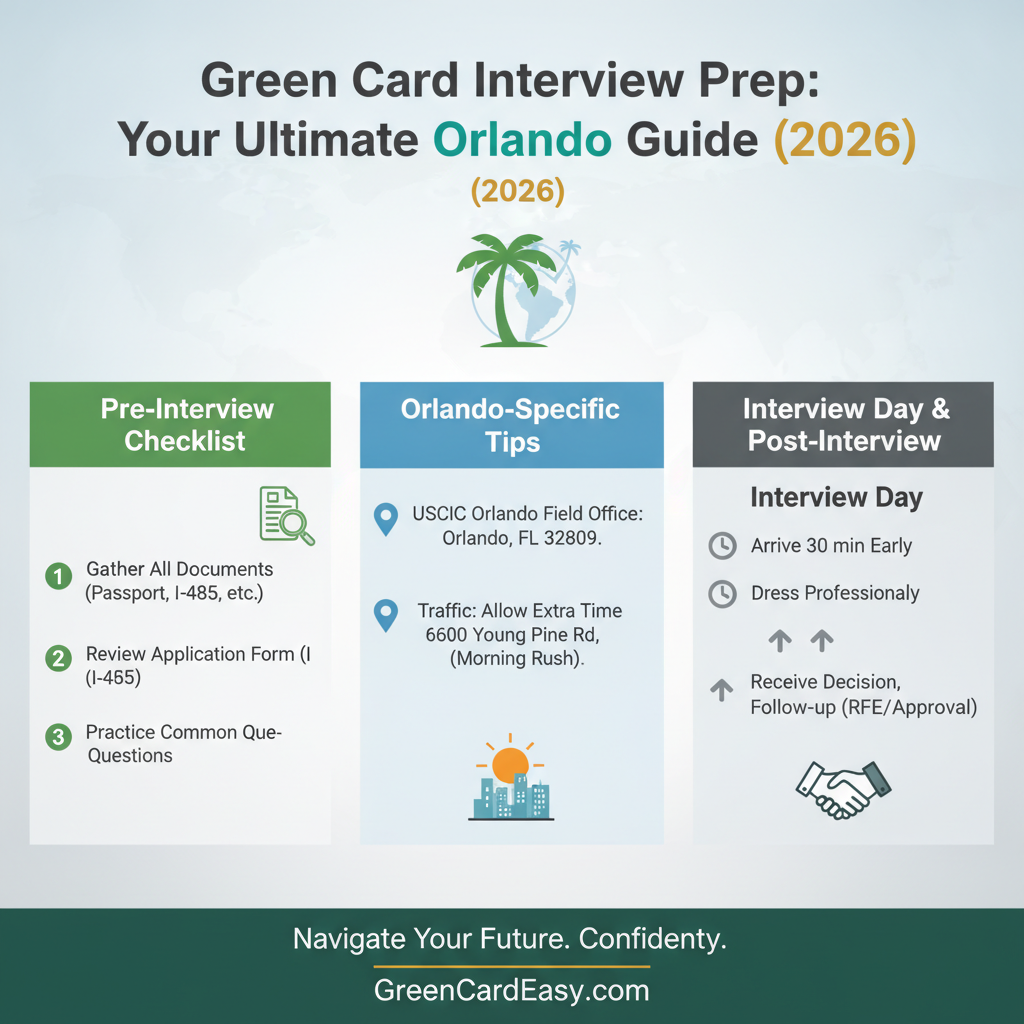
- Plan Your Route: If your interview is at the Orlando USCIS Field Office (6650 TPC Blvd, Orlando, FL 32822), plan your travel in advance. Account for Orlando traffic, especially if you're coming from the I-4 corridor or surrounding areas. Aim to arrive at least 30 minutes early.
- Parking: Research parking options near the field office.
- Childcare: If possible, arrange for childcare. While children can attend, it might be distracting for you and the officer.
- Bring an Attorney: Your immigration attorney can attend the interview with you, providing legal counsel and support. This is highly recommended by Imigrar.
6) The Day of the Interview
Stay calm and focused.
- Be Punctual: Arrive early.
- Be Polite and Respectful: Treat the officer and staff with courtesy.
- Listen Carefully: Listen to each question before answering. If you don't understand, ask the officer to rephrase it.
- Answer Truthfully and Concisely: Answer only the question asked. Do not volunteer extra information unless it's directly relevant or clarifies a previous point.
- Remain Calm: It's natural to be nervous, but try to remain composed. If you need a moment, politely ask for one.
- Review Documents: Be prepared to show original documents and provide copies as requested.
- Take an Interpreter (if needed): If you are not fluent in English, bring a professional, certified interpreter. Do not rely on your spouse or family members to interpret, as this can be problematic. Your Imigrar attorney can advise on this.
7) Post-Interview Steps
The interview is not always the final step.
- Decision: You might receive a decision immediately, or the officer might issue a "Notice of Intent to Deny" (NOID) or "Request for Evidence" (RFE).
- Follow-Up: If an RFE is issued, respond promptly and thoroughly. If a NOID is issued, consult with your attorney immediately to prepare a robust response.
- Approval: If approved, you will typically receive a welcome notice and your Green Card in the mail within a few weeks.
Don't face your Green Card interview alone. Imigrar's experienced immigration lawyers in Orlando can prepare you for every step. Call +1 786-791-3106 today for a free consultation. Se Habla Español.
Practical Steps You Can Take Today for Interview Success
Preparing for your Green Card interview doesn't have to be a last-minute scramble. Here are actionable steps you can start today.
Actionable checklist for immediate preparation:
- Review Your Entire Application Packet: Pull out copies of all forms and supporting documents you submitted. Read through them carefully, noting dates, addresses, and any specific details. Ensure you recall all information accurately.
- Create a Master Document Checklist: Based on your application type (e.g., family-based, employment-based) and the general requirements, create a comprehensive list of every original document and copy you will need to bring. Include the Notice of Interview as the first item.
- Start Gathering Originals and Copies: Do not wait until the week before. Begin collecting all original documents (birth certificates, marriage certificates, passports, divorce decrees, etc.) and making clear, legible copies. For marriage-based cases, start compiling additional evidence of bona fide marriage.
- Organize Your Documents: Invest in a binder or accordion folder. Label sections clearly (e.g., "Original Passports," "Copies of I-130," "Marriage Evidence," "Financial Documents"). This organization will project confidence and professionalism during the interview.
- Discuss with Your Petitioner (if applicable): Sit down with your spouse or other petitioner. Review the application together, discuss your relationship history, and anticipate questions. Ensure both of you are on the same page regarding all facts.
- Schedule a Mock Interview: Ask a trusted friend, family member, or ideally, your immigration attorney, to conduct a mock interview. This helps you practice answering questions under pressure and identify areas where you might hesitate or provide inconsistent information.
- Consult with an Immigration Attorney: If you haven't already, schedule a consultation with an experienced immigration lawyer. They can review your case for potential issues, help you gather and organize documents, and prepare you for specific questions relevant to your situation.
- Check USCIS Processing Times: While it won't change your interview date, knowing the typical USCIS Processing Times for your specific form and the Orlando Field Office can help manage your expectations regarding when to receive your interview notice and final decision.
Document preparation guidance
- Originals vs. Copies: Always bring the original of every document you submit a copy of. The officer will want to see the originals and may keep the copies. Never submit your only original document unless specifically requested and you have a backup.
- Translations: Any document not in English must be accompanied by a complete and accurate English translation. The translator must provide a certification that they are competent to translate from the foreign language into English and that the translation is complete and accurate. This certification must be notarized.
- Affidavits: If you are submitting affidavits from friends or family (e.g., for marriage-based cases), ensure they are notarized and include the full name, address, phone number, and signature of the person making the affidavit. They should describe how they know you and your relationship.
- Photographs: For marriage-based cases, arrange photos chronologically, perhaps in a small album or print-out with dates and captions. Show a variety of photos – with family, friends, on trips, at home.
- Financial Documents: Ensure your Form I-864 and supporting tax documents (transcripts, W-2s, pay stubs) are up-to-date and clearly demonstrate the petitioner's ability to support the beneficiary.
Timeline expectations
The timeline for a Green Card interview can vary significantly depending on the basis of your petition, your country of origin, and the workload of the specific USCIS Field Office (like Orlando) or consulate. Generally:
- Filing to Interview Notice: After filing Form I-485 (Adjustment of Status), it can take several months to over a year to receive your interview notice (Form I-797C). This notice will typically come 30-60 days before your scheduled interview date. For consular processing, the National Visa Center (NVC) will notify you when your case is documentarily complete and ready for an interview at the embassy/consulate.
- Interview to Decision: Sometimes, a decision is made on the spot. More often, the officer needs to conduct further review, and you might receive a decision notice by mail within a few weeks to a few months. In some complex cases, it can take longer.
- Green Card Delivery: Once approved, your physical Green Card is usually mailed within 2-4 weeks of the approval notice.
Warning: These are general timelines and can change. Always check the official USCIS Processing Times for the most current estimates applicable to your case and the Orlando Field Office.

How Imigrar Helps Immigrants in Orlando Prepare for Their Green Card Interview
At Imigrar, we understand that the Green Card interview is more than just a formality; it's a pivotal moment in your immigration journey. Our firm, conveniently located in Orlando, Florida, is dedicated to providing comprehensive legal support to immigrants and their families, ensuring they are fully prepared for this crucial step.
Our experience and expertise
Our team of experienced immigration attorneys brings years of dedicated practice to every client's case. We specialize in family-based immigration, which often involves the Green Card interview process. Our expertise includes:
- Thorough Case Review: We meticulously review your entire application packet, identifying any potential weaknesses or areas that may require additional evidence or explanation during the interview.
- Document Organization and Preparation: We guide you through the process of gathering and organizing all necessary original documents and copies, ensuring nothing is overlooked. We help prepare compelling evidence for marriage-based petitions, such as joint financial records, photos, and affidavits.
- Personalized Interview Preparation: We conduct detailed mock interviews tailored to your specific case. We anticipate the questions an officer might ask, helping you formulate clear, consistent, and truthful answers. We


