


The reporting that sparked this guide
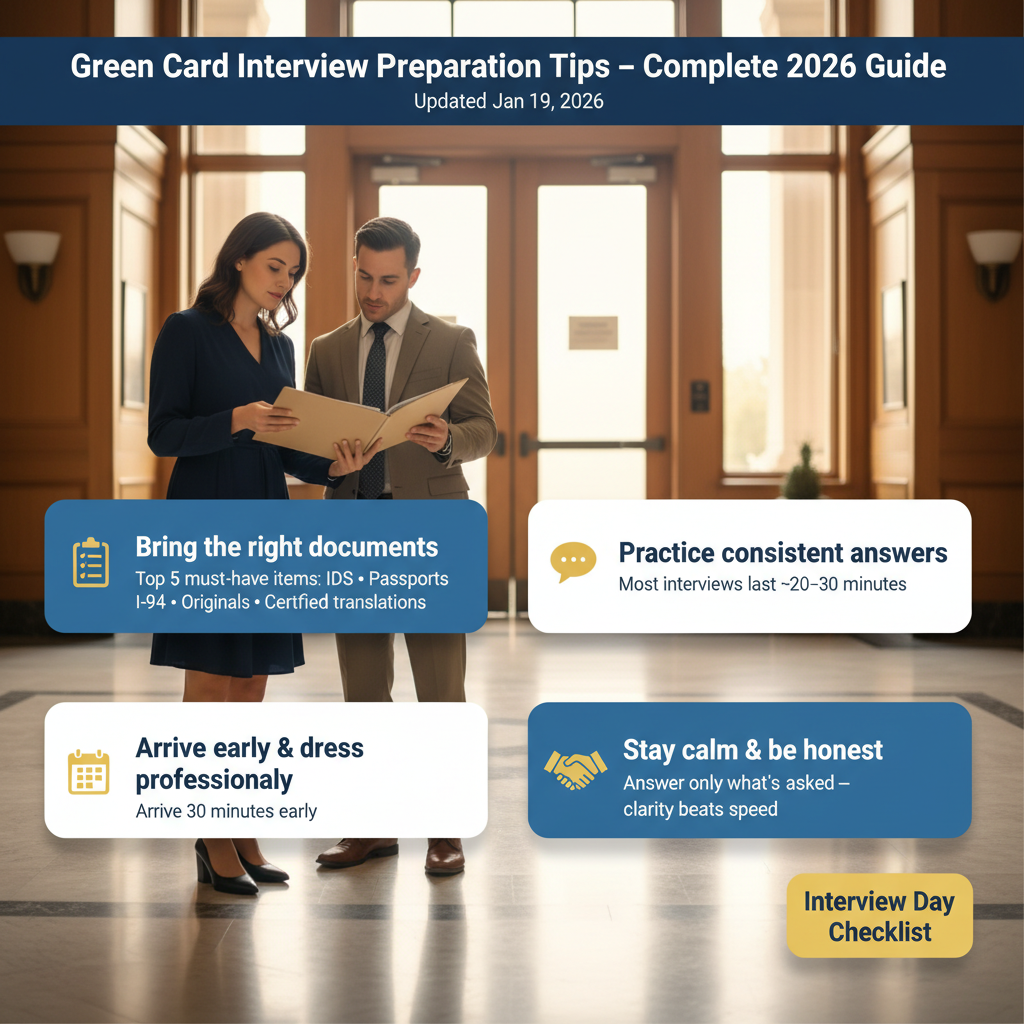
This article is inspired by ongoing immigration-law coverage and trending questions about interview readiness, highlighted here: Green Card Interview Preparation Tips (Immigration Law).
Need Help? Our Orlando immigration team is ready to assist. Call +1 786-791-3106 for a free consultation, or message us online. Se Habla Español.
What This News Means for Immigrants in Orlando and Across Florida
Why this news is showing up now
Green card interviews are a major “pressure point” in the immigration process because they often determine whether an application is approved, delayed, or denied. In recent months, many applicants have reported increased anxiety about interviews due to:
- Shifting USCIS staffing and scheduling patterns that can speed up or slow down interview queues.
- More frequent requests for updated evidence (especially for marriage-based cases) and stricter document review.
- Growing public attention to fraud prevention, which can translate into more detailed questions at interviews.
- Applicants tracking timelines more closely using USCIS Processing Times and noticing sudden changes.
Reminder: Even when your case is strong, an interview can still trigger a Request for Evidence (RFE) or additional review if documents are missing, outdated, inconsistent, or hard to verify.
How it can affect Florida residents
For Florida residents—especially families along the I-4 corridor—interview preparation matters because USCIS field offices can differ in scheduling pace and local practices. If your case is in Orlando, you may be interviewed at the Orlando USCIS Field Office, and you should plan for:
- Travel time and parking considerations in Orange County.
- Bringing well-organized originals and copies to avoid delays.
- Being ready to update USCIS on any life changes since filing (address, job, travel, children, marital status).
Warning: Missing the interview or arriving late can result in a denial for abandonment. If an emergency happens, you generally must request rescheduling as instructed on your notice and document the reason.
What Green Card Interview Preparation Tips Is (and Why It Matters)
A plain-English definition
“Green card interview preparation” means getting ready for the in-person (or occasionally waived) USCIS interview where an officer verifies your identity, reviews your application, checks eligibility, and confirms that your evidence supports approval. For many applicants filing Adjustment of Status through Form I-485, the interview is where USCIS confirms:
- Who you are (identity, immigration history, admissibility).
- Whether the relationship is real (for marriage/family cases).
- Whether the job offer or category requirements are met (for employment cases).
- Whether your forms are accurate and complete.
Preparation is not about “memorizing answers.” It’s about telling the truth clearly, presenting consistent documentation, and understanding what USCIS is legally required to confirm.
Key terms you need to know
- Adjustment of Status: Applying for a green card from inside the United States, typically using Form I-485.
- Consular Processing: Applying for an immigrant visa through the U.S. Department of State at a U.S. consulate abroad (interview occurs overseas).
- Form I-130: Petition for Alien Relative—often the first step in family-based green card cases.
- Form I-485: Application to Register Permanent Residence or Adjust Status—filed by the beneficiary (the person seeking the green card).
- Form I-864: Affidavit of Support—financial sponsorship requirement in many family-based cases.
- Priority Date: The date that controls your place in line for categories with annual visa limits. Your Priority Date can determine when you may file or be approved.
- Admissibility: Whether immigration law allows you to receive a green card (health, criminal, immigration violations, fraud, public charge rules, and other grounds).
- RFE (Request for Evidence): USCIS asks for more documents before approving.
- NOID (Notice of Intent to Deny): USCIS plans to deny unless you respond with strong evidence.
Important: Many interview “problems” are actually paperwork problems—missing civil documents, outdated medical exams, sponsor income issues, or inconsistencies across forms.
Current Immigration Law: The Foundation
Green card interviews are governed by federal immigration law and agency procedures. While the interview experience can vary, the legal foundation is consistent nationwide.
Federal requirements
The primary legal framework comes from the Immigration and Nationality Act (INA) and federal regulations. Key references include:
- INA provisions governing immigrant eligibility and inadmissibility (including INA § 212(a) grounds of inadmissibility).
- INA provisions for family-based immigration (including INA § 201 and § 203 categories and limits).
- INA § 245 and related regulations for Adjustment of Status (commonly implemented through 8 C.F.R. § 245).
- USCIS authority to require interviews and verify eligibility through testimony and documents (commonly implemented through 8 C.F.R. § 103 and related guidance).
USCIS uses your filed forms and evidence—especially Form I-130 and Form I-485—to assess eligibility. You can verify form instructions and updates directly on the USCIS official website and the USCIS Forms page.
Reminder: If you have immigration court proceedings or prior removal issues, your case may intersect with the Executive Office for Immigration Review. Interview preparation should account for any court history, prior orders, or pending motions.
Florida-specific considerations
Immigration is federal law, but Florida residents face practical, location-specific realities:
- Local field office practices: The Orlando USCIS Field Office may have its own scheduling pace and document-handling preferences.
- Address updates: If you move within Florida (for example, from Osceola County to Orange County), update USCIS promptly to avoid missed notices.
- Travel and logistics: Central Florida residents along the I-4 corridor should plan for traffic and arrive early with organized originals and copies.
- Language access: If you are not comfortable in English, you may need an interpreter depending on case type and USCIS rules. Plan ahead with counsel.
Warning: Do not rely on “what a friend experienced” at a different office or in a different year. USCIS procedures can change, and each case has unique risk factors.
How to Prepare for Your Green Card Interview: A Complete Step-by-Step Guide
1) Confirm your interview notice details and your case type
Start by reading your interview notice carefully. Confirm the date, time, location, and any special instructions. Identify your pathway:
- Marriage-based or family-based Adjustment of Status (often Form I-130 + Form I-485).
- Employment-based adjustment (often Form I-485 with an underlying petition such as I-140).
- Other categories (VAWA, asylum-based adjustment, special immigrant categories), each with its own evidence profile.
If your case is in Orlando, verify whether the notice lists the Orlando USCIS Field Office address and whether you must bring a completed medical exam or updated financial documents.
Documents to gather for Step 1:
- Interview notice (original and a copy).
- Government-issued photo IDs (passport, driver’s license/state ID).
- Copies of all receipt notices (I-797) for your pending applications.
- A printed copy of your full filing package (forms and supporting evidence as submitted).
2) Review every form you filed for consistency and accuracy
The officer will often ask questions directly from your applications. Preparation means you and (if applicable) your spouse/petitioner can explain what was filed and why. Review:
- Form I-485 biographic details, addresses, employment history, and “yes/no” admissibility questions.
- Form I-130 relationship history and prior marriages.
- Form I-864 sponsor income, household size, and tax filings.
- Form I-765 and Form I-131 if filed (work permit and advance parole).
Important: If anything has changed since filing (new job, new address, new child, travel, arrest, separation), discuss with an attorney before the interview. Some changes require updates, amendments, or additional evidence.
Documents to gather for Step 2:
- Complete copies of your filed forms (I-130, I-485, I-864, and any others).
- Any RFE/NOID notices and your responses.
- Updated resume-style timeline of addresses and jobs (helpful for accuracy).
- Certified dispositions for any arrests or citations, if applicable.
3) Build a “day-of-interview” document binder (originals + copies)
Think of the interview as a verification appointment. Officers commonly want to see originals of civil documents and updated relationship or financial evidence. Organize your binder into labeled sections so you can quickly hand over what is requested.
Documents to gather for Step 3 (typical categories):
- Identity & immigration: Passports (current and expired), I-94 printout if applicable, visa pages, EAD card, advance parole document, prior approval notices.
- Civil documents (originals): Birth certificates, marriage certificate, divorce decrees/annulments, name-change orders.
- Medical: Sealed Form I-693 medical exam (if required/updated per USCIS instructions).
- Financial sponsorship: Updated pay stubs, employment letter, most recent tax return/transcripts, W-2/1099s for sponsor/joint sponsor (as relevant).
- Relationship evidence (marriage cases): Joint lease/mortgage, joint bank statements, insurance, photos, travel itineraries, children’s birth certificates, affidavits from friends/family (when appropriate).
- Two passport-style photos (sometimes requested; follow your notice).
Reminder: Bring both originals and one set of copies. USCIS may keep copies but usually returns originals after review.
4) Prepare for the questions USCIS is likely to ask
Interview questions typically fall into three buckets: identity/history, eligibility/admissibility, and category-specific issues (like marriage bona fides). Practice answering calmly, honestly, and consistently.
Documents to support Step 4 (for reference during prep):
- A written relationship timeline (how you met, key dates, living arrangements).
- Address/employment history timeline (last 5 years or more, matching forms).
- Copies of prior immigration filings (visas, petitions, prior I-130/I-485 if any).
- Any certified court records and final dispositions (if applicable).
Important: If you do not know an answer, it is better to say “I don’t remember exactly” than to guess. Guessing can create inconsistencies that lead to delays or deeper scrutiny.
5) Plan logistics, interpreter needs, and what to do if something goes wrong
Interview-day stress causes avoidable mistakes. Plan your route, parking, security screening time, and childcare. For Central Florida residents, I-4 traffic can be unpredictable—arrive early.
Documents/items to prepare for Step 5:
- Interview notice and photo ID for building entry.
- Attorney appearance notice/representation documents (if represented).
- Interpreter information (if permitted/needed for your case type).
- Proof of emergency if you must reschedule (hospital note, flight cancellation, etc.).
Warning: Do not bring prohibited items to a federal building. Expect airport-style security. If you are late, you may not be seen.
6) Attend the interview and document what happened afterward
The officer may approve on the spot, issue an RFE, recommend additional review, or schedule a second interview. Keep notes of:
- What documents were requested or taken.
- Any concerns the officer raised.
- Any deadlines given for follow-up evidence.
Documents to gather for Step 6 (post-interview readiness):
- Any paper the officer gives you (RFE sheet, “case held for review” notice, etc.).
- Copies of anything you hand over.
- Tracking info if you later mail evidence to USCIS.
Reminder: If USCIS issues an RFE/NOID, respond by the deadline with a complete, well-organized submission. Missing a deadline can result in denial.
Need Help? Our Orlando immigration team is ready to assist. Call +1 786-791-3106 for a free consultation, or message us online. Se Habla Español.
Practical Steps You Can Take Today
If your interview is coming up soon—or even if you haven’t been scheduled yet—these actions reduce risk and help you feel in control.
Actionable checklist (do this now)
- Create a single folder (digital + paper) with your entire filing package and all USCIS notices.
- Order or download key records: tax transcripts, pay stubs, and updated employment letters for the sponsor (and joint sponsor if used).
- Collect updated relationship evidence from the last 3–6 months (especially for marriage cases).
- Review every “yes/no” question on Form I-485 and be ready to explain any “yes” answers with documents.
- Check your case status and general timelines using USCIS Processing Times.
- Confirm your address is current with USCIS to avoid missing the interview notice.
- Schedule a legal prep session if you have prior immigration violations, arrests, or complex history.
Document preparation guidance
A strong interview binder is simple and officer-friendly:
- Use tabs: “Notices,” “IDs,” “Civil Docs,” “Medical,” “Financial,” “Relationship,” “Other.”
- Put originals in a protective sleeve and copies behind them.
- Highlight key data on copies (dates, account holder names, address) without altering originals.
- Bring translations for any non-English documents with proper certification.
Important: Do not submit fake documents or altered statements. Even small fabrications can lead to fraud findings and long-term immigration consequences.
Timeline expectations (Florida and nationwide)
Timelines vary by category, office workload, and background checks. As a general planning tool:
- Interview notice may arrive weeks to months after biometrics (or later, depending on the case).
- After the interview, some cases are approved the same day; others take weeks or months for final review.
- If USCIS requests additional evidence, your case timeline depends on how fast you respond and how quickly USCIS reviews the response.
Reminder: Some applicants worry about a “90-day window” for approval after interview. In reality, USCIS does not guarantee a fixed approval timeline after the interview, and background checks or supervisory review can extend processing.
If you are concerned about delays, track your case and consult counsel about appropriate follow-up options.
How Imigrar Helps Immigrants in Orlando
Imigrar is an immigration law firm based in Orlando, Florida, serving clients nationwide. Our mission is simple: Keep Families Together. Green card interviews can feel intimidating, but with the right preparation, many applicants walk in confident and walk out relieved.
We help clients by:
- Reviewing your full case for eligibility, admissibility, and consistency across filings.
- Building a customized interview binder and evidence checklist based on your category.
- Preparing you for common and case-specific questions (marriage, prior immigration history, prior filings, travel, and more).
- Identifying red flags early—such as sponsor income shortfalls, prior overstays, or missing civil documents—and fixing them before the interview.
- Supporting you through RFEs/NOIDs and post-interview follow-up when cases are held for review.
We offer a free consultation. Call +1 786-791-3106. Se Habla Español.
Need Help? Our Orlando immigration team is ready to assist. Call +1 786-791-3106 for a free consultation, or message us online. Se Habla Español.
Frequently Asked Questions
Q: I’m worried I’m not eligible—should I still go to the green card interview?
A: In most situations, yes—you should attend unless your attorney advises otherwise. Skipping can lead to denial for abandonment. If you have eligibility concerns (prior overstay, unauthorized work, criminal history, prior misrepresentation), get legal advice immediately so you can prepare disclosures and supporting documents. The goal is to address issues truthfully and strategically, not to “hope it won’t come up.”
Q: Can the green card interview affect my current immigration status?
A: It can. USCIS may review your entire immigration history during the Adjustment of Status interview. If USCIS finds you are inadmissible or believes there was fraud or a material misrepresentation, the Form I-485 can be denied and—depending on your situation—USCIS may refer the case for further action. If you have any prior issues, consult counsel before the interview so you understand risk and possible waiver options.
Q: How long after the interview will I get a decision?
A: Some applicants receive approval the same day or within a few days; others wait weeks or months. Delays often happen due to background checks, supervisor review, missing documents, or an RFE. You can monitor general timeframes at USCIS Processing Times, but those are not exact predictions for a specific case.
Q: What documents are required for a marriage-based green card interview?
A: Commonly requested documents include passports/IDs, the interview notice, original marriage certificate, divorce decrees (if any), updated joint evidence (lease/mortgage, bank statements, insurance), recent photos together, and sponsor financials (tax documents and pay stubs) tied to Form I-864. Many applicants also bring a sealed Form I-693 medical exam if required. Your notice controls—bring exactly what it asks for plus reasonable updates.
Q: How much does it cost to prepare for a green card interview with a lawyer?
A: Legal fees vary based on complexity: straightforward cases may require limited prep, while cases involving prior immigration violations, criminal records, sponsor issues, or potential inadmissibility require deeper analysis and documentation. At Imigrar, we discuss scope and fees transparently during your consultation. Reminder: The cost of poor preparation can be far higher if it leads to denial or long delays.
Q: What happens if my green card is denied after the interview?
A: USCIS may deny the underlying petition (like Form I-130) and/or the Form I-485. Next steps depend on the reason for denial and your procedural posture. Options may include filing a motion to reopen/reconsider, refiling with stronger evidence, pursuing consular processing, or exploring waivers if inadmissibility is the issue. If you are placed in removal proceedings, your case may move to immigration court under EOIR, and you should seek legal representation immediately.
Q: Do we both have to attend the interview for a marriage-based case?
A: Usually, yes. USCIS commonly interviews both spouses together, and sometimes separately if the officer has concerns. If your spouse cannot attend due to a serious reason, speak with an attorney before the interview date and follow the rescheduling instructions on your notice. Do not assume USCIS will excuse a no-show without documentation.
Q: I heard about a “180 days rule”—does it apply to my green card interview?
A: The phrase “180 days” can refer to different immigration concepts (for example, certain portability rules in employment-based cases or unlawful presence thresholds). Whether it matters depends on your category and history. If you have concerns about unlawful presence, travel, or job changes, talk to counsel so your interview answers and evidence match the legal standard that applies to your situation.
Common Mistakes (and How to Avoid Them)
Mistake #1: Showing up with disorganized or missing original documents
Officers often need to verify originals (birth certificates, marriage certificates, divorce decrees, passports). Missing originals can lead to an RFE and delay—or in some cases create credibility concerns.
- How to avoid it: Build a labeled binder with originals in sleeves and copies behind each original. Bring the interview notice and all receipt notices.
Mistake #2: Inconsistent answers between spouses or across forms
In marriage-based interviews, USCIS looks for consistency: dates, addresses, prior marriages, and daily-life details. Inconsistencies do not automatically mean fraud, but they can trigger deeper questioning or a second interview.
- How to avoid it: Review your Form I-130 and Form I-485 together, create a shared timeline, and clarify any confusing points before the interview.
Mistake #3: Minimizing past immigration or criminal issues
Many denials stem from undisclosed arrests, old removal orders, prior visa denials, or misrepresentations—sometimes the applicant thought the issue was “minor” or “too old to matter.”
- How to avoid it: Get certified court dispositions, FOIA records if needed, and legal advice on how to present the facts accurately. Never guess—bring documents.
Extra Interview Guidance for Orlando and Central Florida Residents
If your case is in Orlando, preparation should include local logistics and practical planning:
- The Orlando USCIS Field Office: Arrive early for security screening and check-in procedures.
- For Central Florida residents: Plan for I-4 traffic, weather delays, and parking. Consider arriving 30–60 minutes early.
- Orange County address history: If you have moved within Orange County (or between Orange, Seminole, Osceola, Polk, Volusia), ensure your address history is accurate and consistent with your forms.
Reminder: Even if your interview seems simple, the officer may ask about admissibility questions from Form I-485 (membership, arrests, immigration violations, public benefits, etc.). Review those carefully.
Official Resources to Use (and Why They Matter)
Use official sources to avoid misinformation:
- USCIS official website for policies, updates, and case tools.
- USCIS Forms to confirm you’re using current editions and instructions.
- USCIS Processing Times to set realistic expectations.
- U.S. Department of State for consular processing and immigrant visa information.
- Executive Office for Immigration Review if your matter involves immigration court.
Important: If you read advice online, verify it against official instructions and your interview notice. Procedures can change, and your category may have unique rules.
Need Help? Our Orlando immigration team is ready to assist. Call +1 786-791-3106 for a free consultation, or message us online. Se Habla Español.

Closing: Get Confident Before Your Green Card Interview
Your green card interview is one of the most important checkpoints in the immigration process. The best outcomes usually come from three things: (1) accurate forms, (2) well-organized evidence, and (3) calm, truthful answers that match your documentation.
If you’re preparing for an interview at the Orlando USCIS Field Office—or anywhere in Florida or the United States—Imigrar can help you reduce risk, avoid delays, and present your case clearly.
Call Imigrar today at +1 786-791-3106 for a free consultation, or message us online. Se Habla Español. Keep Families Together.


