


The reporting that sparked this guide
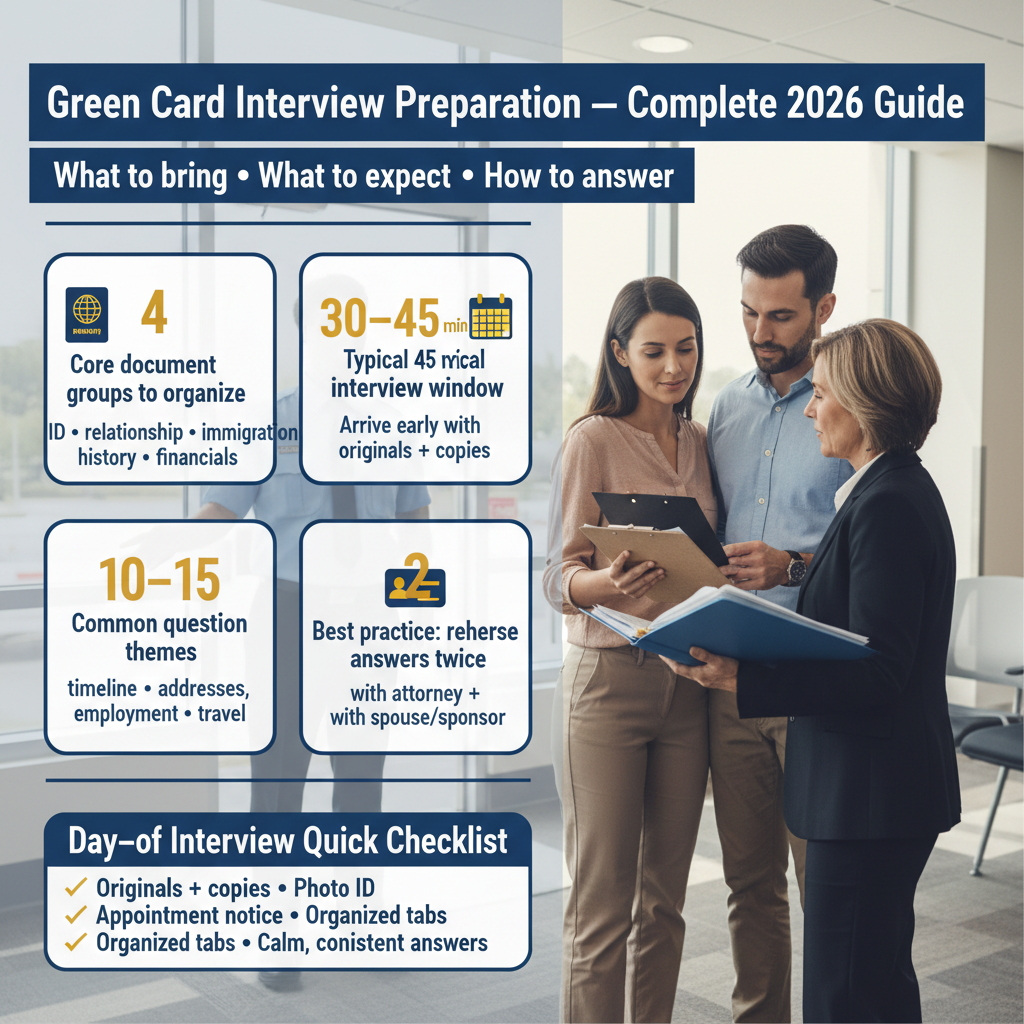
Green card interview preparation is trending in immigration coverage and search results, with many applicants looking for clear, practical guidance amid shifting processing times and increased scrutiny in certain case types. This article was inspired by:
Need Help? Our Orlando immigration team is ready to assist. Call +1 786-791-3106 for a free consultation, or message us online. Se Habla Español.
What This News Means for Immigrants in Orlando and Across Florida
Why this news is showing up now
Green card interviews are getting attention because many applicants are experiencing longer waits, more frequent Requests for Evidence (RFEs), and heightened interview focus on eligibility details—especially for marriage-based cases and cases involving prior immigration history. At the same time, families are trying to plan around work, travel, and school schedules while watching case updates online.
Reminder: Even when your case is strong, the interview is a formal legal step. The officer’s job is to confirm identity, review admissibility, verify eligibility, and resolve any inconsistencies in the record.
In Florida—especially along the I-4 corridor—high demand and population growth can affect scheduling. For many applicants, the interview is the final major step before approval (or, if issues arise, before USCIS requests more evidence).
How it can affect Florida residents
For Central Florida residents, preparation is especially important because:
- The Orlando USCIS Field Office may schedule interviews with limited lead time, and rescheduling can add months.
- Applicants often have complex histories (prior visas, overstays, entries/exits, prior petitions, name variations), which can trigger follow-up questions.
- Florida families frequently need to coordinate childcare, work leave, and travel plans—yet travel should be approached carefully while Adjustment of Status is pending.
Important: If your case is in Orlando, plan to arrive early, organize your documents in a clear system, and review your entire filing package before the interview. Small inconsistencies (addresses, dates, prior marriages, employment history) can cause delays.
What Green Card Interview Preparation Tips Is (and Why It Matters)
A plain-English definition
“Green card interview preparation” means getting ready for your USCIS interview by (1) understanding what USCIS is trying to confirm, (2) bringing the correct documents, and (3) practicing how to answer questions truthfully, consistently, and clearly.
In most family-based Adjustment of Status cases, the interview is where USCIS decides whether the applicant qualifies to become a lawful permanent resident. In employment-based cases, interviews may be waived more often, but they can still be scheduled—especially if there are identity, admissibility, or documentation questions.
Key terms you need to know
- Adjustment of Status: Applying for a green card from inside the U.S., typically using Form I-485.
- Consular Processing: Applying for an immigrant visa abroad through the U.S. Department of State.
- Form I-130: Petition for Alien Relative (often the first step in family cases).
- Form I-485: Application to Register Permanent Residence or Adjust Status.
- Form I-864: Affidavit of Support (financial sponsorship in many family cases).
- Form I-693: Medical exam report from a USCIS-designated civil surgeon.
- Priority Date: Your place in line for a visa number in certain categories (especially family preference and employment-based cases).
- Admissibility: Whether immigration law allows you to receive a green card (criminal issues, immigration violations, health-related grounds, public charge rules, etc.).
- 90-day window: A term often used in immigration discussions about timing and intent; while policies evolve, you should always be truthful and consult counsel if intent/timing could be questioned.
- 180 days: A common threshold in immigration law that can matter in multiple contexts (for example, unlawful presence bars can be triggered by certain durations). Speak with counsel about your specific timeline.
Warning: The interview is not a “formality.” USCIS officers compare your answers to what was filed. If something changed since filing (address, job, marital status, arrests, travel, income), it must be addressed correctly.
Current Immigration Law: The Foundation
Green card interviews are governed by federal immigration law and USCIS procedures. While Florida does not set immigration eligibility rules, Florida-specific realities (local office practices, document access, and coordination with local courts for records) can affect how you prepare.
Federal requirements
Key legal authorities and frameworks include:
- The Immigration and Nationality Act (INA), including eligibility and inadmissibility provisions (commonly referenced as INA § 245 for adjustment and INA § 212 for inadmissibility).
- Federal regulations in 8 C.F.R. (governing USCIS filings, interviews, and evidence standards).
- USCIS policy guidance and instructions for required forms, published on the USCIS official website.
Most family-based adjustment cases involve these USCIS forms (not exhaustive):
- Form I-130 (family petition)
- Form I-485 (adjustment application)
- Form I-864 (affidavit of support)
- Form I-693 (medical exam)
- Form I-765 (work permit, if filed)
- Form I-131 (advance parole/travel document, if filed)
You can confirm current editions and instructions at USCIS Forms and check timing trends at USCIS Processing Times.
Florida-specific considerations
Florida considerations are practical rather than legal eligibility rules. For example:
- If your case is in Orlando, you may be scheduled at The Orlando USCIS Field Office. Plan for traffic on the I-4 corridor and parking time.
- For Orange County residents, obtaining certified court dispositions (if there was any arrest/citation) often requires coordinating with local clerks. Start early.
- Document replacement (Florida birth certificates for U.S. citizen petitioners, marriage certificates, divorce decrees) may take time depending on the county and record type.
Important: If you have any criminal history (even dismissed charges) or prior immigration violations, consult an immigration attorney before the interview. Immigration consequences can differ from criminal outcomes.
How to Prepare for Your Green Card Interview: A Complete Step-by-Step Guide
1) Confirm your interview notice details and plan logistics
When you receive the interview notice, read it line-by-line. The notice tells you where to go, when to arrive, and what to bring. Missing the interview can lead to denial for abandonment in some cases.
Reminder: Arrive early. Security screening and check-in can take time, and late arrival can result in rescheduling.
Documents to gather for this step:
- USCIS interview notice (original)
- Government-issued photo IDs (passport, driver’s license, state ID)
- Any USCIS receipt notices (I-797) for Form I-130, Form I-485, and related filings
- Proof of current address (lease, utility bill, bank statement)
If you need to update your address, do so promptly through USCIS procedures. Keep proof of any updates and confirmations.
2) Rebuild your “filing package” and review it for consistency
USCIS officers often ask questions directly from your forms. The most common interview problems happen when applicants don’t remember what was submitted or when the record contains mistakes.
Create a binder (or digital folder) with copies of everything filed, including:
- A complete copy of Form I-485 and all supporting evidence
- A complete copy of Form I-130 (and Form I-130A if applicable)
- Copies of all prior immigration filings (prior petitions, extensions, asylum filings, etc.)
- All USCIS notices and any RFE responses
Important: If you notice an error (wrong date, wrong address history, missing prior marriage, inaccurate employment dates), talk to an attorney before the interview so you correct it properly and consistently.
3) Prepare identity, civil, and status documents (originals + copies)
USCIS typically wants to see original civil documents and may keep copies. Organize originals in one section and copies in another.
Documents to gather for this step (common list):
- Passports (current and expired)
- Birth certificates (with certified English translations if not in English)
- Marriage certificate (and evidence of legal termination of all prior marriages: divorce decrees/annulments/death certificates)
- Government IDs for both spouses (in marriage-based cases)
- I-94 record (printout if available) and admission stamps
- Employment Authorization Document (EAD) and Advance Parole (if issued)
Warning: Translations must be complete and properly certified. Partial or informal translations can cause delays.
4) Strengthen your eligibility evidence (especially for marriage-based cases)
USCIS interviews commonly focus on whether the relationship is bona fide (real) and not entered into for immigration benefits. Even genuine couples can be tripped up by weak documentation.
Documents to gather for this step (marriage-based “bona fide” evidence):
- Joint lease/mortgage, property deed, or letter from landlord listing both names
- Joint bank account statements (several months, showing normal activity)
- Joint credit cards, loans, or auto financing
- Insurance policies showing each other as beneficiaries (health, auto, life, renter’s)
- Utility bills with both names (or a mix showing same address)
- Photos together over time (include family events, holidays; label dates/locations)
- Children’s birth certificates (if applicable)
- Affidavits from friends/family (helpful in some cases, but usually secondary evidence)
Important: Quality matters more than quantity. Bring a well-organized set that shows a shared life over time.
5) Prepare financial sponsorship and updated income evidence
Many family-based green cards require the petitioner (and sometimes a joint sponsor) to prove sufficient income/assets using Form I-864. Officers may request updated proof if the case has been pending for a while or if the petitioner changed jobs.
Documents to gather for this step:
- Most recent federal tax return transcripts (often preferred over copies)
- W-2s/1099s and recent pay stubs (typically last 1–3 months)
- Employment verification letter (job title, start date, salary, full-time/part-time)
- Proof of assets (if using assets to qualify): bank statements, property appraisals, ownership documents
- If using a joint sponsor: joint sponsor’s updated tax/income documents and proof of U.S. citizenship or lawful permanent residence
Reminder: If the petitioner’s household size changed (new baby, dependent, marriage), that can affect the affidavit of support calculation.
6) Review “admissibility” issues and bring certified dispositions if needed
USCIS must confirm you are admissible. Even minor incidents can matter. If you have ever been arrested, charged, cited, or convicted—anywhere—bring certified court dispositions and arrest reports if available.
Documents to gather for this step (as applicable):
- Certified court dispositions for every charge (including dismissed/withheld adjudication)
- Police reports and arrest records (if available)
- Proof of completion of probation/classes/fines paid
- Immigration records: prior removal/deportation orders, voluntary departure, prior USCIS/ICE documents
Warning: Do not guess or minimize. If asked, answer truthfully and clearly. If you are unsure how to explain a situation, consult counsel before the interview.
7) Do a mock interview and plan how you will answer
Practicing helps you answer confidently and consistently. The goal is not to “memorize” lines—it’s to be accurate and calm.
Documents to use for this step:
- Your full copies of Form I-485 and Form I-130
- Your relationship timeline (first meeting, dating, engagement, marriage, living arrangements)
- A list of “changes since filing” (address, job, travel, new child, legal name change)
Typical questions include: biographic details, address history, employment history, prior marriages, how you met, daily routines, and the yes/no admissibility questions on Form I-485.
Need Help? Our Orlando immigration team is ready to assist. Call +1 786-791-3106 for a free consultation, or message us online. Se Habla Español.
Practical Steps You Can Take Today
If your interview is weeks away (or even months away), you can start now. Preparation reduces stress and lowers the risk of delays.
Actionable checklist (do this now)
- Create a single folder with your full filing copies: Form I-130, Form I-485, supporting evidence, and all USCIS notices.
- Order updated tax transcripts and gather recent pay stubs for Form I-864 support.
- Collect originals + make clean copies of civil documents (birth, marriage, divorce).
- Build a “relationship evidence” packet (if applicable) with labeled photos and joint documents.
- Check expiration dates on passports and IDs; renew if needed.
- Review your address and employment history for the last 5 years (or longer if applicable) so you can answer consistently.
- Check your case status and typical timelines at USCIS Processing Times.
Document preparation guidance
Organize documents in sections with tabs:
- Section A: Interview notice + IDs
- Section B: Originals (civil documents)
- Section C: Copies of filed forms and receipts
- Section D: Updated relationship evidence (if marriage-based)
- Section E: Updated financial evidence (Form I-864)
- Section F: Any court/immigration records (certified)
Important: Bring what the notice requests, plus reasonable updates since filing. Too little evidence is a common problem; overly disorganized “too much” evidence can also slow things down.
Timeline expectations (realistic planning)
Every case is different, but many applicants experience these general phases:
- Filing to biometrics: often weeks to a few months
- Work/travel authorization (if filed): varies widely
- Interview scheduling: can be several months to more than a year depending on category and office workload
- Decision after interview: sometimes same day, often within weeks; some cases receive an RFE or further review
Reminder: If you must reschedule, do it properly and expect delays. If you move, update your address promptly to avoid missing notices.
How Imigrar Helps Immigrants in Orlando
At Imigrar, we help individuals and families prepare for green card interviews with a strategy that is both practical and legally precise—because the details matter. Our mission is to Keep Families Together, and we serve clients in Orlando and nationwide.
Our interview preparation support typically includes:
- Full case review for consistency across Form I-130, Form I-485, and supporting evidence
- Identification of admissibility concerns and risk points (prior immigration history, arrests, prior marriages)
- Customized document checklists based on your case type
- Mock interview preparation so you know what to expect and how to answer clearly
- Guidance on updates since filing (new job, new address, new child, travel, etc.)
Se Habla Español. If you feel nervous or unsure, you are not alone—and you do not have to prepare by yourself.
Need help now? Call +1 786-791-3106 for a free consultation, or message us online.
Frequently Asked Questions
Q: Am I eligible for a green card if I overstayed my visa?
A: Many people who overstayed can still qualify through Adjustment of Status if they are an “immediate relative” of a U.S. citizen (spouse, parent of a U.S. citizen over 21, or unmarried child under 21) and entered the U.S. lawfully (with inspection). However, overstays can be more complicated in other categories. Bring your I-94, entry stamps, and consult an attorney to confirm eligibility and address any 180 days or longer unlawful presence concerns if travel is involved.
Q: Will my current immigration status affect my interview?
A: Yes. USCIS will review whether you maintained lawful status (where required) and whether you are admissible. Some applicants are eligible even after status lapses, while others are not. Your interview may include questions about entries/exits, prior applications, and any removal proceedings. If you have ever been in immigration court, you may also need records connected to Executive Office for Immigration Review proceedings.
Q: How long after the interview will I get a decision?
A: Some applicants receive an approval notice quickly; others are told the case is under review. If USCIS needs more documents, they may issue an RFE. Timing varies by case and local workload. You can monitor general trends at USCIS Processing Times, but your case can move faster or slower depending on complexity.
Q: What documents should I bring to the green card interview?
A: Bring (1) the interview notice, (2) passports/IDs, (3) originals of civil documents (birth/marriage/divorce), (4) copies of everything filed (especially Form I-130 and Form I-485), (5) updated relationship evidence (if marriage-based), (6) updated financial evidence for Form I-864, and (7) certified court dispositions if there is any criminal history. If your documents are not in English, include certified translations.
Q: How much does the green card interview process cost?
A: USCIS filing fees depend on the forms you submitted and your category. You may also pay for the medical exam (Form I-693) and for obtaining certified records/translations. Attorney fees vary by complexity. For the most accurate numbers, review your specific filing plan and confirm current USCIS fees and form editions at USCIS Forms or the USCIS official website.
Q: What happens if my green card is denied after the interview?
A: A denial can happen for missing evidence, credibility concerns, financial sponsorship issues, or inadmissibility. Next steps depend on the reason and your procedural posture. Some denials can be addressed by a motion to reopen/reconsider, refiling, or (in certain situations) review in immigration court. If denial is a risk, get legal advice immediately—especially before traveling or making major life decisions.
Q: Can I bring an interpreter or an attorney to the interview?
A: In many cases, yes—USCIS has rules about interpreters and representatives. If you are more comfortable in Spanish, ask about interpreter options and preparation. Having an attorney can help keep the interview focused and ensure issues are addressed correctly. Se Habla Español at Imigrar.
Q: What if my spouse and I don’t remember the same dates?
A: Small differences happen. The goal is consistency on major facts and honesty about what you do and don’t remember. Review your timeline together and bring documents that support key dates (leases, trips, photos, receipts). Avoid guessing—say you’re not sure when appropriate.
Need Help? Our Orlando immigration team is ready to assist. Call +1 786-791-3106 for a free consultation, or message us online. Se Habla Español.
Common Mistakes (and How to Avoid Them)
Mistake #1: Showing up without originals or with disorganized evidence
USCIS may ask to see original civil documents and compare them to copies. If you bring a messy stack of papers, you risk delays or an RFE.
How to avoid it: Use a binder with tabs, separate originals from copies, and place the interview notice on top. For Central Florida residents driving from Orange County or along the I-4 corridor, pack the night before to avoid last-minute mistakes.
Mistake #2: Forgetting what you filed (or contradicting your forms)
Officers often ask questions pulled directly from Form I-485 and related filings. Contradictions can create credibility concerns.
How to avoid it: Re-read your full submission, including address/employment history and the yes/no admissibility questions. If something is wrong, correct it the right way—don’t “wing it” at the interview.
Mistake #3: Ignoring admissibility risks until the interview
Arrests, prior immigration violations, prior marriages, and misrepresentation concerns can derail an otherwise approvable case.
How to avoid it: Get certified dispositions early, gather immigration records, and consult an attorney before the interview if there is any complexity. Warning: Do not assume a dismissed charge “doesn’t count” for immigration purposes.
Extra Orlando & Central Florida Interview-Day Tips
If your case is in Orlando, these local, practical points can help the day go smoothly:
- The Orlando USCIS Field Office: plan extra time for traffic and parking. Morning appointments can coincide with heavy I-4 corridor congestion.
- Dress professionally and conservatively. You do not need to overdress, but you should look respectful and prepared.
- Turn off your phone and follow security instructions. Bring only what you need.
- If you have children, consider childcare if possible—interviews can take longer than expected.
- Bring a simple cover sheet listing the documents you are providing as “updates since filing.”
Important: If you have a pending travel document and an urgent need to travel, get legal advice before leaving the U.S. Travel can create serious problems in some situations.
For official guidance, always cross-check with:
- USCIS official website
- USCIS Forms
- USCIS Processing Times
- U.S. Department of State (for consular processing and immigrant visa steps)
- Executive Office for Immigration Review (for immigration court information where relevant)
Need Help? Our Orlando immigration team is ready to assist. Call +1 786-791-3106 for a free consultation, or message us online. Se Habla Español.
Closing: Get Interview-Ready with Confidence
The green card interview is one of the most important moments in your immigration journey. The best results usually come from careful organization, truthful and consistent answers, and addressing issues before USCIS raises them.
Reminder: If anything changed since you filed—address, job, household size, prior incidents, or travel—prepare to explain it and bring documentation.
If you want guidance tailored to your case, Imigrar is here to help you prepare, reduce stress, and protect your future.
Need Help? Our Orlando immigration team is ready to assist. Call +1 786-791-3106 for a free consultation, or message us online. Se Habla Español.


