

The reporting that sparked this guide
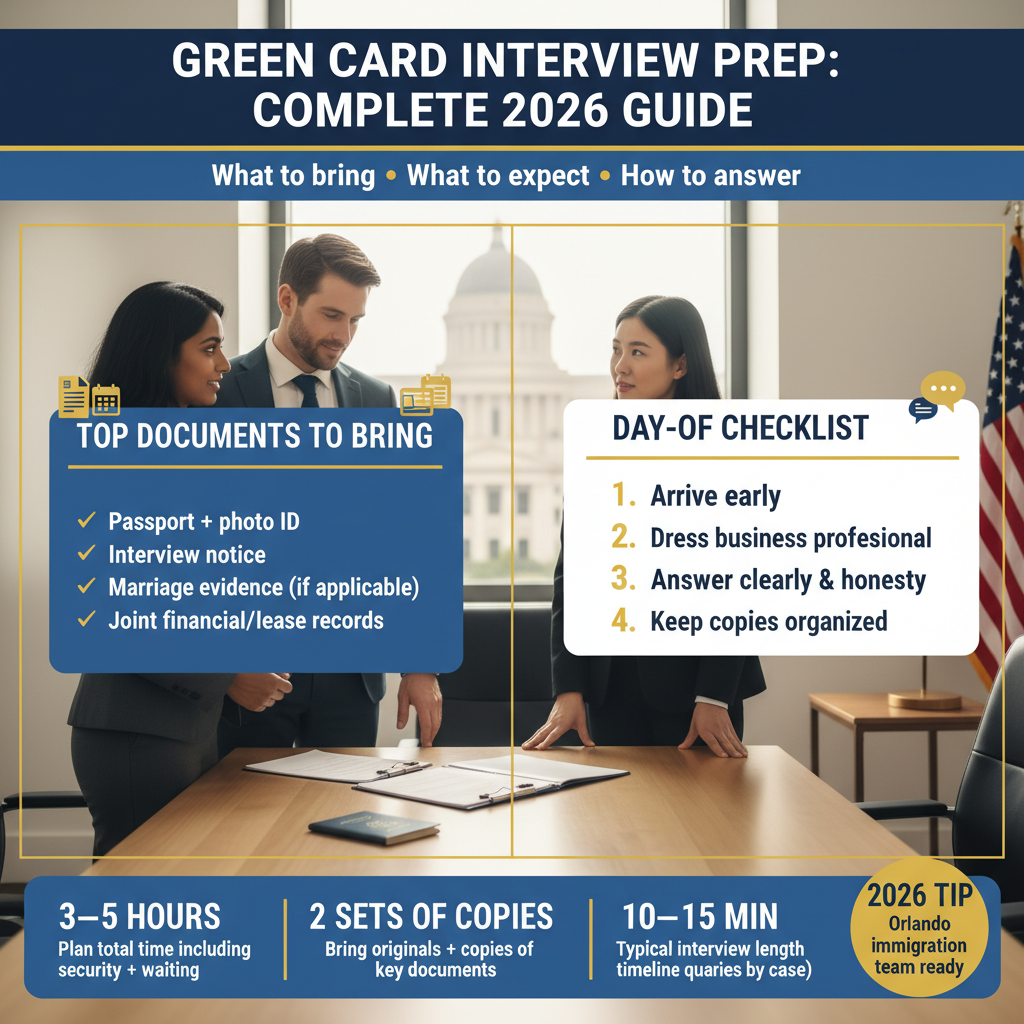
Immigration questions about interviews and adjudications continue trending nationwide. This guide is informed by ongoing coverage and public interest reflected in: Green Card Interview Preparation Tips (Immigration Law).
Need Help? Our Orlando immigration team is ready to assist. Call +1 786-791-3106 for a free consultation, or message us online. Se Habla Español.
What This News Means for Immigrants in Orlando and Across Florida
Why this news is showing up now
Green card interviews are a major stress point for families because they are often the final, make-or-break step in a case. When immigration news trends, it usually reflects real-world patterns: more people filing, shifting USCIS staffing and priorities, and increased scrutiny in certain categories. Even when the law has not changed, interview outcomes can vary based on:
- USCIS workload and local field office practices
- Quality and consistency of the filing package (especially Form I-130 and Form I-485)
- Security and background checks
- Requests for Evidence (RFEs) and Notices of Intent to Deny (NOIDs)
- Policy guidance and training updates that affect how officers ask questions
Reminder: A “trending topic” does not necessarily mean a new law passed—it often means more people are encountering the same problem at the same time: interview scheduling, document confusion, and fear of denial.
How it can affect Florida residents
Florida is home to many immigrant communities, including large populations of family-based applicants, Cuban and Venezuelan families, and employment-based applicants relocating to the I-4 corridor for work. For Central Florida residents, interview preparation matters because:
- Field offices can have different local expectations for how evidence is organized and presented.
- Travel and rescheduling can be costly, especially if you work hourly jobs or have childcare needs.
- Small inconsistencies (addresses, dates, prior entries) can lead to delays, RFEs, or a second interview.
If your case is in Orlando, your interview will typically be handled by the Orlando USCIS Field Office (depending on your ZIP code and case type). That means planning ahead for traffic on the I-4 corridor, parking, arrival time, and ensuring every applicant and petitioner attends when required.
Important: Missing an interview without properly requesting rescheduling can result in denial or case closure. If you cannot attend, get legal advice immediately.
What Green Card Interview Preparation Tips Is (and Why It Matters)
A plain-English definition
“Green card interview preparation” means getting your documents, timeline, and answers ready for the USCIS interview that decides whether your application for lawful permanent residence should be approved. Most interviews focus on:
- Identity and eligibility (who you are and whether you qualify)
- Admissibility (whether any issues make you ineligible to receive a green card)
- Truthfulness and consistency (whether your forms and evidence match your testimony)
- Relationship authenticity (for marriage and certain family-based cases)
In many cases, the interview is straightforward. In others—especially where there are prior immigration violations, arrests, prior marriages, or complicated travel history—interview preparation can be the difference between approval and months (or years) of delay.
Key terms you need to know
- Adjustment of Status: Applying for a green card from inside the U.S., usually using Form I-485.
- Consular Processing: Applying for an immigrant visa abroad through the U.S. Department of State.
- Form I-130: Petition for Alien Relative (often the first step in a family-based case).
- Form I-485: Application to Register Permanent Residence or Adjust Status.
- Priority Date: Your place in line for certain green card categories (especially employment and some family categories).
- RFE: Request for Evidence—USCIS asks for missing/unclear documents.
- NOID: Notice of Intent to Deny—USCIS plans to deny unless you respond strongly.
- Admissibility: Whether the law allows you to receive a green card (health, crime, immigration history, misrepresentation, etc.).
- Warning: Misrepresentation (lying or presenting false documents) can create long-term bars and serious consequences.
Current Immigration Law: The Foundation
Green card interviews are governed by federal immigration law, primarily the Immigration and Nationality Act (INA) and related regulations in the Code of Federal Regulations (CFR). USCIS uses these laws to verify eligibility and admissibility before approving permanent residence.
Federal requirements
Most interview-based green card cases involve these legal building blocks:
- INA § 245 (Adjustment of Status): The main statute governing Adjustment of Status through Form I-485.
- 8 CFR § 245: Regulations that implement INA adjustment rules (including interview authority, evidence, and discretion).
- INA § 212(a) (Grounds of Inadmissibility): Health-related, criminal, immigration violations, public charge-related considerations, and misrepresentation issues—often explored at interview.
- INA § 204 (Petitions): Governs family and employment petitions such as Form I-130.
- Identity and civil document rules, including the requirement to present originals at interview when requested.
USCIS publishes official instructions and updates on the USCIS official website, including form instructions on USCIS Forms and typical processing ranges on USCIS Processing Times.
Important: Form instructions are not “optional.” Officers frequently ask questions that map directly to the yes/no admissibility questions on Form I-485.
Florida-specific considerations
Immigration is federal law, so Florida does not create green card eligibility rules. However, Florida-specific realities can affect preparation:
- Document access: If you need certified court dispositions from Orange County (or other Florida counties), request them early—court retrieval can take time.
- Address history: Many applicants move frequently around the I-4 corridor (Orlando, Kissimmee, Sanford, Lakeland, Tampa). Keep a clean address timeline that matches your forms.
- Traffic/logistics: The Orlando USCIS Field Office area can be congested; plan to arrive early with printed appointment notice and IDs.
- Language: If you need an interpreter, plan ahead. USCIS rules about interpreters and who may serve can vary by case type and local practice.
Reminder: If you have any past arrests—even if charges were dropped—bring certified dispositions. Do not assume “it was dismissed” means “USCIS won’t ask.”
How to Prepare for Your Green Card Interview: A Complete Step-by-Step Guide
1) Confirm your interview type, location, and who must attend
Start by reading your interview notice carefully. Determine whether you are attending:
- Adjustment of Status interview (usually local USCIS field office)
- Marriage-based interview (may involve both spouses and deeper relationship questions)
- Employment-based interview (less common, but still possible)
- Follow-up interview (second interview or “Stokes”-style separate questioning in some cases)
If your case is in Orlando, confirm whether your appointment is at the Orlando USCIS Field Office and plan your route from Orange County or along the I-4 corridor.
Documents to gather for this step:
- Interview appointment notice (original)
- Government-issued photo IDs (passport, driver’s license/state ID)
- Any USCIS receipt notices for Form I-130, Form I-485, Form I-765, Form I-131 (if filed)
- A list of all applicants/derivatives and who must appear
2) Rebuild your entire filing package and check for consistency
Officers often compare your interview answers to what you already submitted. Your goal is consistency across:
- Names (including prior names), dates of birth, and passport numbers
- Address history and employment history
- Entry history (I-94, visa type, dates of entry/exit)
- Marital history (prior marriages, divorce dates, children)
Create a “mirror copy” binder: everything you filed, plus updates. If you used a preparer, ask for a complete copy.
Documents to gather for this step:
- Full copy of submitted Form I-130 and supporting evidence
- Full copy of submitted Form I-485 and supporting evidence
- Copy of medical exam submission details (if already filed) or plan to bring sealed exam if instructed
- All USCIS notices (biometrics, RFEs, approvals, transfers)
- Printout of your Priority Date information if relevant (employment/family preference)
Warning: If you discover an error (wrong date, missing address, incorrect “yes/no” answer), do not “wing it” at interview. Talk to an attorney about the safest correction strategy.
3) Organize originals and certified copies (civil documents and identity)
USCIS frequently asks to see originals, even if you already submitted copies. Bring originals in a secure folder and bring photocopies to leave with the officer if requested.
Documents to gather for this step:
- Passports (current and expired), travel documents
- Birth certificates (applicant and petitioner/sponsor as applicable)
- Marriage certificate; divorce decrees/annulments/death certificates for prior spouses
- Government-issued IDs (driver’s license/state ID)
- I-94 record (print from CBP if available) and visa pages
- Certified court dispositions for any arrests/citations (even if dismissed)
- Two passport-style photos if your notice or category suggests bringing them
If any document is not in English, bring a proper English translation with a certification.
4) Prepare relationship evidence (for marriage and family cases)
For marriage-based green cards, the officer is assessing whether the marriage is bona fide (real) and not entered into for immigration purposes. The best evidence is usually “life together” evidence, not just photos.
Documents to gather for this step:
- Joint lease/mortgage, property deed, or letter from landlord
- Utility bills showing both names or same address over time
- Joint bank statements (several months, not just one)
- Joint tax returns or IRS tax transcripts
- Health/car/renters insurance showing spouse as beneficiary/covered party
- Children’s birth certificates (if applicable)
- Photos across time with family/friends (labeled with dates/locations)
- Travel itineraries or hotel reservations showing shared trips
- Affidavits from friends/family (helpful, but usually secondary)
Important: Quality beats quantity. A well-organized set of statements spanning months/years is better than a stack of random papers from one week.
5) Review admissibility issues and prepare truthful, consistent answers
Many interviews turn on admissibility. Officers may ask about:
- Prior immigration violations (overstays, unauthorized work, prior removal orders)
- Prior visa applications and whether anything was misrepresented
- Criminal history (arrests, charges, convictions)
- Security-related questions
- Public benefits and financial sponsorship (where relevant)
Reminder: The officer may go line-by-line through the yes/no questions on Form I-485. Practice answering clearly: “Yes” or “No,” followed by a short explanation if necessary.
Documents to gather for this step:
- Certified court dispositions and sentencing records (if any)
- Immigration history documents (prior I-94s, prior approvals/denials, notices)
- Proof of compliance with prior immigration orders (if applicable)
- Updated financial sponsorship evidence (often tied to Form I-864 in family cases)
6) Prepare for interview day logistics and post-interview outcomes
Treat interview day like a formal appointment: arrive early, dress neatly, and bring a calm, respectful approach. Expect security screening similar to a courthouse.
Documents to gather for this step:
- Appointment notice (again—do not forget it)
- Organized binder: originals + copies + new evidence
- Pen and a notepad (for instructions)
- Any RFE response copies you previously sent
After the interview, USCIS may:
- Approve on the spot
- Request additional evidence (RFE)
- Hold for review (“case must be reviewed”)
- Schedule a second interview
- Issue a NOID or denial (in more serious issues)
Warning: If you receive a NOID or denial, timelines can be short. Some responses have strict deadlines, and missing them can be fatal to the case.
Need Help? Our Orlando immigration team is ready to assist. Call +1 786-791-3106 for a free consultation, or message us online. Se Habla Español.
Practical Steps You Can Take Today
Preparation is most effective when you start early. Below is a practical, do-this-now checklist that helps most applicants—especially couples preparing for a marriage interview at the Orlando USCIS Field Office.
Actionable checklist (start today)
- Create a “case timeline” document: key dates (entries, marriage, moves, jobs, filings, biometrics).
- Print and review your submitted Form I-130 and Form I-485; highlight anything you might confuse under pressure.
- Gather originals and put them in a separate “Originals Only” folder (birth, marriage, divorce, passports).
- Update relationship evidence: add the most recent 3–6 months of joint documents (bank, lease, insurance).
- Order certified court records early if there is any arrest history in Florida or elsewhere.
- Check your address on file with USCIS; file an AR-11 change if you moved (and confirm it updated).
- Practice interview questions out loud—especially dates, addresses, and “yes/no” admissibility questions.
Document preparation guidance
Organize your binder so the officer can find what they need quickly. A simple structure:
- Tab 1: Appointment notice + IDs
- Tab 2: Copies of Form I-130, Form I-485, receipt notices
- Tab 3: Civil documents (birth/marriage/divorce) + translations
- Tab 4: Immigration status documents (I-94, visas, EAD/AP if any)
- Tab 5: Financial sponsorship (if applicable) and tax evidence
- Tab 6: Relationship evidence (organized by year/month)
- Tab 7: Any criminal/court dispositions
Important: Do not submit fake documents “to strengthen” a case. USCIS can detect inconsistencies, and the consequences can be severe.
Timeline expectations (realistic planning)
Timelines vary by category and workload. Generally:
- After filing Form I-485, biometrics may be scheduled within weeks to a few months.
- Interview scheduling can take several months or longer depending on the local office.
- After interview, some cases are approved same day; others take weeks or months for final review.
To track general ranges, use USCIS Processing Times. For case-specific updates, use your USCIS online account and receipt number.
Reminder: If you are close to a travel plan, do not assume your green card will arrive by a certain date. Plan conservatively and consult an attorney if urgent travel is necessary.
How Imigrar Helps Immigrants in Orlando
At Imigrar, we help families and individuals prepare for green card interviews with a focus on clarity, organization, and credibility—so you walk in knowing what to expect and what USCIS is likely to ask. Our tagline is "Keep Families Together", and we take that mission seriously.
We assist clients in Orlando, Orange County, and throughout the I-4 corridor—and we also serve clients nationwide. Interview preparation support can include:
- Review of your full filing history for consistency and red flags
- Evidence organization strategy (what matters most, what’s redundant)
- Mock interview preparation tailored to your case type
- Support responding to RFEs/NOIDs
- Guidance on prior immigration issues, unlawful presence, unauthorized work, or arrests
Se Habla Español. If you feel more comfortable preparing in Spanish, our team can help.
Call +1 786-791-3106 for a free consultation or message us online to discuss your interview notice, timeline, and the best plan to present your case.
Need Help? Our Orlando immigration team is ready to assist. Call +1 786-791-3106 for a free consultation, or message us online. Se Habla Español.
Frequently Asked Questions
Q: What if I’m worried I’m not eligible for a green card because of a past overstay or unauthorized work?
A: Eligibility depends on your category and history. Many immediate relatives of U.S. citizens can still adjust status despite certain overstays, but other categories may not. Unauthorized work and status violations can be treated differently depending on the petitioner and the statute under INA § 245. Do not guess—bring your full entry and work history to an attorney before the interview so you do not accidentally admit to facts without understanding the legal consequence.
Q: Can the green card interview affect my current immigration status or lead to removal proceedings?
A: It can, especially if USCIS discovers a serious inadmissibility issue, fraud/misrepresentation, or an outstanding removal order. Some denied cases may be referred to immigration court depending on your situation and current policies. Immigration court is handled under the Executive Office for Immigration Review. If you have any prior removal, arrest history, or prior visa denials, get legal advice before the interview.
Q: How long after the interview will I get a decision?
A: Some applicants receive an approval the same day; others see “Case Is Being Actively Reviewed” for weeks or months. Delays can happen due to background checks, supervisor review, or missing documents. If USCIS issues an RFE, your response time and the officer’s review time will affect the final timeline. You can monitor general timelines at USCIS Processing Times.
Q: What documents are required for the green card interview?
A: At minimum, bring your interview notice, passports/IDs, originals of civil documents (birth/marriage/divorce), and a complete copy of what you filed (Form I-130 and Form I-485). For marriage cases, bring updated relationship evidence (joint lease, bank statements, taxes, insurance). If you have any arrests, bring certified dispositions. If any document is not in English, bring certified translations.
Q: How much does it cost to prepare for a green card interview with an attorney?
A: Attorney fees vary based on complexity—straightforward cases may require limited preparation, while cases with prior immigration violations, criminal history, RFEs, or possible inadmissibility waivers require more work. You should also budget for document costs (certified records, translations) and any filing fees if USCIS requests additional forms. For a clear quote, schedule a free consultation with Imigrar at +1 786-791-3106.
Q: What happens if my green card case is denied after the interview?
A: The next steps depend on the reason for denial and your current status. Some denials can be addressed with a motion to reopen/reconsider, an appeal (in limited contexts), refiling, or—if the case is referred—defending the case in immigration court. If you receive a denial or a NOID, act quickly. Warning: Deadlines can be short, and waiting can eliminate options.
Q: Do we both need to attend the marriage-based green card interview?
A: Usually, yes. USCIS typically requires both spouses to appear for a marriage-based Adjustment of Status interview unless USCIS explicitly waives the interview or gives different instructions. If one spouse cannot attend due to an emergency, consult an attorney immediately to request proper rescheduling and document the reason.
Q: Can I bring an interpreter to the Orlando USCIS Field Office interview?
A: In many cases, yes, but interpreter policies can be strict and can vary by case type and local practice. The interpreter must be competent and should not coach you. If you need an interpreter, plan ahead and confirm any special requirements listed on your interview notice. If you are unsure, speak with an attorney before your appointment.
Common Mistakes (and How to Avoid Them)
Mistake #1: Showing up with disorganized or missing originals
Many delays happen because applicants bring copies only, forget passports, or cannot produce certified divorce decrees or court dispositions. Avoid this by creating two folders: one for originals and one for copies to leave with USCIS if requested. If you’re in Orange County, request certified records early so you are not scrambling days before the interview.
Mistake #2: Inconsistent answers compared to the forms
Officers are trained to test consistency. Small differences (move-in date, job start date, prior address) can raise credibility questions. Avoid this by reviewing your exact filings—especially Form I-130 and Form I-485—and creating a shared timeline if you are a couple.
Mistake #3: Minimizing serious issues (arrests, prior removals, or misrepresentation)
Applicants sometimes say “it was expunged” or “it was dismissed” and bring no paperwork. USCIS still expects certified dispositions. Worse, some people guess answers to the admissibility questions. Avoid this by getting your records, speaking with counsel, and answering truthfully. Warning: Misrepresentation can cause long-term immigration consequences.
Additional Official Resources (Use These Carefully)
For trustworthy, up-to-date information, start with these official sources:
- USCIS official website
- USCIS Forms (instructions for Form I-130, Form I-485, and related forms)
- USCIS Processing Times
- U.S. Department of State (consular processing and immigrant visa steps)
- Executive Office for Immigration Review (immigration court information)
Reminder: Online forums and social media can be helpful for emotional support, but they are not legal advice. Your facts (entries, prior petitions, arrests, prior marriages) determine your outcome.
Need Help? Our Orlando immigration team is ready to assist. Call +1 786-791-3106 for a free consultation, or message us online. Se Habla Español.

Closing: Get Interview-Ready and Protect Your Future
A green card interview is not just a conversation—it is a legal eligibility screening under federal law. The best preparation is early, organized, and honest: know what you filed, bring originals, update evidence, and be ready to explain your history clearly.
For Central Florida residents, planning ahead for the Orlando USCIS Field Office—traffic, timing, and documents—can reduce stress and prevent avoidable rescheduling or delays.
If you want help preparing, Imigrar is here to support you. Call +1 786-791-3106 for a free consultation or message us online. Se Habla Español.


