

The reporting that sparked this guide
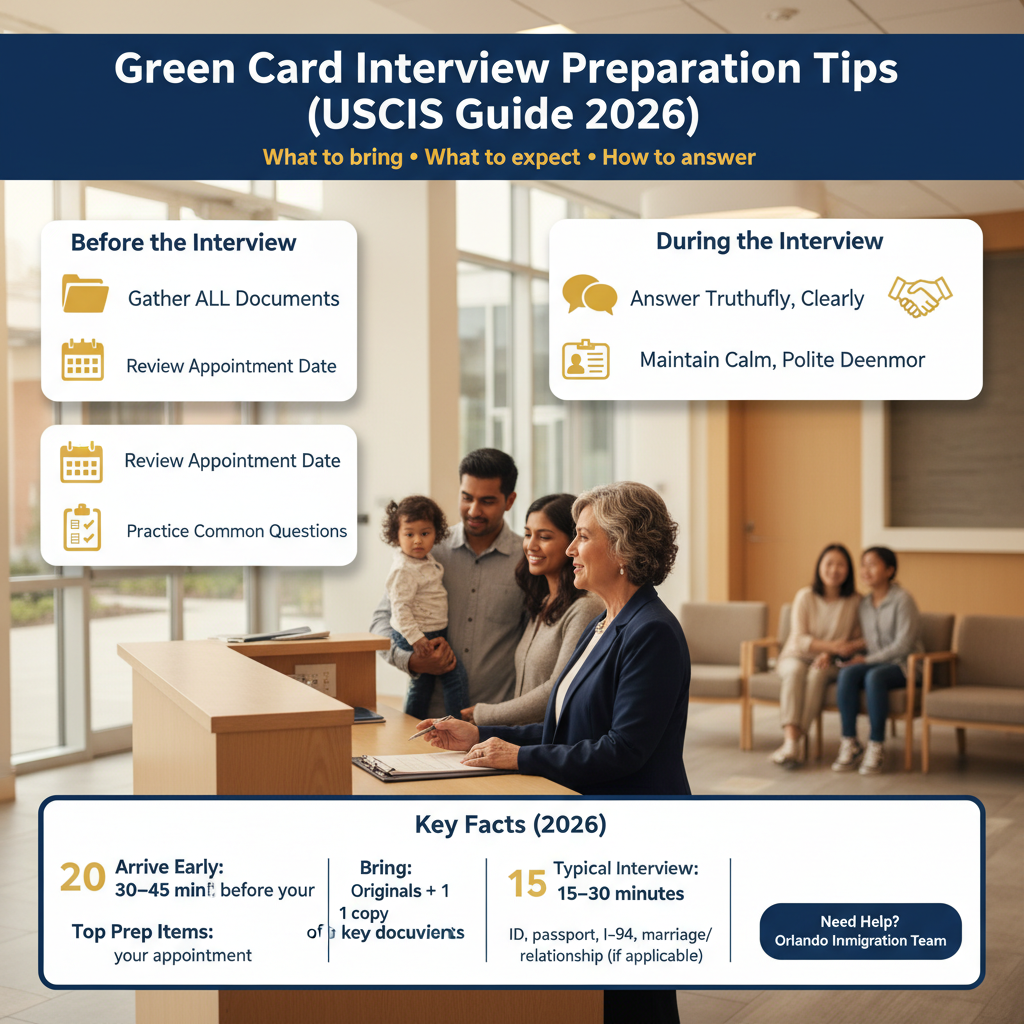
This article was inspired by ongoing coverage and public interest around green card interview preparation and immigration law updates. See the source here: Green Card Interview Preparation Tips (Immigration Law).
Need Help? Our Orlando immigration team is ready to assist. Call +1 786-791-3106 for a free consultation, or message us online. Se Habla Español.
What This News Means for Immigrants in Orlando and Across Florida
Why this news is showing up now
Green card interview preparation is trending because USCIS interview practices continue to evolve, processing backlogs shift, and more applicants are navigating complex life situations—work authorization timing, travel needs, prior immigration history, or marriage-based cases that require careful documentation. Even when the law doesn’t change, the way cases are reviewed can change based on agency priorities, fraud prevention initiatives, staffing, and field office workloads.
Reminder: Most interview problems are not caused by “trick questions.” They come from missing documents, inconsistent answers compared to the forms, or not understanding what USCIS is actually trying to confirm—identity, eligibility, admissibility, and credibility.
How it can affect Florida residents
For Florida residents—especially in Central Florida along the I-4 corridor (Orlando, Kissimmee, Sanford, and surrounding Orange County communities)—small preparation mistakes can lead to big delays. If your case is in Orlando, your interview will typically be handled by the Orlando USCIS Field Office (or another Florida field office depending on your address and case type). Field-office scheduling, local workload, and the complexity of your case can impact how quickly you receive an appointment and whether USCIS asks for extra evidence.
Important: Your goal is not just to “pass the interview.” Your goal is to present a consistent, well-organized case file that matches what you already submitted—especially your Form I-130 and Form I-485—and to be ready to address any eligibility issues confidently and truthfully.
What Green Card Interview Preparation Tips Is (and Why It Matters)
A plain-English definition
“Green card interview preparation” means getting ready for your USCIS interview by (1) understanding what USCIS must verify, (2) bringing the correct documents, (3) reviewing your immigration forms and history for accuracy, and (4) practicing how to answer questions clearly and consistently.
In many cases, the interview is the final step before approval of Adjustment of Status (getting a green card without leaving the U.S.) or the final step in a consular process after an immigrant visa interview abroad (handled by the U.S. Department of State).
Key terms you need to know
- Adjustment of Status: Applying for a green card from inside the U.S., usually using Form I-485.
- Form I-130: Petition for Alien Relative (often used in family-based cases, including marriage cases).
- Form I-485: Application to Register Permanent Residence or Adjust Status.
- Form I-864: Affidavit of Support (financial sponsorship requirement in many family-based cases).
- Form I-693: Immigration medical exam and vaccination record (sealed from the civil surgeon unless otherwise instructed).
- Priority Date: Your place in line for a visa number in certain categories (more common in preference categories than immediate relatives).
- Admissibility: Whether U.S. law allows you to become a permanent resident (issues can include certain immigration violations, crimes, misrepresentation, health-related grounds, and more).
- RFE: Request for Evidence—USCIS asks for additional documents before deciding.
- NOID: Notice of Intent to Deny—USCIS plans to deny unless you respond with strong evidence.
Warning: If anything in your background raises admissibility concerns (prior removal order, unlawful presence, prior marriage petitions, arrests—even if charges were dismissed), interview preparation should include a legal review before you attend.
Current Immigration Law: The Foundation
USCIS interviews are governed by federal immigration law, regulations, and agency policy. While this article provides general education, your exact requirements depend on your category (marriage-based, parent/child, employment-based, asylum-based adjustment, etc.).
Helpful official starting points include the USCIS official website and the USCIS Forms page where USCIS posts current editions and instructions.
Federal requirements
The main legal framework includes the Immigration and Nationality Act (INA) and federal regulations in Title 8 of the Code of Federal Regulations (8 C.F.R.). Many family-based adjustment cases rely on:
- INA § 245 (Adjustment of Status) and related regulations (8 C.F.R. § 245).
- INA § 204 (family-based petitions) and related regulations (8 C.F.R. § 204).
- Public charge and financial sponsorship rules (typically through Form I-864 in family cases).
- Medical admissibility requirements supported by Form I-693.
USCIS officers use the interview to confirm:
- Identity and biographic information (name, date of birth, address history).
- Eligibility under your category (e.g., valid marriage, qualifying relationship, valid entry, visa availability).
- Truthfulness and consistency with filed forms and prior records.
- Admissibility (criminal, immigration, security, and other grounds).
You can track general timeframes using USCIS Processing Times, but note that interview scheduling varies by field office and case complexity.
Florida-specific considerations
Immigration law is federal, but Florida-specific realities matter: local field office scheduling, local documentation norms, and practical issues like language access and travel logistics. For Central Florida residents, the Orlando area’s growth and high demand can influence appointment availability.
If your case is in Orlando, plan your interview day around I-4 corridor traffic patterns, parking, and arrival time. Being late can cause rescheduling—sometimes adding months of delay.
Important: Florida also has unique practical concerns for applicants with prior interactions with state law enforcement. If you have any arrest record in Florida (including Orange County), bring certified dispositions and consult counsel about how to present the record accurately.
Common USCIS forms that appear in green card interview preparation include Form I-130, Form I-485, Form I-864, Form I-693, Form I-765 (work permit), and Form I-131 (Advance Parole).
How to Prepare for Your Green Card Interview: A Complete Step-by-Step Guide
1) Confirm your interview type, location, and who must attend
Start by reading your interview notice carefully. USCIS will specify the date, time, and address (often the field office). In many marriage-based Adjustment of Status cases, both spouses must attend. In some cases (like certain employment-based adjustments), the petitioner/employer does not attend, but the applicant does.
If your case is in Orlando, verify whether your notice lists the Orlando USCIS Field Office and confirm the address on the notice (do not rely on old addresses from online searches).
- Documents to gather for this step:
- Original interview notice (Form I-797 notice).
- Government-issued photo IDs (passport, driver’s license, state ID).
- Any USCIS appointment notices (biometrics, RFEs, etc.).
- Proof of name changes (marriage certificate, court order), if applicable.
Reminder: If you need an interpreter, USCIS rules and practices can vary by office and case type. Review your notice and USCIS guidance and talk to counsel before the interview day to avoid surprises.
2) Rebuild your “case story” from the forms you filed (and fix inconsistencies)
USCIS interviews often focus on what you already submitted. You should reread every page of your filed packet, especially Form I-485 (yes/no inadmissibility questions), Form I-130, and any written statements. If something is wrong, you may be able to correct it at the interview—but you must do it carefully and truthfully.
Officers commonly verify:
- All prior addresses and dates.
- All prior employment and education history.
- All prior marriages/divorces and dates.
- How you met (for marriage cases), relationship timeline, and shared life evidence.
- Prior immigration filings, entries, exits, and visa history.
- Documents to gather for this step:
- Complete copies of everything filed with USCIS (your full submission packet).
- Receipts for Form I-130 and Form I-485 (I-797 receipts).
- Any RFE responses and delivery confirmations.
- Prior immigration approvals/denials, if any.
Warning: Do not “guess” during the interview. If you don’t know a date, say so and provide an approximate timeframe only if you are confident. Inconsistencies can trigger delays, RFEs, or deeper questioning.
3) Assemble originals + a clean, labeled evidence binder (relationship, identity, eligibility)
Think of your interview as a presentation: organized evidence reduces stress and makes it easier for the officer to confirm eligibility. Bring originals where required and copies to hand over if requested.
For marriage-based cases, bring strong “bona fide marriage” evidence that covers the entire relationship—from before marriage to the present.
- Documents to gather for this step (core set):
- Passports (current and expired), travel documents, and I-94 record (printout if applicable).
- Birth certificates (with certified translation if not in English).
- Marriage certificate; divorce decrees/annulments for all prior marriages.
- Form I-693 sealed medical exam (if not already submitted or if USCIS requests an updated one).
- Two passport-style photos (if your notice requests them).
- Documents to gather for this step (marriage evidence examples):
- Joint lease/mortgage, deed, or landlord letter + proof of shared residence.
- Joint bank statements (ideally several months, spread over time).
- Joint credit cards, insurance policies (health, auto, renters), and beneficiary designations.
- Utility bills showing both names or a consistent shared address history.
- Photos together over time with captions (dates/locations/people).
- Travel itineraries, hotel bookings, and event tickets.
- Affidavits from friends/family (if helpful), notarized where possible.
- Children’s birth certificates (if applicable).
Important: Quality matters more than quantity. Ten well-chosen documents that clearly show a shared life can be more persuasive than 200 pages of random screenshots.
4) Prepare for the financial sponsorship review (Form I-864) and public charge-related questions
In many family-based cases, USCIS will review whether the petitioner (and any joint sponsor) meets the income requirements through Form I-864. Even if you already submitted it, officers can ask for updated proof if your interview occurs months later.
- Documents to gather for this step:
- Most recent federal tax return (IRS Form 1040) and W-2/1099s for the sponsor.
- IRS tax transcripts (often preferred when available).
- Recent pay stubs (last 1–3 months).
- Employment verification letter (role, salary, start date).
- If using assets: bank statements, proof of ownership/value, and explanations.
- If using a joint sponsor: their Form I-864 packet and proof of status (passport, birth certificate, or green card).
Reminder: If your sponsor changed jobs, had a drop in income, or filed taxes jointly with a spouse, plan ahead so you can explain the numbers clearly and provide updated evidence.
5) Practice interview questions and plan your interview-day logistics
Interview day is not the time to improvise. Practice answering questions out loud. In marriage cases, each spouse should be able to describe key facts consistently: where you live, how bills are paid, important dates, and the story of your relationship.
Logistics matter, especially for Central Florida residents driving the I-4 corridor:
- Plan to arrive 30–45 minutes early.
- Bring the interview notice for building entry.
- Expect airport-style security screening.
- Do not bring prohibited items (check your notice and local building rules).
- Documents to gather for this step:
- A neatly organized binder (originals + copies).
- A one-page “case summary” (optional) listing key dates and filings.
- Pen and a small notepad (if allowed) for notes.
Warning: If you recently moved, update your address with USCIS properly and bring proof of the update. Missing notices due to an address issue can lead to denial for failure to appear.
6) Understand possible outcomes and how to respond quickly after the interview
Many cases are approved the same day or shortly after, but it’s also normal to receive “case held for review,” an RFE, or a request for updated medical or additional documents.
- Documents to gather for this step:
- Any documents the officer requests (write down exactly what is requested).
- Updated Form I-693 if your medical is expired or missing.
- Certified court dispositions if any criminal history was discussed.
- Additional relationship evidence covering the most recent months.
Important: If you receive an RFE/NOID, pay attention to deadlines. Some notices give only a short window to respond. Missing a deadline can result in denial.
Need Help? Our Orlando immigration team is ready to assist. Call +1 786-791-3106 for a free consultation, or message us online. Se Habla Español.
Practical Steps You Can Take Today
If your interview is coming up, the best time to prepare is now. Here is a practical checklist you can start today—whether your appointment is in two weeks or two months.
Actionable checklist (start now)
- Create a “USCIS Interview” folder (physical binder + digital scan backup).
- Print and review your filed Form I-130 and Form I-485 line-by-line; highlight anything you’re unsure about.
- Update relationship evidence through the current month (new statements, new lease, new insurance cards).
- Gather updated financial evidence for Form I-864 (tax transcript, pay stubs, employment letter).
- Check whether your medical (Form I-693) is valid and in the correct format (sealed if required).
- Order certified court dispositions for any arrests/citations—even if dismissed.
- Plan your route to the interview location and take time off work.
- If you need an interpreter, confirm the plan in advance.
Document preparation guidance
Organize documents by category with labeled tabs:
- Tab A: Interview notice + IDs
- Tab B: Civil documents (birth, marriage, divorce)
- Tab C: Immigration history (I-94, visas, prior approvals)
- Tab D: Financial sponsorship (Form I-864 evidence)
- Tab E: Relationship evidence (timeline order)
- Tab F: Any special issues (court records, waivers, prior overstays)
Reminder: If a document is not in English, provide a proper certified translation. Missing translations can delay approval.
Timeline expectations (real-world)
Interview scheduling and decisions vary widely. You can monitor baseline ranges using USCIS Processing Times, but keep these practical expectations in mind:
- Many applicants wait months between filing and interview scheduling.
- It’s common to receive a decision within days to several weeks after interview, but some cases take longer if additional review is needed.
- If USCIS issues an RFE, your case timeline can extend significantly depending on how quickly you respond and how quickly USCIS reviews it.
Important: If you are relying on work authorization or travel permission, plan ahead. If you travel without valid Advance Parole in many Adjustment of Status situations, USCIS may treat the application as abandoned.
How Imigrar Helps Immigrants in Orlando
At Imigrar, we help families prepare for green card interviews with a focus on clarity, organization, and credibility—so you walk into your appointment knowing what to expect and what USCIS needs to approve your case. We’re based in Orlando, Florida and serve clients nationwide, with a mission to Keep Families Together.
Our support commonly includes:
- Case strategy review for Form I-130/Form I-485 filings and interview readiness.
- Evidence organization and “missing piece” identification (relationship, financial, identity).
- Mock interview preparation tailored to your case facts.
- Legal analysis of admissibility concerns (prior immigration history, arrests, misrepresentation risks).
- RFE/NOID responses and post-interview follow-up.
We offer a free consultation by phone at +1 786-791-3106. Se Habla Español.
Need Help? Our Orlando immigration team is ready to assist. Call +1 786-791-3106 for a free consultation, or message us online. Se Habla Español.
Frequently Asked Questions
Q: Am I eligible for a green card if I overstayed my visa?
A: Many people who overstayed may still be eligible through Adjustment of Status if they are an immediate relative of a U.S. citizen (such as a spouse, unmarried child under 21, or parent of a U.S. citizen over 21) and meet other requirements. However, eligibility depends on your entry history, any prior removal orders, and whether other inadmissibility issues apply. Bring your I-94/entry evidence and consult an attorney before the interview if you have any complicated history.
Q: Will the green card interview affect my current immigration status?
A: The interview itself does not automatically change your status, but what you disclose and what USCIS finds can affect your case. If USCIS believes there is fraud, misrepresentation, or inadmissibility, it can lead to denial and potentially referral to immigration court in some situations. If you have concerns, review your full filing history and any prior encounters with immigration authorities before attending.
Q: How long after the interview will I get a decision?
A: Some applicants are approved the same day; others receive a decision in days or weeks. If the officer needs more evidence or supervisory review, it can take longer. Check your case status online and compare general ranges using USCIS Processing Times. If your case is in Orlando, local workload at the Orlando USCIS Field Office can influence timing.
Q: What documents should I bring to my green card interview?
A: Bring your interview notice, passports/IDs, civil documents (birth/marriage/divorce), copies of your entire filing packet, updated relationship evidence (if marriage-based), and updated financial sponsorship evidence for Form I-864. If USCIS requests it, bring a sealed Form I-693. If you have any arrests, bring certified dispositions. When in doubt, bring both originals and copies.
Q: How much does the green card interview process cost?
A: USCIS fees depend on the forms you filed (commonly Form I-485 and related forms). There may also be costs for the medical exam (Form I-693), certified translations, and obtaining certified court records. Attorney fees vary by complexity. For official filing fee details and form editions, use USCIS Forms and the USCIS official website.
Q: What happens if my green card is denied after the interview?
A: A denial can happen for missing evidence, credibility concerns, ineligibility, or admissibility issues. Next steps depend on the reason: you may be able to file a motion to reopen/reconsider, refile, appeal certain decisions, or address issues through a waiver (if available). In some scenarios, USCIS may refer the case to immigration court. If you receive a denial, act quickly—deadlines can be short—and consult counsel immediately.
Q: Can my spouse and I be separated for questioning (Stokes-style interview)?
A: USCIS can separate spouses when it believes more detailed questioning is needed to confirm a bona fide marriage. Not every case involves this. The best preparation is consistency: review your timeline, living arrangements, finances, and daily routines. If you anticipate heightened scrutiny (short courtship, prior petitions, big age difference, limited cohabitation), legal preparation is especially helpful.
Q: Do I need to bring my children to the interview?
A: It depends on your notice and who is applying. Sometimes derivative applicants or children with separate applications must attend; other times they do not. Follow the instructions on your interview notice and ask your attorney if unclear.
Common Mistakes (and How to Avoid Them)
Mistake #1: Showing up without updated, organized evidence
Many applicants bring only what they filed months ago. USCIS often wants to see what has happened since filing—new leases, new bank statements, new insurance, and updated tax documents. Avoid this by updating your evidence through the current month and organizing it in a labeled binder.
Mistake #2: Not reviewing the exact answers on Form I-485 and Form I-130
Officers frequently ask questions that mirror your forms. If you contradict your own filing—even accidentally—it can create credibility issues. Avoid this by rereading your full packet and preparing explanations for any changes (new job, new address, corrected dates).
Mistake #3: Minimizing past immigration or criminal issues
Applicants sometimes assume that an old overstay, a prior denial, or an arrest “doesn’t matter.” USCIS can see a lot through its systems. Avoid this by disclosing issues to your attorney early, obtaining certified records, and preparing a truthful, consistent explanation. If a waiver may be needed, do not wait until after the interview to plan.
Additional Official Resources (Use These to Verify Details)
- USCIS official website
- USCIS Forms
- USCIS Processing Times
- U.S. Department of State (for consular processing and immigrant visa interviews abroad)
- Executive Office for Immigration Review (immigration court information, if your case intersects with removal proceedings)
Reminder: USCIS rules can be technical, and your facts matter. Use official sources for verification, and seek legal advice for case-specific strategy.
Need Help? Our Orlando immigration team is ready to assist. Call +1 786-791-3106 for a free consultation, or message us online. Se Habla Español.
Closing: Get Interview-Ready with Imigrar (Orlando, Florida)
A successful green card interview is rarely about luck—it’s about preparation, documentation, and consistency. Whether you’re attending at the Orlando USCIS Field Office or another Florida location, having a clear plan can reduce stress and help avoid delays.
If you want help preparing your evidence binder, reviewing your Form I-130/Form I-485 answers, or practicing for interview questions—Imigrar is here to help. We serve Orlando, Orange County, and clients across the I-4 corridor and nationwide.
Call +1 786-791-3106 for a free consultation or message us online. Se Habla Español. Our mission is to Keep Families Together.


