


The reporting that sparked this guide
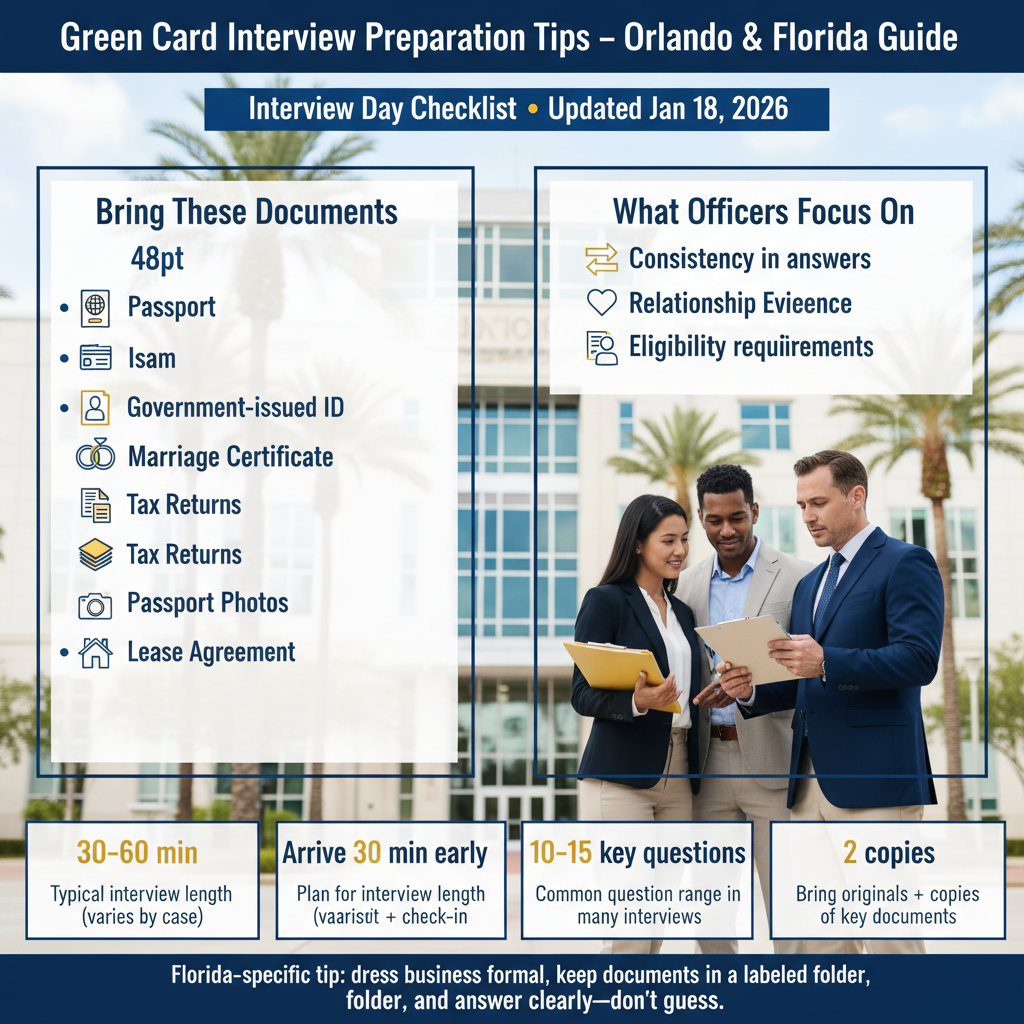
Immigration interview preparation has been trending in recent immigration coverage and analysis. This guide was inspired by: Green Card Interview Preparation Tips (Immigration Law).
Reminder: News headlines can move fast. The rules that decide your case come from federal immigration statutes, regulations, and official agency policy. We’ll translate those rules into a practical, interview-ready plan.
Need Help? Our Orlando immigration team is ready to assist. Call +1 786-791-3106 for a free consultation, or message us online. Se Habla Español.
What This News Means for Immigrants in Orlando and Across Florida
Why this news is showing up now
Green card interviews are back in the spotlight because many applicants are reaching the “final mile” after months (sometimes years) of waiting. Several factors drive the renewed attention:
- USCIS processing shifts: Wait times and interview scheduling patterns change as USCIS reallocates staff and prioritizes certain case types. You can check your category at USCIS Processing Times.
- Higher scrutiny on documentation: USCIS officers are trained to look for inconsistencies across forms, supporting evidence, and prior immigration history.
- More self-filed cases: Many families file without legal support, then realize late in the process that the interview is where small mistakes can become big problems.
- Marriage-based cases remain heavily interview-driven: While some applicants may be waived, many still attend interviews—especially where USCIS wants to confirm the relationship is bona fide.
Important: Even if you feel your case is “simple,” the interview is a legal proceeding. The officer’s job is to verify eligibility, identity, admissibility, and credibility.
How it can affect Florida residents
Florida is home to large immigrant communities and mixed-status families. That means green card interviews often involve real-life complexities: prior entries, visa overstays, old arrests, prior marriages, name variations, and international travel.
If your case is in Orlando, you may be scheduled at the Orlando USCIS Field Office. For Central Florida residents across Orange County and the I-4 corridor (including areas like Kissimmee, Sanford, Altamonte Springs, and surrounding communities), interview logistics matter:
- Arriving early (parking and security lines can be unpredictable).
- Bringing the right originals (not only photocopies).
- Preparing for relationship and eligibility questions that may feel personal but are legally relevant.
Warning: A missed interview or incomplete evidence can lead to delays, a request for evidence (RFE), a Notice of Intent to Deny (NOID), or denial—sometimes triggering removal (deportation) risk depending on your status history.
What Green Card Interview Preparation Tips Is (and Why It Matters)
A plain-English definition
“Green card interview preparation” means getting your case, documents, and testimony ready so that, when USCIS asks questions, your answers match your paperwork and the law. The goal is to help the officer confirm:
- You filed the correct immigration forms (commonly Form I-130 and Form I-485 in family cases).
- You are eligible for permanent residence under the category you applied for.
- You are not inadmissible (for example, due to certain immigration violations, fraud, or criminal issues).
- Your relationship (if marriage-based) is real and not solely for immigration benefits.
In many cases, strong preparation can shorten the process because it reduces the chance of follow-up requests and helps the officer feel confident approving the case.
Key terms you need to know
- Adjustment of Status: Applying for a green card from inside the U.S., usually using Form I-485.
- Consular Processing: Getting an immigrant visa interview abroad through a U.S. consulate (handled through the U.S. Department of State).
- Form I-130: Petition for Alien Relative (usually filed by a U.S. citizen or lawful permanent resident family member).
- Form I-485: Application to Register Permanent Residence or Adjust Status.
- Priority Date: Your place in line for certain family- and employment-based categories (especially when visas are limited).
- Admissibility: Whether immigration law allows you to receive a green card (health, criminal, fraud, immigration history, public charge, etc.).
- RFE / NOID: A Request for Evidence or Notice of Intent to Deny—signals USCIS needs more proof or sees a potential denial issue.
Reminder: Your interview is not only about your relationship. Officers verify identity, prior immigration history, and whether every answer on your forms is truthful and consistent.
Need Help? Our Orlando immigration team is ready to assist. Call +1 786-791-3106 for a free consultation, or message us online. Se Habla Español.
Current Immigration Law: The Foundation
Green card interviews are governed by federal immigration law, USCIS regulations, and policy guidance. While your interview feels conversational, the legal framework is strict.
Core legal authorities include:
- The Immigration and Nationality Act (INA), including INA § 245 (adjustment of status) and INA § 204 (family petitions).
- Federal regulations at 8 C.F.R. § 245 (adjustment) and 8 C.F.R. § 204 (petitions).
- USCIS policy guidance and form instructions published on the USCIS official website.
Federal requirements
Most applicants attending a green card interview through Adjustment of Status must show:
- Proper filing of Form I-485 (and usually Form I-130 if family-based), with fees, signatures, and supporting evidence.
- Eligibility under the category (immediate relative, preference category, employment-based, etc.).
- Admissibility (no disqualifying issues, or eligibility for a waiver if a ground applies).
- Truthfulness: Misrepresentation can lead to denial and long-term bars.
Common related forms and concepts you may see:
- Form I-864 (Affidavit of Support) in most family-based cases.
- Form I-693 (Medical Examination) completed by a USCIS-designated civil surgeon.
- Form I-765 (work permit) and Form I-131 (advance parole travel document) if filed concurrently.
- Form AR-11 (address change) if you moved after filing.
You can find official form editions and instructions at USCIS Forms.
Florida-specific considerations
Immigration law is federal, but Florida residents often face practical and procedural considerations:
- Local field office practices: The Orlando USCIS Field Office may have its own scheduling flow and expectations for document organization.
- Name formats and bilingual records: Many Central Florida families have civil documents from Latin America with two last names, accents, or spelling variations—these must be consistent across Form I-130, Form I-485, and supporting records.
- Prior interactions with Florida courts: Arrests, injunctions, or expunged records can still matter for immigration. Bring certified dispositions.
- Travel and ports of entry: Florida airports and cruise ports are common entry points; your I-94 history and entry documents should match what you reported.
Warning: If you have any arrest history—even if charges were dropped—talk to an attorney before the interview. Immigration consequences can differ from criminal outcomes.
How to Prepare for Your Green Card Interview: A Complete Step-by-Step Guide
1) Confirm your interview type and review your entire filing packet
Start by identifying what kind of interview you have. Most readers mean a USCIS in-person interview for Adjustment of Status based on family (often marriage). But interviews also happen for employment-based adjustments and certain humanitarian categories.
- Read your interview notice carefully (date, time, location, required items).
- Compare the notice to your case type: Form I-130, Form I-485, or other basis.
- Re-read every answer you submitted—especially “yes/no” admissibility questions.
Documents to gather for Step 1 (bring originals + copies):
- Interview notice (Form I-797C notice).
- Complete copies of what you filed (your Form I-130, Form I-485, and all supporting evidence).
- All RFEs/NOIDs and your responses (if any).
- Your receipt notices for each form filed.
Important: If you discover a mistake in your filing (wrong address history, missing trip, incorrect employment dates), do not “wing it” at the interview. Preparation includes planning how to correct errors appropriately.
2) Build a “USCIS-ready” identity and civil documents folder
Officers must confirm identity and eligibility using original civil documents. Missing originals is one of the most avoidable causes of delays.
Documents to gather for Step 2:
- Passports (current and expired) for the applicant; bring all used passports if possible.
- Government-issued photo ID (driver’s license or state ID).
- Birth certificates (long-form) with certified English translations if not in English.
- Marriage certificate (and divorce decrees/annulments/death certificates for all prior marriages for either spouse).
- I-94 record (print from CBP if available) and entry documents/visa page.
- Name change orders (if any).
Reminder: Any foreign-language document should include a proper English translation with a translator certification.
3) Prepare financial sponsorship and household evidence (especially Form I-864)
In most family-based cases, the officer will confirm the petitioner can financially sponsor the applicant. This is often centered on Form I-864.
Documents to gather for Step 3:
- Most recent federal tax return (and W-2/1099s) for the sponsor; bring the last 3 years if available.
- Recent pay stubs (typically last 1–3 months).
- Employment verification letter (job title, salary, start date).
- Proof of assets if income is insufficient (bank statements, property valuations).
- If using a joint sponsor: joint sponsor’s Form I-864 package with proof of status (passport, naturalization certificate, or green card).
Warning: If the sponsor changed jobs, became self-employed, or had a major income change since filing, plan to explain it with updated evidence.
4) Organize relationship evidence (marriage-based cases)
If your green card is based on marriage, the interview often focuses on whether the marriage is bona fide. Strong evidence is not just romantic—it’s practical proof you built a life together.
Documents to gather for Step 4:
- Joint lease/mortgage and proof of shared address (utility bills, mail, insurance).
- Joint bank account statements (showing real use, not just a newly opened account).
- Joint credit cards, loans, or shared financial obligations.
- Health, auto, renter’s, or life insurance showing each other as beneficiaries.
- Children’s birth certificates (if applicable).
- Photos over time with family and friends (labeled with dates/locations).
- Travel itineraries, hotel bookings, event tickets, and communication logs if living apart.
- Affidavits from friends/family (helpful, but usually secondary to financial/cohabitation proof).
For Central Florida residents, consider adding practical items that reflect daily life along the I-4 corridor—commuting patterns, shared childcare schedules, or joint memberships—so long as they are truthful and documented.
5) Rehearse the interview: questions, corrections, and consistency
Preparation includes practicing how to answer without guessing, exaggerating, or contradicting your forms. USCIS officers often ask:
- Biographic questions (full names, DOB, addresses, parents’ names).
- Timeline questions (when you met, when you moved in, key dates).
- Admissibility questions from Form I-485 (arrests, immigration violations, prior removals, misrepresentation).
- Employment and travel history questions.
Documents to gather for Step 5:
- A one-page relationship timeline (for your own preparation).
- Updated address/employment history list (matching what was filed, noting changes).
- Certified court dispositions if any contact with law enforcement occurred.
Important: If you don’t know an answer, it is usually better to say “I don’t remember exactly” than to guess. Guessing can create inconsistencies that look like dishonesty.
6) Plan the day-of logistics for the Orlando USCIS Field Office (or your assigned office)
The interview is also a logistics test: arriving late, forgetting documents, or bringing prohibited items can derail your day.
Documents/items to gather for Step 6:
- Interview notice and government IDs (for building entry).
- Your organized binder (originals + copies, tabbed sections).
- Interpreter plan (if needed) consistent with USCIS rules and your notice.
- Any updated evidence since filing (new lease, new baby, new job, new taxes).
If your case is in Orlando, plan extra time for traffic patterns common in Orange County and the I-4 corridor. Aim to arrive at least 30–45 minutes early for parking and security screening.
7) Know what happens after the interview (and how to respond fast)
After the interview, USCIS may:
- Approve on the spot (sometimes you’ll be told verbally; sometimes approval comes later online).
- Request more evidence (RFE) or issue a NOID.
- Continue the case for review (common when background checks or supervisor review is needed).
Documents to prepare for Step 7:
- A scanned copy of everything you brought (so you can respond quickly to an RFE).
- A plan to track your case online and by mail.
- Your updated address confirmation (file Form AR-11 if you move).
Reminder: Many RFEs have strict deadlines. Missing them can lead to denial. While deadlines vary, treat any USCIS deadline as urgent and respond early whenever possible.
Need Help? Our Orlando immigration team is ready to assist. Call +1 786-791-3106 for a free consultation, or message us online. Se Habla Español.
Practical Steps You Can Take Today
Here’s an actionable checklist you can start right now—whether your interview is in two weeks or two months.
Actionable preparation checklist
- Print and review your filed Form I-130 and Form I-485 line-by-line; highlight anything that changed.
- Create a tabbed binder with sections: Notices, IDs, Civil Docs, Medical (Form I-693), Financial (Form I-864), Relationship Evidence, Immigration History, Other.
- Collect originals (birth/marriage/divorce documents). Keep copies to hand to the officer if requested.
- Update your evidence: bring new joint documents created after filing (new lease renewal, new insurance, new bank statements).
- Practice admissibility questions: arrests, citations, prior immigration violations, misrepresentation—prepare honest, consistent explanations.
- Check medical timing: ensure your Form I-693 is properly sealed if you’re bringing it, and that it’s still valid per USCIS rules.
- Track your timeline using USCIS Processing Times and keep your address current.
Document preparation guidance (simple system that works)
- One binder, two copies: Bring one set of originals and one set of copies. Keep an additional digital scan at home.
- Label photos: Date, location, who is in the photo, and the occasion.
- Show continuity: Evidence over time is stronger than a large pile of documents all created in the last month.
- Translate correctly: Use proper translator certifications for non-English documents.
Timeline expectations (typical, but varies)
While every case differs, many applicants experience:
- Interview notice arriving weeks before the appointment.
- Decision sometimes the same day, but often within several weeks after the interview.
- In some cases, additional review or an RFE/NOID that extends the timeline.
Important: If you are approaching a status expiration or have travel plans, talk to a lawyer before acting. Leaving the U.S. during Adjustment of Status without proper authorization can be risky.
How Imigrar Helps Immigrants in Orlando
Imigrar is an immigration law firm based in Orlando, Florida, serving clients nationwide. Our mission is to Keep Families Together. Green card interviews can feel intimidating—especially when your future depends on how you present documents and answer questions in a short appointment.
We help clients by:
- Reviewing your full case for eligibility and admissibility issues before the interview.
- Preparing a customized interview plan (what to bring, what to expect, what to avoid).
- Organizing evidence in a format USCIS officers can review efficiently.
- Identifying red flags early (prior overstays, entries, arrests, prior marriages, inconsistencies).
- Coaching you on how to answer clearly and truthfully—without overexplaining or guessing.
If your case is in Orlando, we can also help you plan for the day-of process and what to do if the officer issues an RFE, a continuance, or a NOID.
Call +1 786-791-3106 for a free consultation. Se Habla Español.
Frequently Asked Questions
Q: I’m worried I’m not eligible—should I still go to the green card interview?
A: Missing the interview can lead to denial for abandonment. If you have eligibility concerns (for example, a prior removal order, unlawful entry, or a criminal issue), get legal advice immediately before the appointment. In some situations, attending without a strategy can create risk because your answers become part of the record. An attorney can help you assess admissibility, potential waivers, and whether rescheduling is appropriate.
Q: Will the green card interview affect my current immigration status?
A: It can. If you are in valid nonimmigrant status, the interview is usually part of your pending Adjustment of Status process. If you are out of status, USCIS may still have authority to approve certain cases (such as immediate relatives of U.S. citizens), but risks increase if there are fraud allegations, prior orders, or criminal issues. Warning: If USCIS denies and you have no lawful status, you may become a priority for removal proceedings. Removal cases are handled in immigration court under EOIR; see Executive Office for Immigration Review.
Q: How long after the interview will I get a decision?
A: Some applicants receive an approval notice quickly, while others are told the case is being held for review. Background checks, supervisor review, or missing documents can extend the timeline. Track your case and compare typical timeframes using USCIS Processing Times. If there is no update after a reasonable period, a lawyer can help evaluate follow-up options.
Q: What documents are required at the green card interview?
A: At minimum, bring the interview notice, government IDs, passports, and original civil documents (birth/marriage/divorce). Most family-based applicants should also bring updated financial sponsorship evidence (often tied to Form I-864), plus relationship evidence (joint lease, bank statements, insurance, photos). If you have a medical exam, follow USCIS instructions for Form I-693. Official form guidance is on the USCIS official website and USCIS Forms.
Q: How much does it cost to prepare for a green card interview?
A: USCIS filing fees are separate from legal fees. Interview preparation costs vary depending on complexity (for example, prior immigration violations, criminal records, or the need for waivers). Some families only need a document review and interview coaching; others need full representation. Imigrar offers a free consultation to help you understand scope and cost before you commit.
Q: What happens if USCIS denies my green card after the interview?
A: A denial may come with a written explanation and, depending on the case type, options such as a motion to reopen/reconsider, an appeal (in limited contexts), or refiling. If you have no lawful status, denial can also trigger referral to immigration court. Important: Do not ignore a denial notice—deadlines can be short, sometimes within 30 days depending on the remedy. Get legal advice immediately to protect your options.
Q: Do both spouses have to attend a marriage-based green card interview?
A: In most marriage-based Adjustment of Status cases, yes—both the petitioner and beneficiary attend unless USCIS specifically waives the interview or provides instructions otherwise. Bring identification for both and be prepared to answer questions about your shared life and timeline.
Common Mistakes (and How to Avoid Them)
Mistake #1: Bringing only copies and forgetting originals
USCIS often wants to see original civil documents. If you only bring photocopies, the officer may continue the case or issue an RFE.
- How to avoid it: Pack originals in a dedicated folder and bring a second folder of copies to hand over if requested.
Mistake #2: Guessing dates or giving inconsistent answers
Inconsistencies can look like dishonesty, even when they come from nervousness.
- How to avoid it: Review your filed forms and create a simple timeline. If you don’t remember, say so—don’t guess.
Mistake #3: Ignoring “small” issues like old arrests, prior visas, or prior marriages
Issues you consider minor can be legally significant. Immigration evaluates the whole record, not just the current relationship.
- How to avoid it: Bring certified court dispositions, disclose prior immigration history accurately, and consult counsel before the interview if anything could raise admissibility concerns.
Need Help? Our Orlando immigration team is ready to assist. Call +1 786-791-3106 for a free consultation, or message us online. Se Habla Español.
Closing: Get Interview-Ready with Imigrar (Orlando, Florida)
The green card interview is one of the most important appointments in your immigration journey. The best results usually come from clear eligibility analysis, organized documents, and confident, truthful answers that match your filing history.
If your case is in Orlando or anywhere in Florida—and especially if you’re in Orange County or along the I-4 corridor—Imigrar can help you prepare strategically and avoid costly mistakes.
Need help now? Call +1 786-791-3106 for a free consultation or message us online. Se Habla Español. Our mission is to Keep Families Together.


