


The reporting that sparked this guide
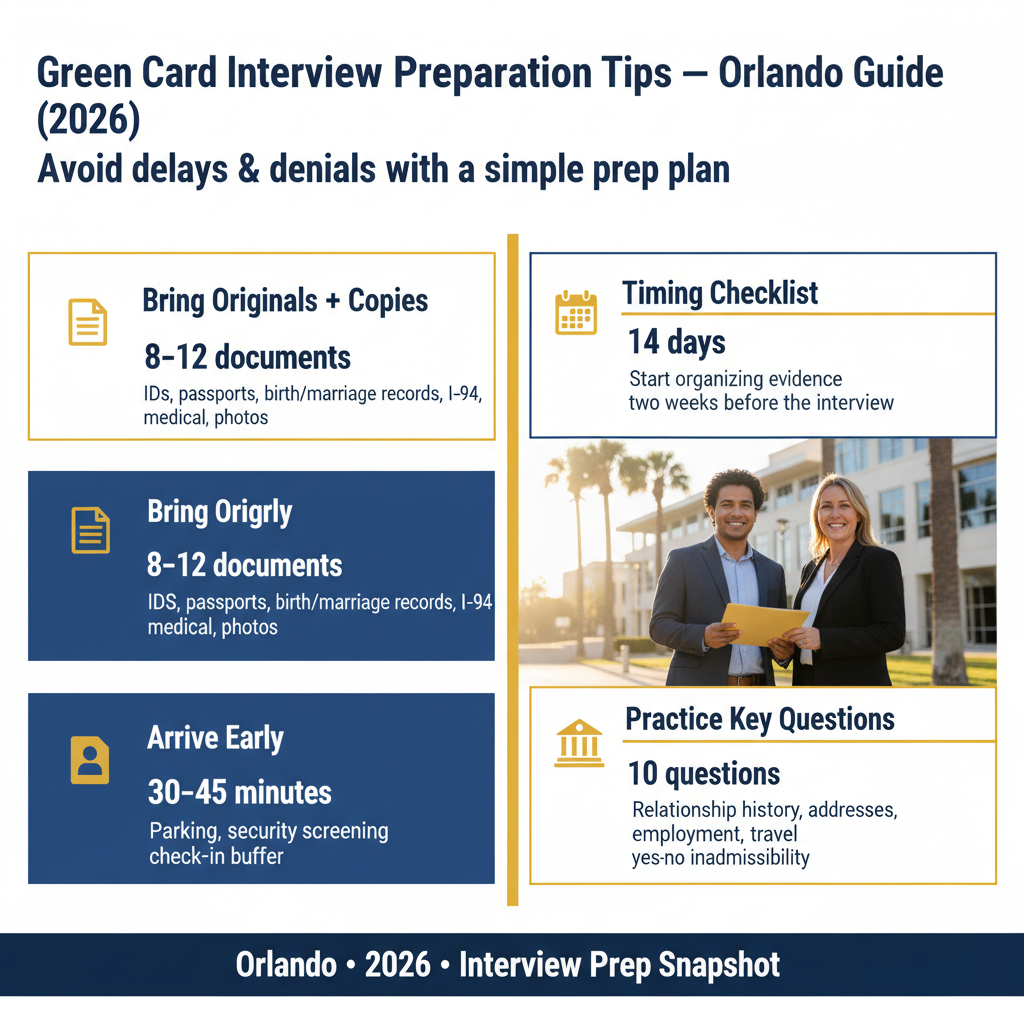
Recent immigration-law headlines and commentary have brought renewed attention to how applicants can avoid delays and denials by preparing thoroughly for the green card interview. In particular, we’re referencing this news aggregation page:
Green Card Interview Preparation Tips (Immigration Law)
Reminder: News coverage often highlights trends (like increased scrutiny, new fraud indicators, or shifting interview practices), but your outcome still depends on your facts, your evidence, and how well you’re prepared to answer questions consistently and credibly.
Need Help? Our Orlando immigration team is ready to assist. Call +1 786-791-3106 for a free consultation, or message us online. Se Habla Español.
What This News Means for Immigrants in Orlando and Across Florida
Why this news is showing up now
Green card interview preparation is trending because USCIS interviews remain one of the most decisive checkpoints in the permanent residence process—especially for family-based cases filed through Adjustment of Status using Form I-485. Interview practices can feel inconsistent from office to office and even officer to officer, and applicants are increasingly sharing experiences online when cases are delayed, rescheduled, or denied for avoidable reasons.
Common drivers behind this renewed attention include:
- Higher scrutiny of relationship evidence in marriage-based cases (especially when documentation is thin or timelines are unusual).
- Backlog and scheduling pressure, which can lead to shorter interviews and less time to “clarify later.”
- More Requests for Evidence (RFEs) or follow-up interviews when files are incomplete or answers conflict with the record.
- Increased reliance on forms and prior statements: officers often compare interview answers to what was filed in Form I-130, Form I-485, prior visas, and prior immigration encounters.
Important: “Trending” does not mean “new law.” It means people are seeing real-world consequences when they treat the interview like a casual appointment instead of a legal proceeding with permanent consequences.
How it can affect Florida residents
For Florida residents—especially in Central Florida along the I-4 corridor (Orlando, Kissimmee, Sanford, and surrounding Orange County communities)—USCIS field office scheduling and local caseloads can shape how quickly you get an interview and how much time you have to prepare.
If your case is in Orlando, your interview is likely handled by The Orlando USCIS Field Office (depending on your address and case type). Local realities that can affect you include:
- Travel and logistics: traffic on I-4 and parking delays can cause late arrivals, which can lead to rescheduling.
- High-volume family filings: Central Florida sees many family-based filings, which can affect interview availability.
- Document readiness: applicants who arrive without updated relationship evidence, updated medicals (if required), or missing translations often trigger delays.
Warning: Rescheduling can add months to your case. Preparation is one of the few things you can control.
What Green Card Interview Preparation Tips Is (and Why It Matters)
A plain-English definition
“Green card interview preparation” means organizing your documents, reviewing your filing history, and practicing how you will answer questions so that your testimony matches your evidence and your forms. The goal is to help the USCIS officer confirm:
- You are eligible for a green card under the category you filed.
- Your application is truthful and supported by credible evidence.
- You are admissible to the United States (or qualify for a waiver if not).
In many cases, the interview is where small mistakes become big problems—like forgetting an old address, misremembering dates, or not disclosing prior immigration issues that USCIS already has in its system.
Key terms you need to know
- Adjustment of Status: Applying for a green card from inside the U.S., typically using Form I-485.
- Consular Processing: Applying for an immigrant visa abroad through the U.S. Department of State, then entering the U.S. as a permanent resident.
- Form I-130: Petition for Alien Relative (often the first step in a family case).
- Form I-485: Application to Register Permanent Residence or Adjust Status.
- Priority Date: Your “place in line” for categories subject to visa limits (more relevant for preference categories than immediate relatives).
- RFE: Request for Evidence—USCIS asks for missing or additional proof.
- NOID: Notice of Intent to Deny—USCIS plans to deny unless you respond convincingly.
- Admissibility: Legal eligibility to be granted permanent residence (health, criminal, immigration violations, public charge rules, etc.).
- 90-day window: Often used in immigration contexts (for example, timing-related rules and deadlines). Your case may have critical timing windows depending on category and travel; consult counsel.
- 180 days: A common threshold in immigration rules (for example, certain unlawful presence calculations). Whether it applies depends on your history.
Reminder: The officer’s job is to verify facts, not to “help you remember.” Preparation reduces the risk of inconsistent answers.
Current Immigration Law: The Foundation
Green card interviews are governed by federal immigration law and USCIS policy. Your eligibility depends on the Immigration and Nationality Act (INA) and related regulations.
Federal requirements
Most green card interviews—especially for family-based Adjustment of Status—focus on eligibility under the INA and admissibility standards. Key legal foundations include:
- INA § 245 (Adjustment of Status): who can adjust, and under what conditions.
- INA § 212 (Inadmissibility): health grounds, criminal grounds, immigration violations, misrepresentation, and more.
- INA § 204 (Petitions): standards for family petitions like Form I-130.
- 8 C.F.R. § 245 and related regulations: procedural rules for adjustment filings and interviews.
USCIS relies on the forms you filed and supporting evidence submitted through the USCIS official website and by mail. Common forms tied to the interview include:
- Form I-130 (family petition)
- Form I-485 (green card application)
- Form I-864 (Affidavit of Support, in many family cases)
- Form I-693 (medical exam and vaccination record)
- Form I-765 (work permit, if filed)
- Form I-131 (Advance Parole travel document, if filed)
Important: Bring originals of civil documents and a clean, organized copy set. Officers often ask to see originals even if you already uploaded or mailed copies.
For forms and instructions, use USCIS Forms. To track estimates, check USCIS Processing Times.
Florida-specific considerations
Immigration is federal law, but Florida residents can face practical, location-based issues that matter for interviews:
- Field office logistics: If you’re scheduled at The Orlando USCIS Field Office, plan for I-4 traffic, parking, and security screening time.
- Name and document consistency: Florida DMV records, marriage certificates, and court records should match your immigration filings. If there are discrepancies (hyphenated names, multiple last names, prior married names), address them proactively.
- Prior Florida court matters: Arrests, citations, injunctions, or expunged/sealed cases may still require certified dispositions for immigration purposes.
If you have immigration court history, that’s handled under EOIR. You can find official information at the Executive Office for Immigration Review.
Need Help? Our Orlando immigration team is ready to assist. Call +1 786-791-3106 for a free consultation, or message us online. Se Habla Español.
How to Prepare for Your Green Card Interview: A Complete Step-by-Step Guide
1) Confirm your interview notice details and build a timeline
Start with your USCIS interview notice (date, time, location, and what to bring). Then build a simple timeline of your case—from first meeting (for couples) or from petition filing (for other categories) through today.
Important: If you recently moved, ensure USCIS has your current address. Missing an interview because of an address problem can be disastrous.
Documents to gather for this step:
- USCIS interview notice (original and a copy)
- Government-issued photo IDs (passport, driver’s license)
- Your A-Number (from USCIS notices) and receipt numbers
- A written timeline of key dates (entries, exits, marriage, filings)
- Any prior USCIS notices: biometrics, RFEs, approvals, etc.
2) Re-read every form you filed (and fix inconsistencies early)
USCIS officers commonly ask questions directly from your forms—especially Form I-485 (yes/no inadmissibility questions), Form I-130 (relationship details), and Form I-864 (financial sponsorship). If your interview answers conflict with your filing, it can trigger an RFE, a second interview, or a denial.
Reminder: If you discover a mistake, do not “wing it” at the interview. Many errors can be corrected through a written explanation or an amendment at the interview, depending on the issue.
Documents to gather for this step:
- Complete copies of what you submitted: Form I-130, Form I-485, and supporting exhibits
- Copies of all receipt notices (I-797)
- Any RFE/NOID and your response package
- Prior immigration filings (asylum, DACA, TPS, prior petitions) if applicable
- A list of corrections/clarifications you may need to provide
3) Assemble your “originals + updated evidence” interview binder
Think of your interview binder as two layers:
- Original civil documents (to show the officer)
- Updated supporting evidence since you filed (to strengthen the case)
For marriage-based cases, updated evidence is often what convinces USCIS that the relationship is ongoing and real.
Documents to gather for this step:
- Passports (current and expired), I-94 record (if available), visas
- Birth certificates (petitioner and applicant) + certified translations if not in English
- Marriage certificate, divorce decrees/annulments/death certificates for all prior marriages
- Two passport-style photos (if requested in notice)
- Form I-693 medical exam (if you have a sealed envelope or need an updated one)
- Updated proof of shared life (see Step 4)
Warning: Never open a sealed Form I-693 envelope. If it must be sealed, keep it sealed.
4) Prepare category-specific evidence (marriage, family, employment, etc.)
Not all green card interviews are the same. The evidence you emphasize should match your category.
Marriage-based (most common): Show a real marital relationship and shared life.
Documents to gather for this step (marriage-based examples):
- Joint lease/mortgage, property deed, HOA letters
- Joint bank statements (several months), credit cards, shared loans
- Insurance policies showing each other as beneficiaries (health, auto, life)
- Utility bills showing same address
- Children’s birth certificates (if applicable)
- Photos together across time (with family/friends, holidays, travel)
- Travel itineraries, hotel bookings, event tickets
- Affidavits from friends/family (helpful, but usually secondary to hard documents)
Other family-based categories: Focus on the qualifying relationship and eligibility. Bring updated proof of petitioner status (U.S. passport, naturalization certificate, or green card).
Employment-based: Bring the I-140 approval, job offer letter, and paystubs if applicable (interviews vary by case type and local practice).
5) Practice the questions—especially “yes/no” admissibility questions
USCIS interviews are often a mix of:
- Identity and biographic verification
- Relationship questions (for family cases)
- Immigration history (entries, exits, overstays, prior petitions)
- Security and admissibility questions from Form I-485
Important: The “yes/no” questions are not casual. They cover arrests, drugs, prostitution, trafficking, terrorism, misrepresentation, voting, and more. A wrong answer can create serious legal consequences.
Documents to gather for this step:
- A copy of your completed Form I-485 (every page)
- Certified court dispositions for any arrest/citation (even if dismissed)
- Proof of compliance for any prior immigration issues (approvals, receipts, waivers)
- A written “memory aid” of key dates (entries/exits, addresses, jobs)
6) Plan interview-day logistics (arrival, security, interpreter, attorney)
Interview day is not the day to improvise. Plan to arrive early, bring only what you need, and expect airport-style security.
If your case is in Orlando, plan extra time for I-4 traffic and parking. For Central Florida residents coming from Kissimmee, Sanford, Winter Park, or Lake Mary, a 30–60 minute buffer is often wise.
Documents/items to gather for this step:
- Interview notice and photo ID for entry
- Organized binder (originals + copies)
- Pen, small notepad, and a document checklist
- Interpreter arrangement if needed (follow USCIS rules; some cases require bringing your own)
- Attorney G-28 notice of appearance (if represented)
Reminder: If you need language support, tell your attorney early. Se Habla Español at Imigrar.
7) Know what happens after the interview (and how to respond fast)
After the interview, USCIS may:
- Approve on the spot (sometimes you’ll be told verbally)
- Approve later after supervisor review
- Issue an RFE for missing items
- Schedule a second interview (sometimes called a “Stokes” interview in marriage cases)
- Issue a NOID or denial
Warning: If you receive an RFE/NOID, deadlines are strict. Missing a deadline can lead to denial. Treat it like an emergency.
Documents to gather for this step:
- Any handouts given by the officer
- Stamped copies (if the officer stamps documents)
- A written summary of questions asked (do this right after leaving)
- Tracking plan for your case status on USCIS
Need Help? Our Orlando immigration team is ready to assist. Call +1 786-791-3106 for a free consultation, or message us online. Se Habla Español.
Practical Steps You Can Take Today
Here’s a practical checklist you can start now—even if your interview is weeks away.
Actionable checklist (do these in the next 48–72 hours)
- Create a shared folder (digital + physical) labeled “USCIS Interview” and place your interview notice on top.
- Print and re-read your full submissions: Form I-130, Form I-485, and all exhibits.
- Order certified court dispositions if there is any criminal history (even dismissed cases).
- Request updated joint evidence (bank statements, lease renewal letters, insurance declarations pages).
- Write down key dates: first entry, most recent entry, marriage date, address history, job history.
- Check your case status and estimated processing times at USCIS Processing Times.
Document preparation guidance
Organize your binder with tabs:
- Tab A: Interview notice + IDs
- Tab B: Originals (birth, marriage, divorce, passports)
- Tab C: Copies of all filed forms and receipts
- Tab D: Updated relationship evidence (chronological)
- Tab E: Financial sponsorship (Form I-864, tax transcripts, W-2s)
- Tab F: Medical (Form I-693) and vaccinations
- Tab G: Any prior immigration history (approvals, notices, entries/exits)
Important: If any document is not in English, bring a proper certified translation.
Timeline expectations (realistic planning)
Every case is different, but many applicants experience:
- Interview notice issued weeks to months in advance (varies by office and category).
- Decision sometimes same day, but often within several weeks after the interview.
- If an RFE is issued, the case can extend by weeks to months depending on response time and review queues.
Reminder: If you are close to a deadline affecting your status, travel, or work authorization, get legal advice immediately—don’t assume the interview will “fix it.”
How Imigrar Helps Immigrants in Orlando
At Imigrar, we help clients in Orlando and nationwide prepare for green card interviews with a strategy that is evidence-driven and tailored to your case. Our mission is to Keep Families Together.
Our interview-prep support typically includes:
- A full review of your filing history (what USCIS already has in the record)
- Identification of red flags (prior overstays, entries, arrests, prior marriages, inconsistencies)
- A customized document checklist and binder plan
- Mock interview practice focused on your facts and your officer’s likely concerns
- Guidance on how to correct errors and submit updated documents appropriately
Se Habla Español. We can prepare you in English or Spanish so you feel confident and understood.
Free consultation: Call +1 786-791-3106 to discuss your interview notice, your category, and what you should prioritize first—especially if your case involves prior immigration issues or any criminal history.
Frequently Asked Questions
Q: What if I’m not sure I’m eligible for a green card—should I still attend the interview?
A: In most situations, yes—you should attend unless your attorney advises otherwise. Missing the interview can lead to denial for abandonment. If you have eligibility concerns (for example, unlawful entry, prior removal order, misrepresentation, or criminal issues), consult an attorney immediately to assess risks and prepare a legal strategy. Bring all relevant documents, including prior USCIS/ICE paperwork and any court dispositions.
Q: Can the green card interview affect my current immigration status?
A: It can. If USCIS finds you are ineligible or believes there was fraud or misrepresentation, the case can be denied and, in some situations, referred for enforcement or placed into removal proceedings. If you have any prior issues (overstay, unauthorized work, prior denials), get legal advice before the interview. If you have immigration court involvement, you may also need to coordinate with EOIR resources at the Executive Office for Immigration Review.
Q: How long after the interview will I get a decision?
A: Some applicants receive an approval the same day, but many receive a decision within a few weeks. If USCIS needs more evidence, you may receive an RFE. Processing can vary by office workload; check general estimates at USCIS Processing Times. If your case is in Orlando, local scheduling volume can affect timing.
Q: What documents should I bring to a marriage-based green card interview?
A: Bring (1) originals of civil documents (passports, birth certificates, marriage certificate, divorce decrees), (2) copies of everything filed (especially Form I-130 and Form I-485), and (3) updated proof of your shared life: joint bank statements, lease/mortgage, insurance, photos across time, and any children’s records. Also bring the sponsor’s updated financial documents tied to Form I-864 (tax transcripts and proof of current income).
Q: How much does it cost to prepare for a green card interview with a lawyer?
A: Legal fees vary based on complexity (prior immigration violations, criminal history, prior marriages, RFEs/NOIDs, or the need for waivers). Some cases require extensive document reconstruction and legal briefing. Imigrar offers a free consultation to evaluate the scope and provide transparent next steps. Government filing fees are separate and set by USCIS; always confirm on the USCIS official website.
Q: What happens if my green card is denied after the interview?
A: Denial outcomes depend on the reason. USCIS may deny and provide appeal/motion options in limited contexts, or you may refile if eligible. In some cases, USCIS may issue an NTA (Notice to Appear) and refer you to immigration court. If you receive a denial, act quickly—deadlines can be short, and strategy matters. Save the denial notice, request your file if needed, and consult counsel immediately before taking any further steps (including travel).
Q: Do we both have to attend the interview?
A: In most marriage-based Adjustment of Status cases, yes—the petitioner and applicant typically attend together unless USCIS instructs otherwise. If a spouse is deployed, ill, or cannot attend for a serious reason, you may need to request rescheduling or alternative arrangements with strong documentation.
Q: Should I bring an interpreter to the Orlando USCIS Field Office?
A: If you are not comfortable answering detailed questions in English, you should plan for language assistance consistent with USCIS rules and your notice instructions. Miscommunication can cause inconsistent answers. Imigrar can help you prepare in Spanish—Se Habla Español—and advise on interpreter logistics for your specific interview.
Common Mistakes (and How to Avoid Them)
Mistake #1: Showing up with outdated or weak evidence
Many couples bring only what they filed months ago. Officers often want to see that the relationship is ongoing today.
How to avoid it: Bring updated joint documents covering the most recent 3–12 months (banking, lease, insurance, taxes, photos). Organize chronologically and highlight both names and the shared address.
Mistake #2: Inconsistent answers because you didn’t review your forms
Applicants forget what they wrote on Form I-485 or Form I-130 and answer differently at the interview.
How to avoid it: Re-read the entire filing packet. Make a list of sensitive topics (prior addresses, prior marriages, entries/exits, arrests). Practice answering clearly and truthfully.
Mistake #3: Ignoring “small” legal issues (arrests, prior overstays, prior statements)
What feels minor to you may be legally significant to USCIS—especially if it involves admissibility, misrepresentation, or criminal grounds.
How to avoid it: Obtain certified dispositions, bring immigration records, and consult an attorney before the interview. Warning: Do not guess when asked about arrests or prior immigration history—if you don’t know, explain and provide documents.
Additional Official Resources (Use These, Not Rumors)
Use official sources to verify instructions, forms, and general processes:
- USCIS official website
- USCIS Forms
- USCIS Processing Times
- U.S. Department of State (consular processing and immigrant visas)
- Executive Office for Immigration Review (immigration court information)
Reminder: Online forums can be useful for emotional support, but they are not a substitute for legal advice tailored to your record.
Need Help? Our Orlando immigration team is ready to assist. Call +1 786-791-3106 for a free consultation, or message us online. Se Habla Español.

Closing: Be Ready, Be Organized, Be Honest
Your green card interview is one of the most important appointments in your immigration journey. The best preparation is a combination of: (1) accurate forms, (2) strong updated evidence, (3) consistent, truthful answers, and (4) a plan for any legal issues that could affect admissibility.
If your case is in Orlando—or anywhere in Florida along the I-4 corridor—planning ahead can prevent reschedules, RFEs, and avoidable denials.
Need support now? Imigrar is here to help you Keep Families Together.
Need Help? Our Orlando immigration team is ready to assist. Call +1 786-791-3106 for a free consultation, or message us online. Se Habla Español.


