


The reporting that sparked this guide
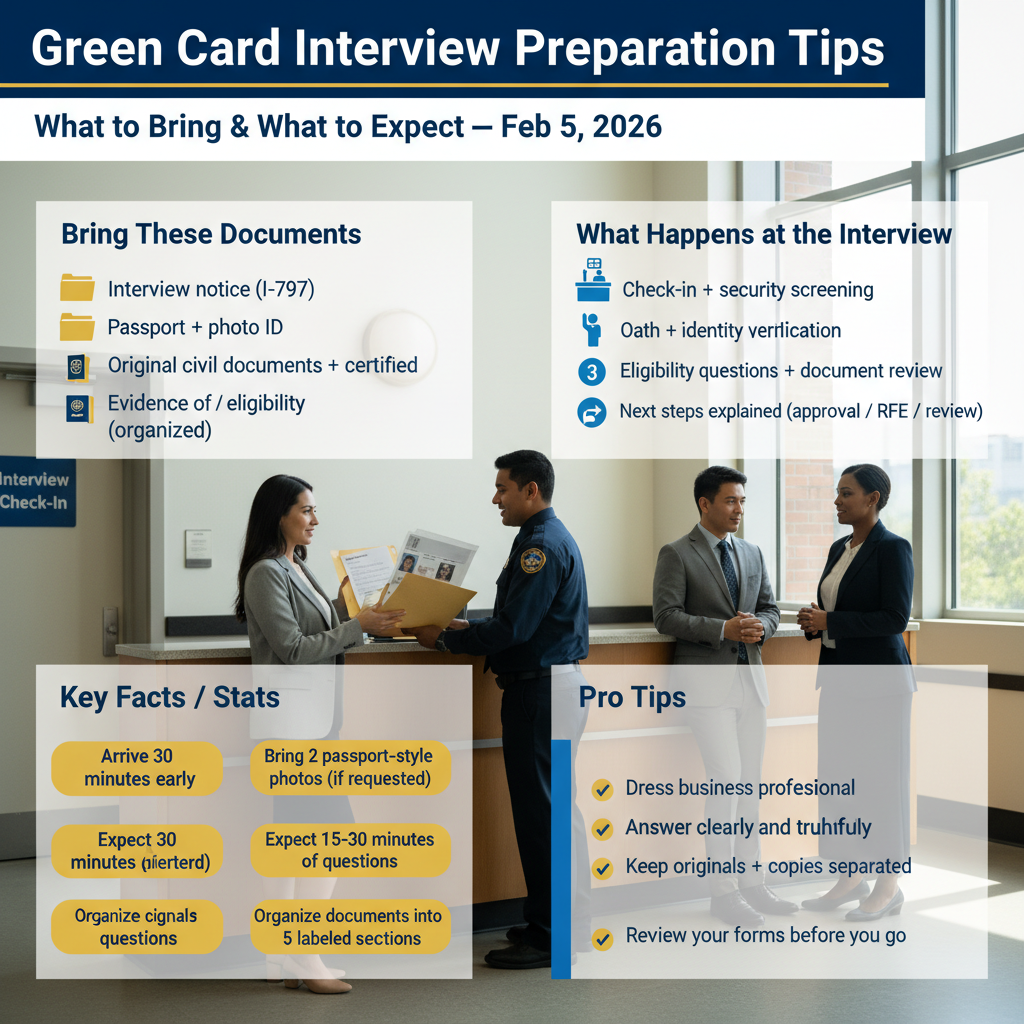
This article is inspired by trending immigration coverage and questions that often follow major updates and increased public attention to USCIS processing and enforcement priorities. Reference:
Need Help? Our Orlando immigration team is ready to assist. Call +1 786-791-3106 for a free consultation, or message us online. Se Habla Español.
What This News Means for Immigrants in Orlando and Across Florida
Why this news is showing up now
Green card interview preparation is trending again because USCIS has been actively adjusting interview practices—waiving some interviews in certain categories while scheduling more interviews in others to address fraud concerns, identity verification, and eligibility questions. When interview patterns shift, applicants feel it immediately: more appointments, more Requests for Evidence (RFEs), and more anxiety about what to bring and what to say.
Reminder: Even if you hear that “interviews are being waived,” many applicants still receive interviews. USCIS can require an interview in almost any case if the officer believes it’s necessary to confirm identity, verify information, or resolve inconsistencies.
How it can affect Florida residents
For Florida residents—especially in high-growth areas like Orlando, Kissimmee, and the I-4 corridor—USCIS appointment availability and processing times can fluctuate. If your case is in Orlando, the interview experience can be influenced by local field office scheduling, staffing, and case volume.
Important: The Orlando USCIS Field Office may schedule interviews with relatively short notice. Missing an interview can lead to a denial for abandonment in some situations, so planning early is critical.
You can monitor general timelines using USCIS Processing Times (note that processing time tools are estimates and not a guarantee).
What Green Card Interview Preparation Tips Is (and Why It Matters)
A plain-English definition
“Green card interview preparation” means getting ready for a USCIS (or U.S. consulate) interview where an immigration officer reviews your application for lawful permanent residence and asks questions to confirm that:
- You are eligible for a green card under the category you applied for.
- Your forms are accurate and consistent with your documents.
- Your identity and background checks are clear.
- If applying through a relationship (like marriage), the relationship is real and not for immigration purposes.
Preparation matters because the interview is often the final step before approval—and it’s also the point where USCIS may discover inconsistencies that lead to delays, RFEs, a Notice of Intent to Deny (NOID), or denial.
Key terms you need to know
- Adjustment of Status: Applying for a green card from inside the U.S., typically using Form I-485.
- Consular Processing: Applying for an immigrant visa through a U.S. consulate abroad after an approved petition (often Form I-130).
- Form I-130: Petition for Alien Relative (common for family-based cases).
- Form I-485: Application to Register Permanent Residence or Adjust Status.
- Priority Date: Your place in line for a visa in certain categories; it can control when you can file or when USCIS can approve.
- RFE: Request for Evidence—USCIS asks for more documents before deciding.
- NOID: Notice of Intent to Deny—USCIS plans to deny unless you respond with strong evidence.
- 90-day window: Commonly discussed for certain timing rules (for example, conditional residence filing windows or planning around status changes). The correct “window” depends on your specific case type.
- 180 days: A time period that appears in multiple immigration contexts (for example, certain portability rules for employment-based cases and some unlawful presence considerations). The meaning depends on your situation.
Warning: Online advice often mixes rules across different categories. A marriage-based Adjustment of Status interview is not the same as an employment-based interview, and neither is the same as a consular interview at a U.S. embassy.
Current Immigration Law: The Foundation
Green card interviews are governed by federal immigration law and USCIS regulations. Officers use the Immigration and Nationality Act (INA), federal regulations, and USCIS policy guidance to decide eligibility.
Federal requirements
Common legal foundations include:
- INA § 245 (8 U.S.C. § 1255): The main statute for Adjustment of Status eligibility.
- INA § 213A (8 U.S.C. § 1183a): Affidavit of Support requirements (typically Form I-864).
- INA § 204 (8 U.S.C. § 1154): Family-based petitions such as Form I-130.
- INA § 212 (8 U.S.C. § 1182): Inadmissibility grounds (health, criminal, immigration violations, public charge-related issues, misrepresentation).
- 8 C.F.R. § 245 and related regulations: Procedures and evidence rules for adjustment cases.
Official resources you can rely on include the USCIS official website and the USCIS Forms page for instructions and updates.
If your case involves consular processing, the U.S. Department of State provides immigrant visa guidance and interview expectations abroad.
Florida-specific considerations
Immigration is federal law, so Florida does not create “Florida green card rules.” However, Florida-specific realities can affect your case in practical ways:
- Local field office scheduling: The Orlando USCIS Field Office interview calendar can impact timelines for Central Florida residents.
- Document availability: If you were married, divorced, or had name changes in Florida, you may need certified records from Florida agencies (and you must bring them to the interview).
- Address stability: If you move along the I-4 corridor (Orlando–Lakeland–Tampa), update USCIS quickly to avoid missed notices.
Important: Always keep USCIS informed of your address. Missing mail can lead to missed biometrics or interview appointments.
Need Help? Our Orlando immigration team is ready to assist. Call +1 786-791-3106 for a free consultation, or message us online. Se Habla Español.
How to Prepare for Your Green Card Interview: A Complete Step-by-Step Guide
1) Confirm your interview type, location, and what USCIS is deciding
Start by identifying what kind of green card interview you have:
- Adjustment of Status interview at a USCIS field office (common for family-based cases and many employment-based cases).
- Consular interview abroad after National Visa Center (NVC) processing.
- “Combo” interview issues (for example, pending waivers or prior immigration history requiring extra review).
If your case is in Orlando, your notice will typically list the Orlando USCIS Field Office address and instructions. Read every line of the interview notice.
Documents to gather for this step:
- Interview notice (I-797) and any USCIS appointment letters
- Copies of your filed Form I-485, Form I-130, and related filings
- Any RFE/NOID notices and your responses
- Your receipt notices (I-797C) for key forms
2) Build a “master file” that matches every answer on your forms
USCIS officers often verify that your testimony matches your paperwork. Preparation means you can quickly find support for every major claim: identity, lawful entry (if applicable), relationship history, employment history, and address history.
Create a binder (or folders) with tabs. Put originals in one section and copies in another. USCIS may want to see originals but will usually keep copies.
Documents to gather for this step:
- Passports (current and expired), including biographic pages and all U.S. entry stamps
- Birth certificates (certified copies) with certified translations if not in English
- Government-issued IDs (driver’s license, state ID)
- I-94 record (print from CBP when available) and entry documents
- Marriage certificate, divorce decrees, annulment orders, death certificates (if applicable)
- Name change documents (court orders) if applicable
- All prior immigration approvals/denials and notices
Reminder: If any document is not in English, bring a full certified translation and the translator’s certification.
3) Prepare category-specific evidence (marriage, family, employment, asylum-based, etc.)
Interview questions and evidence expectations depend on the basis of your green card. The most common interview type in Orlando is marriage-based Adjustment of Status. USCIS typically looks for proof of a real shared life.
Marriage-based cases: documents to gather
- Joint lease/mortgage and proof of shared address (past and current)
- Joint bank statements (several months), credit cards, loans
- Utility bills showing both names (or one name plus proof of same address)
- Insurance policies (health, auto, renter’s/home) showing spouse coverage
- Tax returns (IRS transcripts are excellent), W-2s/1099s
- Photos over time with family and friends (labeled with dates/places)
- Children’s birth certificates (if applicable)
- Affidavits from friends/family (optional but can help in thin-evidence cases)
Employment-based cases: documents to gather
- Job offer letter and/or employment verification letter
- Recent pay stubs and W-2s
- Educational credentials and evaluations (if used in the filing)
- Evidence the job still exists and you intend to work in the sponsored role
- If applicable, portability evidence after 180 days under AC21 rules (case-specific)
Family-based (non-spouse) cases: documents to gather
- Proof of the qualifying relationship (birth certificates, adoption decrees, legitimation evidence)
- Evidence of ongoing relationship and support
- Any documents showing custody or legal guardianship if relevant
Warning: Do not submit altered documents or “templates” found online. Misrepresentation can trigger inadmissibility under INA § 212(a)(6)(C)(i) and may require a waiver—or may be fatal to the case.
4) Re-check admissibility issues and prepare to explain any “red flags”
Many interview delays happen because USCIS needs clarification on admissibility. Common red flags include:
- Prior visa overstays or unauthorized work
- Prior marriages or quick remarriage timelines
- Arrests/charges (even if dismissed or sealed)
- Prior immigration applications with inconsistent facts
- Multiple addresses or frequent moves
The best approach is not to “talk around” an issue, but to prepare a clear, truthful, document-supported explanation.
Documents to gather for this step:
- Certified court dispositions for any arrest/charge (all outcomes)
- Police reports if available and requested by counsel
- Evidence of lawful entry or proof of how you entered (as applicable)
- Prior immigration filings (copies) to ensure consistency
- Waiver filings/receipts if a waiver is required (case-specific forms may include Form I-601 or Form I-601A)
Important: If you have any criminal history, consult an immigration attorney before the interview. Immigration consequences can be complex even for minor offenses.
5) Practice the interview: questions, pacing, and consistency
A strong interview is calm, consistent, and responsive. Officers are trained to look for credibility and consistency. You should practice:
- Your timeline (how you met, dating history, engagement, marriage, living arrangements)
- Basic biographic information (full names, dates of birth, addresses)
- What you submitted (so you can explain documents if asked)
- Yes/no eligibility questions on Form I-485 (security, immigration violations, etc.)
Documents to gather for this step:
- A copy of your signed Form I-485 and any supplements
- A copy of your signed Form I-130 package
- A written relationship timeline (for marriage-based cases)
- A list of your prior addresses, jobs, and travel dates
Reminder: If you don’t understand a question, it’s okay to ask the officer to repeat or clarify. Do not guess.
6) Plan interview-day logistics for the Orlando USCIS Field Office (or your assigned office)
Interview-day stress can cause avoidable mistakes. Plan for parking, traffic, and security screening. For Central Florida residents traveling on I-4, build in extra time for accidents and congestion.
Bring your appointment notice and identification and arrive early. Expect airport-style security. Some items may be restricted.
Documents to gather for this step:
- Interview notice (I-797)
- Government-issued photo ID(s)
- Passport(s) and travel documents
- Medical exam results if required/updated (often Form I-693, in the required format)
- Any updated evidence since filing (new lease, new bank statements, new baby birth certificate, etc.)
Warning: If you are sick or have an emergency, follow the notice instructions and request rescheduling as soon as possible. Do not simply skip the interview.
7) Know what happens after the interview (approval, RFE, review, or denial)
After the interview, several outcomes are possible:
- Approval on the spot (sometimes you’ll be told verbally; sometimes it updates later online).
- Case held for review (common when the officer needs supervisor review or additional background checks).
- RFE for missing/updated documents (such as updated medical exam or sponsor documents).
- NOID if USCIS believes eligibility isn’t met but gives you a chance to respond.
- Denial if USCIS concludes you are ineligible or the evidence is insufficient.
Documents to gather for this step:
- A copy of any handouts the officer gives you
- Your interview notes (write down what was asked and what was requested)
- Any RFE/NOID response plan and supporting evidence
If there is a denial and you are placed in removal proceedings, your case may shift to immigration court under the Executive Office for Immigration Review. Not every denial leads to court, but it’s important to get legal advice immediately.
Practical Steps You Can Take Today
Here is a practical checklist you can start right now—before you even receive the interview notice.
Actionable preparation checklist
- Create a single folder with every USCIS receipt notice and a copy of what you filed (Form I-130, Form I-485, and supporting evidence).
- Order key civil documents now (certified birth certificates, marriage/divorce records). If you need translations, start early.
- Collect “relationship evidence” monthly (bank statements, lease renewals, insurance, photos).
- Review your Form I-485 yes/no questions so you can answer confidently and truthfully.
- Check your passport expiration date and renew if needed (where possible).
- Track your case status and save screenshots/updates.
- Update your address with USCIS immediately after any move.
Document preparation guidance (what officers like to see)
- Consistency: Names, dates, and addresses should match across documents.
- Continuity: Evidence should cover time���from filing to interview—not just one month.
- Clarity: Use labels and a table of contents; highlight names and addresses on statements.
- Originals + copies: Bring originals when available and a clean copy set for USCIS.
Timeline expectations
Timelines vary by category and office. Many applicants go through: filing → biometrics → (sometimes) EAD/AP → interview → decision. To check estimated time ranges, use USCIS Processing Times.
Important: If USCIS requests evidence, respond by the deadline listed on the notice. Late responses can lead to denial.
If you need to download or verify the latest edition of forms and instructions, use USCIS Forms and confirm details on the USCIS official website.
Need Help? Our Orlando immigration team is ready to assist. Call +1 786-791-3106 for a free consultation, or message us online. Se Habla Español.
How Imigrar Helps Immigrants in Orlando
At Imigrar, we help families and individuals prepare for green card interviews with a strategy that is organized, evidence-driven, and tailored to your category—especially marriage-based Adjustment of Status cases that are common for Central Florida residents.
Our team supports you by:
- Reviewing your full filing history for consistency (including older visa filings).
- Creating a customized interview document checklist.
- Preparing you for the most common interview questions and “red flag” topics.
- Updating filings when life changes happen (new job, new address, new child, prior divorce records found late).
- Responding to RFEs/NOIDs with organized legal arguments and evidence.
We are based in Orlando, Florida, and serve clients nationwide. Our mission is simple: Keep Families Together.
Se Habla Español. We offer a free consultation—call +1 786-791-3106 or message us online.
Frequently Asked Questions
Q: Can I still be eligible for a green card if I overstayed my visa?
A: Sometimes, yes—especially in immediate relative cases (spouse/parent/child under 21 of a U.S. citizen) applying through Adjustment of Status. However, overstays can be complicated in other categories and may affect admissibility or require consular processing. Bring proof of your last lawful entry (passport stamps, I-94) and speak with an attorney if you have multiple entries, prior removals, or long unlawful presence.
Q: Will the green card interview affect my current immigration status?
A: The interview itself does not automatically change your status, but the decision can. If USCIS approves your Form I-485, you become a lawful permanent resident. If USCIS denies the case, your situation depends on what status you had (if any) and your immigration history. Warning: A denial can sometimes lead to referral to immigration court, so get legal advice quickly if there are risk factors.
Q: How long after the interview will I get a decision?
A: Some applicants receive same-day approval, while others are placed in “review” for weeks or months. Delays can be due to background checks, supervisor review, missing documents, or an RFE. You can track general expectations on USCIS Processing Times, but interview-to-decision timing is highly case-specific.
Q: What documents are required at the interview for a marriage-based case?
A: Bring (1) the interview notice, (2) passports and IDs, (3) originals of civil documents (birth/marriage/divorce), (4) your medical exam if required (Form I-693 in the correct format), and (5) updated evidence of a real marriage (joint bank statements, lease, insurance, photos, tax transcripts). If your case is in Orlando, organize everything for quick access because officers may move quickly through questions.
Q: How much does the green card interview process cost?
A: Costs may include USCIS filing fees (already paid at filing), medical exam fees (set by the civil surgeon), translation costs, and attorney fees if you hire counsel. For updated fee amounts and form editions, verify directly on the USCIS official website and USCIS Forms. If finances are tight, ask about payment planning and focus on avoiding mistakes that cause expensive delays.
Q: What happens if my green card is denied after the interview?
A: USCIS will send a written decision explaining the reason. Depending on the basis, you may be able to file a motion to reopen/reconsider, refile, or pursue other relief. In some cases, USCIS may issue an NTA and place you in removal proceedings, where the case is handled under the Executive Office for Immigration Review. Important: Do not ignore a denial notice—deadlines can be short, and strategy depends on the exact denial grounds.
Q: Do both spouses have to attend the interview?
A: In most marriage-based Adjustment of Status interviews, yes—the petitioner and beneficiary should attend unless USCIS specifically says otherwise. If there is a serious reason someone cannot attend, consult an attorney immediately and follow the rescheduling instructions on the notice.
Q: What if we don’t have a lot of joint documents yet?
A: This is common for newlyweds. Bring what you do have and show a pattern of building a shared life: proof of living together, beneficiary designations, correspondence addressed to both, wedding-related evidence, and credible explanations. Officers look at the totality of evidence, not one perfect document.
Common Mistakes (and How to Avoid Them)
Mistake #1: Showing up with disorganized or incomplete documents
Many applicants bring a stack of papers without structure. This can slow the interview and increase the chance the officer misses key proof.
- Use a binder with tabs: Identity, Civil Docs, Immigration History, Financial Support, Relationship Evidence, Updates.
- Bring originals plus a clean copy set.
- Label photos and highlight names/addresses on statements.
Mistake #2: Inconsistent answers compared to the forms
Officers compare what you say to what you filed. Small inconsistencies can look like credibility issues.
- Review your signed Form I-485 and Form I-130 before the interview.
- Prepare a timeline (dates you met, moved in, married, trips, etc.).
- If you made a mistake on a form, be ready to correct it clearly and truthfully.
Mistake #3: Ignoring “red flags” like arrests, prior filings, or prior marriages
Applicants sometimes hope an issue “won’t come up.” USCIS often already sees it in background checks.
- Get certified dispositions for any criminal case—even if dismissed.
- Bring divorce decrees and proof prior marriages ended legally.
- Speak to an immigration attorney if you suspect inadmissibility concerns under INA § 212.
Additional Official Resources (Use These, Not Rumors)
For accurate, up-to-date information, start with official government sources:
- USCIS official website
- USCIS Forms
- USCIS Processing Times
- U.S. Department of State (consular processing and immigrant visas)
- Executive Office for Immigration Review (immigration court information)
Reminder: Social media can be helpful for emotional support, but it is not a substitute for the instructions for your specific Form I-485 or the notice you received.
Need Help? Our Orlando immigration team is ready to assist. Call +1 786-791-3106 for a free consultation, or message us online. Se Habla Español.
Closing: Get Confident Before Your Green Card Interview
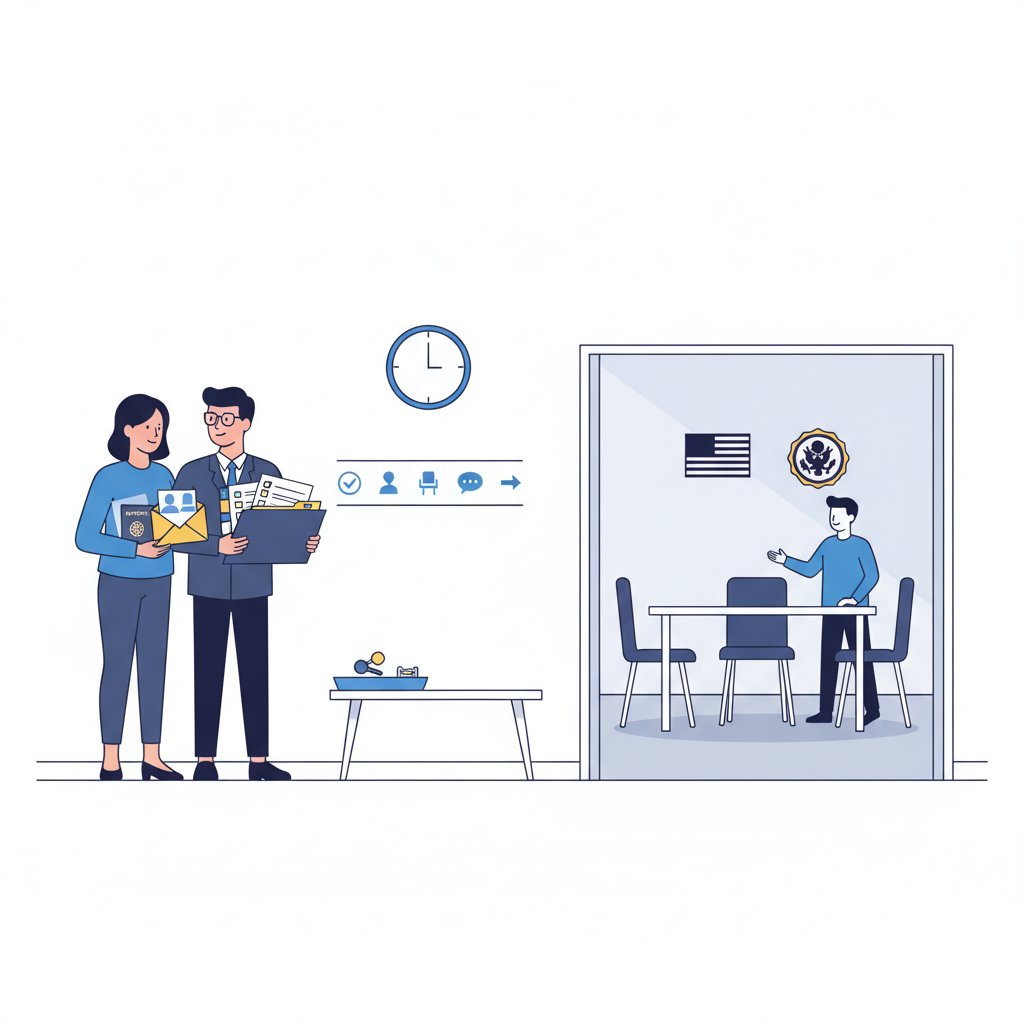
Preparing for a green card interview is not about memorizing “perfect answers.” It’s about telling the truth clearly, matching your testimony to your paperwork, and bringing the documents that prove eligibility. For Central Florida residents, planning ahead for the Orlando USCIS Field Office—traffic, parking, organization, and updated evidence—can make a real difference.
If you want help building a strong interview packet, preparing for difficult questions, or responding to an RFE/NOID, Imigrar is here for you.
Need help now? Call +1 786-791-3106 for a free consultation or message us online. Se Habla Español. We serve clients in Orlando, Orange County, and nationwide—because our mission is to Keep Families Together.


