


The reporting that sparked this guide
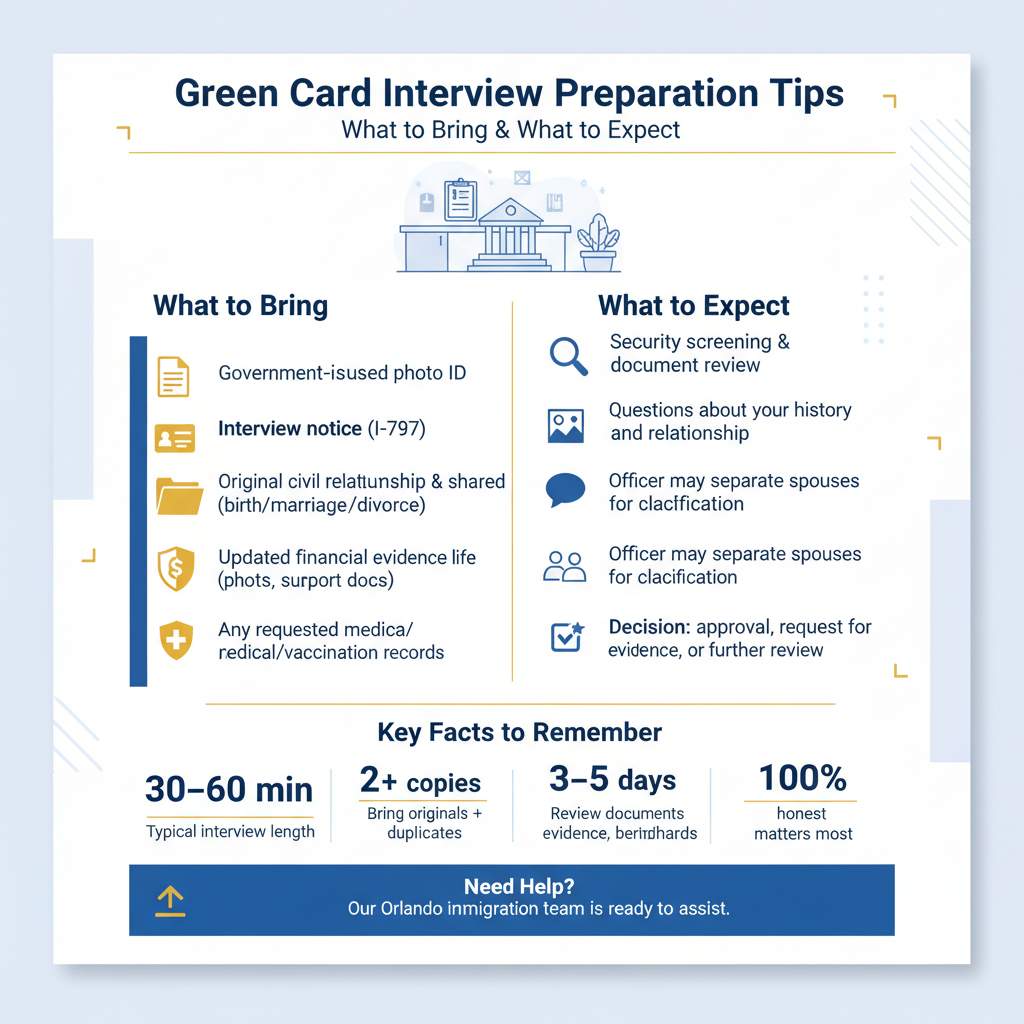
Trending immigration coverage and ongoing discussion about interview practices and adjudication standards inspired this practical preparation guide: Green Card Interview Preparation Tips (Immigration Law).
Need Help? Our Orlando immigration team is ready to assist. Call +1 786-791-3106 for a free consultation, or message us online. Se Habla Español.
What This News Means for Immigrants in Orlando and Across Florida
Why this news is showing up now
Green card interviews are trending again because USCIS interview scheduling has been shifting as workloads move between service centers and local field offices, and because many families are filing (or re-filing) Adjustment of Status cases after travel, marriage, new job opportunities, or changes in eligibility. When interview practices fluctuate—more interviews in some categories, fewer in others—people search for reliable, step-by-step guidance on what to expect and how to avoid delays.
Reminder: USCIS can waive interviews in some cases, but it can also require an interview even when you think your paperwork is “perfect.” The safest approach is to prepare as if an interview will happen.
How it can affect Florida residents
For Florida residents, interview preparation matters because local field offices (including the Orlando area) often handle a high volume of family-based filings and naturalization cases. If your case is in Orlando, you may be scheduled at The Orlando USCIS Field Office and expected to appear on time with originals, updated evidence, and clear answers about your eligibility.
For Central Florida residents along the I-4 corridor—Orlando, Kissimmee, Sanford, Daytona Beach, and surrounding Orange County communities—travel time, parking, childcare, and work schedules can create real pressure on interview day. Planning ahead reduces stress and helps you present your case clearly.
Important: A green card interview is not just a “formality.” It is a legal screening. Officers confirm identity, admissibility, and (in marriage cases) whether the relationship is bona fide.
What Green Card Interview Preparation Tips Is (and Why It Matters)
A plain-English definition
“Green card interview preparation” means organizing your documents, understanding the questions you may be asked, reviewing your immigration history for accuracy, and practicing how to explain your case honestly and consistently—so the USCIS officer can approve your lawful permanent residence with minimal delay.
In most family-based cases filed inside the U.S., the interview is part of Adjustment of Status through Form I-485. In consular processing cases, the “green card interview” happens at a U.S. embassy or consulate through the U.S. Department of State. This article focuses mainly on USCIS interviews for Form I-485 (inside the U.S.), with notes for consular cases where helpful.
Key terms you need to know
- Adjustment of Status: The process of applying for a green card from inside the U.S., usually using Form I-485.
- Form I-130: The family petition filed by a U.S. citizen or lawful permanent resident to establish a qualifying relationship.
- Form I-485: The application to register permanent residence or adjust status.
- Priority Date: The date that determines your place in line for a visa number in certain categories (especially when a visa bulletin applies).
- Admissibility: Whether U.S. law allows you to receive a green card (issues can include certain criminal history, immigration violations, fraud, health grounds, or public charge rules depending on category and timing).
- RFE (Request for Evidence): A USCIS request for additional documents.
- NOID (Notice of Intent to Deny): A warning that USCIS plans to deny unless you respond convincingly.
- 90-day window: Often used in immigration contexts to describe timing rules (for example, conditional residence removal filing window). It is not a universal rule for all green card interviews, but timing concepts matter.
- 180 days: A common timing threshold in immigration (for example, certain portability rules in employment cases). Not every family case uses it, but deadlines can be strict.
Warning: Memorizing “perfect” answers is less important than being truthful, consistent, and prepared with documents that support what you say.
Current Immigration Law: The Foundation
Green card interviews are grounded in federal immigration law and USCIS regulations. Your eligibility generally depends on the Immigration and Nationality Act (INA) and corresponding regulations in Title 8 of the Code of Federal Regulations (8 C.F.R.). USCIS officers use these authorities to verify identity, relationship validity (if applicable), and admissibility.
Federal requirements
Most green card interview standards flow from:
- The Immigration and Nationality Act (INA), including eligibility for immigrant categories and grounds of inadmissibility (commonly INA § 212).
- Adjustment of status authority (commonly INA § 245) and implementing regulations in 8 C.F.R. Part 245.
- Family petition rules and evidence standards tied to Form I-130 and Form I-485.
- Identity and security checks, including biometrics requirements and background screening.
USCIS publishes official instructions and policy guidance that officers follow. For primary guidance, start at the USCIS official website and the USCIS Forms page for the most current form instructions.
Important: Always use the latest edition of each form and follow the current filing instructions; USCIS can reject outdated versions or incorrectly filed packages.
Florida-specific considerations
Immigration is federal law, so Florida does not set green card eligibility rules. However, Florida-specific realities can affect interview success:
- Local field office practices: The Orlando area caseload can influence scheduling and how strictly officers request updated evidence.
- Language access: If you need an interpreter, plan ahead. USCIS rules on interpreters can change; confirm current requirements before the interview.
- Document retrieval: Florida residents may need certified records from local courts or agencies (Orange County Clerk of Courts, DMV records, etc.) if there were any arrests, citations, or name changes.
- Travel logistics: For Central Florida residents along the I-4 corridor, arriving early matters—traffic and parking can be unpredictable.
Reminder: If your case is in Orlando, treat the interview notice as a strict appointment. Missing it can cause denial for abandonment unless you properly reschedule.
Need Help? Our Orlando immigration team is ready to assist. Call +1 786-791-3106 for a free consultation, or message us online. Se Habla Español.
How to Prepare for Your Green Card Interview: A Complete Step-by-Step Guide
Below is a practical, attorney-style roadmap you can follow whether you filed through marriage, another family category, or another eligible pathway. The steps assume you are preparing for a USCIS interview connected to Form I-485 (inside the U.S.).
1) Confirm what type of case you have and what USCIS must prove
Interview preparation starts with knowing what USCIS is actually deciding. In most cases, the officer is verifying:
- Your identity and biographic information
- Your eligibility category (family relationship, petition approval, visa availability)
- Your admissibility (criminal, immigration, medical, fraud/misrepresentation issues)
- For marriage cases: that the marriage is real and not for immigration purposes
If your case involves a visa bulletin category, your Priority Date and visa availability can matter at approval time.
Documents to gather for Step 1:
- Your USCIS receipt notices for Form I-130, Form I-485, and any related filings (e.g., Form I-864, Form I-765, Form I-131)
- A full copy of what you filed (your “filing package”)
- Any USCIS notices, RFEs, or NOIDs and your responses
- Your interview notice (with address, time, and instructions)
2) Build a “master folder” of originals and a clean copy set
USCIS commonly asks to see originals and keeps copies. A strong strategy is to bring:
- One folder with originals (do not staple originals)
- One folder with copies (well-labeled)
- Optional: a third folder with “updated evidence since filing”
For marriage-based Adjustment of Status, updated joint evidence is often the difference between a smooth approval and a frustrating RFE.
Documents to gather for Step 2 (bring originals + copies):
- Passports (current and expired), travel documents
- Birth certificates (certified copies if available) + translations if not in English
- Marriage certificate, divorce decrees, annulment orders, death certificates (if applicable)
- Government-issued photo IDs (driver’s license/state ID)
- I-94 record (printout if available) and prior approval notices
- Two passport-style photos (if your notice requests them)
3) Update your relationship and household evidence (especially for marriage cases)
USCIS wants to see a real shared life. If you filed months ago, bring evidence from the period after filing up to the interview date. For couples, the goal is to show you are combining finances, living together, and presenting yourselves publicly as a married couple.
Documents to gather for Step 3 (examples):
- Lease/mortgage showing both names, or letters from landlord plus proof of cohabitation
- Joint bank statements (several months, not just one)
- Joint credit card statements or shared loans
- Insurance policies (health, auto, renters/home) showing spouse as beneficiary or insured
- Utility bills with shared address (even if not both names, show continuity)
- Tax returns (married filing jointly if applicable) and IRS transcripts
- Birth certificates of children (if any)
- Photos over time with family/friends, labeled with dates/locations
- Travel itineraries, hotel bookings, event invitations, affidavits from friends/family (when appropriate)
Important: Quality beats quantity. A well-organized set of documents covering your timeline is more persuasive than a box of random papers.
4) Review every answer you gave USCIS—line by line
Many interview problems come from inconsistencies between:
- What you wrote on Form I-485 and what you say at the interview
- What you filed on Form I-130 and what your spouse says
- Your prior visa applications, entries, and past immigration filings
Officers often ask “yes/no” questions from the Form I-485 inadmissibility section. Do not guess. If you are unsure, review your filing copy and discuss with counsel.
Documents to gather for Step 4:
- A complete copy of your submitted Form I-485 and all supplements
- A complete copy of your submitted Form I-130 and supporting evidence
- Any prior DS-160/DS-260 confirmations (if you have them)
- Any prior immigration filings or notices (asylum, DACA, TPS, removal proceedings, etc.)
- Court dispositions for any arrests/citations (certified copies)
Warning: If there is a mistake in your forms, do not “hide it.” The right approach is to correct it appropriately (often at the interview, sometimes by filing an amendment or response).
5) Prepare for the financial sponsorship review (Form I-864)
Many green card interviews include questions about the Affidavit of Support. USCIS may request updated income evidence, especially if the case has been pending for a long time or if the sponsor changed jobs.
Documents to gather for Step 5:
- Copy of the filed Form I-864 (and joint sponsor’s if used)
- Most recent tax return and/or IRS tax transcript
- Recent pay stubs (commonly last 1–3 months)
- Employment verification letter
- Proof of lawful status for sponsor (passport, naturalization certificate, green card copy)
- If using assets: bank statements, property appraisals, proof of ownership
Reminder: If your sponsor’s household size changed (new baby, dependent, new marriage), it can affect the income threshold.
6) Practice interview questions and plan your interview-day logistics
Preparation includes both content and execution. Your goal is to arrive calm, organized, and consistent.
Documents/items to prepare for Step 6:
- Your interview notice
- Photo IDs for everyone attending
- Organized binders/folders (originals + copies)
- Any required interpreter arrangements (if applicable)
- A written timeline of your relationship and immigration history
If your case is in Orlando, plan extra time for I-4 corridor traffic, parking, and security screening. Arrive early enough to avoid rushing—rushing leads to mistakes.
7) Get legal guidance if there are “risk factors”
Some cases should not be handled with generic tips alone. If any of these apply, talk to an immigration lawyer before the interview:
- Prior removal/deportation order or pending proceedings (check the Executive Office for Immigration Review if relevant)
- Arrests, charges, or convictions (even if dismissed)
- Prior marriage-based filings
- Unlawful entry, visa overstay, or unauthorized employment (varies by category)
- Possible fraud/misrepresentation issues
- Complex financial sponsorship (joint sponsor, assets, self-employment)
Documents to gather for Step 7:
- Certified court dispositions and arrest reports (if any)
- FOIA results (if previously requested)
- Prior USCIS/ICE/CBP paperwork, removal documents, voluntary departure records
- All prior immigration applications and decisions
Need Help? Our Orlando immigration team is ready to assist. Call +1 786-791-3106 for a free consultation, or message us online. Se Habla Español.
Practical Steps You Can Take Today
If your interview is scheduled—or you expect it soon—these actions can immediately improve your readiness and reduce the chance of an RFE or delay.
Actionable checklist (do this now)
- Important: Download and print your full I-94 and travel history documents you can access.
- Create a single “case timeline” (entries, status changes, marriage date, moves, jobs).
- Re-read your filed Form I-485 and Form I-130 and mark anything that needs updating (address changes, new job, new child).
- Collect updated joint documents covering the last 3–12 months (bank, lease, insurance, taxes).
- Request certified court dispositions early if there were any arrests (some counties take time).
- Check your case status and estimated timelines using USCIS Processing Times.
- Confirm you are using the latest form instructions from USCIS Forms.
Document preparation guidance
Organize documents in the same order you expect to discuss them:
- Identity: passports, IDs, birth certificates
- Entry/status: I-94, prior approvals, visas
- Relationship: marriage certificate + joint life evidence
- Financial: Form I-864 support evidence
- Eligibility/admissibility: court records, prior immigration records
Reminder: Any non-English document should include a proper English translation with a translator certification statement.
Timeline expectations
Timelines vary by category and field office. In general:
- After filing Form I-485, biometrics may occur first, then the interview notice later.
- Some applicants receive a decision the same day; others receive a request for more evidence or a decision notice later.
- If additional review is needed, the case can remain pending after interview (“held for review”).
Warning: Do not make international travel plans unless you have proper travel authorization (for many applicants, this means an approved Advance Parole document or another valid basis to travel). If unsure, consult counsel before traveling.
How Imigrar Helps Immigrants in Orlando
At Imigrar, we help families and individuals prepare for green card interviews with a strategy that is both practical and legally grounded. Our mission—Keep Families Together—means we focus on reducing risk, avoiding delays, and presenting your case clearly and respectfully.
- Interview prep sessions tailored to your category (marriage, family, other)
- Document organization and evidence planning (what to bring, what to update)
- Form review for consistency across Form I-130, Form I-485, and related filings
- Risk assessment for inadmissibility issues and prior immigration history
- Orlando-focused logistics guidance for the local process
We serve clients nationwide from Orlando, Florida. Call us at +1 786-791-3106 for a free consultation. Se Habla Español.
Frequently Asked Questions
Q: Am I eligible for a green card interview through Adjustment of Status?
A: Eligibility depends on your category and how you entered/stayed in the U.S. Many applicants adjust through a qualifying family relationship using Form I-130 + Form I-485. However, certain immigration violations or inadmissibility issues may require a waiver or may prevent adjustment. If you are unsure, review your entry history (I-94, visa, prior filings) and speak with an attorney before the interview.
Q: Will attending the interview affect my current immigration status?
A: Attending the interview itself does not “cancel” your current status, but what you say and what USCIS finds can have consequences. If USCIS believes there is fraud, misrepresentation, or a serious inadmissibility issue, the case can be denied and may trigger additional steps. Warning: If you have prior removal issues or criminal history, get legal advice before the interview.
Q: How long does it take to get a decision after the green card interview?
A: Some applicants receive an approval on the spot or shortly after. Others receive an RFE or the case is held for review. Processing varies by field office and case complexity. You can monitor general timing trends using USCIS Processing Times, but your case may be faster or slower depending on background checks, evidence, and officer review.
Q: What documents are required for the green card interview?
A: At minimum, bring the interview notice, passports/IDs, civil documents (birth/marriage/divorce records), and originals of key submissions. Most applicants should also bring updated evidence, especially for marriage-based cases (joint bank statements, lease, insurance, taxes). Reminder: Bring both originals and copies, and include certified translations for non-English documents.
Q: How much does the green card interview process cost?
A: USCIS filing fees are separate from legal fees and can change over time. Your total cost may include filing fees for Form I-485 and related forms, medical exam costs, translation costs, and attorney fees if you hire counsel. Always confirm current fees and instructions directly on the USCIS official website and consider a legal consultation to avoid expensive mistakes.
Q: What happens if my green card is denied after the interview?
A: USCIS may deny if eligibility is not proven, documents are missing, inadmissibility applies, or the officer believes the relationship is not bona fide (in marriage cases). Next steps depend on the reason: you might file a motion, refile, pursue a waiver, or—if you are placed in removal proceedings—defend your case in immigration court (see the Executive Office for Immigration Review). If denial is possible, consult an attorney immediately to protect your options.
Q: Do both spouses have to attend a marriage-based green card interview?
A: Typically yes. USCIS generally expects both the petitioner and beneficiary to appear. If there is a serious reason someone cannot attend, you must follow the instructions on the interview notice to request rescheduling and provide proof. Important: Missing an interview without properly rescheduling can lead to denial for abandonment.
Q: If we moved recently in Orange County, do we need to update USCIS before the interview?
A: Yes. Address changes should be updated promptly, and you should bring proof of your current address to the interview. If you moved within Central Florida along the I-4 corridor, your case may remain at the same field office or be transferred depending on USCIS procedures. Bring a lease/mortgage, utility bills, and updated IDs if available.
Common Mistakes (and How to Avoid Them)
Mistake #1: Showing up with incomplete originals or disorganized evidence
Many applicants bring only copies, or they bring originals but cannot quickly find what the officer requests. This can cause delays or an RFE.
- How to avoid it: Use two folders (originals + copies) and label tabs (Identity, Entry, Marriage, Financial, Updates).
- Reminder: Bring the interview notice and government IDs at the top of your folder.
Mistake #2: Inconsistent answers between spouses or between forms and testimony
In marriage cases, small inconsistencies happen, but repeated contradictions can raise concerns. In any case type, inconsistencies with Form I-485 can trigger deeper questioning.
- How to avoid it: Review your filing copy together, confirm key dates (meeting, engagement, marriage, moves), and be honest if you don’t remember something exactly.
- Warning: Do not guess on yes/no inadmissibility questions—review them carefully.
Mistake #3: Ignoring “risk factors” until the interview is already scheduled
Arrests, prior immigration violations, or past filings can require waivers or careful legal framing. Waiting until interview week can limit options.
- How to avoid it: Get certified dispositions early, request records if needed, and consult counsel as soon as you receive the interview notice.
- Important: If a waiver might be needed, timing can be critical—some strategies depend on when and how USCIS raises the issue.
Orlando Interview Day: What to Expect and How to Stay Calm
If your case is in Orlando, your experience often follows a predictable pattern: security screening, check-in, waiting area, then the interview with an officer. The officer typically places you under oath, reviews IDs, and walks through your application.
For Central Florida residents, especially those traveling from Orange County or along the I-4 corridor, build in extra time. Arriving late can create unnecessary complications.
- Dress neatly and conservatively (business casual is usually appropriate).
- Answer only what is asked; do not volunteer unrelated details.
- If you don’t understand a question, ask the officer to repeat or clarify.
- Keep documents accessible—do not shuffle papers nervously.
Reminder: USCIS officers are trained to evaluate credibility. Calm, consistent, and well-supported answers help your case.
Official Resources to Bookmark (Do Not Rely on Social Media Alone)
Interview rules and form requirements can change. Use official sources:
- USCIS official website
- USCIS Forms
- USCIS Processing Times
- U.S. Department of State (for consular processing and visa interview guidance)
- Executive Office for Immigration Review (for immigration court information)
Warning: Online “checklists” can be outdated or wrong. Always confirm with official instructions and, when needed, legal counsel.
Need Help? Our Orlando immigration team is ready to assist. Call +1 786-791-3106 for a free consultation, or message us online. Se Habla Español.
Closing: Prepare Confidently, Protect Your Future
A green card interview can feel intimidating, but with the right preparation—organized documents, consistent answers, and updated evidence—you can walk in with confidence. Whether you are applying through marriage, family sponsorship, or another eligible category, the interview is your chance to confirm the truth of your case and move one step closer to permanent residence.
If your case is in Orlando or anywhere in Florida, Imigrar is ready to help you prepare strategically and avoid the most common pitfalls. Call +1 786-791-3106 for a free consultation. Se Habla Español. Our mission is to Keep Families Together.


