Today is 2026-04-14.
Need Help? Our Orlando immigration team is ready to assist. Call +1 786-791-3106 for a free consultation, or message us online. Se Habla Español.
The reporting that sparked this guide
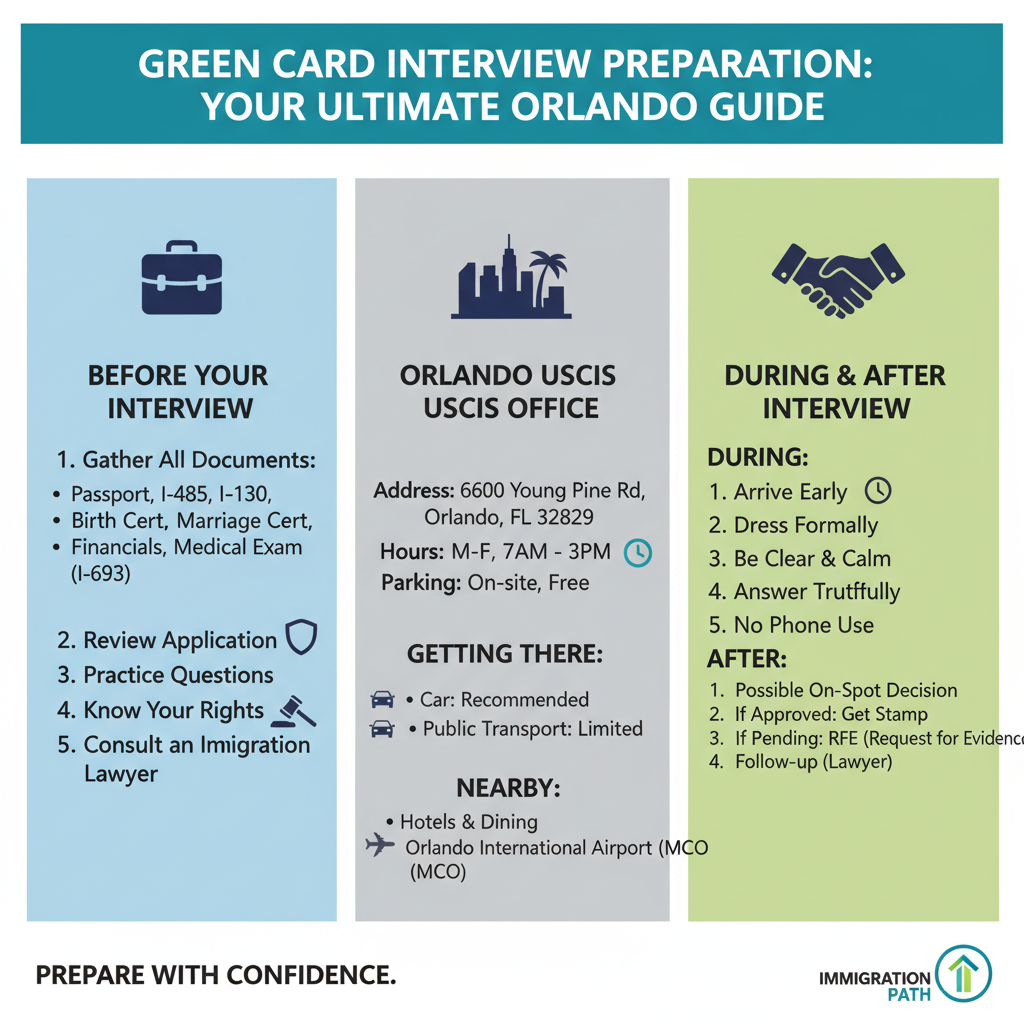
The journey to obtaining a Green Card, or lawful permanent residency in the United States, is a significant milestone for countless individuals and families. A crucial step in this process for many is the Green Card interview. Recent discussions and ongoing guidance from various Green Card Interview Preparation Tips (Immigration Law) sources consistently highlight the importance of thorough preparation for this interview. This continuous emphasis underscores the complexity of immigration law and the need for applicants to be well-informed and ready to present their case clearly and accurately. At Imigrar, we understand that this interview can be a source of anxiety, but with the right preparation, it can be a smooth and successful step towards your American dream.
What This News Means for Immigrants in Orlando and Across Florida
Why this news is showing up now
The Green Card interview is not a new requirement; it has been a fundamental part of the immigration process for decades. However, the consistent appearance of "Green Card Interview Preparation Tips" in immigration news reflects several ongoing realities. Firstly, immigration policies and procedures, while stable in their core, often see minor adjustments or shifts in enforcement priorities. These changes can subtly alter the focus of interviews, making updated preparation advice crucial. Secondly, the sheer volume of Green Card applications means that USCIS (U.S. Citizenship and Immigration Services) continually processes thousands of cases, each culminating in an interview for most Adjustment of Status applicants. This constant flow generates a continuous demand for reliable information. Finally, the digital age allows for rapid dissemination of advice, and as more people share their experiences, the collective wisdom on interview preparation grows, leading to a perpetual cycle of new tips and refreshed guidance.
For individuals and families in Orlando and across the Sunshine State, staying current with these trends is paramount. The Green Card interview is your opportunity to demonstrate your eligibility for permanent residency and to confirm the information provided in your application forms. It’s not merely a formality; it’s a critical assessment by an immigration officer. Understanding why preparation tips are always trending means recognizing that the stakes are always high, and being well-prepared is the best way to ensure a positive outcome.
How it can affect Florida residents
Florida is a vibrant hub for immigrants from all corners of the globe, and the need for meticulous Green Card interview preparation is particularly relevant here. Whether your case is handled at the Orlando USCIS Field Office, the Miami Field Office, or through Consular Processing abroad, the core principles of interview readiness remain the same. For Central Florida residents, your interview will most likely take place at the Orlando USCIS Field Office, located at 6650 Tussing Rd, Orlando, FL 32807.
The impact of proper preparation can directly influence the timeline and outcome of your application. An unprepared applicant might face delays due to Requests for Evidence (RFEs), or even a denial, necessitating appeals or new applications, which can be costly and time-consuming. Conversely, a well-prepared applicant can often navigate the interview smoothly, leading to quicker approvals and the sooner realization of their Green Card status. For families along the I-4 corridor and throughout Orange County, this means less stress, fewer delays, and the ability to "Keep Families Together" – a core mission of Imigrar.
Florida's diverse population means that interviews may involve various cultural nuances or language barriers. Understanding the process, knowing what documents to bring, and being able to articulate your case clearly, often with the help of an experienced attorney, can make all the difference. The constant news about interview tips serves as a powerful reminder for all Florida residents embarking on this journey: preparation is not optional; it’s essential.
What Green Card Interview Preparation Is (and Why It Matters)
A plain-English definition
A Green Card interview is a meeting with an immigration officer from U.S. Citizenship and Immigration Services (USCIS) or a Consular Officer at a U.S. Embassy or Consulate abroad. The primary purpose of this interview is for the officer to verify the information you provided in your Green Card application, ask questions to confirm your eligibility, and ensure that you meet all legal requirements for permanent residency in the United States. Think of it as a final check-point where you get to personally present your case and answer any lingering questions the government might have about your application.
For most applicants, particularly those applying for Adjustment of Status (changing from a nonimmigrant visa to a Green Card while in the U.S.), this interview is the conclusive step before a decision is made on their application. It's a formal, yet often conversational, process designed to ensure the integrity of the immigration system and that only eligible individuals receive Green Cards. For family-based petitions, especially marriage-based ones, the interview also serves to confirm the legitimacy of the relationship.
Key terms you need to know
Navigating the immigration process requires understanding some specific terminology. Here are key terms related to your Green Card journey and interview:
- Green Card: Also known as a Permanent Resident Card, it proves you are authorized to live and work permanently in the United States.
- Adjustment of Status (AOS): The process of applying for a Green Card while physically present in the United States. This is typically done by filing Form I-485, Application to Register Permanent Residence or Adjust Status.
- Consular Processing: The process of applying for a Green Card through a U.S. Embassy or Consulate abroad. This applies if you are outside the U.S. when your Green Card becomes available.
- Petitioner: The U.S. citizen or lawful permanent resident who files an immigration petition on behalf of another individual (the beneficiary). For example, a U.S. citizen spouse filing Form I-130 for their foreign spouse.
- Beneficiary: The foreign national seeking an immigration benefit, such as a Green Card, who is sponsored by a petitioner.
- Priority Date: The date USCIS receives your immigration petition (e.g., Form I-130). This date determines your place in line for a Green Card, especially for categories with annual limits.
- Affidavit of Support (Form I-864): A legally binding document signed by the petitioner (and sometimes a joint sponsor) promising financial support for the immigrant. This ensures the immigrant won't become a public charge.
- Public Charge: A term used in immigration law to describe an individual who is primarily dependent on the government for subsistence. Applicants must demonstrate they are not likely to become a public charge.
- Request for Evidence (RFE): A letter from USCIS asking for additional documents or information to support your application. This can delay processing.
- Notice of Intent to Deny (NOID): A letter from USCIS indicating their intention to deny your application unless you provide specific information or evidence to overcome the grounds for denial.
- Medical Examination (Form I-693): A required medical exam conducted by a USCIS-approved civil surgeon to ensure you meet health-related admissibility requirements.
Understanding these terms will empower you to better comprehend the Green Card process and what the interviewing officer will be looking for. It also helps you communicate more effectively with your legal counsel at Imigrar.
Feeling overwhelmed by immigration jargon? Let Imigrar simplify the process for you. Our Orlando-based attorneys speak English and Spanish and are ready to explain every step. Call +1 786-791-3106 for your free consultation. Se Habla Español.
Current Immigration Law: The Foundation for Your Green Card Interview
The Green Card interview is rooted in the Immigration and Nationality Act (INA), the primary body of law governing immigration in the United States. Specifically, various sections of the INA dictate who is eligible for a Green Card and what criteria must be met to be deemed admissible to the U.S.
Federal requirements
At a federal level, the legal framework for Green Card interviews primarily revolves around proving eligibility for a specific immigration category and demonstrating admissibility to the United States. Key statutes and regulations include:
- INA § 212 (8 U.S.C. § 1182): This section outlines the grounds of inadmissibility, which are reasons a person might be barred from entering or remaining in the U.S. These grounds cover health-related issues, criminal history, security risks, public charge concerns, misrepresentation, and prior immigration violations. The interview is a critical step for the officer to assess if any of these grounds apply to you.
- INA § 245 (8 U.S.C. § 1255): This section governs Adjustment of Status for individuals already in the U.S. It specifies the conditions under which a foreign national can change their nonimmigrant status to lawful permanent resident status without leaving the country. The interview ensures these conditions are met.
- INA § 201-204 (8 U.S.C. § 1151-1154): These sections deal with immigrant visas, including family-sponsored and employment-based categories, establishing the annual limits and preference systems. Your interview will confirm your eligibility under one of these categories.
During the interview, the USCIS officer will refer to these legal frameworks to determine if you have met all requirements. For instance, in a marriage-based Green Card interview, the officer will assess if the marriage is bona fide (real) under INA § 204(c), which prohibits sham marriages entered into solely for immigration benefits. They will also ensure that the petitioner's Affidavit of Support (Form I-864) meets the income requirements to prevent the beneficiary from becoming a public charge, as per INA § 212(a)(4).
All required forms, such as Form I-130 (Petition for Alien Relative), Form I-485 (Application to Register Permanent Residence or Adjust Status), and Form I-864 (Affidavit of Support), are designed to gather information relevant to these legal statutes. You can find detailed instructions and the forms themselves on the USCIS Forms page of the USCIS official website.
Florida-specific considerations
While immigration law is federal, the practical application often involves local USCIS field offices. For applicants in Central Florida, your interview will typically be scheduled at the Orlando USCIS Field Office. The officers there are trained to apply federal law, but familiarity with local resources or common issues in the region can sometimes be beneficial.
For example, knowing the specific logistical details of the Orlando office – parking, security procedures, and typical wait times – can help reduce stress on the day of your interview. While there are no Florida-specific immigration laws that directly impact your Green Card interview, understanding the local context is part of comprehensive preparation. The Orlando office handles a high volume of family-based petitions, particularly marriage-based applications, given the diverse population in Orange County and surrounding areas along the I-4 corridor. This means officers are highly experienced in evaluating the authenticity of relationships and financial sponsorships common in these types of cases.
Important: Always ensure you are following the latest guidance from USCIS, as procedures can be updated. Your immigration attorney at Imigrar is always up-to-date with current federal requirements and local office practices in Orlando.
How to Prepare for Your Green Card Interview: A Complete Step-by-Step Guide
The Green Card interview is a pivotal moment in your immigration journey. Proper preparation is not just recommended; it is absolutely essential. This comprehensive guide will walk you through the necessary steps to ensure you are ready.
1) Understand Your Interview Notice (Form I-797C)
The first step begins when you receive your interview notice, typically Form I-797C, Notice of Action, from USCIS. Do not underestimate the importance of this document. It contains critical information:
- Date and Time: Mark your calendar immediately and plan to arrive at least 30 minutes early.
- Location: For Central Florida residents, this will likely be the Orlando USCIS Field Office. Confirm the full address and plan your route.
- Required Documents: The notice will list specific documents you must bring. This list is not exhaustive and you should always bring *all* documents related to your application, even if not explicitly listed.
- Petitioner/Beneficiary Presence: It will specify who must attend (e.g., both petitioner and beneficiary for marriage-based cases, or just the beneficiary for some employment-based cases).
Actionable Tip: Read your interview notice multiple times. If anything is unclear, consult with your Imigrar attorney immediately. Do not guess or assume.
2) Gather and Organize All Required Documents
This is arguably the most critical step. The USCIS officer will review your original documents and compare them to the copies you submitted with your application. A well-organized packet demonstrates diligence and can significantly streamline the interview.
Required Documents Checklist (General):
- Interview Notice (Form I-797C): Your official invitation.
- Government-Issued Photo ID: Passport, driver’s license, or state ID.
- All Original Passports and Travel Documents: Current and expired.
- Birth Certificates: For both beneficiary and petitioner (if applicable), with certified English translations if not in English.
- Marriage Certificate(s): If applicable, with certified translations.
- Divorce Decrees or Death Certificates: For any previous marriages of either party, with certified translations.
- Medical Examination Report (Form I-693): In a sealed envelope from the civil surgeon. Ensure it's valid (within 2 years of the exam date).
- Affidavit of Support (Form I-864) and Supporting Financial Documents:
- Most recent federal income tax returns (Form 1040) with all schedules and W-2s/1099s.
- Proof of current employment (e.g., employment verification letter, recent pay stubs).
- Proof of assets (bank statements, property deeds) if income is insufficient.
- Proof of Relationship (for family-based petitions, especially marriage-based): This is crucial.
- Joint bank accounts statements.
- Joint leases or mortgage statements.
- Utility bills in both names.
- Joint car titles or insurance.
- Children's birth certificates (if applicable).
- Photographs together (weddings, vacations, daily life – organize chronologically and label).
- Letters, emails, social media communication.
- Affidavits from friends/family attesting to the relationship.
- Life insurance policies, wills, or trusts naming each other as beneficiaries.
- Police Certificates/Court Records: From any country where you lived for more than 6 months since age 16, and for any arrests/convictions, even if charges were dropped or expunged.
- Copies of All Forms Filed: Form I-130, Form I-485, Form I-765 (Employment Authorization), Form I-131 (Advance Parole), etc., along with all supporting evidence submitted.
- Additional Documents Specific to Your Case: E.g., employment offer letters for employment-based petitions, educational degrees, professional licenses.
Organization Tip: Use a binder with dividers. Label each section clearly (e.g., "Original Birth Certificates," "Marriage Evidence," "Financial Documents"). Have a separate folder for copies of everything you submitted. Bring two sets of copies – one for USCIS, one for your records. Do not staple documents; use paper clips.
3) Review Your Application Forms Thoroughly
The immigration officer will have your entire application file in front of them. It is imperative that you are familiar with every piece of information you submitted. Review:
- Your Answers on All Forms: Especially Form I-485 and Form I-130. Ensure you remember dates, addresses, employment history, and answers to all "yes/no" questions.
- Consistency is Key: Any discrepancies between your verbal answers and the written application can raise red flags. If there are minor errors or changes since filing (e.g., a new address or job), be prepared to explain them clearly and provide updated documentation.
- Personal History: Be ready to discuss your entry into the U.S., previous immigration history, and any potential issues (e.g., overstays, past arrests, previous visa denials).
Warning: Never lie or intentionally misrepresent facts. Immigration fraud has severe consequences, including permanent bars from the U.S. If you have concerns about past issues, discuss them with your Imigrar attorney *before* the interview.
4) Practice Answering Potential Questions
While you cannot predict every question, you can anticipate common themes. Practice answering questions clearly, concisely, and honestly. For marriage-based cases, expect questions designed to verify the authenticity of your relationship.
Common Question Categories:
- Personal Background: Name, date of birth, place of birth, parents' names, educational history, employment history.
- Immigration History: How you entered the U.S., visa history, any previous applications, any prior removals or deportations.
- Petitioner's Background (if applicable): Similar questions about your sponsoring relative.
- Relationship Details (for marriage-based):
- How and when did you meet?
- When did you get married?
- What is your spouse's date of birth, place of employment, parents' names?
- Do you live together? Describe your home.
- Who pays the bills?
- What did you do last weekend?
- Details about your wedding, honeymoon, holidays.
- Spouse's favorite food, hobbies, daily routine.
- Admissibility Questions: Related to health, criminal history, security, public charge, and past immigration violations (these are the "yes/no" questions on Form I-485, Part 8).
Tip: If you don't understand a question, politely ask the officer to repeat or rephrase it. Do not guess. If you don't know the answer, say so honestly. Practice with your attorney or a trusted friend/family member. Your attorney can conduct mock interviews.
5) Prepare for the Interview Day Logistics
The day of the interview can be stressful, but good planning can alleviate much of the anxiety.
- Arrive Early: Aim to arrive at the Orlando USCIS Field Office at least 30 minutes before your scheduled time. This allows for security checks, finding parking, and calming your nerves. Being late can lead to rescheduling or even denial.
- Dress Appropriately: Dress in business casual or professional attire. This shows respect for the process and the interviewing officer.
- Bring an Interpreter (If Needed): If you are not fluent in English, you may bring a neutral, adult interpreter. Your attorney can also serve as an interpreter. Do not bring a child or the petitioner/beneficiary to interpret for each other.
- Limit Companions: Only those required to attend (petitioner, beneficiary, attorney, interpreter) should go into the interview room. Other family members can wait in the lobby.
- Food and Drink: You may not be able to bring food or drink into the interview room. Plan accordingly, especially if you have a long wait.
Location-Specific Tip: The Orlando USCIS Field Office can be busy. Factor in traffic, especially if you're traveling from other parts of Central Florida along the I-4 corridor. Parking is usually available but may require a short walk.
6) What to Expect During the Interview
Knowing the typical flow can help you feel more comfortable.
- Check-in: Upon arrival, you'll check in at the reception desk.
- Waiting Area: You'll then wait until your name is called. Wait times can vary significantly.
- The Oath: The interview will begin with you (and your attorney/interpreter) being sworn in to tell the truth.
- Document Review: The officer will likely ask for your interview notice and government-issued photo ID. They will then review your original documents against the copies in your file.
- Questioning: The officer will proceed with questions about your application, personal history, and eligibility. They may ask both the petitioner and beneficiary questions, sometimes separately, especially in marriage-based cases.
- Attorney's Role: Your Imigrar attorney will be present to observe, clarify questions, and object to inappropriate lines of questioning. They cannot answer for you but can provide guidance.
- Honesty and Demeanor: Be honest, calm, and respectful. Maintain eye contact. Answer questions directly and don't elaborate unnecessarily unless asked.
Reminder: The officer's goal is to ensure you meet all legal requirements. Be prepared to provide clear, consistent answers and evidence.
7) Post-Interview Procedures
The interview is not always the final step to a decision.
- On-the-Spot Decision: Sometimes, the officer may approve your case immediately or indicate that approval is likely.
- Request for Evidence (RFE): If the officer needs more information or documents, they will issue an RFE, providing a deadline (e.g., 87 days) for you to submit the requested items.
- Further Review: Often, the officer will state that a decision will be mailed to you. Processing times can vary (check USCIS Processing Times).
- Approval and Green Card Mailing: If approved, you will receive an approval notice, and your Green Card will be mailed to you.
- Notice of Intent to Deny (NOID) or Denial: In some cases, USCIS may issue a NOID or a denial. If this happens, it is crucial to consult your attorney immediately to discuss options like filing a response to a NOID, an appeal, or a motion to reopen/reconsider.
Important: Keep your attorney informed of any communication you receive from USCIS after the interview. Do not discard any documents.
Practical Steps You Can Take Today for Interview Success
The journey to your Green Card is a marathon, not a sprint. Starting your interview preparation early can significantly reduce stress and increase your chances of success.
Actionable Checklist:
- Review Your Entire Application File: Go through every form and document you submitted to USCIS. Make sure you are familiar with all dates, addresses, and answers.
- Create a Master Document Checklist: Based on your interview notice and general requirements, list every original document and copy you need to bring.
- Gather Originals and Make Copies: Start collecting all original documents (birth certificates, marriage certificates, passports, etc.) and make clear, legible copies. Organize them in a binder.
- Obtain Certified Translations: If any document is not in English, get a certified English translation. This must include a statement from the translator that they are competent to translate and that the translation is accurate.
- Schedule Your Medical Exam (If Not Already Done): Ensure your Form I-693 is valid and in a sealed envelope from a USCIS-approved civil surgeon.
- Verify Financial Sponsorship: Confirm your petitioner's (and any joint sponsor's) financial documents are complete and meet the poverty guidelines.
- Collect Relationship Evidence (for marriage-based cases): Continuously gather photos, joint bills, and other proof of a bona fide marriage. The more evidence, the better.
- Practice Answering Questions: Have a mock interview with your attorney or a trusted person. Focus on clear, concise, and consistent answers.
- Plan Your Interview Day Logistics: Know the location, parking, and traffic for the Orlando USCIS Field Office. Arrange for transportation and an interpreter if necessary.
- Consult with an Immigration Attorney: This is perhaps the most crucial step. An experienced attorney from Imigrar can help you with all of the above, identify potential issues, and accompany you to the interview.
Document Preparation Guidance
- Originals vs. Copies: Always bring the original of every document you submitted a copy of. The officer will want to see the original. Keep the originals organized and separate from your copies.
- Translations: For any document not in English, provide both the original document and a certified English translation. The translator must sign a statement certifying their competence and the accuracy of the translation.
- Photographs: For marriage-based cases, bring a selection of photos that show your relationship over time, with family and friends. Organize them chronologically and label them (who, what, when, where).
- Digital Evidence: While physical documents are preferred, printouts of text messages, emails, or social media posts can be supplementary evidence for relationship cases.
Timeline Expectations
The timeline for Green Card processing, including the interview, can vary significantly depending on the type of petition, the USCIS field office workload, and your country of origin. You can check average processing times on the USCIS Processing Times page.
- Petition Filing to Interview Notice: After filing Form I-130 and Form I-485 concurrently (or after Form I-130 approval for some categories), it can take several months to over a year to receive an interview notice.
- Interview to Decision: While some cases are approved on the spot, many require additional review. A decision can be mailed within a few weeks to several months after the interview.
- Green Card Delivery: Once approved, the physical Green Card is usually mailed within 30 days.
Important: These are general estimates. Your specific timeline may differ. Continuous communication with your Imigrar attorney will keep you informed of your case's progress.