What This News Means for Immigrants in Orlando and Across Florida
Why this news is showing up now
The need for comprehensive Green Card interview preparation isn't new, but its prominence in current immigration discourse reflects several ongoing factors. USCIS (U.S. Citizenship and Immigration Services) continually refines its interview procedures to enhance efficiency and detect potential fraud. This means applicants must be more prepared than ever to present their case clearly and consistently. Furthermore, with fluctuating processing times and evolving policy priorities, the interview stage often feels more impactful and definitive for applicants who have already endured lengthy waits. The collective experience of countless immigrants highlights the critical difference that thorough preparation can make, turning a stressful encounter into a successful step forward.How it can affect Florida residents
Florida is a vibrant hub for immigrants from across the globe, with Orlando serving as a significant point of contact for many navigating the immigration system. For residents of Orlando, Central Florida, and indeed, throughout the state, the Green Card interview process typically takes place at a local USCIS Field Office, such as the one in Orlando. This means local procedures, officer caseloads, and specific regional nuances can influence the interview experience. Given Florida's diverse immigrant population, a wide array of Green Card categories are processed here, from family-based petitions (like marriage-based Green Cards) to employment-based applications and asylum adjustments. Understanding the universal requirements alongside any specific considerations for your local field office is paramount. The stakes are particularly high for families, and knowing how to navigate the process effectively can mean the difference between a swift approval and frustrating delays or even denial. This is where personalized legal guidance, especially from a firm familiar with the Orlando area, becomes invaluable.Need Help Preparing for Your Green Card Interview? Don't leave your future to chance. Our Orlando immigration team is ready to assist. Call +1 786-791-3106 for a free consultation, or message us online. Se Habla Español.
What Green Card Interview Preparation Is (and Why It Matters)
The Green Card interview is a mandatory step for most applicants seeking to become lawful permanent residents of the United States, particularly those applying for **Adjustment of Status (AOS)** from within the U.S. or through **Consular Processing** abroad. It is not merely a formality but a critical opportunity for USCIS or a Consular Officer to verify the information provided in your application, assess your eligibility for a Green Card under U.S. immigration law, and confirm that you are not inadmissible to the United States.A plain-English definition
Simply put, the Green Card interview is a face-to-face meeting with an immigration officer who will ask you questions about your application, your background, and your relationship (if applying based on marriage or family ties). Its primary purpose is to ensure that you meet all the legal requirements for permanent residency and that the information you've submitted is truthful and consistent. For many, especially those applying through marriage, it's also a chance for the officer to determine the **bona fides** (genuineness) of the relationship. This interview is your moment to present yourself and your case clearly, honestly, and confidently.Key terms you need to know
Navigating the immigration process means encountering a host of specific legal terms. Understanding these will empower you during your preparation: * **Adjustment of Status (AOS):** The process of applying for a Green Card from within the United States. This is contrasted with **Consular Processing**, which involves applying for an immigrant visa through a U.S. Embassy or Consulate abroad. * **Petitioner:** The U.S. citizen or lawful permanent resident who files an immigration petition (e.g., **Form I-130**, Petition for Alien Relative) on behalf of an immigrant. * **Beneficiary:** The immigrant for whom the petition is filed, and who is seeking the Green Card. * **Form I-130, Petition for Alien Relative:** The initial petition filed by a U.S. citizen or LPR to establish a qualifying relationship with a foreign national relative. * **Form I-485, Application to Register Permanent Residence or Adjust Status:** The primary application form filed by an immigrant within the U.S. to request a Green Card. * **Form I-864, Affidavit of Support:** A legally binding document signed by the **Petitioner** (and sometimes a joint sponsor) to demonstrate that the immigrant will not become a **Public Charge** (dependent on government assistance). * **Public Charge:** A ground of inadmissibility for individuals who are likely to primarily depend on the government for subsistence. The **Form I-864** addresses this concern. * **Bona Fide Marriage:** In marriage-based Green Card applications, this refers to a genuine, real marriage entered into for love and companionship, not solely for immigration benefits. Officers scrutinize evidence to ensure the marriage is **bona fide**. * **Priority Date:** The date USCIS receives your petition (e.g., **Form I-130**). This date determines your place in the visa queue for numerically limited categories. * **Request for Evidence (RFE):** A letter from USCIS asking for additional documents or information to support your application. * **Notice of Intent to Deny (NOID):** A letter from USCIS indicating their intention to deny your application unless you provide specific information or explanations within a set timeframe. * **Inadmissibility:** Legal grounds under U.S. immigration law that can prevent someone from entering the U.S. or obtaining a Green Card (e.g., certain criminal convictions, health issues, prior immigration violations). Understanding these terms is the first step in demystifying the Green Card interview process and preparing effectively.Current Immigration Law: The Foundation
The framework for Green Card eligibility and the interview process is rooted deeply in the Immigration and Nationality Act (INA), primarily found in Title 8 of the U.S. Code. This complex body of law dictates who can immigrate, under what conditions, and the procedures involved. As of 2026-03-20, the fundamental principles governing Green Card applications remain consistent, though interpretations and enforcement priorities can evolve.Federal requirements
The core federal requirements for obtaining a Green Card are outlined in various sections of the INA. For most applicants, the journey begins with an approved petition establishing eligibility in a specific category: * **Family-Based Immigration (INA 201, 203):** U.S. citizens and lawful permanent residents can petition for certain qualifying relatives. This category is vast, including immediate relatives (spouses, minor children, parents of U.S. citizens) who are not subject to numerical quotas, and preference categories (adult children, siblings) who are. * **Employment-Based Immigration (INA 203):** Individuals with specific job skills, investment capital, or extraordinary abilities may qualify, often requiring a U.S. employer to sponsor them. * **Refugees and Asylees (INA 207, 208):** Individuals granted refugee status or asylum can adjust to permanent residency after one year. * **Diversity Immigrant Visa Program (INA 203(c)):** The "Diversity Visa Lottery" provides Green Cards to individuals from countries with historically low rates of immigration to the U.S. Beyond establishing a qualifying category, all applicants must demonstrate they are not "inadmissible" to the U.S. under INA 212. Grounds of inadmissibility include: * **Health-related grounds:** Certain communicable diseases, lack of vaccinations. * **Criminal grounds:** Convictions for certain crimes, drug trafficking. * **Security-related grounds:** Terrorism, espionage. * **Public Charge grounds:** Likelihood of becoming primarily dependent on government assistance. This is often addressed by the **Form I-864, Affidavit of Support**. * **Immigration violations:** Prior unlawful presence, misrepresentation, deportation. Waivers may be available for some grounds of inadmissibility, but these are complex and require careful legal strategy. The Green Card interview is designed to thoroughly examine all these facets of an applicant's case.Florida-specific considerations
While there are no unique Florida state laws governing Green Card eligibility, the implementation of federal immigration law occurs at the local level. For applicants in Orlando and Central Florida, the **Orlando USCIS Field Office** (located at 6680 Corporate Centre Blvd, Orlando, FL 32822) is where most **Adjustment of Status** interviews take place. **Important:** Each field office develops certain local practices, and officers may have particular areas of focus. For example, in a region with a high volume of marriage-based petitions, officers might be especially attuned to signs of **bona fide** marriages. While the law is federal, the experience can feel localized. Having an attorney familiar with the Orlando office can provide valuable insights into what to expect. Required USCIS forms for Green Card applications typically include: * **Form I-130**, Petition for Alien Relative (filed by the U.S. citizen/LPR petitioner). * **Form I-485**, Application to Register Permanent Residence or Adjust Status (filed by the beneficiary). * **Form I-864**, Affidavit of Support (filed by the petitioner/sponsor). * **Form I-693**, Report of Medical Examination and Vaccination Record (completed by a USCIS-approved civil surgeon). * **Form I-765**, Application for Employment Authorization (optional, for work permit while AOS is pending). * **Form I-131**, Application for Travel Document (optional, for advance parole while AOS is pending). You can find all official forms and detailed instructions on the USCIS official website. Always download the latest version of forms, as they are updated periodically.Overwhelmed by Immigration Law? Imigrar provides clear, expert guidance. Call +1 786-791-3106 for a free consultation, or message us online. We help families nationwide, with a strong presence in Orlando, Florida. Se Habla Español.
How to Prepare for Your Green Card Interview: A Complete Step-by-Step Guide
Preparing for your Green Card interview is a multi-faceted process that requires meticulous attention to detail, thorough organization, and a clear understanding of your case. Following these steps will significantly increase your chances of a successful outcome.1) Understand Your Case Type and Eligibility
Before anything else, you must have a crystal-clear understanding of the basis of your Green Card application. Are you applying through: * **Family-Based:** Marriage to a U.S. citizen or LPR, parent of a U.S. citizen, child of a U.S. citizen/LPR, or sibling of a U.S. citizen? * **Employment-Based:** Through a specific job offer, extraordinary ability, or investment? * **Asylum/Refugee Status:** Adjusting status after one year of asylum or refugee status? * **Other Categories:** Diversity Visa, Special Immigrant Juvenile, VAWA, etc.? Each category has distinct eligibility requirements and specific types of evidence that an immigration officer will be looking for. For instance, marriage-based cases heavily focus on proving a **bona fide marriage**, while employment-based cases will scrutinize your qualifications and the legitimacy of the job offer. Knowing your category guides your entire preparation process. **Required Documents for this step (to review):** * Your original **Form I-130** (if applicable) and its approval notice. * Your original **Form I-485** application and all supporting documents you submitted. * Any **Request for Evidence (RFE)** responses you submitted.2) Gather and Organize ALL Required Documents
This is arguably the most critical step. You must bring all original documents, along with a complete set of photocopies, to your interview. Do NOT assume the officer has everything they need. USCIS often requests originals for review. **General Required Documents (Originals and Copies):** * **Interview Notice:** The official letter from USCIS scheduling your interview. * **Identification:** Valid passport, driver's license (if applicable), state ID. * **Birth Certificates:** For yourself, petitioner, and any children. * **Marriage Certificate:** If applicable. * **Divorce Decrees/Death Certificates:** For any prior marriages of either spouse (if applicable). * **Medical Examination Report:** **Form I-693**, completed by a USCIS-approved civil surgeon, in a sealed envelope. **Important:** Ensure it's current. * **Financial Documents:** * **Form I-864, Affidavit of Support**, signed by the petitioner/sponsor. * Petitioner's most recent federal tax returns (typically 3 years), W-2s, 1099s, pay stubs, employment verification letter. * Evidence of assets (bank statements, property deeds) if income is insufficient. * **Proof of Relationship (for family-based cases, especially marriage):** * Joint bank accounts, joint leases/mortgages, utility bills in both names, joint insurance policies, photos together (dated, from different periods), affidavits from friends/family, birth certificates of children born to the marriage, travel itineraries, correspondence (emails, texts, cards). * **Proof of Employment/Education (for employment-based cases):** * Diplomas, transcripts, professional licenses, employer letters, pay stubs, offer letters. * **Police Clearances/Court Records:** For any arrests or convictions, even if expunged. * **Prior Immigration Documents:** Previous visas, I-94 records, EAD cards, Advance Parole documents. * **Passport Photos:** Two identical, color passport-style photos (2x2 inches), taken within the last 30 days. * **Any RFEs or NOIDs:** And your responses to them. **Organization Tip:** Create a well-organized folder or binder. Use dividers and tabs to clearly label each section (e.g., "Identification," "Marriage Docs," "Financial," "Medical"). This makes it easy to quickly retrieve documents when requested.3) Review Your Application Forms Thoroughly
You must be intimately familiar with every answer you provided on your **Form I-485**, **Form I-130**, and any other forms submitted. The officer will use these forms as the basis for their questions. * Read through your entire application package several times. * Highlight any areas where you might have difficulty recalling details. * Ensure consistency between your answers and the supporting documents. * Pay close attention to dates, addresses, employment history, and travel history. Any discrepancies, even minor ones, can raise red flags and prolong the interview.4) Practice Answering Potential Questions
Role-playing the interview can significantly reduce anxiety and improve your responses. Practice with a friend, family member, or your attorney. **Common Interview Questions (tailored to your case type):** * **General:** What is your full name? Date of birth? Current address? Have you ever been arrested? Have you ever been deported? Have you ever committed a crime you were not arrested for? * **Marriage-Based (for both petitioner and beneficiary):** * How did you meet? When did you get married? * Describe your wedding day. * What is your spouse's date of birth/parents' names/job? * Who wakes up first? Who cooks? What did you do last weekend? * Do you have joint accounts? Where do you live? * Have you traveled together? * Show me pictures from your wedding and daily life. * **Employment-Based:** * What is your job title? What are your daily duties? * Who is your employer? What does the company do? * What are your qualifications for this job? * **Asylum-Based:** Questions about your fear of persecution, country conditions, and specific events. **Important:** Practice being honest, concise, and direct. Do not volunteer information that is not asked for. If you don't understand a question, politely ask the officer to repeat or rephrase it.5) Prepare for the Interview Day Logistics
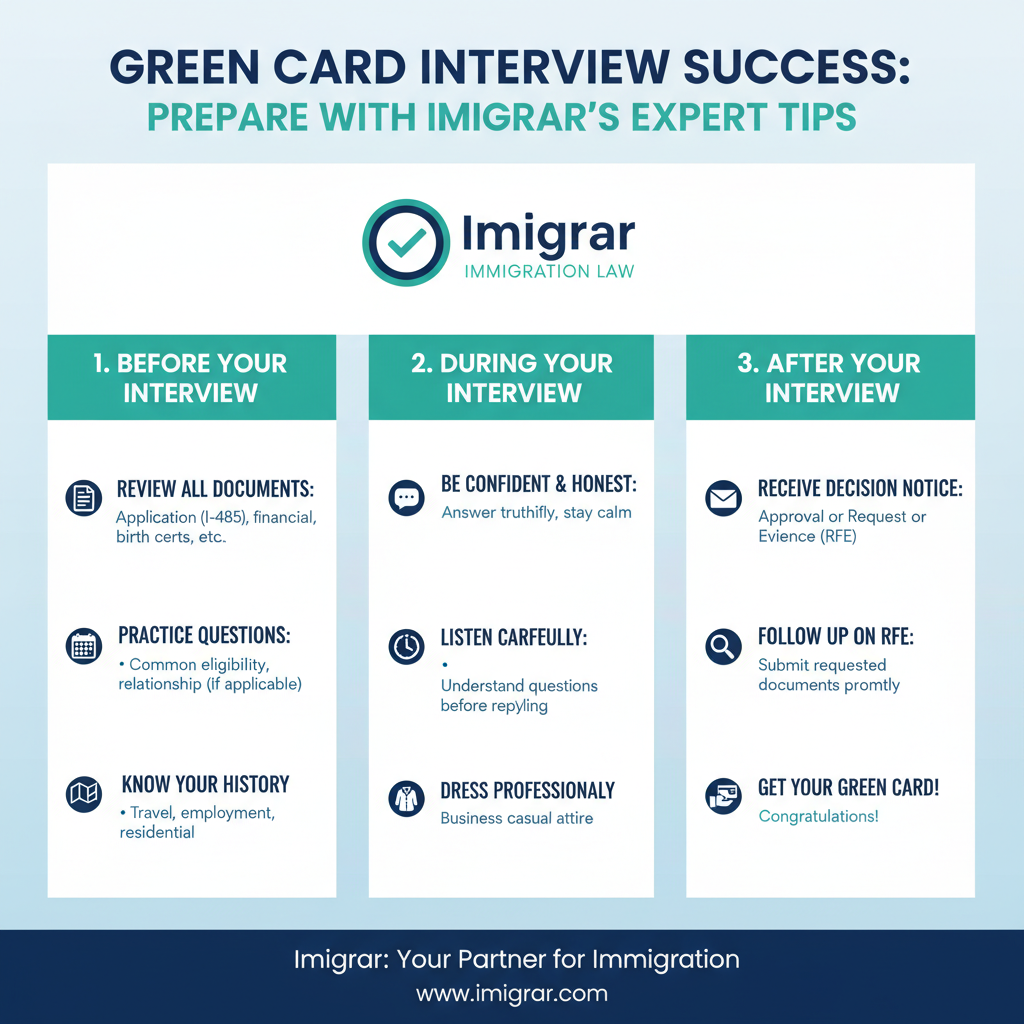
The day of your interview requires careful planning to ensure you arrive prepared and on time. * **Location:** Know the exact address of the **Orlando USCIS Field Office** (6680 Corporate Centre Blvd, Orlando, FL 32822). Plan your route, considering potential traffic on the I-4 corridor. * **Arrival Time:** Arrive at least 30 minutes before your scheduled appointment. Late arrivals can lead to rescheduling or even denial. * **Attire:** Dress professionally, as if you were attending a job interview. This shows respect for the process and the officer. * **Companions:** Only the applicant, petitioner (if applicable), and your attorney are generally allowed into the interview room. Children are often permitted but confirm any policies with your attorney or the USCIS office directly. * **Interpreter:** If you are not fluent in English, you **must** bring a certified interpreter. They must be fluent in both English and your native language, not be a party to the case, and not be your attorney. Inform USCIS in advance if you require an interpreter.6) During the Interview: What to Expect
The interview will typically follow a structured format: * **Oath:** You and your petitioner (if present) will be sworn in to tell the truth. * **Questions:** The officer will review your application forms and ask questions based on the information provided, as well as general eligibility questions. * **Document Review:** The officer will ask for specific original documents and compare them to the copies you submitted. * **Fingerprints:** In some cases, fingerprints may be taken again to verify identity. * **Honesty is paramount.** Answer truthfully and consistently. If you don't know an answer, say so. If you need clarification, ask. * **Do not argue or become defensive.** Maintain a respectful and calm demeanor. * **Your attorney's role:** If you bring an attorney, they are there to represent you, clarify questions, object to improper questions, and ensure your rights are protected. They typically do not answer questions on your behalf unless specifically asked.7) Post-Interview Actions
The outcome of your interview is not always immediate. * **Decision:** You may receive a decision on the spot, or the officer may inform you that a decision will be mailed to you. * **Request for Evidence (RFE):** If the officer needs more information, they may issue an RFE, giving you a deadline to submit additional documents. Respond promptly and thoroughly, ideally with legal assistance. * **Notice of Intent to Deny (NOID):** In more serious cases, you might receive a NOID, explaining why USCIS intends to deny your application. This is a critical juncture where legal counsel is essential to formulate a strong response. * **Follow-up:** If you don't hear back within the expected timeframe (check USCIS processing times), your attorney can help you inquire about your case status.