


The journey to obtaining a Green Card, or lawful permanent residency in the United States, is a significant milestone for countless individuals and families. While the application process itself can be complex, for many, the Green Card interview stands as the final, crucial step. This interview is your opportunity to demonstrate your eligibility and sincerity to U.S. Citizenship and Immigration Services (USCIS) or a Consular Officer.
At Imigrar, an immigration law firm based in Orlando, Florida, we understand the immense pressure and anxiety that can accompany this interview. Our mission is to "Keep Families Together," and a successful Green Card interview is often paramount to achieving that goal. This comprehensive guide is designed to demystify the interview process, provide you with actionable preparation tips, and empower you to approach your interview with confidence.
Need Expert Guidance for Your Green Card Interview? Our Orlando immigration team at Imigrar is ready to assist. We serve clients nationwide and are dedicated to helping you prepare thoroughly. Call +1 786-791-3106 for a free consultation, or message us online. Se Habla Español.
The reporting that sparked this guide
The constant stream of information regarding immigration law, particularly concerning the intricate processes like Green Card interviews, underscores the vital need for accurate and up-to-date guidance. News sources often highlight changes in policy, processing times, or common pitfalls, prompting a continuous demand for clear, practical advice. Our commitment to staying abreast of these developments ensures that our clients receive the most current and effective strategies for their immigration journey.
Green Card Interview Preparation Tips (Immigration Law)
What This News Means for Immigrants in Orlando and Across Florida
The ongoing discussion and focus on immigration processes, particularly the Green Card interview, is not just abstract news; it has tangible implications for individuals and families residing in Florida.
Why this news is showing up now
Immigration law and policy are dynamic fields, constantly evolving with administrative changes, legislative efforts, and shifting global landscapes. The persistent attention on topics like Green Card interview preparation reflects several factors:
- Increased Scrutiny: U.S. immigration authorities continue to enhance their vetting processes to ensure national security and prevent fraud. This means interviews are more thorough, and preparation is more critical than ever.
- Digital Age Demand: In an era of instant information, immigrants and their families are actively seeking clear, reliable advice online. Legal content that breaks down complex processes into understandable steps is highly valued.
- Post-Pandemic Backlog & Changes: While the immediate impacts of the pandemic have somewhat receded, its effects on USCIS operations, including processing times and interview scheduling, continue to reverberate. Applicants are seeking guidance on navigating these ongoing challenges.
- Focus on Family Unity: For many, the Green Card interview is the final hurdle to family reunification. The enduring importance of "Keep Families Together" makes news and guides on this topic perpetually relevant.
How it can affect Florida residents
Florida, particularly Central Florida with its vibrant and diverse population, is a significant hub for immigrants. Residents in Orlando, Kissimmee, Tampa, and along the I-4 corridor are directly impacted by immigration policies and procedures. Here's how this focus on Green Card interviews affects you:
- Local USCIS Field Office: If your case is an Adjustment of Status (applying for a Green Card from within the U.S.), your interview will likely be scheduled at the Orlando USCIS Field Office. Understanding the local office's procedures and expectations is crucial.
- Diverse Community Needs: Florida is home to a vast array of immigrant communities, many of whom may have varying levels of English proficiency or familiarity with U.S. legal processes. The need for clear, multilingual guidance (Se Habla Español) is paramount.
- High Volume of Cases: Due to Florida's large immigrant population, the Orlando and other Florida USCIS offices handle a significant volume of Green Card applications. Proper preparation can help avoid delays and requests for additional evidence (RFEs) that could further extend processing times.
- Economic Impact: Successful immigration directly contributes to Florida's economy and social fabric. Preparing adequately ensures individuals can quickly gain legal status and contribute fully to their communities.
For Central Florida residents, staying informed and preparing diligently for your Green Card interview is not just a recommendation—it's a necessity for a smooth and successful transition to permanent residency.
What Green Card Interview Preparation Is (and Why It Matters)
The Green Card interview is a formal meeting with an immigration officer who reviews your application for lawful permanent residency. It's a critical step in the immigration process, designed to verify the information you've provided, confirm your eligibility, and ensure you are not inadmissible to the U.S.
A plain-English definition
Think of the Green Card interview as your opportunity to personally present your case to the U.S. government. Whether you're applying for your Green Card from within the United States (Adjustment of Status) or from abroad (Consular Processing at a U.S. embassy or consulate), this interview is where an immigration officer will ask you questions about your application, your background, and your relationship (if it's a family-based petition). They want to ensure all the information is accurate and that you meet all the legal requirements to become a permanent resident.
Important: This is not a casual conversation. It's a formal proceeding where your future in the U.S. hangs in the balance. Proper preparation is key to demonstrating credibility and ensuring a favorable outcome.
Key terms you need to know
Navigating the immigration system requires understanding specific terminology. Here are some key terms related to your Green Card interview:
- Green Card: Formally known as a Permanent Resident Card, it proves your authorization to live and work permanently in the United States.
- Adjustment of Status (AOS): The process of applying for lawful permanent resident status (a Green Card) while physically present in the United States. This typically involves submitting Form I-485.
- Consular Processing: The process of applying for an immigrant visa at a U.S. embassy or consulate abroad, which, upon entry to the U.S., results in receiving a Green Card.
- USCIS: U.S. Citizenship and Immigration Services, the government agency responsible for administering immigration and naturalization benefits.
- Petitioner: The U.S. citizen or lawful permanent resident who files an immigrant petition (e.g., Form I-130) on behalf of a foreign national relative.
- Beneficiary: The foreign national who is seeking an immigration benefit, such as a Green Card, based on a petition filed on their behalf.
- Form I-130, Petition for Alien Relative: Filed by a U.S. citizen or LPR to establish the relationship with an eligible foreign relative who wishes to immigrate to the United States.
- Form I-485, Application to Register Permanent Residence or Adjust Status: Filed by an eligible foreign national to apply for a Green Card from within the U.S.
- Form I-864, Affidavit of Support: A legally enforceable contract filed by the petitioner (sponsor) to show they have sufficient income or assets to support the intending immigrant(s) and that the immigrant(s) will not become a public charge.
- Form I-693, Report of Medical Examination and Vaccination Record: Completed by a USCIS-approved civil surgeon to document the applicant's medical eligibility for a Green Card.
- Priority Date: The date your immigrant petition (e.g., Form I-130) was properly filed. This date determines your place in the visa queue for numerically limited categories.
- Request for Evidence (RFE): A letter from USCIS asking for more information or documents to support your application.
- Notice of Intent to Deny (NOID): A letter from USCIS indicating their intention to deny your application unless you provide specific information or evidence to overcome the stated reasons for denial.
Current Immigration Law: The Foundation
The Green Card interview process is rooted in federal immigration law, primarily the Immigration and Nationality Act (INA). Understanding the legal framework is essential for anyone undergoing this process.
Federal requirements
The INA sets forth the fundamental requirements for obtaining a Green Card, whether through family-based petitions, employment-based petitions, or other categories. Key sections of the INA govern:
- Eligibility Categories: Sections 201-204 of the INA define who can immigrate, including immediate relatives of U.S. citizens (spouses, unmarried children under 21, parents) and other family-preference categories.
- Grounds of Inadmissibility: Section 212 of the INA lists various reasons why an applicant might be deemed "inadmissible" to the U.S. and therefore ineligible for a Green Card. These can include health-related grounds, criminal history, security concerns, public charge concerns, immigration violations, and more. During the interview, the officer will assess if any of these grounds apply to you.
- Bona Fide Relationship: For marriage-based Green Cards (a very common category), the law requires proof of a "bona fide" or genuine marriage, not one entered into solely for immigration purposes. This is a significant focus during interviews for spouses.
- Financial Support: Section 213A of the INA mandates that most family-based immigrants (and some employment-based immigrants) have a financial sponsor who files Form I-864, Affidavit of Support, demonstrating sufficient income to prevent the immigrant from becoming a public charge.
- Medical Examination: Section 212(a)(1) requires a medical examination by a USCIS-approved civil surgeon to ensure the applicant is not inadmissible on health-related grounds.
These federal requirements are non-negotiable, and your interview is designed to ensure you meet them all. Having an experienced attorney can help you navigate these complex legal standards. For detailed information on specific laws, refer to the USCIS Policy Manual or the USCIS official website.
Florida-specific considerations
While immigration law is federal, practical considerations can vary by location. For residents of Florida, especially those in the Orlando metropolitan area, the following points are particularly relevant:
- Orlando USCIS Field Office: If you are adjusting status, your interview will be conducted at the local USCIS Field Office, located at 6680 Corporate Centre Blvd, Orlando, FL 32822. Familiarize yourself with its location and parking well in advance.
- High Volume: As previously mentioned, Florida's large immigrant population means USCIS offices handle a high volume of cases. This can sometimes affect processing times, making thorough preparation even more critical to avoid delays. You can check current processing times for the Orlando office on the USCIS Processing Times page.
- Diverse Applicant Pool: The Orlando area serves a melting pot of cultures and languages. If you are not fluent in English, remember your right to an interpreter (more on this later).
- Local Legal Support: Having an Orlando-based immigration law firm like Imigrar, with local knowledge and experience with the specific practices of the Orlando Field Office, can be a significant advantage. We understand the nuances of the local process.
Don't Face Your Green Card Interview Alone. Imigrar's experienced attorneys in Orlando are dedicated to providing comprehensive preparation and support. We help clients nationwide. Call us at +1 786-791-3106 for a free consultation. ¡Se Habla Español!
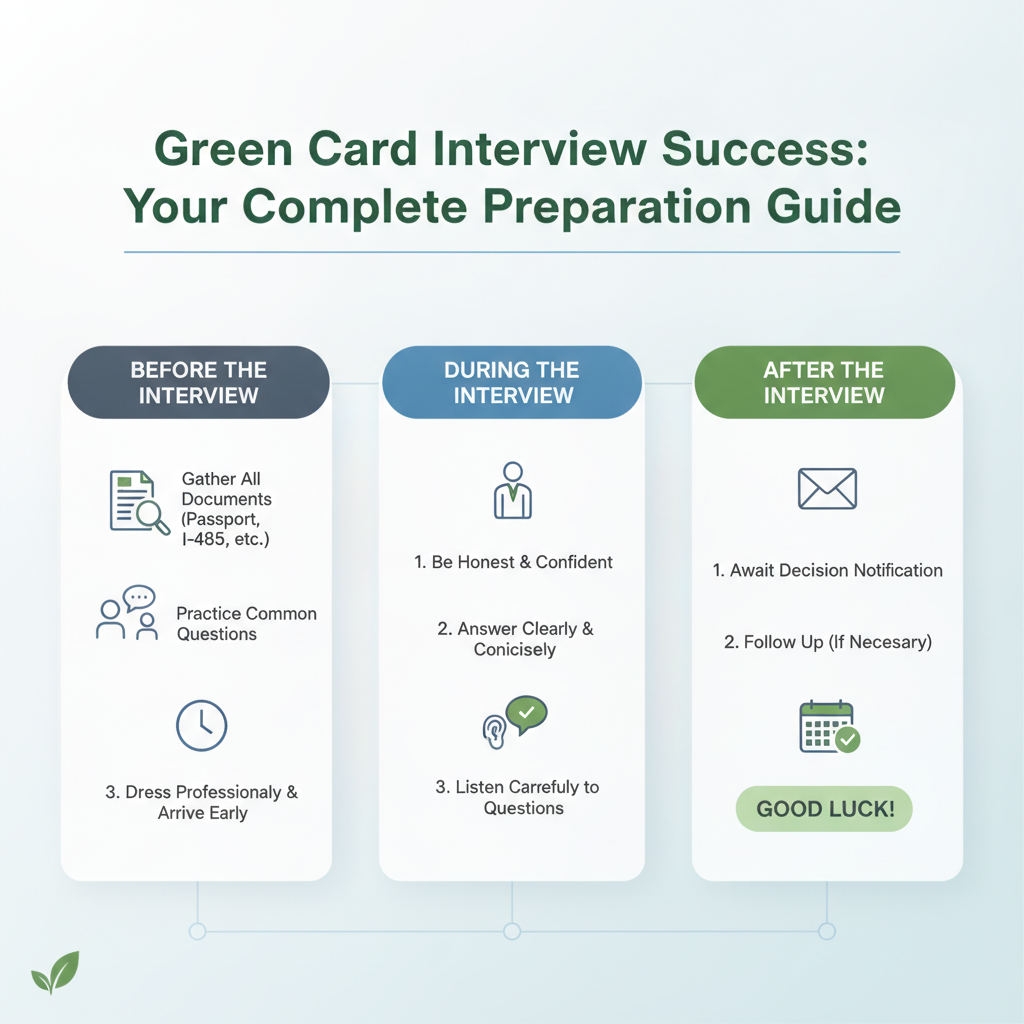
How to Prepare for Your Green Card Interview: A Complete Step-by-Step Guide
Preparing for your Green Card interview can feel overwhelming, but breaking it down into manageable steps makes the process clearer and less stressful. Follow this detailed guide to ensure you're fully ready.
1) Understand Your Interview Notice (Form I-797C)
The first step begins the moment you receive your Form I-797C, Notice of Action, which is your interview notice. This document is critical and contains vital information:
- Date and Time: Mark your calendar immediately. Plan to arrive at least 30 minutes to an hour early.
- Location: For Adjustment of Status, this will be your local USCIS Field Office (e.g., Orlando USCIS Field Office). For Consular Processing, it's the U.S. Embassy or Consulate abroad.
- Required Documents: The notice will list specific original documents you must bring. This is not an exhaustive list; you should bring all documents related to your application.
- Case Number: This number identifies your application. Keep it handy for all communications.
Actionable Tip: Read your interview notice carefully multiple times. If anything is unclear, contact your attorney immediately. Do not guess or assume.
2) Gather and Organize ALL Required Documents
This is arguably the most crucial step. The immigration officer will review your application and compare it against the documents you present. You must bring originals and copies of everything. Organize them meticulously in a binder or folder with dividers.
General Required Documents (Bring Originals and Copies):
- Interview Notice (Form I-797C)
- Government-issued Photo Identification: Passport, driver's license, state ID.
- All Passports: Current and expired, especially those used for entry into the U.S.
- Birth Certificates: For both the applicant and the petitioner (if applicable).
- Marriage Certificate: If applying based on marriage.
- Divorce Decrees or Death Certificates: For any prior marriages of both applicant and petitioner.
- Children's Birth Certificates: If they are included in the application or are relevant to your marital history.
- Form I-693, Report of Medical Examination and Vaccination Record: If not already submitted or if expired. Ensure it's in a sealed envelope from the civil surgeon.
- Form I-864, Affidavit of Support: And all supporting financial documents (tax returns, W-2s, pay stubs, bank statements) for the petitioner and any joint sponsors.
- Police Records/Court Dispositions: For any arrests or convictions, even if expunged or dismissed.
- Prior Immigration Documents: E.g., I-20s (for F-1 students), I-797 approval notices for previous visas (H-1B, L-1, etc.), I-94 arrival/departure records.
Additional Documents for Marriage-Based Green Cards (Proof of Bona Fide Marriage):
This category requires substantial evidence to prove your marriage is genuine. The more evidence you have, the stronger your case.
- Joint Financial Documents: Joint bank accounts, joint credit cards, joint tax returns, joint utility bills, joint mortgage/lease agreements.
- Joint Insurance Policies: Health, life, auto insurance naming both spouses.
- Property Ownership: Joint deeds, titles to vehicles, or other assets.
- Photos: Dated photos of you and your spouse together over time, with family, friends, and at significant events (wedding, holidays, vacations).
- Correspondence: Cards, letters, emails, text messages exchanged between you and your spouse.
- Affidavits from Friends/Family: Letters from people who know your relationship, notarized, detailing their knowledge of your genuine marriage.
- Children's Birth Certificates: If you have children together.
- Travel Itineraries: Showing joint trips.
Reminder: For any document not in English, you must provide a certified English translation along with a copy of the original document. The translator must provide a statement certifying their competence and the accuracy of the translation.
3) Review Your Application Forms Thoroughly
The immigration officer will have your entire application packet in front of them. You must be intimately familiar with every detail you submitted, especially Form I-130 and Form I-485.
- Read through your entire application: Every question, every answer.
- Identify potential discrepancies: Even minor inconsistencies can raise red flags. If you find errors, discuss them with your attorney. You may need to proactively address them.
- Memorize key dates and facts: Dates of marriage, entry into the U.S., birth dates, addresses, employment history.
- Understand the "Why": Be prepared to explain why you answered certain questions the way you did, or why specific documents were submitted.
Warning: Any inconsistencies between your testimony and your application can lead to suspicion of misrepresentation or fraud, which can have severe consequences, including denial and future bars to immigration.
4) Practice Answering Potential Questions
While you can't predict every question, you can anticipate common themes based on your application type.
General Questions:
- "What is your full name?" "What is your date of birth?"
- "What is your current address?"
- "When did you last enter the U.S.?" "How did you enter?"
- "Have you ever been arrested or convicted of a crime?"
- "Have you ever violated immigration laws?"
- "Do you understand the oath of allegiance to the U.S.?"
For Marriage-Based Green Cards:
- "How did you meet your spouse?" "When and where was your first date?"
- "Who proposed?" "When and where was the wedding?"
- "What are your spouse's parents' names?" "What does your spouse do for a living?"
- "Describe your typical day together."
- "Do you share a bank account? What bills do you pay together?"
- "Where do you keep your toothbrush?" (Yes, officers sometimes ask very personal details to gauge genuineness).
Actionable Tip: Conduct a mock interview with your attorney, a trusted friend, or family member. Practice answering clearly, concisely, and honestly. Focus on providing direct answers without volunteering unnecessary information.
5) Dress Professionally and Arrive Early
First impressions matter. Treat your interview like a job interview.
- Dress Code: Business casual or professional attire (suit, dress, slacks, collared shirt). Avoid overly casual clothing.
- Punctuality: Plan to arrive at the USCIS Field Office at least 30-60 minutes before your scheduled time, especially in Orlando where traffic along the I-4 corridor can be unpredictable. This allows time for parking, security, and finding your waiting area without feeling rushed.
- What to Bring: Only necessary documents, your phone (silenced), and a small bag. Leave valuable items at home if possible.
Important: Check the USCIS website for any specific instructions regarding visitors or prohibited items at the Orlando Field Office.
6) During the Interview: Be Honest, Calm, and Clear
The interview itself is a test of your preparedness, honesty, and composure.
- Take the Oath Seriously: You will be asked to swear or affirm that your testimony will be true. This is a formal legal proceeding.
- Listen Carefully: Pay close attention to each question. If you don't understand, politely ask the officer to repeat or rephrase it.
- Be Honest: Always tell the truth, even if the answer is unfavorable. Lying or misrepresentation has severe consequences, including permanent bars from the U.S.
- Answer Directly: Provide concise, truthful answers. Do not elaborate unnecessarily unless asked.
- Maintain Composure: It's natural to be nervous, but try to remain calm and collected. If you need a moment, politely ask for one.
- Refer to Your Attorney: If you have an attorney present, they are there to represent you. They can clarify questions, object to improper questions, and ensure your rights are protected. They cannot answer for you directly but can advise you.
- Interpreter: If you require an interpreter, USCIS typically provides one for free. You cannot bring a family member or friend to interpret. If you brought your own approved interpreter (rare, usually only if USCIS cannot provide one for your language), ensure they are qualified.
7) After the Interview: Follow Up and Next Steps
The interview isn't always the final step.
- Immediate Decision: Sometimes, the officer will approve your case on the spot or tell you a decision will be mailed.
- Request for Evidence (RFE): If the officer needs more documents or clarification, they will issue an RFE, usually within a few weeks. Respond promptly and thoroughly.
- Notice of Intent to Deny (NOID): If USCIS intends to deny your case, they will send a NOID, giving you a chance to respond. This is a critical point where legal counsel is indispensable.
- Waiting for Decision: If no immediate decision or RFE, you will typically receive a decision by mail within a few weeks to a few months. You can check your case status online using your receipt number on the USCIS Case Status Online tool.
- Green Card Mailing: Once approved, your Green Card will be mailed to you, usually within 90 days.

Practical Steps You Can Take Today
Don't wait until the last minute to prepare. Here’s an actionable checklist to start today:
- Consult with an Immigration Attorney: This is the most crucial step. An attorney can review your application, identify potential issues, help you gather documents, and prepare you for specific questions.
- Gather Original Documents Early: Don't wait for the interview notice. Start collecting birth certificates, marriage licenses, tax returns, and any other relevant documents now.
- Organize Your File: Create a well-indexed binder with copies and originals clearly separated.
- Review Your Submitted Application: Get a copy of everything you submitted to USCIS and read it cover to cover. Highlight any areas you might need to clarify.
- Practice Explaining Your Story: Be ready to articulate your journey, your relationship (if applicable), and your answers to application questions clearly and concisely.
- Collect Additional Supporting Evidence: Especially for marriage-based cases, continuously gather new joint documents, photos, and correspondence to demonstrate the ongoing nature of your relationship.
- Check USCIS Processing Times: Stay informed about general timelines for the Orlando Field Office via the USCIS Processing Times page. This helps manage expectations.
Document preparation guidance
- Create a Master Checklist: Based on your interview notice and advice from your attorney.
- Label Everything: Use sticky notes or tabs to clearly label each document in your binder.
- Multiple Copies: Have at least two full sets of copies for every original document you bring. One for the officer, one for your attorney, and one for your own reference.
- Certified Translations: Ensure all non-English documents have certified translations attached.
- Affidavits: If using affidavits from friends/family, ensure they are notarized and include the full contact information of the affiant.
Timeline expectations
The timeline for receiving an interview notice and a final decision can vary significantly:
- Interview Scheduling: After filing Form I-485, it can take several months to over a year to receive an interview notice, depending on the USCIS Field Office backlog and your specific category.
- Post-Interview Decision: While some receive an immediate decision, many will wait anywhere from a few days to several months for a decision notice to arrive by mail.
- Green Card Delivery: Once approved


