


The reporting that sparked this guide: Green Card Interview Preparation Tips (Immigration Law)
What This News Means for Immigrants in Orlando and Across Florida
Why this news is showing up now
The Green Card interview is not a new requirement; it has been a fundamental part of the immigration process for decades. However, its significance is consistently emphasized due to several factors. Firstly, immigration policies and enforcement priorities can shift, leading to more rigorous scrutiny during interviews. Secondly, as the volume of applications fluctuates, USCIS (U.S. Citizenship and Immigration Services) continually refines its interview procedures to ensure integrity and efficiency. Thirdly, the digital age means information (and misinformation) spreads rapidly, making reliable, current guidance more important than ever. The continuous flow of immigration news, particularly regarding processing times and success rates, naturally brings the interview process to the forefront, prompting immigration attorneys and advocacy groups to provide updated preparation strategies. For Imigrar, "Keep Families Together" is our tagline, and ensuring our clients are fully prepared for this critical step is central to our mission.How it can affect Florida residents
Florida, particularly Central Florida with its vibrant international community in cities like Orlando, is home to a vast immigrant population. Many residents are either in the midst of their Green Card application process or preparing to begin it. For Florida residents, understanding the nuances of the Green Card interview is crucial. The Orlando USCIS Field Office, located in Orange County, processes a significant number of these interviews annually. Being well-prepared means you can navigate the local office's procedures more effectively, minimize delays, and present your case clearly and confidently. Moreover, Florida's diverse population means that many applicants may require interpreters or have unique cultural considerations, which proper preparation can address. The state's proximity to international travel hubs also means many Green Card applicants are adjusting status from various temporary visas, each presenting its own set of interview considerations.Need Help? Our Orlando immigration team is ready to assist. Call +1 786-791-3106 for a free consultation, or message us online. Se Habla Español.
What Green Card Interview Preparation Is (and Why It Matters)
The Green Card interview is a mandatory step for most individuals applying for lawful permanent residency in the United States, whether through Adjustment of Status (applying within the U.S.) or Consular Processing (applying from abroad). It is the government’s opportunity to verify the information provided in your application, confirm your eligibility, and ensure that no grounds of inadmissibility apply to your case. For many, especially those applying through marriage to a U.S. citizen, it's also a chance for a USCIS officer to assess the bona fides (authenticity) of the relationship.A plain-English definition
Simply put, your Green Card interview is a face-to-face meeting with a U.S. immigration officer. During this meeting, the officer will ask you questions about your application, your background, your reasons for seeking a Green Card, and, if applicable, the nature of your relationship with your petitioner. It's an opportunity for you to present yourself, clarify any ambiguities, and demonstrate that you meet all the legal requirements for permanent residency. Think of it as the final exam of your immigration journey – a chance to prove everything you've submitted in writing.Key terms you need to know
Navigating the Green Card process involves understanding specific terminology. Here are some essential terms related to your interview: * **Adjustment of Status (AOS):** The process of applying for a Green Card while physically present in the United States. Your interview will typically be at a USCIS Field Office, like the one in Orlando, Florida. * **Consular Processing:** The process of applying for a Green Card from outside the United States through a U.S. embassy or consulate in your home country. * **USCIS Officer:** The immigration official who conducts your interview and makes a recommendation on your case. They are trained to assess credibility and verify information. * **Petitioner:** The U.S. citizen or lawful permanent resident who files an immigrant petition on your behalf (e.g., your spouse, parent, or employer). * **Beneficiary:** The immigrant seeking the Green Card (you). * **Form I-130, Petition for Alien Relative:** The initial petition filed by a U.S. citizen or LPR on behalf of a qualifying relative. * **Form I-485, Application to Register Permanent Residence or Adjust Status:** The primary application for a Green Card filed by the beneficiary when adjusting status within the U.S. * **Form DS-260, Immigrant Visa Application:** The primary application for an immigrant visa filed by the beneficiary when undergoing consular processing. * **Priority Date:** The date USCIS receives your immigrant petition (usually Form I-130 or Form I-140). This date determines your place in the visa queue. * **Affidavit of Support (Form I-864):** A legally binding document signed by the petitioner (and sometimes a joint sponsor) to ensure the immigrant will not become a public charge. * **Notice of Interview (Form I-797C):** The official document from USCIS or the National Visa Center (NVC) informing you of your interview date, time, and location, and listing required documents. * **Bona Fide Marriage:** A marriage entered into in good faith, not solely for immigration purposes. This is heavily scrutinized in marriage-based Green Card interviews. * **Request for Evidence (RFE):** A letter from USCIS or NVC requesting additional documents or information to support your application.Current Immigration Law: The Foundation
The framework for Green Card eligibility and the interview process is rooted primarily in the Immigration and Nationality Act (INA), specifically sections related to immigrant visas and adjustment of status. The INA, along with subsequent regulations and policy memoranda, dictates who is eligible for permanent residency, the grounds for inadmissibility, and the procedures for application and interview.Federal requirements
At the federal level, the fundamental requirements for a Green Card generally involve: 1. **Eligibility Category:** You must qualify under an immigrant visa category, such as family-sponsored (e.g., immediate relatives of U.S. citizens, family preference categories) or employment-based. 2. **Approved Immigrant Petition:** An immigrant petition (e.g., Form I-130, Form I-140) must be filed and approved on your behalf. 3. **Visa Availability:** For most preference categories, an immigrant visa number must be available according to the Visa Bulletin, based on your Priority Date. Immediate relatives of U.S. citizens do not have visa backlogs. 4. **Admissibility:** You must be admissible to the United States. This means you must not fall under any grounds of inadmissibility, such as certain criminal convictions, health issues, prior immigration violations, or being deemed a "public charge." If you are inadmissible, you may need to apply for a waiver. 5. **Good Moral Character:** While not explicitly a requirement for all Green Card categories, USCIS officers generally assess an applicant's good moral character, especially in discretionary cases. The interview serves as the primary mechanism for USCIS to confirm these requirements. The officer will review all submitted documentation, including your Form I-130 (if applicable), Form I-485 (for Adjustment of Status) or Form DS-260 (for Consular Processing), financial documents like Form I-864, medical examination results (Form I-693), and biographical information. The purpose is to ensure that all information is accurate, consistent, and that you truthfully meet all legal criteria. For comprehensive details on all forms and requirements, always refer to the USCIS official website.Florida-specific considerations
While the federal laws are uniform across the nation, how they are applied can feel different depending on your local USCIS Field Office. For residents of Central Florida, your Green Card interview will likely take place at the Orlando USCIS Field Office. * **Local Office Procedures:** Each field office develops minor procedural differences. For example, the Orlando office may have specific protocols for check-in, interpreter services, or document submission on the day of the interview. Your Imigrar attorney, familiar with the Orlando office, can provide insights into these local nuances. * **Accessibility:** The Orlando Field Office is generally accessible via major roadways, including the I-4 corridor. However, traffic in Orlando can be unpredictable, especially during peak hours. Planning your commute well in advance is critical to ensure you arrive on time. * **Diverse Population:** Orlando's rich multicultural fabric means that the USCIS officers are accustomed to interviewing individuals from a wide array of backgrounds and languages. While this can be reassuring, it underscores the importance of clear communication, and if needed, having a certified interpreter. * **State Regulations:** While Florida does not have its own immigration laws that directly impact federal Green Card eligibility, state laws can affect related matters, such as obtaining birth certificates, marriage licenses, or police records, which are often crucial supporting documents for your application.Need Help? Our Orlando immigration team is ready to assist. Call +1 786-791-3106 for a free consultation, or message us online. Se Habla Español.
How to Prepare for Your Green Card Interview: A Complete Step-by-Step Guide
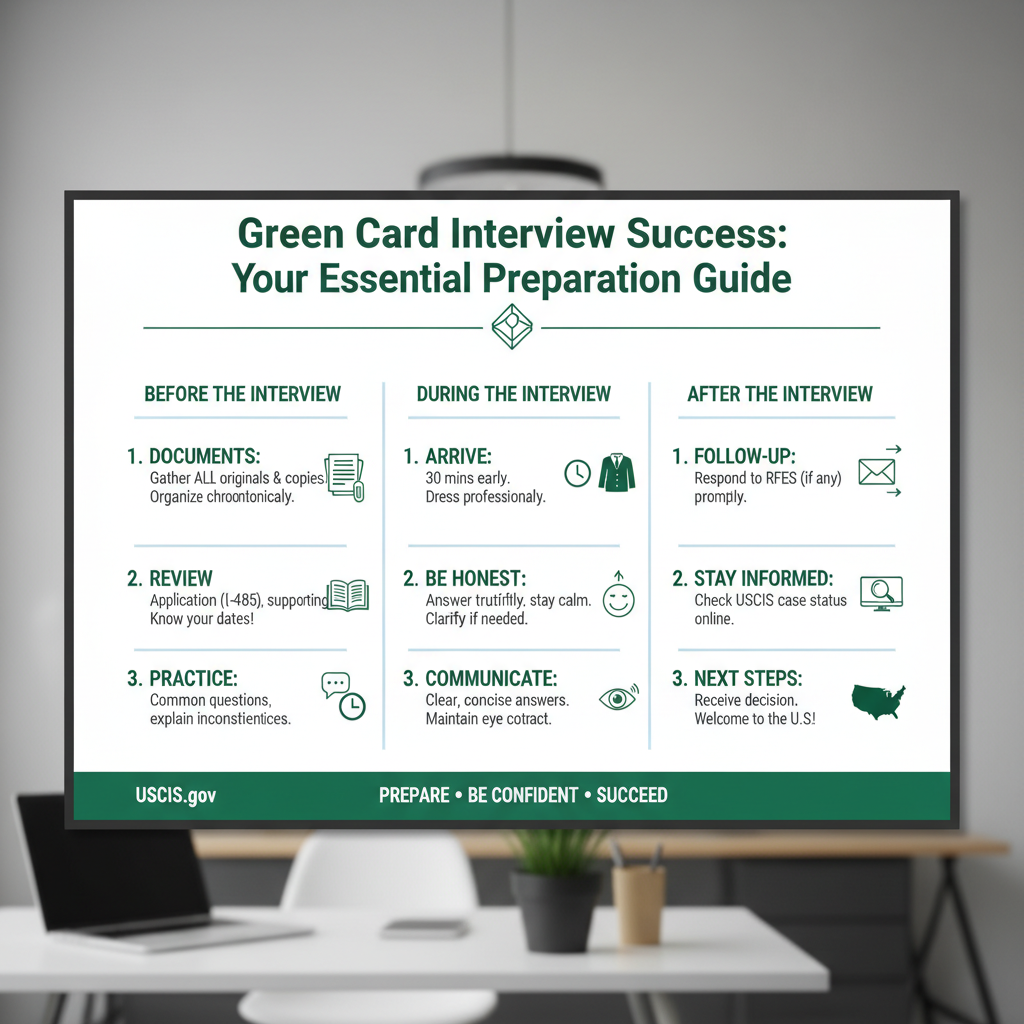
Preparing for your Green Card interview is a multi-faceted process that requires meticulous attention to detail and a strategic approach. Here is a comprehensive, step-by-step guide to help you navigate this critical stage with confidence.1) Understand Your Interview Notice (Form I-797C)
The first crucial step is to carefully read your **Notice of Interview (Form I-797C)**. This document contains vital information you need to know: * **Date and Time:** Note the exact date and time of your interview. Arriving late can lead to cancellation and significant delays. * **Location:** Confirm the address of the USCIS Field Office or Consulate. For Central Florida residents, this will likely be the Orlando USCIS Field Office. * **Required Documents:** The notice will list specific documents you must bring. This list is not exhaustive and you should always bring all original documents related to your case. * **Attendees:** For marriage-based cases, both the petitioner and beneficiary must attend. For other categories, only the beneficiary may be required. * **Interpreter Needs:** If you require an interpreter, the notice may specify requirements or suggest bringing your own. **Actionable Advice:** As soon as you receive your interview notice, mark your calendar, share it with your attorney, and begin assembling the documents requested.2) Gather and Organize All Required Documents
This is arguably the most critical step. The USCIS officer will use your documents to verify your application. You must bring *all* original documents submitted with your application, plus copies, and any new documents that have emerged since you filed. Organize them neatly in a binder or folder, clearly labeled. **Required Documents Checklist (Bring Originals and Copies):** * **Interview Notice (Form I-797C):** Your official interview letter. * **Government-Issued Photo ID:** Valid passport, driver's license (e.g., Florida driver's license), or state ID. * **All Passports:** Your current and any expired passports. * **Birth Certificates:** Your original birth certificate and, if applicable, your petitioner's. (With certified English translations if not in English). * **Marriage Certificate:** If applicable, your original marriage certificate. (With certified English translation). * **Divorce Decrees/Death Certificates:** For any previous marriages of yourself or your petitioner, bring original divorce decrees or death certificates. (With certified English translations). * **Medical Examination Report (Form I-693):** If you haven't submitted it yet, or if it has expired (it's valid for two years from the civil surgeon's signature date). Must be in a sealed envelope. * **Affidavit of Support (Form I-864):** The original signed form from your petitioner (and joint sponsor, if applicable), along with all supporting financial documents: * Most recent federal income tax returns (including W-2s, 1099s, and all schedules). * Proof of current employment (employment letter, recent pay stubs). * Proof of assets (bank statements, property deeds), if needed to meet poverty guidelines. * **Proof of Relationship (for marriage-based cases):** Extensive evidence demonstrating a bona fide marriage: * Joint bank accounts (statements, joint credit cards). * Joint leases, mortgages, or property deeds (e.g., for a home in Orlando). * Joint utility bills, insurance policies (health, life, auto, home). * Children's birth certificates (if you have children together). * Photos together (wedding, holidays, family events, travel). * Correspondence (emails, texts, cards). * Affidavits from friends and family testifying to the relationship. * Any other documentation showing commingling of lives and assets. * **Employment Authorization Document (EAD) and Advance Parole (AP):** If you have them. * **Academic Degrees/Diplomas:** If your application is employment-based. * **Police Clearances:** From any country you lived in for more than 6 months since age 16 (for consular processing, or if requested for AOS). * **Military Records:** If applicable. * **Previous Immigration Documents:** Copies of all prior applications (e.g., visa applications, previous Green Card applications), entry/exit stamps, I-94 records. * **Two Passport-Style Photos:** Recent, color photos meeting USCIS specifications. * **Any RFEs (Requests for Evidence) and Your Responses:** Copies of all correspondence with USCIS. **Important:** For any documents not in English, you must provide a certified English translation along with a copy of the original document.3) Review Your Application Forms (I-130, I-485, etc.)
You and your petitioner (if applicable) must be intimately familiar with every detail submitted in your application forms. The USCIS officer will compare your interview answers to the information on these forms. Any inconsistencies, even minor ones, can raise red flags. * **Read Everything:** Go through your Form I-130, Form I-485, and all supporting documents (including your medical exam and affidavit of support) multiple times. * **Cross-Reference:** Ensure dates, addresses (including previous residences in Florida or elsewhere), names, and other biographical information are consistent across all forms. * **Understand Questions:** Be prepared to explain any "yes" answers to questions about criminal history, prior immigration violations, or other sensitive topics. * **Petitioner's Knowledge:** If it's a marriage-based case, both spouses should know the details of the forms, especially those pertaining to the relationship.4) Practice Answering Potential Questions
Role-playing with your attorney, a trusted friend, or family member can significantly boost your confidence. Practice speaking clearly and concisely. **Common Interview Questions:** * **Biographical:** Your full name, date of birth, place of birth, parents' names, previous addresses (e.g., "What was your address before moving to Orlando?"). * **Application Details:** When did you enter the U.S.? What type of visa did you have? Have you ever been arrested or convicted of a crime? Have you ever violated immigration law? * **Marriage-Based Specific (for both spouses):** * How and when did you meet? * When did you decide to get married? Where was the wedding? Who attended? * What are your spouse's parents' names? Birthdays? * What do you do for fun together? * Describe your daily routine. * Who pays which bills? * Do you have joint accounts? Where do you live (e.g., "Do you live in Orlando, and in which neighborhood?")? * What are your spouse's hobbies? Favorite food? * When was the last time you saw your spouse's family? * Have you traveled together? **Warning:** Do not memorize answers. Instead, understand the facts of your case so you can answer truthfully and naturally.5) Prepare for the Interview Day Logistics
The day of the interview can be stressful. Planning ahead for logistics can alleviate some anxiety. * **Dress Code:** Dress professionally, as if for a job interview. This shows respect for the process and the officer. * **Arrival Time:** Plan to arrive at least 30-45 minutes before your scheduled interview time, especially for the Orlando Field Office which can have security lines and parking challenges. Factor in potential Orlando traffic on the I-4 corridor. * **Bringing Your Attorney:** You have the right to have your immigration attorney accompany you to the interview. At Imigrar, we strongly recommend this as our presence can provide legal guidance, ensure fair procedure, and help address any unexpected issues. * **Interpreter:** If you are not fluent in English, bring a certified interpreter. They must be fluent in both English and your native language, be at least 18 years old, and not be a party to the application (e.g., your petitioner cannot interpret for you). * **Children:** If you have young children, arrange for childcare if possible. While they are usually allowed, it can be distracting.6) During the Interview: What to Expect and How to Behave
Your demeanor and responses during the interview are crucial. * **Be Truthful and Honest:** Always tell the truth, even if it's uncomfortable. Lying to an immigration officer can lead to permanent bars from the U.S. * **Listen Carefully:** Pay close attention to each question. If you don't understand, politely ask the officer to repeat or rephrase it. * **Answer Directly and Concisely:** Provide direct answers to the questions asked. Avoid volunteering unnecessary information, which can sometimes complicate your case. * **Remain Calm and Respectful:** The officer's job is to ask questions and sometimes challenge your responses. Maintain a respectful attitude, even if you feel nervous or frustrated. * **Correct Mistakes:** If you realize you've made a mistake on your application or in a previous answer, politely correct it. * **Maintain Eye Contact:** This conveys honesty and confidence. * **Sign Documents:** Be prepared to sign various documents under oath. * **Attorney's Role:** Your attorney will be there to advise you, clarify questions, object to inappropriate questions, and ensure your rights are protected.7) After the Interview: Next Steps and Follow-Up
The interview is usually the final step before a decision. * **Decision:** The officer may tell you immediately that your Green Card is approved, or they might say they need more time. * **Request for Evidence (RFE):** If the officer needs more documents, they will issue an RFE, typically with a deadline (e.g., 87 days). Respond promptly and thoroughly. * **Notice of Decision:** You will receive a written decision by mail. If approved, your Green Card will be mailed to you, often within a few weeks. * **Denial:** If your application is denied, the notice will explain the reasons and your options, which may include filing an appeal or a motion to reopen/reconsider. * **Conditional Green Card:** If you're married for less than two years when your Green Card is approved, you'll receive a 2-year conditional Green Card. You'll need to file Form I-751, Petition to Remove Conditions on Residence, within the 90-day window before it expires.Need Help? Our Orlando immigration team is ready to assist. Call +1 786-791-3106 for a free consultation, or message us online. Se Habla Español.
Practical Steps You Can Take Today
Don't wait until the last minute to prepare for your Green Card interview. Here are actionable steps you can start taking now to ensure you're fully ready. **Actionable Checklist:** 1. **Consult an Immigration Attorney:** If you haven't already, schedule a consultation with an experienced immigration lawyer. They can review your case, identify potential issues, and guide your preparation. Imigrar offers free consultations in Orlando and nationwide. 2. **Organize Your Documents Systematically:** Create a physical and digital folder for all your immigration documents. Categorize them (e.g., "Personal IDs," "Marriage Proof," "Financials"). Use tabs and labels. 3. **Review Your Entire Application:** Sit down with your spouse (if applicable) and thoroughly read every form you submitted. Highlight any areas where you might need to refresh your memory or gather additional evidence. 4. **Start Gathering New Evidence (Especially for Marriage Cases):** Continuously collect evidence of your ongoing relationship, such as new joint bank statements, utility bills, photos, travel tickets, or correspondence. 5. **Practice Answering Questions:** Even if you don't have an attorney yet, think about the common questions listed above and practice answering them out loud. 6. **Check Medical Exam Validity:** Verify the expiration date of your Form I-693. If it's expired or nearing expiration, plan to get a new one. 7. **Address Any Potential Inadmissibility Issues:** If you have any past issues (e.g., minor criminal infractions, previous overstays), discuss them with your attorney immediately to explore possible waivers or mitigation strategies. **Document Preparation Guidance:** * **Originals vs. Copies:** Always bring *original* documents to the interview. Also, prepare a complete set of *photocopies* for the officer, even if you previously submitted them. This can save time if they need to keep a copy. * **Translations:** If any document is not in English, you *must* provide a certified English translation. The translator must sign a certificate stating they are competent to translate and that the translation is accurate. * **Photos:** Ensure all photos are current, passport-style, and meet USCIS specifications. * **Medical Exam:** Keep the Form I-693 in its sealed envelope if you are bringing it to the interview. Do not open it. **Timeline Expectations:** * **Interview Scheduling:** After submitting your Form I-485, it can take anywhere from a few months to over a year to receive your interview notice, depending on your USCIS field office and specific case type. You can check average processing times on the USCIS Processing Times page. * **Interview Decision:** Some officers may give you an immediate verbal approval, but a formal written decision (and your Green Card) usually arrives by mail within a few weeks to a couple of months. * **RFEs:** If you receive an RFE, you typically have 87 days to respond. * **Conditional Green Card Removal (Form I-751):** If you receive a conditional Green Card, you must file Form I-751 within the 90-day window before its expiration. Start preparing for this well in advance.How Imigrar Helps Immigrants in Orlando
At Imigrar, our mission is "Keep Families Together." We understand that the Green Card interview is a high-stakes event, and proper preparation is the key to success. Our Orlando-based immigration team is dedicated to providing comprehensive, compassionate, and effective legal representation for immigrants in Central Florida and across the nation. **Our Experience and Expertise:** * **Deep Local Knowledge:** We are intimately familiar with the procedures and expectations of the Orlando USCIS Field Office, having guided countless clients through their interviews there. This local insight can be invaluable. * **Comprehensive Preparation:** We don't just fill out forms; we prepare you for every aspect of your interview. This includes: * Thorough review of your entire application package. * Detailed document organization and checklist creation. * Extensive mock interview sessions, simulating the actual interview experience. * Guidance on what to expect, how to answer questions, and appropriate demeanor. * Addressing any potential red flags or complex issues in your case. * **Attorney Representation:** An Imigrar attorney can accompany you to your interview, providing legal support, intervening if necessary, and ensuring your rights are protected throughout the process. Our presence can provide significant peace of mind. * **Post-Interview Support:** Whether it's responding to an RFE or appealing a denial, we stand by our clients through every step until a final resolution. **Free Consultation Offer:** We understand that navigating immigration law can be daunting and costly. That's why Imigrar offers a **free consultation** to discuss your Green Card case and interview preparation needs. During this consultation, we can assess your situation, explain the process, and outline how our services can benefit you. **Se Habla Español:** We are proud to serve Florida's diverse community. Our team is fully bilingual, and we are ready to assist you in both English and Spanish. You can communicate comfortably and clearly with us, ensuring no detail is lost in translation. Call us today at +1 786-791-3106 to schedule your free consultation and take the first step towards a successful Green Card interview.
Frequently Asked Questions
Q: Who needs to attend the Green Card interview?
A: Generally, the applicant (beneficiary) must attend. If you are applying for a Green Card based on marriage to a U.S. citizen or lawful permanent resident, both you and your spouse (the petitioner) must attend the interview. For other family-based or employment-based categories, typically only the beneficiary is required, though the USCIS officer may request the petitioner to attend if they deem it necessary. Your interview notice (Form I-797C) will specify who must be present. It's also highly recommended to have your immigration attorney accompany you.
Q: What if I don't speak English well? Do I need an interpreter?
A: Yes, if you are not fluent in English, you must bring a certified interpreter to your interview. The interpreter must be at least 18 years old, fluent in both English and your native language, and cannot be your attorney or the petitioner for your case. Failure to bring a suitable interpreter can lead to the cancellation of your interview and significant delays. Inform your attorney if you need assistance arranging for an interpreter.
Q: How long does the Green Card interview typically last?
A: The length of a Green Card interview can vary significantly. Simple, straightforward cases might last only 15-20 minutes. More complex cases, especially marriage-based interviews where the officer needs to assess the bona fides of the relationship, can last an hour or even longer. Be prepared to spend several hours at the USCIS Field Office, accounting for check-in, waiting times, and the interview itself. For example, at the Orlando USCIS Field Office, wait times can fluctuate.
Q: What happens if I forget to bring a required document?
A: Forgetting a required document can cause delays. In some cases, the USCIS officer might be lenient and allow you to mail the missing document or schedule a follow-up appointment. More often, they will issue a **Request for Evidence (RFE)**, which you must respond to within a specific deadline (e.g., 87 days). In the worst-case scenario, if the document is critical and you cannot provide it, your application could be denied. This underscores the importance of thorough document preparation and bringing all originals and copies. If you realize you've forgotten something, inform your attorney immediately.
Q: Are there any costs associated with the Green Card interview itself?
A: There is no separate fee specifically for the Green Card interview. The interview fee is included in the filing fees for your primary applications, such as Form I-4


