


The journey to obtaining a Green Card, or lawful permanent residency in the United States, is a significant milestone for countless individuals and families. After submitting your application, one of the most pivotal stages you'll face is the Green Card interview. This interview is your opportunity to demonstrate your eligibility and sincerity to U.S. Citizenship and Immigration Services (USCIS).
For many, the thought of an interview can be daunting. What questions will be asked? What documents are needed? How can you ensure you make the best impression? At Imigrar, your dedicated immigration law firm in Orlando, Florida, we understand these concerns. Our mission is to "Keep Families Together" by providing expert guidance and support through every step of the immigration process, including comprehensive preparation for your Green Card interview.
The reporting that sparked this guide
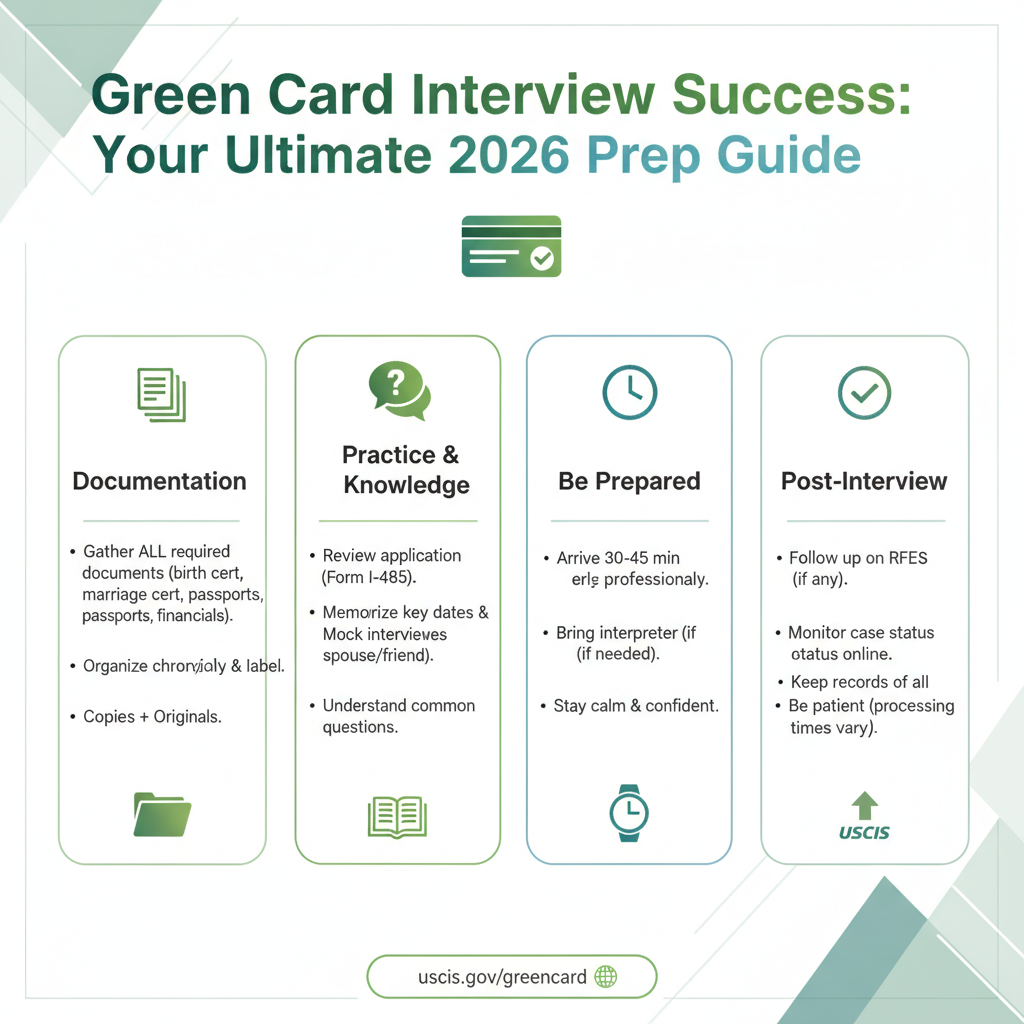
The ongoing discussion and emphasis on immigration procedures, particularly the Green Card interview process, underscore its critical importance. This guide is inspired by and aims to address the common questions and anxieties highlighted in broad discussions around Green Card Interview Preparation Tips (Immigration Law), reflecting the consistent need for clear, actionable advice for applicants nationwide.
What This News Means for Immigrants in Orlando and Across Florida
The Green Card interview remains a cornerstone of the immigration process, and recent trends and policy discussions continue to emphasize its role in ensuring the integrity of the U.S. immigration system. For immigrants in Orlando, across Central Florida, and throughout the Sunshine State, understanding this crucial step is more important than ever.
Why this news is showing up now
In 2026, the focus on Green Card interview preparation is particularly relevant due to several factors. USCIS continues to streamline its processes while simultaneously enhancing its vetting procedures. This dual focus means that while processing times might see fluctuations, the rigor of the interview itself remains paramount. There's an ongoing emphasis on preventing fraud and ensuring that all applicants meet the strict eligibility criteria for permanent residency. Furthermore, as immigration policies evolve, the interview serves as a critical checkpoint where officers can clarify information, address discrepancies, and assess the veracity of an applicant's claims and relationships. This constant evolution in policy and processing keeps the topic of interview preparation consistently in the news and at the forefront of applicants' minds.
How it can affect Florida residents
Florida is a vibrant hub for immigrants from all over the world, with a significant presence in cities like Orlando. For residents of Florida, especially those in Orange County and along the I-4 corridor, the Orlando USCIS Field Office is a primary point of contact for Green Card interviews. This means understanding local procedures and potential backlogs specific to this office is crucial. The state's diverse population also implies a wide array of Green Card application types, from family-based petitions to employment-based adjustments, each with its unique interview considerations. Preparing effectively ensures that Florida residents can navigate the local specifics, minimize delays, and present their strongest case to the officers at the Orlando field office. Given the high volume of applications in Florida, being thoroughly prepared can significantly impact the efficiency and success of your interview experience.
Need Help? Our Orlando immigration team is ready to assist. Call +1 786-791-3106 for a free consultation, or message us online. Se Habla Español.
What the Green Card Interview Is (and Why It Matters)
The Green Card interview is arguably the most critical stage in your journey to becoming a lawful permanent resident of the United States. It's the moment when you, and often your petitioner, meet directly with a USCIS officer to discuss your application.
A plain-English definition
Simply put, the Green Card interview is a face-to-face meeting with a U.S. immigration officer. Its primary purpose is for USCIS to verify the information provided in your application forms, confirm your eligibility for a Green Card, and ensure that you are not inadmissible to the United States under current immigration law. For family-based petitions, particularly marriage-based Green Cards, the interview also serves to confirm the legitimacy of your relationship. It’s a chance for the officer to ask questions, review your original documents, and assess your credibility and the truthfulness of your statements.
Key terms you need to know
Navigating the immigration process requires familiarity with specific terminology. Here are some key terms related to your Green Card interview:
- Adjustment of Status (AOS): This refers to the process of applying for lawful permanent resident status (a Green Card) while physically present in the United States. If you're applying for a Green Card from within the U.S., you're likely undergoing an AOS interview.
- Consular Processing: If you are applying for your Green Card from outside the U.S., your interview will take place at a U.S. embassy or consulate in your home country. This is known as Consular Processing.
- Immigrant Visa: For those undergoing Consular Processing, a successful interview leads to the issuance of an immigrant visa, which allows you to enter the U.S. as a permanent resident.
- Petitioner: The U.S. citizen or lawful permanent resident (LPR) who filed an immigration petition (like Form I-130) on behalf of an immigrant relative. The petitioner often attends the interview with the beneficiary.
- Beneficiary: The immigrant who is seeking the Green Card based on a petition filed on their behalf. This is you, the applicant.
- USCIS Field Office: The local office where your interview will be conducted if you are adjusting status within the U.S. For Central Florida residents, this is typically the Orlando USCIS Field Office.
- National Visa Center (NVC): For Consular Processing cases, the NVC acts as a liaison between USCIS and U.S. embassies/consulates abroad, collecting documents before the interview is scheduled.
- Priority Date: For certain visa categories, this is the date USCIS received your petition. It determines your place in the visa queue and when an immigrant visa becomes available to you.
- Affidavit of Support (Form I-864): A legally binding document filed by a sponsor (usually the petitioner) to accept financial responsibility for the immigrant. This is a critical document for many Green Card interviews.
Understanding these terms will help you comprehend the various stages and requirements of your Green Card application, making your interview preparation more effective.
Current Immigration Law: The Foundation for Your Green Card Interview
Your Green Card interview is not just a conversation; it's a legal proceeding governed by the Immigration and Nationality Act (INA) and federal regulations. Understanding the legal framework is essential for appreciating the questions you'll be asked and the documents you'll need to provide.
Federal requirements
The eligibility for a Green Card is rooted in federal law, primarily the Immigration and Nationality Act (INA). Key sections of the INA dictate who can apply for permanent residency and what criteria they must meet. For instance, INA Section 245(a) outlines the requirements for Adjustment of Status within the United States. This section specifies that an applicant must have been inspected and admitted or paroled into the U.S. and be eligible for an immigrant visa. The most common paths to a Green Card involve family-based petitions (like those based on marriage to a U.S. citizen or LPR) or employment-based petitions.
A crucial aspect of federal law is the concept of "inadmissibility." INA Section 212 lists various grounds that can make an individual inadmissible to the U.S., including criminal history, certain health-related issues, immigration violations, and public charge concerns. The interview is a primary mechanism for USCIS to assess if any of these inadmissibility grounds apply to you. If they do, you may need to apply for a waiver to overcome them.
The interview also verifies the information submitted on key USCIS forms:
- Form I-130, Petition for Alien Relative: Filed by a U.S. citizen or LPR to establish a qualifying relationship with an eligible foreign national.
- Form I-485, Application to Register Permanent Residence or Adjust Status: Your primary application for a Green Card if you are applying from within the U.S.
- Form I-864, Affidavit of Support: A legally enforceable contract where a sponsor promises to financially support the immigrant, ensuring they won't become a "public charge."
- Form I-693, Report of Medical Examination and Vaccination Record: Completed by a USCIS-approved civil surgeon to ensure you meet health-related standards.
All these forms and their supporting documents are subject to scrutiny during your interview. For detailed information and to download forms, visit the USCIS Forms page on the USCIS official website.
Florida-specific considerations
While immigration law is federal, the practical application often involves local nuances. For Central Florida residents, the Orlando USCIS Field Office conducts most Green Card interviews for Adjustment of Status applicants. Understanding the typical procedures and common questions asked by officers at this specific office can be beneficial. While the fundamental laws remain the same nationwide, local offices might have slight variations in how they schedule, conduct, or prioritize certain types of interviews. For instance, the Orlando office serves a diverse population, meaning officers are well-versed in various cultural backgrounds and family structures, but also vigilant about potential issues common to the region. After your Green Card is approved, Florida state-specific processes will apply for things like obtaining a Florida driver's license or accessing state benefits, further cementing the importance of local knowledge.
Need Help? Our Orlando immigration team is ready to assist. Call +1 786-791-3106 for a free consultation, or message us online. Se Habla Español.

How to Prepare for Your Green Card Interview: A Complete Step-by-Step Guide
Preparing for your Green Card interview is a detailed process that, when done correctly, significantly increases your chances of a successful outcome. Follow this comprehensive step-by-step guide to ensure you're fully ready.
1) Understand Your Interview Notice (Form I-797C)
Your journey begins with receiving your interview notice, typically Form I-797C, Notice of Action. This document is not just a formality; it contains vital information you must review immediately and carefully.
- Date, Time, and Location: Confirm the exact date, time, and address of your interview. For Central Florida residents, this will likely be the Orlando USCIS Field Office. Note if the interview is for you alone or if your petitioner (e.g., spouse) is also required to attend.
- Required Documents List: The notice will include a list of specific documents you must bring. This list is crucial and often includes originals of documents you previously submitted copies of. Do not ignore any item on this list.
- Instructions: Read all accompanying instructions. They may include details about bringing an interpreter, rules for bringing guests, or security procedures at the USCIS office.
Important: If you cannot attend your scheduled interview, you must request a reschedule as soon as possible. Missing an interview without proper notification can lead to a denial of your application.
2) Gather All Original Documents and Copies
This is perhaps the most critical preparation step. You must bring all original documents related to your application, along with a complete set of copies. Organize everything meticulously in a binder or folder, clearly labeled. For marriage-based Green Cards, the emphasis on proving a bona fide marriage is significant.
- Proof of Identity and Nationality:
- Your valid foreign passport (and any expired passports).
- Original birth certificate (with certified English translation if not in English).
- Any national identity cards.
- Driver's license or state ID (especially for Florida residents).
- Proof of Relationship (for Family-Based Petitions):
- Original marriage certificate (if applicable).
- Birth certificates of any children you share.
- Photos of your relationship (dating, wedding, family life, travel).
- Joint bank accounts, credit card statements, utility bills, lease agreements, property deeds.
- Joint tax returns (Important: bring complete copies, not just the first page).
- Life insurance policies, health insurance, wills naming each other as beneficiaries.
- Affidavits from friends/family attesting to the bona fides of your relationship.
- Any other evidence demonstrating your shared life and genuine marriage.
- Financial Support Documents:
- Completed and signed Form I-864, Affidavit of Support (if not already submitted).
- Sponsor's most recent federal income tax returns (e.g., IRS Form 1040) with W-2s or 1099s.
- Sponsor's employment verification letter and pay stubs.
- Proof of assets if income is insufficient (bank statements, property deeds).
- Medical Examination Report:
- Your original Form I-693, Report of Medical Examination and Vaccination Record, in a sealed envelope from the civil surgeon. Do NOT open this envelope.
- Prior Immigration Applications:
- Copies of all previously submitted USCIS forms (e.g., Form I-130, Form I-485, Form I-765 for Employment Authorization, Form I-131 for Advance Parole).
- Receipt notices (Form I-797) for all applications.
- Criminal and Court Records (if applicable):
- Certified copies of any arrest records, court dispositions, or police reports, even for minor infractions.
- Proof of rehabilitation if applicable.
- Other Documents:
- Any divorce decrees from prior marriages for you or your spouse.
- Certified English translations for any foreign-language documents.
Reminder: Bring ALL originals and a complete set of copies for the officer. The officer will review the originals and may keep the copies.
3) Review Your Application Forms Thoroughly
Before your interview, you must reread every single form you submitted to USCIS, especially your Form I-130 and Form I-485. The interviewing officer will have these forms in front of them and will ask questions based on the information you provided. Any inconsistencies, even minor ones, can raise red flags.
- Consistency Check: Ensure that your answers during the interview align precisely with what you wrote on your forms.
- Dates and Details: Memorize important dates (birth dates, marriage dates, dates of entry, addresses, employment history).
- Petitioner's Forms: If applicable, the petitioner (e.g., your spouse) should also review all forms they submitted, especially Form I-130 and Form I-864.
- Be Honest: If you realize there's a minor error on a form, be prepared to honestly explain it to the officer. Do not try to cover it up.
4) Practice Answering Potential Questions
Familiarity with common interview questions can significantly boost your confidence and ensure clear, concise answers. Practice with your spouse, a friend, or your attorney.
- Personal History: Questions about your full name, date of birth, place of birth, parents' names, previous addresses, and educational background.
- Immigration History: How you entered the U.S., your visa type, previous immigration applications, and any past immigration violations.
- Relationship Questions (for Marriage-Based Green Cards):
- "How and when did you meet your spouse?"
- "When and where did you get married?"
- "What does your spouse do for work?"
- "Describe a typical day together."
- "What are your spouse's hobbies?"
- "Where do you keep your toothbrushes?" (Yes, officers ask seemingly trivial questions to gauge genuine cohabitation.)
- "Have you met your spouse's family?"
- Criminal History: Questions about any arrests, charges, or convictions, even if expunged or minor.
- Inadmissibility Grounds: Questions about health, public charge concerns, or any potential grounds of inadmissibility.
Tip: Answer truthfully and directly. Do not volunteer unnecessary information. If a question is unclear, politely ask the officer to repeat or rephrase it. If you don't know an answer, it's better to say "I don't know" than to guess.
5) Dress Appropriately and Arrive Early
Your appearance and punctuality reflect your respect for the process and the interviewing officer.
- Dress Code: Opt for professional or business-casual attire. This shows seriousness and respect. Avoid overly casual clothing.
- Punctuality: Plan to arrive at the USCIS field office at least 30-45 minutes before your scheduled interview time. This allows for parking, security checks, and finding the correct waiting area without feeling rushed or stressed. For the Orlando USCIS Field Office, traffic along the I-4 corridor can be unpredictable, so factor in


