


The journey to obtaining a Green Card, or lawful permanent residency in the United States, is a monumental step for many immigrants and their families. While the application process involves numerous forms and extensive documentation, one of the most crucial stages is the Green Card interview. This interview is your opportunity to demonstrate your eligibility and integrity directly to a U.S. Citizenship and Immigration Services (USCIS) officer.
For immigrants in Orlando, across Florida, and nationwide, proper preparation for this interview is not just recommended—it's essential. A well-prepared applicant can navigate the interview with confidence, ensuring all questions are answered truthfully and all required evidence is presented effectively. Conversely, inadequate preparation can lead to delays, requests for additional evidence, or even denial of the application.
Need Help Preparing? Don't face your Green Card interview alone. Our experienced Orlando immigration team at Imigrar is ready to assist you every step of the way. Call +1 786-791-3106 for a free consultation, or message us online. Se Habla Español.
NEWS SOURCE REFERENCE SECTION
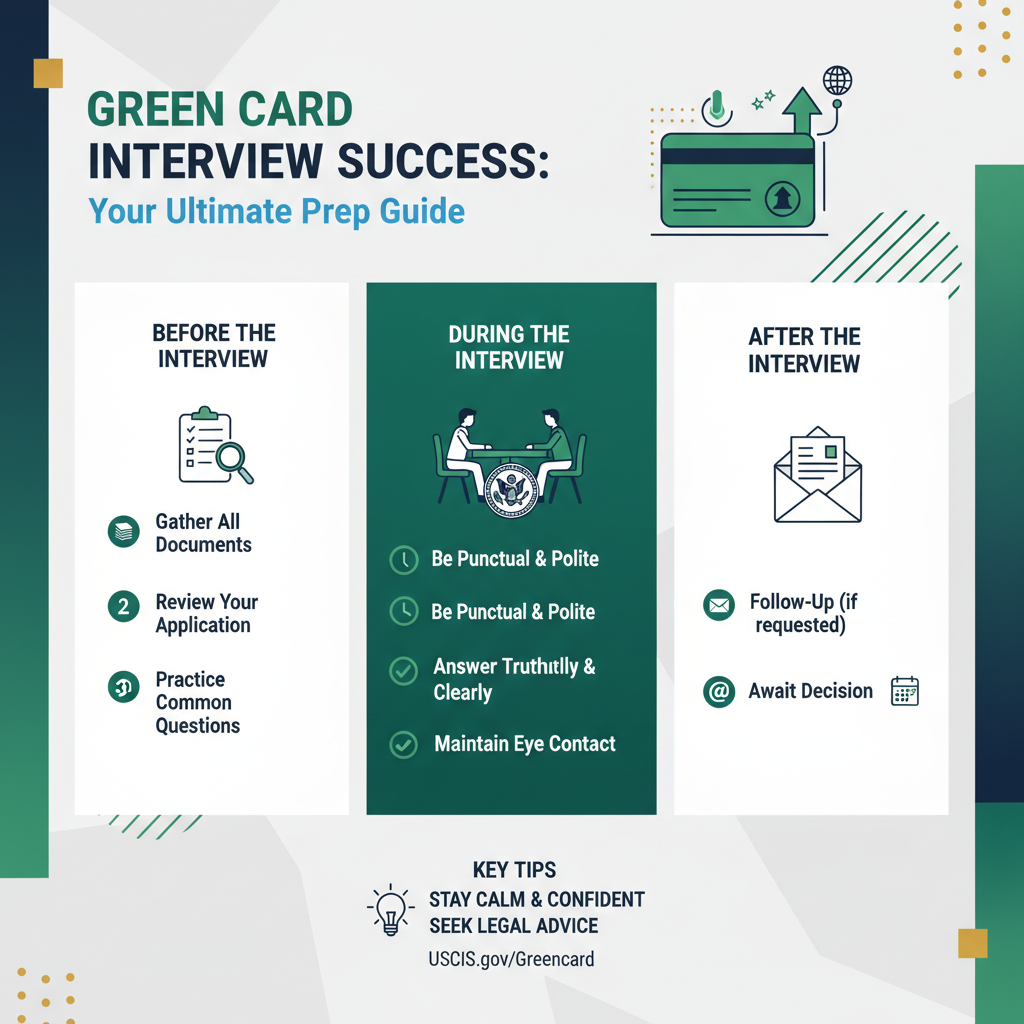
The reporting that sparked this guide: Green Card Interview Preparation Tips (Immigration Law)
What This News Means for Immigrants in Orlando and Across Florida
The ongoing discussion and focus on Green Card interview preparation within immigration law circles highlight the critical importance of this final hurdle in the permanent residency process. While the core requirements for Green Cards remain consistent, the nuances of an interview can vary, making expert advice invaluable.
Why this news is showing up now
The emphasis on Green Card interview preparation is a perennial topic in immigration law because it is the personal interaction point where all the paperwork culminates. USCIS officers are tasked with ensuring applicants meet all legal requirements and that no fraud or misrepresentation is involved. With evolving immigration policies and heightened scrutiny in certain categories, applicants are increasingly seeking robust preparation strategies to ensure a successful outcome. Furthermore, as processing times fluctuate, applicants often have more time to prepare, making comprehensive guides like this especially timely.
How it can affect Florida residents
Florida is home to one of the largest and most diverse immigrant populations in the United States. For residents in Orlando, Central Florida, and throughout the state, navigating the Green Card process means interacting with local USCIS field offices, such as the Orlando USCIS Field Office. While federal law governs the Green Card process, local office procedures and the sheer volume of applications can influence scheduling and the specific focus of interviews. Understanding the importance of thorough preparation is particularly vital for Floridians, many of whom are pursuing family-based Green Cards or employment-based Green Cards, which frequently involve interviews. Being prepared can help reduce stress and improve the chances of a smooth process, especially given the diverse backgrounds and languages spoken by applicants in Orange County and along the I-4 corridor.
What Green Card Interviews Are (and Why They Matter)
A Green Card interview is a mandatory step for most individuals seeking lawful permanent residency in the United States. It is a formal meeting with a USCIS officer who reviews your application, verifies your identity, and assesses your eligibility for a Green Card based on U.S. immigration law.
A plain-English definition
Think of the Green Card interview as your final exam for permanent residency. It’s a conversation where a government official asks you questions about your application, your background, and your relationship (if applicable) to ensure that everything you've submitted is true and that you qualify for a Green Card. It's designed to confirm the information in your application and to give you an opportunity to clarify any discrepancies or provide additional evidence.
Key terms you need to know
- Adjustment of Status (AOS): This is the process of applying for a Green Card while you are physically present in the United States. If you apply this way, your interview will be at a USCIS field office (like the one in Orlando).
- Consular Processing: This is the process of applying for a Green Card through a U.S. embassy or consulate in your home country. If you apply this way, your interview will be held abroad.
- USCIS Officer: The government official who conducts your interview and makes a recommendation on your application.
- Petitioning Relative/Employer: The U.S. citizen or lawful permanent resident who filed the initial immigration petition (e.g., Form I-130 for family-based, Form I-140 for employment-based) on your behalf.
- Beneficiary: You, the immigrant, who is seeking the Green Card.
- Affidavit of Support (Form I-864): A legally binding document signed by a petitioner (or joint sponsor) to accept financial responsibility for the immigrant. This is crucial in family-based cases.
- Priority Date: The date your immigration petition was filed. This date determines when your Green Card becomes available, especially for categories with annual limits.
- Notice of Interview (Form I-797C): The official document from USCIS informing you of your interview date, time, and location, along with a list of required documents.
The interview matters because it's the final opportunity for USCIS to evaluate your case directly. It’s where your truthfulness, consistency, and eligibility are personally assessed. A positive interview experience can lead to swift approval, while a poor one can lead to delays or even denial.
Current Immigration Law: The Foundation
The framework for Green Cards and their associated interviews is established by the Immigration and Nationality Act (INA), the primary body of U.S. immigration law. This act outlines who is eligible for permanent residency, the different categories available, and the procedures for application and adjudication.
Key sections of the INA relevant to Green Card eligibility include:
- INA Section 245(a): Governs Adjustment of Status for individuals already in the U.S. It specifies that an alien who has been inspected and admitted or paroled into the United States, and who is eligible for an immigrant visa and admissible to the U.S., may adjust their status to that of a lawful permanent resident.
- INA Sections 201-204: These sections detail the categories and processes for family-based immigration, including immediate relatives of U.S. citizens (spouses, minor children, parents) and other preference categories.
- INA Sections 203(b): Outlines the categories for employment-based immigration.
- INA Section 212(a): Lists the grounds of inadmissibility, which are reasons an applicant might be denied a Green Card (e.g., criminal history, certain health issues, public charge concerns, immigration violations). The interview is crucial for the officer to assess if any of these grounds apply.
Federal requirements
At the federal level, all Green Card applicants must meet specific requirements depending on their category (family-based, employment-based, asylum, etc.). Common federal requirements include:
- Eligibility: You must qualify under a specific immigrant visa category.
- Admissibility: You must not be inadmissible to the U.S. based on health, criminal, security, public charge, or other grounds.
- Proper Documentation: All required forms and supporting documents must be accurately completed and submitted. These typically include:
- Form I-130, Petition for Alien Relative (for family-based cases)
- Form I-485, Application to Register Permanent Residence or Adjust Status (for AOS)
- Form I-864, Affidavit of Support (for most family-based and some employment-based cases)
- Form I-765, Application for Employment Authorization (optional, for work permit)
- Form I-131, Application for Travel Document (optional, for advance parole)
- Form I-693, Report of Medical Examination and Vaccination Record
- Interview: Most applicants must attend an interview with a USCIS officer or a consular officer.
For detailed information on forms and processes, always refer to the USCIS official website.
Florida-specific considerations
While immigration law is federal, its application is experienced locally. For Florida residents, especially those in Orlando and the surrounding areas, your Green Card interview for Adjustment of Status will likely take place at the Orlando USCIS Field Office. It's important to be aware of the office's location, parking options, and security procedures. The officers at this office are experienced in handling cases from diverse backgrounds found in Central Florida, including many family-based petitions. There are no Florida-specific immigration laws that impact Green Card eligibility; however, state laws regarding marriage, birth certificates, and other civil documents will be relevant when collecting supporting evidence.
Overwhelmed by Forms and Laws? Imigrar simplifies the complex immigration process. Our Orlando attorneys are experts in U.S. immigration law and can guide you through every federal requirement. Call us at +1 786-791-3106 for a free consultation. Se Habla Español.
How to Prepare for Your Green Card Interview: A Complete Step-by-Step Guide
Preparing for your Green Card interview is paramount to a successful outcome. This guide provides a comprehensive, step-by-step approach to ensure you are fully ready.
1) Understand Your Interview Notice (Form I-797C)
Your interview journey begins the moment you receive your official Notice of Interview (typically Form I-797C) from USCIS. This document is critical.
- Review Immediately: Check the date, time, and location of your interview. For Orlando residents, this will likely be the Orlando USCIS Field Office.
- List of Required Documents: The notice will include a specific list of documents you must bring. This list is in addition to the documents you already submitted with your application. Do not overlook this section!
- Rescheduling: If you cannot attend on the scheduled date, you must request a reschedule as soon as possible. Be aware that rescheduling can significantly delay your case.
Actionable Tip: Mark your calendar and set reminders as soon as you receive the notice. Begin gathering the specific documents requested.
2) Review Your Application Package Thoroughly
The USCIS officer will have your entire application file in front of them during the interview. You must be familiar with every detail you submitted.
- Go Through Every Form: Review your Form I-130, Form I-485, Form I-864, and any other forms you submitted. Pay attention to dates, addresses, employment history, and answers to all questions.
- Identify Potential Discrepancies: If there are any errors or outdated information, be prepared to explain them clearly and truthfully. Bring updated documentation if necessary.
- Understand the Basis of Your Application: Know exactly why you are eligible for a Green Card (e.g., marriage to a U.S. citizen, employment sponsorship).
Reminder: Consistency is key. Your verbal answers must align with the information in your written application.
3) Gather and Organize All Required Documents
This is arguably the most critical step. The interview notice will specify documents, but generally, you should bring all original documents and a complete set of copies of everything you submitted, plus any new evidence.
Required Documents Checklist (General, but always follow your specific notice):
- Interview Notice (Form I-797C)
- Identification:
- Valid passport (and all previous passports)
- State-issued ID (e.g., Florida driver's license)
- Originals of All Documents Submitted:
- Birth certificates (for you, petitioner, children)
- Marriage certificate (if applicable)
- Divorce decrees or death certificates for any previous marriages (for both you and petitioner)
- Children’s birth certificates
- Adoption decrees (if applicable)
- Financial Documents (for Form I-864, Affidavit of Support):
- Original Form I-864 signed by petitioner/joint sponsor
- Petitioner’s most recent federal income tax returns (IRS transcripts preferred)
- Proof of employment and income (pay stubs, employment verification letter)
- Assets documentation (bank statements, property deeds, if needed to meet income requirement)
- Medical Exam (Form I-693): Sealed envelope from the civil surgeon. Do NOT open this envelope.
- Photos: Two U.S. passport-style photos, taken within 30 days of the interview.
- Evidence of Relationship (for marriage-based cases): This is vital to prove your marriage is bona fide. Bring originals and copies of:
- Joint bank accounts statements
- Joint lease agreements or mortgage statements
- Utility bills in both names
- Insurance policies (health, life, auto) showing each other as beneficiaries
- Children's birth certificates (if applicable)
- Photos together (wedding, vacations, daily life)
- Affidavits from friends/family attesting to the marriage
- Correspondence between spouses (emails, texts, cards)
- Copies of All Documents: Bring a complete set of photocopies of every document, even if you submitted them previously. The officer may keep the copies and return your originals.
- Translations: Any document not in English must be accompanied by a certified English translation.
Important: Organize your documents clearly in a folder or binder, separated by type. This makes it easy to present them quickly when requested by the officer.
4) Prepare for Common Interview Questions
The questions will vary based on your Green Card category, but some themes are universal.
- Personal Background: Questions about your name, date of birth, place of birth, parents, previous addresses, and immigration history.
- Application Details: Questions about the information on your Form I-485, Form I-130, etc.
- Grounds of Inadmissibility: Questions about criminal history, health issues, previous immigration violations, or misrepresentations. Always answer truthfully.
- For Marriage-Based Green Cards:
- How and when did you meet?
- What is your spouse's full name, date of birth, and parents' names?
- Details about your wedding, honeymoon, and living arrangements.
- Daily routines, shared activities, future plans.
- Questions designed to confirm the legitimacy of your marriage.
- For Employment-Based Green Cards:
- Details about your job offer, employer, and duties.
- Your qualifications for the position.
- Understanding of your employer's business.
Warning: Be truthful and consistent. Any attempt to deceive or misrepresent facts can lead to denial and severe immigration consequences.
5) Practice Your Responses and Professionalism
Knowing the questions is one thing; answering them confidently and clearly is another.
- Practice with a Trusted Person: Have a friend, family member, or your attorney conduct a mock interview.
- Speak Clearly and Concisely: Answer only the question asked. Do not volunteer extra information unless it's directly relevant and clarifies your answer.
- If You Don't Understand: It’s okay to ask the officer to repeat or rephrase a question. Do not guess or pretend to understand.
- Dress Professionally: Present yourself respectfully. Business casual attire is generally appropriate.
- Be Polite and Respectful: Maintain a positive demeanor throughout the interview.
6) Attend the Interview Prepared and Punctual
The day of the interview requires careful planning.
- Arrive Early: Aim to arrive at the Orlando USCIS Field Office at least 30-45 minutes before your scheduled time. This allows for parking, security checks, and finding your waiting area. Traffic on the I-4 corridor can be unpredictable, so plan accordingly.
- Bring Everything: Double-check that you have your interview notice, all original documents, copies, photos, and your sealed medical exam.
- Who Should Attend: If it's a marriage-based interview, both you and your petitioning spouse must attend. If you have an attorney, they should also attend. For children, check the notice; typically, only the applicant and petitioner attend.
- Interpreters: If you are not fluent in English, bring a certified interpreter. Your attorney cannot act as your interpreter.
7) Know What to Expect After the Interview
The interview is not always the end of the process.
- Immediate Decision: Sometimes, the officer will tell you on the spot that your Green Card is approved.
- Request for Evidence (RFE): If the officer needs more information or documents, they will issue an RFE, giving you a deadline to respond.
- Notice of Intent to Deny (NOID): If the officer believes you are not eligible, they may issue a NOID, explaining their reasons and giving you a chance to respond before a final decision.
- Further Review: Often, the officer will say they need to review your case further. This is common and doesn't necessarily mean there's a problem. Processing times can vary, so monitor your case status online at USCIS Processing Times.
- Approval: If approved, you will typically receive an approval notice, and your Green Card will be mailed to you within a few weeks.
Don't Risk Delays or Denials! Let Imigrar's Orlando immigration lawyers guide you through every step of your Green Card interview preparation. We help you organize documents, practice questions, and ensure you're fully confident. Call +1 786-791-3106 today for your free consultation. Se Habla Español.
Practical Steps You Can Take Today
The best time to start preparing for your Green Card interview is now. Even before you receive your interview notice, you can take proactive steps to ensure a smooth process.
Actionable checklist:
- Start Gathering Original Documents: Begin collecting birth certificates, marriage certificates, divorce decrees, and any other vital records. Ensure all are current and valid.
- Request IRS Tax Transcripts: For your petitioner (and any joint sponsor), request their federal tax transcripts for the last three years from the IRS. These are preferred over copies of tax returns.
- Organize Existing Records: Create a dedicated folder or binder for your immigration documents. Keep copies of everything you submit to USCIS.
- Review Your Submitted Application: If you have copies of your Form I-130, Form I-485, and supporting documents, review them now to refresh your memory on the details.
- Collect Relationship Evidence (Marriage-Based): Continuously gather evidence of your bona fide marriage, such as joint bank statements, utility bills, photos, and any correspondence. Consistency over time is key.
- Consult an Attorney: Schedule a free consultation with an immigration attorney at Imigrar. We can review your case, identify potential issues, and help you strategize your preparation.
- Check USCIS Processing Times: Monitor the USCIS Processing Times page for the Orlando Field Office to get an estimated timeline for your interview.
Document preparation guidance
- Originals vs. Copies: Always bring original documents, but also have a complete set of photocopies. The officer may keep the copies.
- Translations: Any document not in English must be accompanied by a certified translation. The translator must attest that they are competent to translate and that the translation is accurate.
- Affidavits: If you have affidavits from friends or family supporting your case (especially for marriage-based cases), ensure they are notarized and include the affiant's contact information.
- Order and Label: Organize your documents logically. Use dividers and labels to quickly access specific documents when requested.
Timeline expectations
The timeline from filing your application to receiving an interview notice can vary significantly based on your Green Card category, the specific USCIS field office (e.g., Orlando), and current processing backlogs. After your interview, a decision can be made on the spot, within a few days, or sometimes take several weeks or months, especially if an RFE is issued. Always check the USCIS Processing Times for the most up-to-date estimates.
How Imigrar Helps Immigrants in Orlando
At Imigrar, we understand that the Green Card interview can be one of the most stressful parts of the immigration process. Our mission, "Keep Families Together," drives our commitment to providing compassionate, expert legal representation to immigrants in Orlando, Central Florida, and nationwide.
Our experience and expertise
Our team of dedicated immigration attorneys has extensive experience guiding clients through every stage of the Green Card process, including thorough interview preparation. We stay up-to-date on the latest immigration laws and policies, ensuring our advice is always accurate and effective. We have a deep understanding of what USCIS officers look for, particularly at the Orlando USCIS Field Office, and can anticipate potential challenges specific to your case.
We assist with:
- Comprehensive Case Review: We meticulously review your entire application package to identify any inconsistencies or missing information before the interview.
- Document Organization: We help you organize all necessary documents, ensuring you have both originals and copies, correctly translated, and ready for presentation.
- Personalized Mock Interviews: We conduct detailed mock interviews, asking questions similar to those you'll face, providing feedback, and helping you build confidence.
- Addressing Complex Issues: If your case involves past immigration issues, criminal history, or other complexities, we help you prepare explanations and gather supporting evidence.
- Attorney Representation at Interview: An Imigrar attorney can accompany you to your interview at the Orlando USCIS Field Office, providing legal support and intervening if necessary.
Free consultation offer
We believe everyone deserves access to quality legal advice. That's why Imigrar offers a free consultation to discuss your Green Card interview preparation needs. This is an opportunity for you to ask questions, understand your options, and learn how our firm can provide invaluable support. Don't leave your future to chance.
Se Habla Español: Our team is fully bilingual and ready to assist our Spanish-speaking clients with clear, culturally sensitive communication. We ensure you understand every aspect of your case in your preferred language.

Frequently Asked Questions
Q: Who needs a green card interview?
A: Most applicants for a Green Card, whether through Adjustment of Status in the U.S. or via Consular Processing abroad, are required to attend an interview. This includes individuals applying based on family relationships (spouses, parents, children) and many employment-based categories. There are limited exceptions, such as for certain children adjusting status or some employment-based applicants who may qualify for an interview waiver, but these are rare and at USCIS's discretion.
Q: What if my spouse cannot attend the interview?
A: For marriage-based Green Card interviews, it is mandatory for both the petitioner (U.S. citizen or LPR spouse) and the beneficiary (immigrant spouse) to attend. If your spouse cannot attend due to an emergency (e.g., serious illness, military deployment), you must notify USCIS immediately and provide evidence of the reason. USCIS may reschedule the interview or, in very rare cases, waive the petitioner's presence, but this is not guaranteed and requires strong justification. Failing to appear without prior notification can lead to denial.
Q: How long does a green card interview last?
A: The duration of a Green Card interview can vary widely. Simple, straightforward cases might last only 15-20 minutes. More complex cases, especially those with extensive evidence for a bona fide marriage or issues in the applicant's immigration history, could last 30 minutes to an hour or even longer. It's best to allocate at least 2-3 hours for the entire visit to the USCIS office in Orlando, including waiting and security checks.
Q: What kind of questions will I be asked?
A: The questions will depend on your specific Green Card category. For family-based cases, expect questions about your personal background, immigration history, and the details of your relationship (how you met, daily life, shared finances, future plans). For employment-based cases, expect questions about your qualifications, job duties, and the petitioning employer. USCIS officers are primarily trying to verify the information in your application and ensure you meet all legal requirements and are not inadmissible.
Q: Do I need an attorney for my green card interview?
A: While it is not legally mandatory to have an attorney at your Green Card interview, it is highly recommended, especially if your case has any complexities. An experienced immigration attorney from Imigrar can prepare you thoroughly, ensure all documents are in order, and accompany you to the interview. Your attorney can provide legal guidance, clarify questions, and protect your rights during the process. This can significantly reduce stress and increase the likelihood of a positive outcome.
Q: What happens if my green card application is denied after the interview?
A: If your Green Card application is denied after the interview, USCIS will send you a written decision explaining the reasons for the denial. Depending on the reason, you might have options:
- File a Motion to Reopen or Reconsider: If you believe the decision was based on an error of fact or law, or if you have new evidence.
- File an Appeal: You might be able to appeal the decision to the Administrative Appeals


