


The journey to obtaining a Green Card, also known as lawful permanent residency, is a pivotal moment for many immigrants seeking to build a life in the United States. While the application process itself can be complex, the Green Card interview stands as a critical juncture, often determining the success or denial of an application. For those in Orlando, across Florida, and indeed nationwide, thorough preparation for this interview is not just recommended—it's essential.
Need Expert Guidance for Your Green Card Interview? Don't face this crucial step alone. Our experienced Orlando immigration team at Imigrar is ready to assist you in preparing for a successful interview. Call +1 786-791-3106 for a free consultation, or message us online. Se Habla Español.
The reporting that sparked this guide
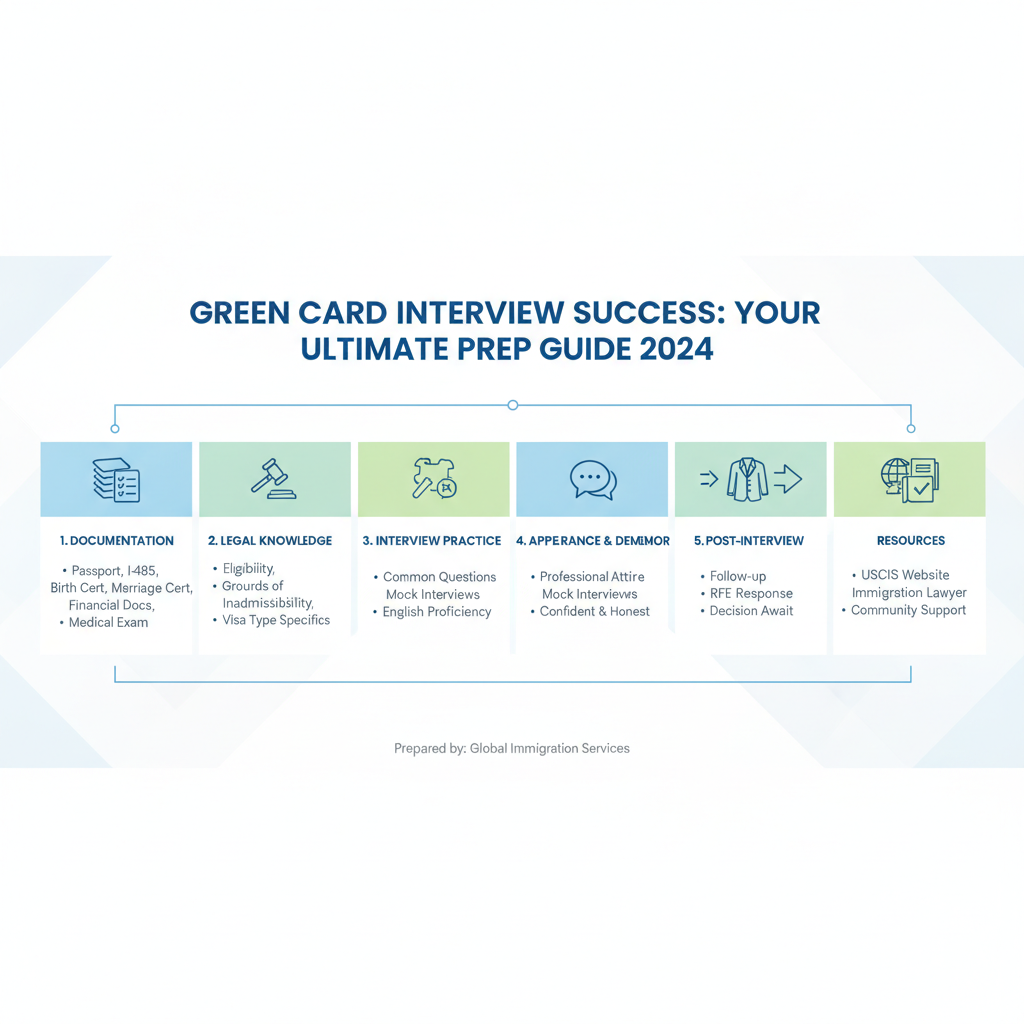
The constant stream of information and updates within Green Card Interview Preparation Tips (Immigration Law) highlights the ongoing importance and scrutiny placed on this final stage of the Green Card application. Staying informed about best practices and common pitfalls is crucial for applicants to navigate this process successfully.
What This News Means for Immigrants in Orlando and Across Florida
For immigrants residing in Orlando, Central Florida, and throughout the Sunshine State, news and discussions around Green Card interview preparation are always highly relevant. Florida is a melting pot of cultures and home to a vast immigrant population, making immigration matters a daily reality for countless families. Understanding the nuances of the interview process can make all the difference in securing your future in the U.S.
Why this news is showing up now
Discussions surrounding Green Card interview preparation are evergreen in the realm of immigration law. While there may not be a single, dramatic policy shift causing this specific topic to trend today, June 24, 2026, several factors contribute to its perpetual relevance. Firstly, USCIS continues to refine its interview protocols and focus on specific areas of concern, such as the legitimacy of relationships in marriage-based cases or the veracity of employment claims. Secondly, as processing times fluctuate, more applicants are nearing their interview dates, naturally increasing the demand for guidance. Thirdly, with an ever-evolving digital landscape, individuals are constantly seeking up-to-date, reliable information to navigate complex legal processes. The emphasis on thoroughness and honesty remains paramount, and immigration attorneys and resources like Imigrar regularly update their advice to reflect current agency priorities and best practices.
How it can affect Florida residents
Florida, with its diverse population and numerous USCIS field offices (including the prominent Orlando USCIS Field Office), sees a high volume of Green Card interviews daily. For residents along the I-4 corridor and across the state, this means:
- Local Procedures: While federal law governs the process, each field office can have slightly different operational nuances. Being prepared for the specific environment of the Orlando or other Florida field offices is beneficial.
- Diverse Caseloads: Florida's immigrant communities are incredibly varied, leading to a broad spectrum of Green Card applications—from family-based petitions (spouses, parents, children) to employment-based and asylum-based adjustments. Effective preparation must be tailored to the specific type of case.
- Language Barriers: While USCIS provides interpreters, having your own trusted legal counsel who can communicate effectively in English and Spanish (Se Habla Español) can provide immense comfort and clarity during the interview.
- Increased Scrutiny: Given Florida's status as a major entry point and diverse state, USCIS officers are often highly experienced and thorough. Applicants must be meticulously prepared to answer questions and present evidence.
- Access to Legal Support: With a significant number of immigration law firms like Imigrar in Orlando, Florida residents have access to expert assistance, which is crucial for complex cases or those who feel overwhelmed by the process.
What the Green Card Interview Is (and Why It Matters)
The Green Card interview is a mandatory step for most individuals applying for lawful permanent residency in the United States, particularly those undergoing Adjustment of Status (AOS) from within the U.S. or Consular Processing abroad. This interview serves as a critical opportunity for a U.S. Citizenship and Immigration Services (USCIS) officer to verify the information provided in your application, assess your eligibility, and determine your admissibility to the United States.
A plain-English definition
Think of the Green Card interview as a conversation with a government official (a USCIS officer) where they review your application for permanent residency. Their main goals are to confirm that all the information you've submitted is true and accurate, that you meet all the legal requirements for a Green Card, and that there are no reasons (like certain criminal offenses or immigration violations) that would prevent you from becoming a permanent resident. It's a chance for them to ask questions directly and clarify any ambiguities in your submitted documents. For many, especially those applying through marriage, it's also a crucial opportunity to demonstrate the legitimacy of their relationship.
Key terms you need to know
- Green Card: The common term for the document issued to lawful permanent residents (LPRs) of the United States. It signifies your authorized status to live and work permanently in the U.S.
- Adjustment of Status (AOS): The process of applying for a Green Card while physically present in the United States. This is an alternative to Consular Processing, which involves applying through a U.S. embassy or consulate abroad.
- USCIS: U.S. Citizenship and Immigration Services, the federal agency responsible for administering immigration and naturalization benefits. This is the agency that conducts your Green Card interview.
- Petitioning Relative/Employer: The U.S. citizen or lawful permanent resident (or employer) who files an immigrant petition on behalf of the beneficiary. For example, a U.S. citizen spouse files Form I-130 for their foreign national spouse.
- Beneficiary: The foreign national individual for whom an immigrant petition is filed and who is seeking a Green Card.
- Inadmissibility: Legal grounds that prevent a foreign national from entering or remaining in the U.S., such as certain criminal convictions, health issues, or past immigration violations. Many questions in the interview aim to uncover potential grounds of inadmissibility.
- Bona Fide Marriage: A marriage that is entered into in good faith, not solely for the purpose of obtaining an immigration benefit. This is a critical element scrutinized in marriage-based Green Card interviews.
- Priority Date: The date USCIS receives your immigrant petition (e.g., Form I-130). This date determines your place in the visa queue, especially for preference categories, and influences when a visa becomes available.
- Request for Evidence (RFE): A letter issued by USCIS asking for additional documents or information to support your application. This can happen before or after an interview.
Current Immigration Law: The Foundation
The Green Card interview process is firmly rooted in the Immigration and Nationality Act (INA), which is the primary body of U.S. immigration law. The INA outlines who is eligible for a Green Card, the various categories under which one can apply, and the grounds for inadmissibility that could lead to a denial. Understanding these legal underpinnings is crucial for interview preparation.
Federal requirements
Most Green Card applications, particularly those involving an interview, fall under specific sections of the INA. Key statutes include:
- INA § 245 (Adjustment of Status): This section details the eligibility requirements for individuals seeking to adjust their status to lawful permanent resident while in the United States. Generally, applicants must have been lawfully admitted or paroled into the U.S., be eligible for an immigrant visa, and be admissible to the U.S.
- INA § 201 & § 203 (Immigrant Visa Categories): These sections define the categories of individuals eligible for immigrant visas, such as immediate relatives of U.S. citizens (spouses, unmarried children under 21, parents) who are not subject to numerical limitations, and preference categories (e.g., adult children, siblings, employment-based immigrants) who are subject to visa quotas and waiting periods.
- INA § 212 (General Classes of Aliens Ineligible to Receive Visas and Inadmissible): This crucial section lists numerous grounds of inadmissibility, covering areas like health-related grounds, criminal grounds, security grounds, public charge, illegal entry and immigration violations, and misrepresentation. The interview is a primary mechanism for USCIS officers to assess these grounds.
- INA § 204 (Procedure for Granting Immigrant Status): This section outlines the petitioning process, such as the filing of Form I-130, Petition for Alien Relative, or Form I-140, Immigrant Petition for Alien Worker.
Applicants must demonstrate that they meet all eligibility criteria for their specific Green Card category and that they are not inadmissible under any of the INA's provisions. This often involves submitting extensive documentation and undergoing background checks, including fingerprinting (biometrics) and a medical examination.
For detailed information on current laws and forms, always refer to the USCIS official website.
Florida-specific considerations
While immigration law is federal, its application can have local nuances. For Florida residents, particularly those in Orange County and surrounding areas, the Orlando USCIS Field Office is where most Green Card interviews for Adjustment of Status will take place. Although the legal requirements remain the same nationwide, understanding the local office’s typical procedures, waiting times, and any specific areas of focus can be beneficial. For instance, high volumes of family-based petitions in Florida mean officers are highly experienced in evaluating the authenticity of marriages and family relationships. Imigrar, located in Orlando, is intimately familiar with the local field office's practices and can provide invaluable insights.
Key USCIS forms frequently associated with the Green Card interview process include:
- Form I-130, Petition for Alien Relative: Filed by a U.S. citizen or LPR to establish a qualifying relationship with a foreign national.
- Form I-485, Application to Register Permanent Residence or Adjust Status: The primary application form for a Green Card when applying from within the U.S.
- Form I-864, Affidavit of Support: Filed by the petitioner (sponsor) to demonstrate they can financially support the immigrant and that the immigrant will not become a public charge.
- Form I-693, Report of Medical Examination and Vaccination Record: Completed by a USCIS-approved civil surgeon to ensure the applicant meets health-related admissibility requirements.
- Form I-765, Application for Employment Authorization: Often filed concurrently with Form I-485 to allow the applicant to work while their Green Card application is pending.
- Form I-131, Application for Travel Document: Often filed concurrently with Form I-485 to allow the applicant to travel internationally while their Green Card application is pending (Advance Parole).
Reminder: All forms and requirements are subject to change. Always consult the USCIS Forms page for the latest versions and instructions.
Feeling Overwhelmed by Forms and Legal Jargon? Our team at Imigrar specializes in simplifying complex immigration processes. Let us help you ensure all your forms are correctly filed and your legal foundation is strong. Reach out to our Orlando office at +1 786-791-3106 for a free consultation. Se Habla Español.
How to Prepare for Your Green Card Interview: A Complete Step-by-Step Guide
The Green Card interview is the culmination of months, sometimes years, of preparation. Approaching it with diligence and a clear strategy can significantly increase your chances of success. Here's a step-by-step guide to help you prepare effectively.
1) Understand Your Case Type and Eligibility
Before anything else, thoroughly understand the specific category under which you are applying for your Green Card. This foundational knowledge will guide your preparation. Are you an immediate relative of a U.S. citizen (spouse, unmarried child under 21, parent)? Are you in a preference category (e.g., married child of a U.S. citizen, sibling, employment-based)? Your category dictates the specific legal requirements and the types of evidence most relevant to your case. For family-based cases, the focus will often be on proving a bona fide relationship. For employment-based cases, it will be on your qualifications and the legitimacy of the job offer. Be familiar with your Priority Date and if a visa is currently available according to the U.S. Department of State Visa Bulletin.
- Required Documents for this step:
- Copy of your Form I-130 (if family-based) or Form I-140 (if employment-based) approval notice.
- Copy of your Form I-797, Notice of Action, confirming receipt or approval of your petition.
- Any previous notices from USCIS related to your case.
2) Gather and Organize ALL Required Documents
This is arguably the most critical step. You must bring all original documents and a complete set of copies of every document you submitted with your application, plus any new evidence that has become available since you filed. Create an organized binder with dividers for each category of documents. This shows professionalism and makes it easy for the officer to review your file. Do not forget any documents requested in your interview notice.
- General Required Documents (Originals and Copies):
- Your Interview Notice (Form I-797C).
- Your government-issued photo identification (passport, driver's license).
- Your foreign birth certificate (and certified translation if not in English).
- Your marriage certificate (if applicable, and certified translation).
- Divorce decrees or death certificates for all prior marriages of both applicant and petitioner (if applicable, and certified translations).
- Your passport, including the visa you used to enter the U.S. and any entry stamps.
- Your Form I-94, Arrival/Departure Record (print the latest from CBP website).
- Form I-693, Report of Medical Examination and Vaccination Record, in a sealed envelope (if not already submitted). Ensure it's current.
- Form I-864, Affidavit of Support, with all supporting financial documents (tax returns, W-2s, pay stubs) for the petitioner and any joint sponsors.
- Two passport-style photos meeting USCIS specifications.
- Police certificates from any country you lived in for 6+ months since age 16 (if required for your case type or consular processing).
- For marriage-based cases, extensive evidence of a bona fide marriage:
- Joint bank statements, credit card statements.
- Joint utility bills, leases, mortgages.
- Insurance policies (health, life, auto) showing each other as beneficiaries.
- Birth certificates of children born to the marriage.
- Photos together (dating, wedding, holidays, with family/friends).
- Affidavits from friends/family attesting to the relationship.
- Joint tax returns.
- For employment-based cases, updated letters of employment, pay stubs, and any necessary professional licenses or certifications.
- Any other documents specifically requested in your interview notice or that support your eligibility.
3) Review Your Application Forms Thoroughly
Go over every form you submitted (Form I-485, Form I-130, Form I-864, etc.) line by line. Ensure you remember every answer you provided, especially dates, addresses, and details about your immigration history. The USCIS officer will have your entire file in front of them and will be looking for consistency. Any discrepancies, even minor ones, can raise red flags and prolong the interview or even jeopardize your case. If you discover any inaccuracies or changes since filing, prepare to explain them clearly and truthfully.
- Documents to Review:
- Copies of all submitted forms (e.g., Form I-485, Form I-130, Form I-864, Form I-765, Form I-131).
- Any personal statements or affidavits you previously submitted.
- All supporting evidence that was originally filed with your application.
4) Practice Answering Common Interview Questions
While you can't predict every question, many are standard. Practice answering them out loud with your petitioner (if applicable) or a trusted friend/family member. Focus on being clear, concise, and truthful. Do not memorize answers, but be familiar with the facts of your case. For marriage-based interviews, expect detailed questions about your relationship, how you met, daily life, shared responsibilities, and future plans.
- Sample Questions to Practice:
- "When and how did you meet your spouse?" (for marriage-based cases)
- "What is your spouse's date of birth/where were they born/what is their job?"
- "Describe a typical day in your household."
- "Have you ever been arrested, cited, or detained by any law enforcement officer for any reason?"
- "Have you ever violated U.S. immigration laws?"
- "Do you have any children together?"
- "What are your future plans as a couple/family?"
- "Have you ever claimed to be a U.S. citizen?"
- "Have you ever committed a crime for which you were not arrested?"
- "What is the name of your employer?" (for employment-based or current employment)
- "Where do you currently live?"
5) Prepare for the Interview Day Logistics
Plan your journey to the Orlando USCIS Field Office (or relevant location) well in advance. Know the exact address, parking situation, and allow ample travel time to arrive at least 30 minutes early. Dress professionally, as if for a job interview. Bring your interview notice, a valid photo ID, and your organized binder of documents. Decide if you will bring an attorney (highly recommended for complex cases) or an interpreter (if needed and not provided by USCIS).
- Checklist for Interview Day:
- Your Interview Notice.
- Valid government-issued photo ID (passport, driver's license).
- Your complete, organized binder of original documents and copies.
- The contact information for your attorney (if applicable).
- A list of any questions you may have (though officers typically answer questions after they have completed their assessment).
- A small bag for essentials, as storage may be limited.
6) During the Interview: Be Honest, Calm, and Clear
When you are called in, greet the officer respectfully. Listen carefully to each question before answering. Answer truthfully and directly, without volunteering unnecessary information. If you don't understand a question, politely ask the officer to rephrase it. If you don't know an answer, simply state that you don't know, rather than guessing. Maintain eye contact and a calm demeanor. If your spouse or petitioner is with you, ensure your answers are consistent. If you have an attorney, they will be there to advise you and clarify any legal points.
- Tips for a Smooth Interview:
- Be Punctual: Arrive early.
- Be Respectful: Treat the USCIS officer with courtesy.
- Be Truthful: Honesty is paramount. Any misrepresentation can lead to a denial and future immigration issues.
- Be Concise: Answer the question asked, nothing more, nothing less, unless elaboration is specifically requested.
- Stay Calm: It's natural to be nervous, but try to remain composed. Deep breaths can help.
- Don't Argue: If you disagree with a statement, allow your attorney to address it.
- Bring an Interpreter: If you are not fluent in English, bring a professional interpreter or utilize the one provided by USCIS (if available and requested in advance).
7) Post-Interview Procedures and Follow-Up
At the end of the interview, the officer may tell you if your case is approved, or they may state that a decision will be mailed to you. Sometimes, further action is required, such as a Request for Evidence (RFE) for additional documents, or a second interview. If you receive an RFE, respond promptly and thoroughly. If your case is approved, you will typically receive your Green Card in the mail within a few weeks. If denied, you will receive a written explanation, and it is crucial to consult an immigration attorney immediately to discuss your options, which may include filing a motion to reconsider or appeal.
- What to Expect After the Interview:
- Immediate approval stamp (rare, but possible).
- A verbal indication of approval, with the card mailed later.
- A notice that a decision will be mailed within a certain timeframe (e.g., 120 days).
- A Request for Evidence (RFE), which must be addressed within the specified deadline.
- A notice for a second interview (rare, but can happen for complex cases or if initial evidence was insufficient).
- A denial notice.

Practical Steps You Can Take Today
Preparing for your Green Card interview is an ongoing process that begins long before you receive that interview notice. Here are actionable steps you can initiate immediately to ensure you're as ready as possible.
Actionable Checklist for Green Card Interview Preparation:
- Review Your Entire Application Package: Pull out copies of every form and supporting document you submitted. Read through them carefully, ensuring you remember all details. Highlight any areas where you might anticipate questions or where information might have changed.
- Gather *All* Original Documents: Start compiling all original birth certificates, marriage certificates, passports, divorce decrees, and


