

The journey to obtaining a Green Card, or lawful permanent residency in the United States, is a significant milestone for many immigrants and their families. While often exciting, it can also be a source of anxiety, particularly as the Green Card interview approaches. This interview is a critical step in the process, serving as an opportunity for U.S. Citizenship and Immigration Services (USCIS) to verify the information in your application, confirm your eligibility, and ensure you meet all legal requirements.
At Imigrar, an immigration law firm based in Orlando, Florida, we understand the stakes involved. Our mission is to "Keep Families Together," and a successful Green Card interview is paramount to achieving that goal for our clients. We are committed to providing professional, accurate, and actionable guidance to help you navigate this complex process with confidence. Whether you are in Orlando, elsewhere in Florida, or across the nation, our team is here to support you.
Need Expert Green Card Interview Preparation? Don't face your USCIS interview alone. Our Orlando immigration team is ready to assist you every step of the way. Call +1 786-791-3106 for a free consultation, or message us online. Se Habla Español.
The reporting that sparked this guide
The increasing focus on immigration processes and the detailed scrutiny applied to Green Card applications have consistently made "Green Card Interview Preparation Tips" a trending topic in legal news and immigrant communities. This enduring relevance underscores the importance of thorough preparation for this pivotal step in the immigration journey.
Green Card Interview Preparation Tips (Immigration Law)What This News Means for Immigrants in Orlando and Across Florida
The ongoing discussion and demand for information on Green Card interview preparation is not just a passing trend; it reflects a constant need for clarity and guidance in a frequently evolving immigration landscape. For immigrants and their families, understanding the interview process is key to successfully achieving permanent residency.
Why this news is showing up now
The emphasis on Green Card interview preparation is perennially relevant due to several factors. Firstly, the sheer volume of individuals applying for permanent residency means that interviews are a daily occurrence at USCIS field offices nationwide, including the Orlando USCIS Field Office. Secondly, immigration policies and enforcement priorities can shift, sometimes leading to increased scrutiny during interviews. Applicants naturally seek to mitigate risks by being as prepared as possible. Finally, the interview process itself can be intimidating, and the natural human desire for comprehensive guidance fuels the continuous search for reliable preparation tips. As of mid-2026, there's a sustained focus on ensuring applicants meet all eligibility criteria, making meticulous preparation more crucial than ever.
How it can affect Florida residents
For individuals residing in Florida, particularly those in the greater Orlando area and along the I-4 corridor, news related to Green Card interview preparation is directly applicable. The Orlando USCIS Field Office serves a vast and diverse immigrant population across Central Florida. This means that many residents of Orange County and surrounding areas will attend their interviews right here in Orlando. The impact of inadequate preparation can be significant, potentially leading to delays, Requests for Evidence (RFEs), or even denial of an application. Conversely, being well-prepared can streamline the process, reduce stress, and significantly increase the likelihood of a positive outcome. Given Florida's large immigrant community, staying informed about best practices for interviews is not just helpful—it's essential for maintaining family unity and securing one's future in the U.S.
What Green Card Interviews Are (and Why They Matter)
A Green Card interview is a formal meeting with a USCIS officer (for Adjustment of Status cases) or a Consular Officer at a U.S. Embassy or Consulate abroad (for Consular Processing cases). The primary purpose of this interview is to verify the information provided in your application, confirm your eligibility for a Green Card, and ensure that you are not inadmissible to the United States under current immigration law. It's a critical step where the officer assesses your credibility and the authenticity of your claims, especially in family-based petitions where the genuineness of a relationship is often scrutinized.
A plain-English definition
Simply put, your Green Card interview is your chance to meet face-to-face with an immigration officer who will review your application and ask you questions about your life, your family, your finances, and your reasons for wanting to live permanently in the U.S. Think of it as a final verification step. For family-based petitions, such as those based on marriage, the officer wants to ensure that your marriage is legitimate and not entered into solely for immigration purposes. For employment-based petitions, they will confirm your qualifications and the validity of the job offer. It's a formal, yet often straightforward, conversation designed to ensure everything is in order before your Green Card is approved.
Key terms you need to know
Navigating the Green Card process requires understanding specific terminology. Here are some key terms that will frequently come up:
- Adjustment of Status (AOS): This refers to the process of applying for a Green Card while physically present in the United States. If approved, you "adjust" your immigration status from a temporary one (like a visa holder) to a permanent resident.
- Consular Processing: This is the alternative to AOS, used when an applicant is outside the United States. The Green Card interview takes place at a U.S. Embassy or Consulate in their home country.
- USCIS (U.S. Citizenship and Immigration Services): The government agency responsible for administering the country's lawful immigration system, including processing Green Card applications and conducting interviews domestically. You can find more information on the USCIS official website.
- Department of State (DOS): The federal executive department responsible for U.S. foreign policy. For Consular Processing cases, the DOS oversees U.S. Embassies and Consulates abroad. Visit U.S. Department of State for more details.
- Immigrant Visa: For those undergoing Consular Processing, this is the visa issued by a U.S. Embassy or Consulate that allows them to travel to the U.S. and be admitted as a lawful permanent resident.
- Sponsor/Petitioner: The U.S. citizen or lawful permanent resident who files a petition on behalf of the immigrant applicant (the beneficiary). For family-based petitions, this is typically a spouse, parent, or adult child.
- Beneficiary: The immigrant applicant seeking the Green Card.
- Affidavit of Support (Form I-864): A legally binding document signed by the petitioner (and sometimes a joint sponsor) promising financial support for the immigrant, ensuring they will not become a "public charge."
- Inadmissibility: Specific grounds under immigration law (e.g., certain criminal convictions, health issues, prior immigration violations, or public charge concerns) that can prevent an individual from being granted a Green Card.
- Priority Date: The date your immigration petition (**Form I-130**, **Form I-140**, etc.) was properly filed with USCIS. This date determines your place in the visa queue, especially for categories with annual numerical limits.
Understanding these terms will significantly help you comprehend the legal framework of your application and the questions you might face during your interview.
Current Immigration Law: The Foundation
The Green Card interview process is governed by the Immigration and Nationality Act (INA), which is the body of law that governs immigration to the United States. Specifically, sections of the INA outline eligibility criteria for various Green Card categories, grounds of inadmissibility, and the procedures for Adjustment of Status (INA Section 245) and Consular Processing. The officer conducting your interview will be applying these laws to your specific case.
Federal requirements
At the federal level, the fundamental requirements for obtaining a Green Card typically include:
- A Valid Immigrant Petition: This is the initial step, usually **Form I-130** (Petition for Alien Relative) for family-based cases or **Form I-140** (Immigrant Petition for Alien Worker) for employment-based cases. This petition must be approved by USCIS.
- Eligibility for a Visa Category: You must qualify for a specific Green Card category (e.g., immediate relative of a U.S. citizen, family preference category, employment-based preference, refugee/asylee).
- Admissibility: You must not be subject to any grounds of inadmissibility, such as certain criminal convictions, past immigration fraud, health issues (unless waived), or a likelihood of becoming a public charge. The interview is a key stage for assessing these factors.
- Properly Filed Application: You must have submitted **Form I-485**, Application to Register Permanent Residence or Adjust Status (for AOS) or completed the Consular Processing application forms (**DS-260**).
- Financial Sponsorship: For most family-based and some employment-based categories, a sponsor must submit **Form I-864**, Affidavit of Support, demonstrating their ability to financially support you.
- Medical Examination: You must undergo a medical examination by a USCIS-approved civil surgeon (for AOS) or a panel physician (for Consular Processing) to ensure you meet health-related standards. The results are submitted on **Form I-693**.
The interview serves as the final check to ensure all these requirements are met, and that the information provided in your extensive application package is accurate and truthful. The officer will verify your identity, review your documents, and ask questions to confirm your eligibility and the authenticity of your claims, particularly in marriage-based cases.
Florida-specific considerations
While immigration law is federal, the practicalities of the process often involve local USCIS field offices. For residents of Central Florida, your Adjustment of Status interview will likely take place at the Orlando USCIS Field Office. This office serves applicants from Orange County and the surrounding areas. While the legal requirements remain the same nationwide, understanding the specific procedures and potential wait times for the Orlando office can be beneficial. You can check current processing times for the Orlando Field Office and other USCIS offices on the USCIS Processing Times page. There are no Florida-specific immigration laws that affect the federal Green Card eligibility criteria, but understanding the local administrative context is important for planning and preparation.
Important USCIS Forms related to Green Card applications and interviews:
- Form I-130, Petition for Alien Relative
- Form I-485, Application to Register Permanent Residence or Adjust Status
- Form I-864, Affidavit of Support Under Section 213A of the INA
- Form I-693, Report of Medical Examination and Vaccination Record
- Form I-765, Application for Employment Authorization (often filed concurrently with **Form I-485**)
- Form I-131, Application for Travel Document (often filed concurrently with **Form I-485**)
You can find all official forms and instructions on the USCIS Forms page.
Confused by Immigration Forms? Imigrar in Orlando specializes in helping clients accurately complete and file all necessary USCIS forms. Contact us at +1 786-791-3106 for expert guidance. Se Habla Español.
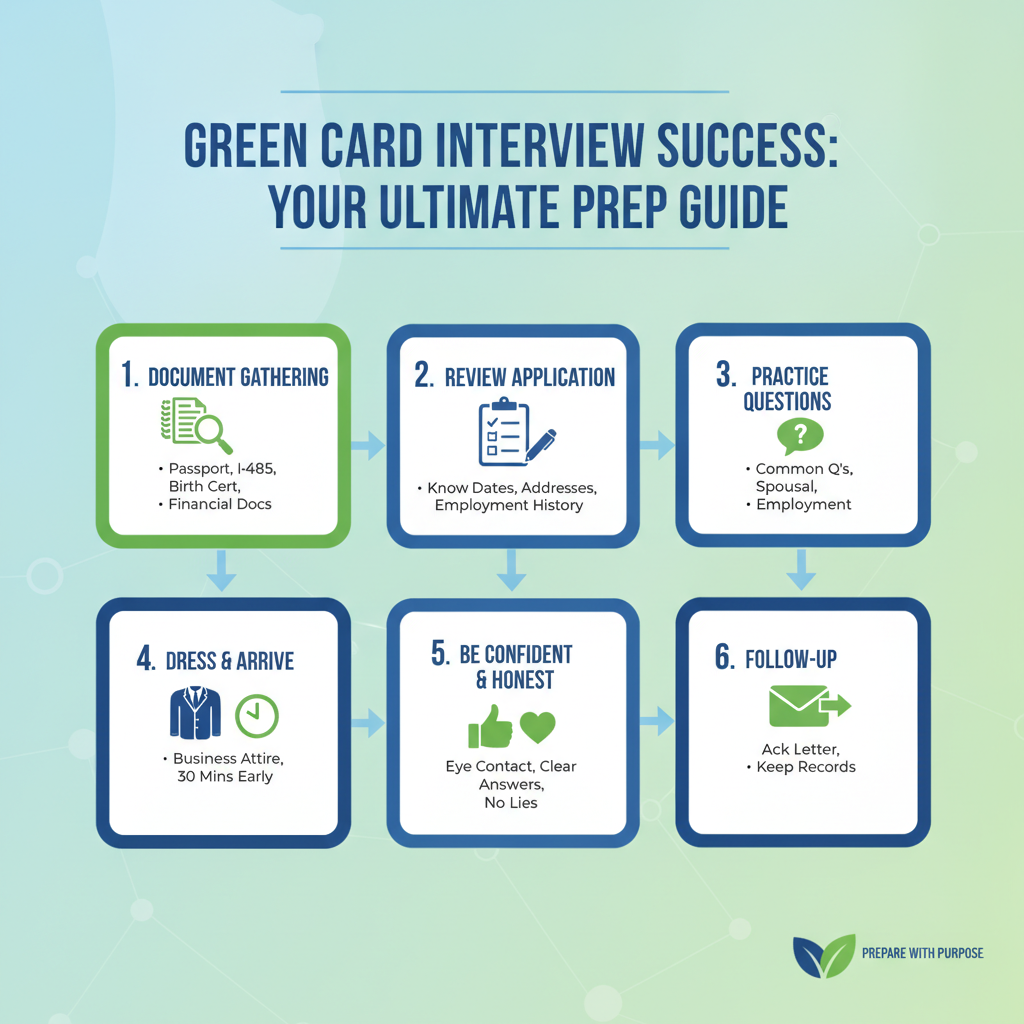
How to Prepare for Your Green Card Interview: A Complete Step-by-Step Guide
Thorough preparation is the single most important factor for a successful Green Card interview. This detailed guide will walk you through the essential steps to ensure you are ready.
1) Understand Your Case and Application
Before anything else, you must have an intimate understanding of every detail in your submitted application package. This includes your initial petition (**Form I-130** or **Form I-140**), your Adjustment of Status application (**Form I-485**), the Affidavit of Support (**Form I-864**), and all supporting documents. The interviewing officer will have your entire file in front of them and will be looking for consistency and accuracy.
- Review all submitted forms: Read through every question and your corresponding answer. Pay close attention to dates, addresses, employment history, and travel history.
- Recall key dates: Be prepared to state the dates of your marriage (if applicable), entry into the U.S., filing of various applications, and significant life events.
- Understand the basis of your petition: Clearly articulate how you qualify for a Green Card (e.g., "I am applying as the spouse of a U.S. citizen").
- Know your sponsor's details: If you have a sponsor, understand their employment, income, and relationship to you.
Required Documents for this step (to review, not to bring yet):
- Complete copy of your filed **Form I-130** (if family-based) or **Form I-140** (if employment-based).
- Complete copy of your filed **Form I-485**, Application to Register Permanent Residence or Adjust Status.
- Complete copy of your filed **Form I-864**, Affidavit of Support.
- Copies of all supporting documents submitted with your applications (e.g., birth certificates, marriage certificates, previous visa copies).
2) Gather and Organize ALL Required Documents
This is arguably the most critical logistical step. You must bring all original documents, plus a complete set of copies, to your interview. USCIS will need to see the originals and may keep the copies. Failing to bring a required document can cause delays or even a denial. Organize your documents neatly in a binder with tabs for easy access.
- Interview Notice: The official letter from USCIS scheduling your interview.
- Passports: Your current passport and any expired passports you may have used to enter the U.S.
- Birth Certificates: Original birth certificates for both the applicant and the petitioner (if family-based).
- Marriage Certificate: Original marriage certificate (if applicable).
- Divorce Decrees/Death Certificates: Any previous divorce decrees or death certificates for prior spouses of either applicant or petitioner.
- Medical Examination Results: Your sealed **Form I-693**, Report of Medical Examination and Vaccination Record. Ensure it is less than two years old and still valid. Important: Do not open the sealed envelope.
- Police Clearances: If required, original police certificates from any country you've lived in for 6+ months since age 16.
- Financial Documents:
- Original **Form I-864** (Affidavit of Support) if not already submitted or if an updated one is requested.
- Petitioner's (and joint sponsor's, if applicable) federal income tax returns (IRS transcripts preferred) for the last three years.
- Proof of current employment: employment letter, recent pay stubs.
- Bank statements, property deeds, or other asset documentation.
- Proof of Relationship (for family-based petitions):
- Photographs: A collection of photos showing you and your spouse/family over time (e.g., wedding, vacations, holidays).
- Joint financial documents: Joint bank accounts, credit cards, utility bills, leases/mortgages, car titles, insurance policies (life, health, auto).
- Children's birth certificates (if any shared children).
- Affidavits from friends/family attesting to the bona fide nature of your relationship.
- Correspondence: Letters, emails, text messages (judiciously chosen to show relationship, not excessive).
- Employment Documents (for employment-based petitions): Original job offer letter, educational degrees, professional licenses, letters of recommendation.
- Travel Documents: Any **Form I-94** Arrival/Departure Records, previous visa stamps.
- Translations: Any documents not in English must be accompanied by a certified English translation.
3) Prepare for Interview Questions
The officer will ask questions to confirm the information in your application and assess your eligibility. While it's impossible to predict every question, you can anticipate common themes based on your application type.
- For all applicants:
- Verify personal information: Name, date of birth, place of birth, addresses.
- Confirm immigration history: How and when you entered the U.S., previous visas, past immigration applications.
- Review criminal history: Any arrests, convictions, or immigration violations.
- Confirm inadmissibility questions: Questions from Part 8 of **Form I-485** (e.g., do you have certain communicable diseases, have you engaged in terrorism, are you likely to become a public charge).
- For family-based (especially marriage-based) applicants:
- How did you meet your spouse?
- When and where did you get married?
- What is your spouse's date of birth, place of employment, etc.? (The officer may ask specific details about your spouse, and vice versa if they are present).
- Describe your daily routine together.
- Who pays the bills? Do you have joint accounts?
- Where do you live? Who else lives with you?
- Have you traveled together?
- Do you have children together?
- What are your future plans as a couple?
- Be prepared for questions that may seem intrusive but are designed to ascertain the bona fide nature of your marriage.
Practice: Practice answering questions truthfully and concisely. Avoid rambling. If you don't know an answer, it's okay to say so. If you need clarification, ask the officer to repeat the question. Consider doing a mock interview with your attorney or a trusted friend.
4) Attend Your Medical Examination (if not already done)
If you haven't already done so, schedule and complete your medical examination with a USCIS-approved civil surgeon. This exam assesses your health and vaccination status to ensure you meet U.S. health requirements. The civil surgeon will provide you with a sealed envelope containing **Form I-693**. Warning: The envelope must remain sealed. If it is opened, USCIS will not accept it. Ensure the exam is valid (typically for two years from the date of the civil surgeon's signature) at the time of your interview.
- List of


