


The journey to obtaining a Green Card, also known as lawful permanent residency in the United States, is a significant milestone for many immigrants and their families. While the application process involves numerous forms and extensive documentation, the Green Card interview often stands out as one of the most crucial and, for some, most intimidating steps. It’s the moment when you directly engage with a U.S. Citizenship and Immigration Services (USCIS) officer, providing an opportunity to affirm the details of your application and demonstrate your eligibility.
At Imigrar, an immigration law firm based in Orlando, Florida, our mission is to "Keep Families Together." We understand the hopes and anxieties that accompany the Green Card process. This comprehensive guide is designed to demystify the interview, offering practical, actionable advice to help you prepare thoroughly and confidently, whether you're in Orlando, across Florida, or anywhere nationwide.
Need Help? Our Orlando immigration team is ready to assist. Call +1 786-791-3106 for a free consultation, or message us online. Se Habla Español.
The reporting that sparked this guide: Green Card Interview Preparation Tips (Immigration Law)
What This News Means for Immigrants in Orlando and Across Florida
Recent trends and discussions in immigration law frequently highlight the importance of thorough preparation for all stages of the Green Card application process, especially the interview. While the fundamental requirements for Green Card interviews remain consistent, USCIS processing times and procedural nuances can evolve. Staying informed and meticulously prepared is always key to a successful outcome.
Why this news is showing up now
The topic of Green Card interview preparation is perennially relevant because the interview is a mandatory step for most applicants seeking Adjustment of Status (applying for a Green Card from within the U.S.) or Consular Processing (applying for an immigrant visa from outside the U.S.). With ongoing changes in immigration policies, increased scrutiny on fraud detection, and fluctuating caseloads at USCIS field offices, the emphasis on a well-prepared interview remains paramount. News sources often feature this topic to provide timely advice, reflect current processing challenges, or highlight successful strategies as part of the broader conversation around immigration law. As of April 2026, USCIS continues to prioritize efficiency and integrity in the adjudication process, making proper preparation more critical than ever.
How it can affect Florida residents
For immigrants residing in Florida, particularly those in the bustling Orlando metropolitan area and the wider Central Florida region, understanding Green Card interview preparation is vital. Florida is a melting pot of cultures and home to a large immigrant population. This means the Orlando USCIS Field Office, like others across the state, handles a significant volume of Green Card applications. Being prepared can help you navigate potential delays, effectively address specific questions related to your Florida residency (e.g., address history, local employment), and ensure your case is presented clearly and accurately. Whether your interview is scheduled at the Orlando Field Office or another location, the principles of thorough preparation apply. For instance, demonstrating consistent residency within Orange County or along the I-4 corridor might be part of your application details that an officer may verify.
What Green Card Interview Preparation Is (and Why It Matters)
The Green Card interview is a formal meeting with a USCIS officer where they review your application, verify the information you’ve provided, and assess your eligibility for lawful permanent residency. It’s an opportunity for you to present your case directly and for the officer to clarify any discrepancies or require additional evidence.
A plain-English definition
Simply put, the Green Card interview is your chance to tell your story and prove to an immigration officer that you meet all the legal requirements to become a permanent resident of the United States. It’s not a test to trick you, but a structured conversation to ensure the integrity of the immigration system. For marriage-based Green Cards, for example, it's where you demonstrate the legitimacy of your marital relationship.
Key terms you need to know
- Adjustment of Status (AOS): The process of applying for a Green Card while physically present in the United States. This is primarily done by filing Form I-485, Application to Register Permanent Residence or Adjust Status.
- Consular Processing: The process of applying for an immigrant visa at a U.S. embassy or consulate abroad, typically after an immigrant petition (like Form I-130) has been approved by USCIS.
- Petitioner: The U.S. citizen or lawful permanent resident who files an immigrant petition (e.g., Form I-130, Petition for Alien Relative) on behalf of an eligible foreign national.
- Beneficiary: The foreign national for whom an immigrant petition is filed and who seeks a Green Card.
- Prima Facie: Latin for "on its face" or "at first sight." In immigration, it refers to an application that appears valid and complete based on the initial evidence provided.
- Affidavit of Support: A legally binding document (Form I-864) signed by a sponsor (usually the petitioner) to accept financial responsibility for the immigrant, ensuring they will not become a public charge.
- Priority Date: The date your immigrant petition (e.g., Form I-130 or Form I-140) was properly filed with USCIS. This date determines your place in the visa queue for numerically limited categories.
- Alien Registration Number (A-Number): A unique, eight- or nine-digit identification number assigned by USCIS to each non-citizen.
- Notice of Action (NOA): A formal notification from USCIS regarding the status of your application or petition.
- Public Charge: A term used in immigration law to describe an individual who is primarily dependent on the government for subsistence, as demonstrated by receipt of public cash assistance for income maintenance or long-term institutionalization at government expense.
Need Help? Our Orlando immigration team is ready to assist. Call +1 786-791-3106 for a free consultation, or message us online. Se Habla Español.
Current Immigration Law: The Foundation
The legal framework for Green Card eligibility and the interview process is primarily governed by the Immigration and Nationality Act (INA), specifically sections related to immigrant visas and adjustment of status. The interview serves to ensure compliance with these laws.
Federal requirements
At the federal level, the legal requirements for obtaining a Green Card are outlined in the INA. Key sections include:
- INA Section 201: Defines the numerical limitations on immigrant visas.
- INA Section 203: Details the preference categories for immigrant visas (e.g., family-sponsored, employment-based).
- INA Section 212: Specifies grounds of inadmissibility, which can prevent an applicant from receiving a Green Card (e.g., health issues, criminal history, public charge concerns, misrepresentation).
- INA Section 245: Governs the Adjustment of Status process, allowing eligible individuals to apply for a Green Card without leaving the U.S.
During the interview, the USCIS officer will assess whether you meet the eligibility criteria for your specific Green Card category (e.g., marriage to a U.S. citizen, employment sponsorship, asylum status) and whether any grounds of inadmissibility apply to your case. They will also verify that you have submitted all required forms, including but not limited to:
- Form I-130, Petition for Alien Relative (filed by a U.S. citizen or LPR for a family member)
- Form I-485, Application to Register Permanent Residence or Adjust Status (the primary Green Card application for those in the U.S.)
- Form I-864, Affidavit of Support Under Section 213A of the INA (financial sponsorship)
- Form I-693, Report of Medical Examination and Vaccination Record
- Form I-765, Application for Employment Authorization (often filed concurrently with Form I-485)
- Form I-131, Application for Travel Document (often filed concurrently for Advance Parole)
All information provided in these forms must be consistent and truthful. For more detailed information on forms and regulations, visit the USCIS official website.
Florida-specific considerations
While the federal laws are uniform across the U.S., practical considerations can be Florida-specific. For residents of Orlando and Central Florida, your interview will likely be scheduled at the Orlando USCIS Field Office. Familiarity with local transportation, parking, and specific office procedures (which are usually communicated in your interview notice) can ease stress on the day of your interview. Furthermore, the diverse population in Florida means that USCIS officers are accustomed to reviewing cases from various backgrounds, but this also means they are well-versed in common issues that may arise for applicants from specific regions or with certain types of evidence. For example, local police records or court documents from Orange County or neighboring counties may be reviewed.
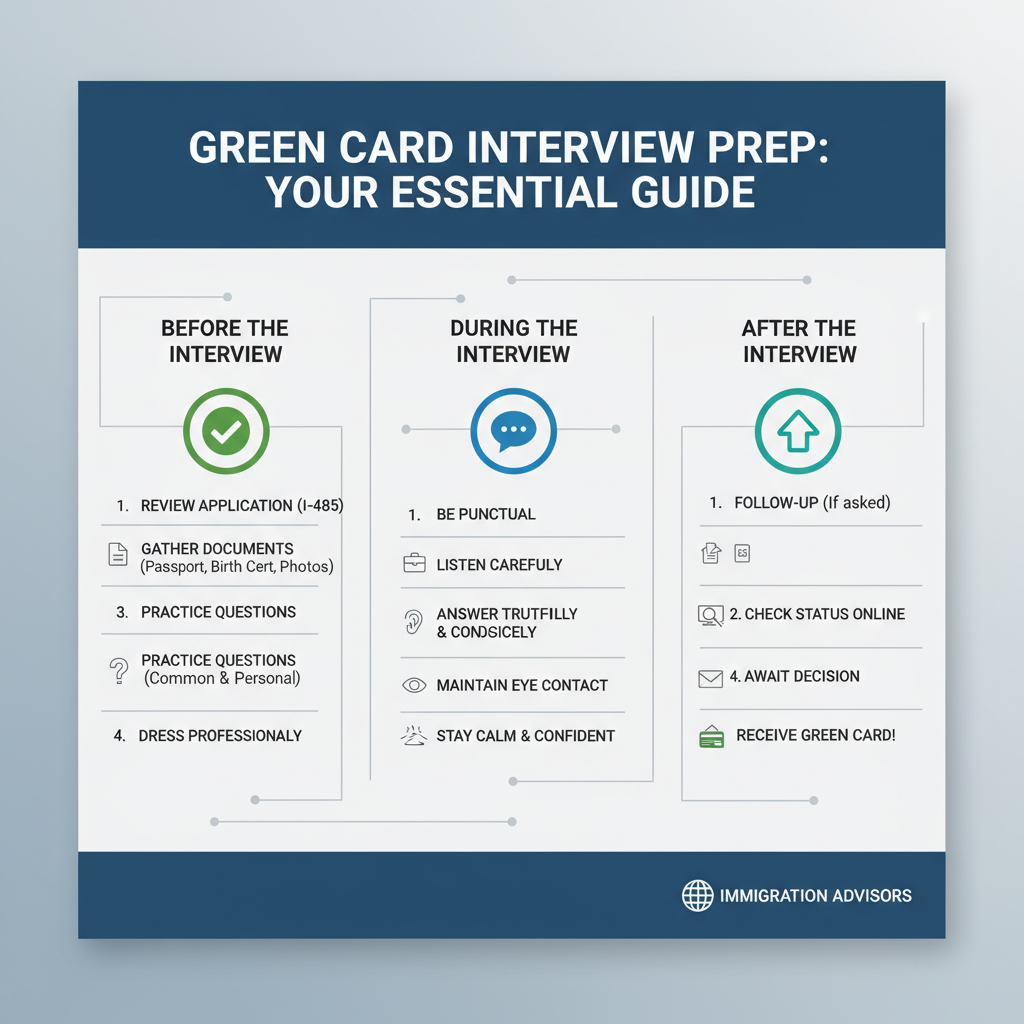
How to Prepare for Your Green Card Interview: A Complete Step-by-Step Guide
Preparation is the cornerstone of a successful Green Card interview. Follow these steps meticulously to ensure you are ready to present your case confidently.
1) Understand Your Case and Eligibility
Before anything else, thoroughly understand the basis of your Green Card application. Are you applying through marriage, family sponsorship, employment, asylum, or another category? Each category has specific requirements and common questions. Review your original petition and application forms (e.g., Form I-130, Form I-485) to refresh your memory on every detail you submitted.
- What to review:
- The category under which you are applying (e.g., immediate relative, employment-based, diversity visa).
- All answers provided on Form I-130, Form I-485, Form I-864, and any other supporting forms.
- Your personal history as detailed in your application (addresses, employment, travel, criminal history, marital history).
- Any previous immigration applications or interactions with USCIS.
- Why it matters: Consistency is key. The interviewing officer will compare your verbal answers with the information in your application. Any significant discrepancies without clear explanation can raise red flags.
2) Gather and Organize All Required Documents
This is arguably the most critical step. Your interview notice will list specific documents to bring. However, it’s prudent to bring originals and copies of ALL documents you submitted with your initial application, plus any new evidence that strengthens your case. Organize them neatly in a folder or binder.
- Essential Documents to Bring (Originals and Copies):
- Interview Notice (Form I-797C): The official letter from USCIS scheduling your interview.
- Government-Issued Photo Identification: Valid passport, driver’s license (especially important for Florida residents), or state ID.
- Your Passport and Travel Documents: All passports, even expired ones, and any travel documents (e.g., Form I-94 Arrival/Departure Record, Advance Parole document Form I-512L).
- Birth Certificates: For yourself, your spouse (if applicable), and any children.
- Marriage Certificate(s): If applying based on marriage, and any divorce decrees or death certificates for previous marriages of both spouses.
- Medical Examination Report: Form I-693, if not already submitted or if it has expired. Ensure it is sealed in an envelope as provided by the civil surgeon.
- Affidavit of Support (Form I-864) Package: The original signed Form I-864, the sponsor's most recent federal tax returns (with all schedules, W-2s, 1099s), and proof of employment/income (pay stubs, employment verification letter).
- Police Certificates/Court Records: From any country or U.S. jurisdiction where you lived for more than 6 months since age 16, or where you had arrests/convictions.
- Photos: Passport-style photos if requested or if you haven't submitted them recently.
- Employment Authorization Document (EAD): If you have one (Form I-766).
- Proof of Address: Lease agreements, utility bills, bank statements showing your Orlando or Florida address.
- Translations: Any document not in English must be accompanied by a certified English translation.
- Specific to Marriage-Based Green Cards (Evidence of Bona Fide Marriage):
- Joint bank accounts (statements, voided checks).
- Joint utility bills (electricity, water, internet).
- Joint lease agreements or property deeds.
- Joint car insurance, health insurance, life insurance policies.
- Photos together (dating, engagement, wedding, holidays, family events).
- Letters, emails, social media communication.
- Affidavits from friends/family attesting to the marriage.
- Children’s birth certificates (if applicable).
- Any other evidence showing commingling of finances and shared life.
- Important: Bring both the originals and high-quality photocopies of every document. The officer will likely keep the copies and return the originals.
3) Review Your Application Forms Thoroughly
Go through your entire application package line by line. Understand every question and every answer you provided. If you don't remember an answer or made a mistake, be prepared to explain it truthfully. This familiarity will help you answer questions consistently and confidently.
- Practice recalling: Dates of entry, addresses, employment history, names of family members, travel history, and any arrests or interactions with law enforcement.
- Identify potential issues: If there are any inconsistencies or potentially problematic answers, prepare a clear, honest explanation.
- Understand the "Yes/No" questions: Pay particular attention to the "Part 8. General Information" section of Form I-485, which covers grounds of inadmissibility.
4) Practice Answering Potential Interview Questions
While you can't predict every question, many are standard. Practice answering common questions clearly and concisely. If your spouse is accompanying you (for marriage-based interviews), practice together.
- Common Personal Questions:
- "What is your full name and date of birth?"
- "What is your current address?"
- "When did you last enter the U.S.?"
- "What is your employment history?"
- "Have you ever been arrested or convicted of a crime?"
- "Have you ever been denied a visa or removed from the U.S.?"
- Common Marriage-Based Questions:
- "How did you meet your spouse?"
- "When did you get married?"
- "What are your spouse’s parents' names?"
- "Do you live together? Describe your home."
- "What do you do for fun together?"
- "Who pays the bills? How do you manage finances?"
- "When was the last time you saw your spouse's family?"
- Reminder: Answer truthfully and directly. If you don't know an answer, say so. Do not guess or fabricate information.
5) Prepare for the Interview Day Logistics
Beyond the paperwork, logistical preparation is crucial to ensure you arrive calm and on time.
- Location and Time: Double-check the address of the Orlando USCIS Field Office (or other designated location) and the exact time of your appointment.
- Travel: Plan your route in advance, considering traffic, especially during peak hours on the I-4 corridor. Aim to arrive at least 30-45 minutes early.
- Attire: Dress professionally, as you would for a job interview. This shows respect for the process and the interviewing officer.
- Children: If possible, arrange childcare. If children must attend, bring quiet activities to keep them occupied.
- Attorney Presence: If you have retained an attorney, confirm their attendance and ensure they have all necessary documents. Having legal representation can provide peace of mind and expert guidance during the interview.
6) Attend the Interview with Confidence
On the day of the interview, maintain a respectful and honest demeanor.
- Be Truthful: Always tell the truth. Providing false information can lead to severe penalties, including a permanent bar from the U.S.
- Be Respectful: Address the officer respectfully.
- Listen Carefully: Listen to each question fully before answering. If you don't understand a question, politely ask the officer to repeat or rephrase it.
- Answer Concisely: Answer questions directly and to the point. Avoid volunteering unnecessary information unless asked.
- Provide Documents When Asked: Only present documents when the officer requests them.
- Don't Argue: If the officer seems skeptical, remain calm and present facts or evidence. Do not argue or become defensive.
- Seek Clarification: If at any point you feel overwhelmed or unsure, especially if you have an attorney present, you can ask for a moment to consult with them.
7) Follow Up After the Interview
The interview doesn't always end with an immediate decision. Sometimes, the officer may issue a Request for Evidence (RFE) or indicate that your case requires further review.
- Request for Evidence (RFE): If you receive an RFE, respond promptly and thoroughly with the requested documents.
- Decision: If approved, you will typically receive your Green Card in the mail within a few weeks. If denied, you will receive a written explanation of the decision.
- Legal Counsel: If you face a denial or an RFE, it is crucial to consult with an experienced immigration attorney immediately to understand your options, which may include filing a motion to reopen or appeal.
Need Help? Our Orlando immigration team is ready to assist. Call +1 786-791-3106 for a free consultation, or message us online. Se Habla Español.
Practical Steps You Can Take Today
Starting your preparation early can significantly reduce stress and improve your chances of a successful interview. Here's an actionable checklist:
- Review Your Entire Application Package: Gather all copies of forms (Form I-130, Form I-485, Form I-864, etc.) and supporting documents you submitted. Create a master file.
- Create a Document Checklist: Based on your application and potential needs, make a detailed list of all original and copy documents you will bring.
- Start Gathering Originals: If you only submitted copies, begin collecting the original versions of all birth certificates, marriage certificates, passports, financial records, etc.
- Organize Your Evidence: Place documents in a binder with clear tabs for easy access. Group similar documents together (e.g., all marriage evidence, all financial documents).
- Practice Interview Questions: Have a friend or family member conduct a mock interview with you. For marriage-based cases, practice with your spouse.
- Confirm Medical Exam Status: Check the validity of your Form I-693. If it's expiring or hasn't been submitted, schedule an appointment with a USCIS-approved civil surgeon.
- Consult with an Immigration Attorney: Even if you started your application independently, a consultation with an attorney can identify potential issues and provide invaluable guidance.
- Check USCIS Processing Times: Regularly monitor the USCIS Processing Times website for your specific field office (e.g., Orlando Field Office) to get an idea of when to expect an interview notice.
- Update Your Address: If you’ve moved, ensure USCIS has your current address by filing Form AR-11, Alien’s Change of Address Card, and updating your pending application.
Document preparation guidance
- Originals vs. Copies: Always bring original documents for the officer to review, along with a complete set of photocopies. The officer will usually keep the copies and return the originals.
- Translations: Any document not in English must be accompanied by a complete and accurate English translation, certified by the translator. The certification must state that the translator is competent to translate and that the translation is accurate.
- Photographs: Ensure any photos submitted are recent and meet USCIS specifications (2x2 inches, white background, full face, unretouched).
Timeline expectations
The timeline from filing your Green Card application to attending an interview can vary significantly based on your application category, the specific USCIS field office, and current caseloads. Generally:
- Filing to Interview Notice: After filing Form I-485, it can take several months to over a year to receive an interview notice. You will typically receive an interview notice (Form I-797C) about 3-6 weeks before your scheduled interview date.
- Interview to Decision: Sometimes a decision is made on the spot. More often, it takes a few weeks or months to receive a final decision or a Request for Evidence (RFE).
- Check Processing Times: For the most up-to-date information, always refer to the USCIS Processing Times tool. Select Form I-485 and your local field office (e.g., Orlando, FL) to get an estimate.
How Imigrar Helps Immigrants in Orlando
At Imigrar, we understand that preparing for a Green Card interview can be a complex and stressful process. Our dedicated team of immigration attorneys in Orlando is here to provide expert guidance and support every step of the way.
- Our experience and expertise: We have extensive experience navigating the intricacies of U.S. immigration law. Our attorneys are well-versed in the requirements and procedures of the Orlando USCIS Field Office and understand the unique challenges faced by immigrants in Central Florida. We stay up-to-date on all immigration policy changes and processing nuances.
- Comprehensive Case Review: We thoroughly review your entire application package, identify potential issues, and help you gather all necessary documentation.
- Personalized Interview Preparation: We conduct mock interviews, preparing you for common and specific questions an officer might ask, ensuring you feel confident and ready.
- Attorney Representation: One of our experienced attorneys can accompany you to your interview, providing legal counsel and advocating on your behalf. This can significantly reduce stress and ensure your rights are protected.
- Post-Interview Support: We assist with responding to RFEs or addressing any issues that arise after the interview, guiding you through the next steps.
We are committed to "Keep Families Together" and providing compassionate, effective legal representation. Don't face your Green Card interview alone. We offer a free consultation to discuss your case and how we can help.
Se Habla Español. Our bilingual team is ready to serve the Spanish-speaking community in Orlando and across the nation.

Frequently Asked Questions
Q: Do I always need an interview if I filed for adjustment of status?
A: Most applicants for Adjustment of Status (Form I-485) are required to attend an interview. However, USCIS may waive the interview requirement for certain categories, particularly for employment-based applications where the applicant has a strong record and clear eligibility. Family-based applications, especially those based on marriage, almost always require an interview to verify the bona fides of the relationship. It's best to assume an interview will be required and prepare accordingly.
Q: Can my current immigration status affect my green card interview?
A: Yes, your current immigration status at the time of filing and interview can significantly impact your Green Card application. For example, if you overstayed a visa or entered without inspection, you might be subject to grounds of inadmissibility, requiring a waiver. If you are maintaining a valid nonimmigrant status (like an H-1B or L-1 visa) while applying for Adjustment of Status, it generally strengthens your case. It is crucial to disclose your entire immigration history accurately.
Q: How long after my interview will I receive a decision?
A: The timeline for receiving a decision varies. Sometimes, the USCIS officer may approve your case on the spot, and you'll receive a welcome notice and Green Card in the mail within a few weeks. In other cases, the officer may need more time to review your file, request additional evidence (RFE), or conduct background checks. It can take several weeks or even months to receive a final decision. You can check your case status online using your receipt number on the USCIS official website.
Q: What if I don't have all the required documents for my interview?
A: Warning: Failing to bring all required documents can lead to delays or even denial. If you genuinely cannot obtain a specific document (e.g., a birth certificate from a country with civil unrest), you should bring secondary evidence (e.g., baptismal records, affidavits from elders) and a detailed explanation of why the primary document is unavailable. If you realize you are missing something before the interview, contact your attorney immediately. During the interview, if you are missing a document, the officer may issue a Request for Evidence (RFE) or a Notice of Intent to Deny (NOID), giving you a chance to submit it within a specified timeframe (e.g., 87 days).


