


Navigating the complex world of U.S. immigration can be one of the most challenging journeys an individual or family undertakes. For many, the ultimate goal is securing a Green Card, granting them lawful permanent residency. A critical step in this process is the Green Card interview, a moment that can feel daunting but is crucial for approval.
At Imigrar, an immigration law firm based in Orlando, Florida, our mission is to "Keep Families Together." We understand the hopes and anxieties surrounding your immigration journey. This comprehensive guide is designed to demystify the Green Card interview process, providing you with the knowledge and preparation needed to approach it with confidence.
Need Help? Our Orlando immigration team is ready to assist. Call +1 786-791-3106 for a free consultation, or message us online. Se Habla Español.
The reporting that sparked this guide: Green Card Interview Preparation Tips (Immigration Law)
What This News Means for Immigrants in Orlando and Across Florida
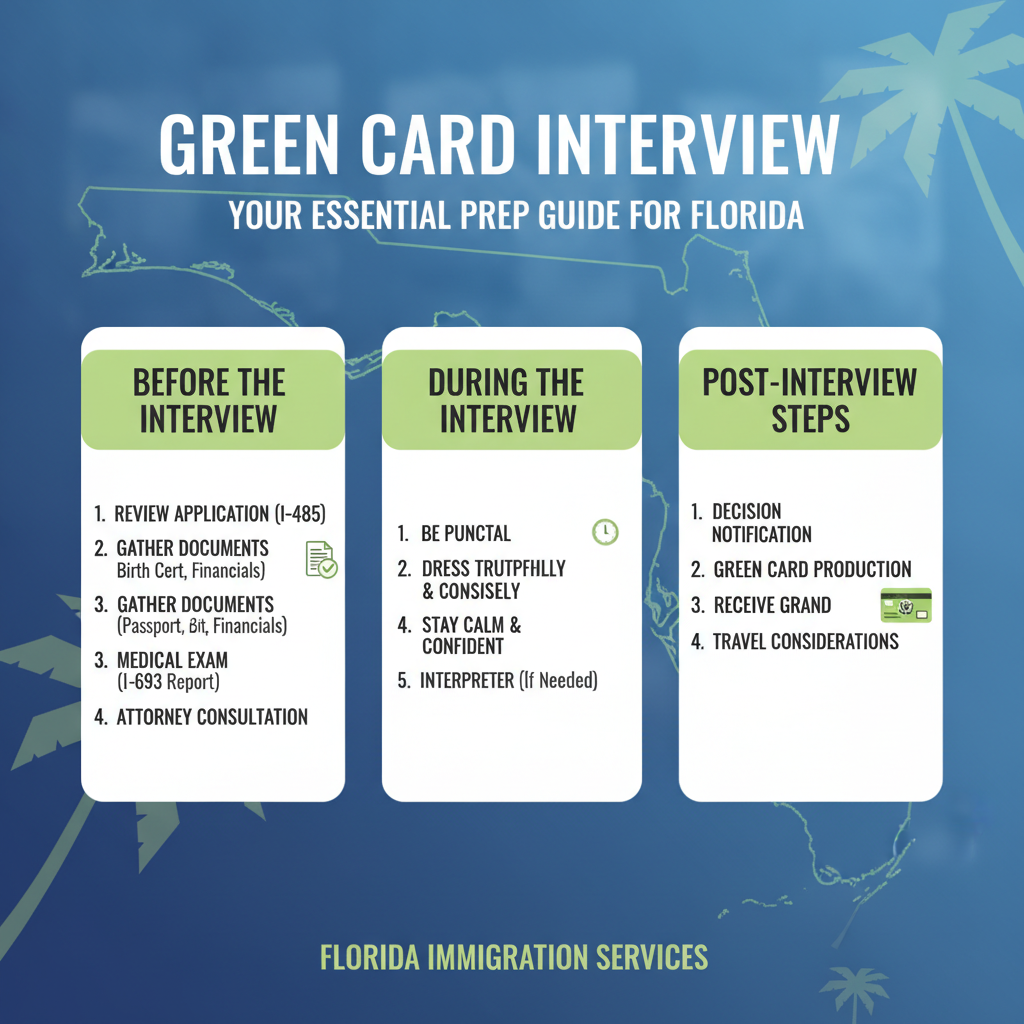
The continuous discussion around immigration law, particularly regarding critical steps like the Green Card interview, underscores its importance for countless individuals and families. For those seeking to establish permanent residency in the United States, understanding every facet of this interview is not just helpful—it’s essential.
Why this news is showing up now
Immigration law and policy are dynamic, constantly evolving, and frequently discussed in the media. As of 2026-07-06, public and legal interest in efficient and fair immigration processes remains high. The United States Citizenship and Immigration Services (USCIS) continues to process a significant backlog of applications, leading to ongoing discussions about processing times, interview protocols, and the best ways for applicants to prepare. Reports on immigration law often highlight practical aspects like interview preparation because these are the touchpoints where applicants directly interact with the system, and where proper preparation can make all the difference. Furthermore, with continued efforts to streamline processes, understanding current best practices for interviews is always relevant.
How it can affect Florida residents
Florida, particularly Central Florida and the Orlando metropolitan area, is home to a vibrant and diverse immigrant population. This means that a large number of individuals and families in our community are actively pursuing Green Cards through various avenues, such as family-based petitions, employment-based petitions, or asylum. For Orlando residents and those across the I-4 corridor, the Orlando USCIS Field Office is the primary location for interviews. Therefore, any news or guidance related to Green Card interview preparation directly impacts local applicants. Proper preparation can significantly reduce stress, prevent delays, and increase the likelihood of a successful outcome, helping Florida families stay together. Conversely, being unprepared can lead to requests for additional evidence (RFEs), interview rescheduling, or even denial, causing significant disruption to lives in Orange County and beyond.
What Green Card Interview Preparation Is (and Why It Matters)
A Green Card interview is a mandatory step for most individuals applying for lawful permanent residency in the United States, especially for those seeking Adjustment of Status from within the U.S. or through Consular Processing abroad. This interview serves as an opportunity for a USCIS officer (or a Consular Officer if applying overseas) to verify the information provided in your application, confirm your eligibility, and ensure you meet all legal requirements for a Green Card.
A plain-English definition
Think of the Green Card interview as a conversation with an immigration officer. You've submitted many forms and documents to prove you qualify for a Green Card. Now, the officer wants to meet you in person to ask questions about your application, your background, and your relationship (if it’s a marriage-based petition). They want to make sure everything you've said is true and that you meet all the legal rules to become a permanent resident of the U.S. It’s your chance to clarify anything and present your case directly.
Key terms you need to know
- Green Card: Officially known as a Permanent Resident Card, it proves you are authorized to live and work permanently in the United States.
- Adjustment of Status (AOS): The process of applying for a Green Card while physically present in the United States. This is contrasted with Consular Processing, which occurs at a U.S. embassy or consulate abroad.
- USCIS (U.S. Citizenship and Immigration Services): The government agency responsible for processing immigration petitions and applications, including Green Cards. USCIS official website
- Petitioner: The U.S. citizen or lawful permanent resident who files an immigration petition (e.g., Form I-130) on behalf of an immigrant relative.
- Beneficiary/Applicant: The immigrant seeking a Green Card.
- Affidavit of Support (Form I-864): A legally binding document signed by a petitioner (sponsor) to accept financial responsibility for the immigrant. This is crucial to prevent the immigrant from becoming a "public charge."
- Public Charge: A legal term referring to an individual who is primarily dependent on the government for subsistence, as demonstrated by the receipt of public cash assistance for income maintenance or long-term institutionalization at government expense.
- Priority Date: The date USCIS receives your immigration petition. This date determines your place in the visa queue for certain categories.
- Notice of Interview: The official document sent by USCIS or the Department of State informing you of your interview date, time, and location, along with a list of required documents.
Current Immigration Law: The Foundation
The process of obtaining a Green Card is governed by the Immigration and Nationality Act (INA), primarily found in Title 8 of the U.S. Code. This complex body of law sets forth the eligibility requirements, application procedures, and interview protocols. Understanding these foundational laws is crucial for a successful application.
Federal requirements
At the federal level, the INA outlines various paths to a Green Card, including family-sponsored, employment-based, diversity lottery, and special immigrant categories. Regardless of the path, the core requirements for a Green Card interview involve:
- Eligibility Verification: The applicant must demonstrate eligibility for the specific Green Card category they applied under. For instance, in a marriage-based petition, the applicant must prove a bona fide (real) marriage.
- Admissibility: Applicants must be "admissible" to the United States. This means they must not fall under any grounds of inadmissibility, such as certain criminal convictions, health-related issues, or past immigration violations. Waivers may be available for some grounds.
- Financial Support: For most family-based and some employment-based categories, the applicant must have a financial sponsor who files an Affidavit of Support (Form I-864) to ensure they will not become a public charge.
- Identity and Background Checks: USCIS conducts thorough background checks, including fingerprinting (biometrics), to verify identity and check for any disqualifying factors.
Key forms involved in the Green Card process include:
- Form I-130, Petition for Alien Relative (filed by the U.S. citizen or LPR petitioner)
- Form I-485, Application to Register Permanent Residence or Adjust Status (filed by the immigrant applicant for Adjustment of Status)
- Form I-864, Affidavit of Support (filed by the financial sponsor)
- Form I-693, Report of Medical Examination and Vaccination Record (completed by a USCIS-approved civil surgeon)
For detailed information on these forms and more, visit the USCIS Forms page.
Florida-specific considerations
While immigration law is federal, practical considerations can be location-specific. For residents of Central Florida, your Green Card interview will most likely take place at the Orlando USCIS Field Office. This office serves applicants from Orange County, Seminole County, Osceola County, and surrounding areas. Knowing your specific field office is important for understanding local procedures, parking, and transportation. The officers at the Orlando office are highly experienced in various types of Green Card applications, especially marriage-based and family-based petitions, which are common in our diverse community.
It's also worth noting that Florida's large immigrant population means the Orlando USCIS Field Office handles a high volume of cases. While this doesn't change the law, it can sometimes affect scheduling and processing times. You can always check USCIS Processing Times for an estimate relevant to your specific field office and form type.
How to Prepare for Your Green Card Interview: A Complete Step-by-Step Guide
The Green Card interview is a pivotal moment in your immigration journey. Thorough preparation is key to a successful outcome. Here’s a detailed, step-by-step guide to help you get ready.
1) Review Your Entire Application Package Thoroughly
Before your interview, you must be intimately familiar with every document you submitted. This includes your original petition (e.g., Form I-130), your Adjustment of Status application (Form I-485), and all supporting documents. The interviewing officer will primarily base their questions on the information contained within these forms.
- Actionable Advice:
- Gather copies of all forms and supporting documents you submitted to USCIS.
- Read through each form as if you were the officer, looking for any inconsistencies or areas that might require clarification.
- If you submitted a joint petition (e.g., marriage-based), both the petitioner and beneficiary should review all documents together.
- Pay special attention to dates, addresses, employment history, and personal details.
- Required Documents for Review:
- Complete copy of Form I-130 (if applicable)
- Complete copy of Form I-485
- Complete copy of Form I-864 (Affidavit of Support)
- Copies of all supporting evidence (birth certificates, marriage certificates, divorce decrees, passports, employment letters, etc.)
- Copies of any previous immigration applications or petitions (e.g., asylum applications, visa applications)
2) Organize and Prepare All Original Documents and Copies
The Notice of Interview will list specific documents to bring. However, it’s always best to bring originals and copies of *all* documents related to your case. Organize them neatly in a folder, separated by category, for easy access during the interview. Make sure to have a separate set of copies for the officer to keep.
- Actionable Advice:
- Create a checklist based on your Notice of Interview and this guide.
- Place original documents in one section and corresponding copies in another.
- Consider using dividers or labels for different categories (e.g., "Identification," "Financial," "Relationship Evidence").
- For marriage-based interviews, ensure you have strong, compelling evidence of a bona fide marriage.
- Essential Documents to Bring (Originals and Copies):
- Notice of Interview
- Passport(s) (current and expired, if any)
- Birth Certificate(s)
- Marriage Certificate (if applicable)
- Divorce Decrees or Death Certificates for any prior marriages (of both petitioner and beneficiary, if applicable)
- Form I-94, Arrival/Departure Record (if applicable)
- Employment Authorization Document (EAD) and Advance Parole document (if applicable)
- Driver's License or State ID (especially if residing in Florida)
- Two passport-style photos (even if you submitted them previously)
- Form I-693, Medical Examination Report (if not already submitted, or if it has expired – it's valid for 2 years from the civil surgeon's signature date)
- Form I-864, Affidavit of Support, with all supporting financial documents for the sponsor (tax returns, W-2s, pay stubs, employment verification letter)
- Proof of petitioner's U.S. citizenship or lawful permanent residency (e.g., U.S. passport, birth certificate, naturalization certificate, Green Card)
- All evidence of a bona fide marriage (for marriage-based Green Cards):
- Joint bank statements, credit card statements
- Joint leases or mortgage agreements
- Utility bills in both names
- Insurance policies (health, life, auto) showing each other as beneficiaries
- Photos together (dating, wedding, with family/friends)
- Children's birth certificates (if applicable)
- Affidavits from friends/family attesting to the marriage
- Travel itineraries, tickets, hotel bookings from joint trips
- Any other documents showing cohabitation and commingling of finances/life.
- Police clearance certificates from any country where you lived for 6+ months since age 16 (if required, especially for consular processing)
- Any other documents specifically requested in your Notice of Interview.
3) Practice Answering Potential Interview Questions
While you can't predict every question, many are standard. Practicing your answers can help you remain calm and articulate during the actual interview. For marriage-based petitions, be prepared for detailed questions about your relationship.
- Actionable Advice:
- Review your application forms and anticipate questions related to your background, family history, employment, and how you met your spouse (if applicable).
- Practice answering truthfully, clearly, and concisely. Avoid offering unnecessary information.
- For marriage-based interviews, practice separately and then together with your spouse. Questions will focus on your daily life, shared experiences, and future plans.
- Consider mock interviews with a trusted friend, family member, or your attorney.
- Common Question Areas:
- Your personal details (name, date of birth, address, parents' names)
- How you entered the U.S. and your immigration history
- Your current employment and education
- Criminal history (if any)
- For marriage-based: How and when you met, your first date, proposal, wedding details, daily routines, shared friends, future plans, financial commingling.
- For sponsor: Questions about income, assets, and ability to support the beneficiary.
4) Attend Your Medical Examination
The medical examination is a crucial part of the Adjustment of Status process. It must be conducted by a USCIS-approved civil surgeon. The results, sealed in an envelope, must be submitted to USCIS. If you already submitted it with your Form I-485, ensure it's still valid (generally 2 years from the civil surgeon's signature date). If not, bring the sealed envelope to your interview.
- Actionable Advice:
- Locate a USCIS-approved civil surgeon in your area (search on the USCIS official website).
- Schedule your exam well in advance of your interview.
- Bring your passport, vaccination records, and any medical history to the exam.
- Ensure the civil surgeon provides the results in a sealed envelope. Do NOT open it.
- Important: If your medical exam results were submitted and are approaching their expiration date, consult with your attorney about whether a new exam might be needed.
5) Understand the Role of Your Attorney and Interpreter
You have the right to have an attorney present at your interview. An attorney can provide guidance, clarity, and protect your rights. If you or your spouse are not fluent in English, you may also need a certified interpreter.
- Actionable Advice:
- If you have an attorney, ensure they are fully aware of your interview date and time and have prepared with you.
- If you need an interpreter, inform USCIS in advance if they need to provide one. Otherwise, you must bring your own certified interpreter. Do not rely on family members or friends to interpret unless explicitly allowed and certified.
- An attorney can represent you at the interview, ensure the officer asks appropriate questions, and intervene if necessary.
- Reminder: Your attorney is there to represent your legal interests, not to answer questions on your behalf. You must answer the questions yourself.
6) What to Do on Interview Day
On the day of your interview, present yourself professionally and arrive early. Be polite, honest, and direct in your answers.
- Actionable Advice:
- Dress appropriately: Business casual attire is recommended.
- Arrive early: Plan to arrive at the Orlando USCIS Field Office (or other location) at least 30 minutes before your scheduled time to allow for security checks and finding parking (which can be challenging in downtown Orlando).
- Bring everything: Double-check that you have all original documents, copies, your Notice of Interview, and your attorney (if applicable).
- Be truthful and consistent: Answer all questions honestly and consistently with the information in your application.
- Listen carefully: Make sure you understand each question before answering. If you don't understand, politely ask the officer to rephrase it.
- Don't volunteer information: Only answer the question asked. Do not elaborate unnecessarily unless prompted.
- Stay calm and polite: Maintain a respectful demeanor throughout the interview.
- If applying with a spouse: Both of you will be interviewed, sometimes together, sometimes separately (especially for marriage-based cases where the officer wants to confirm the authenticity of the relationship).
- Warning: Providing false information or misrepresenting facts can lead to denial of your application and serious immigration consequences.
Feeling Overwhelmed? The complexities of the Green Card interview don't have to be faced alone. Imigrar's experienced immigration lawyers in Orlando are here to guide you. Call us today at +1 786-791-3106 for a free consultation. Se Habla Español.
Practical Steps You Can Take Today
Don't wait until the last minute to prepare for your Green Card interview. Here are practical steps you can start taking right now to ensure you're ready.
Actionable Checklist:
- Locate and Organize All Submitted Documents: Gather your complete copies of Form I-130, Form I-485, Form I-864, and all supporting evidence. Put them in a dedicated folder.
- Create a "To Bring" Folder: Start collecting all original documents and their copies that you will need on interview day, as outlined in Step 2 of our guide.
- Schedule Your Medical Exam: If you haven't already, find a USCIS-approved civil surgeon in Central Florida and schedule your Form I-693 exam.
- Review Your Application Forms: Read through every question and answer on your submitted forms. Highlight any areas where you might need to provide additional context or explanation.
- Compile Relationship Evidence (if applicable): If you're applying based on marriage, continuously gather new evidence of your bona fide marriage – recent joint bills, new photos, updated bank statements.
- Practice Q&A: Ask a friend or family member to quiz you on common interview questions, especially those related to your application details and relationship history.
- Consult with an Attorney: Schedule a consultation with an experienced immigration attorney, like those at Imigrar, to review your case and prepare specifically for your interview.
Document Preparation Guidance
- Originals vs. Copies: Always bring both. The officer will want to see the originals but will keep the copies. Never surrender an original unless specifically requested and you have a record of it.
- Translations: Any document not in English must be accompanied by a certified English translation. The translator must sign a statement certifying their competence and the accuracy of the translation.
- Organization is Key: A well-organized file speaks volumes. Use tabs, dividers, and a clear system so you can quickly locate any document the officer asks for.
- New Evidence: If you have new, compelling evidence that wasn't submitted with your original application (especially for marriage-based cases), bring it. This includes recent joint bank statements, utility bills, photos, or travel documents.
Timeline Expectations
The timeline from filing your Form I-485 to receiving your interview notice can vary significantly based on your application type, your local USCIS Field Office (e.g., Orlando), and current USCIS processing times. As of 2026, processing times remain dynamic. After your interview, a decision can be made on the spot, or it may take several weeks or even months. You can monitor your case status online using your receipt number on the USCIS official website.
- Pre-Interview: After filing Form I-485, you will typically receive a biometrics appointment notice within 3-5 weeks, followed by your Notice of Interview several months later. The wait for an interview can range from 6 months to over 2 years, depending on the category and field office.
- Interview Day: The interview itself usually lasts 20-60 minutes.
- Post-Interview: Some decisions are made immediately. If approved, you may receive a stamp in your passport and your Green Card will be mailed within a few weeks. If more evidence is needed, you'll receive a Request for Evidence (RFE). If denied, you'll receive a denial letter with reasons.
How Imigrar Helps Immigrants in Orlando
At Imigrar, we understand that the Green Card interview is more than just a formality; it's a critical step towards a new life. Our Orlando-based immigration law firm is dedicated to providing comprehensive and compassionate legal support to individuals and families throughout Florida and nationwide.
Our experience and expertise
Our attorneys possess extensive experience in all facets of immigration law, with a particular focus on family-based petitions and Adjustment of Status cases. We regularly guide clients through the Green Card interview process at the Orlando USCIS Field Office and other locations. We know the types of questions officers ask, the evidence they seek, and the common pitfalls applicants encounter. We leverage this expertise to prepare you thoroughly, ensuring you walk into your interview feeling confident and informed.
Free consultation offer
We believe everyone deserves access to quality legal advice. That's why Imigrar offers a free, no-obligation consultation. During this consultation, we will review your specific case, explain the Green Card interview process as it applies to you, and outline how our services can assist in maximizing your chances of success. Whether you're just starting your application or have an interview scheduled, we're here to help.
Se Habla Español: Our team is fully bilingual, fluent in both English and Spanish, ensuring that language is never a barrier to receiving expert legal counsel. We are committed to serving the diverse communities of Orlando and beyond.
Ready to Prepare for Your Interview? Don't leave your Green Card to chance. Contact Imigrar today for expert legal guidance and peace of mind. Call +1 786-791-3106 for your free consultation. Se Habla Español.
Frequently Asked Questions
Q: What if I don't speak English well enough for the interview?
A: If you are not fluent in English, you have the right to bring a certified interpreter to your Green Card interview. It is crucial that the interpreter is unbiased and fluent in both English and your native language. Do not bring a family member or friend to interpret unless explicitly approved by USCIS and they are professionally certified. Alternatively, you can request USCIS to provide an interpreter, though this should be done in advance and is not always guaranteed. Having a professional interpreter ensures accurate communication and prevents misunderstandings that could jeopardize your case.
Q: What happens if my spouse and I are interviewed separately for a marriage-based Green Card?
A: Separate interviews, often called "Stokes interviews," are not uncommon, especially if the USCIS officer has concerns about the authenticity of your marriage. During these interviews, you and your spouse will be asked detailed questions about your relationship, often identical questions, to see if your answers are consistent. It's vital to be truthful and ensure your responses align with the information provided in your application and with each other. This is why thorough preparation and reviewing your application together is so important. If you are called for a Stokes interview, it's highly advisable to have an attorney present.
Q: How long does it take to get a decision after the interview?
A: The timeline for a decision varies. Sometimes, the USCIS officer may approve your application on the spot, and you might receive an approval stamp in your passport. In other cases, the officer may need to review additional documents or conduct further background checks. This can lead to a decision taking anywhere from a few days to several weeks or even months. If a decision isn't made immediately, you will typically receive a written notice in the mail. You can check your case status online at the USCIS official website.
Q: What documents are absolutely essential to bring to the interview?
A: You must bring your Notice of Interview, all original documents you submitted copies of (birth certificates, marriage certificates, passports, etc.), and the original sealed Form I-693 (Medical Examination Report) if not previously submitted or if it's nearing expiration. For marriage-based cases, bring all original evidence of your bona fide marriage. It's always best to err on the side of caution and bring anything remotely related to your application, organized and ready. Refer to Step 2 of our guide for a comprehensive list.
Q: Are there any fees I need to pay at the interview?
A: Generally, you do not pay any fees at the Green Card interview itself. All required filing fees for Form I-130 and Form I-485, as well as the biometrics fee, should have been paid when you submitted your application. The fee for the medical examination is paid directly to the civil surgeon. However, you might need to pay the USCIS Immigrant Fee ($220) after approval, before your physical Green Card is produced, but this is not typically handled at the interview itself.
Q: What happens if my Green Card application is denied after the interview?
A: If your Green Card application is denied, you will receive a written decision explaining the reasons for the denial. The options available to you will depend on the specific reasons for denial. You might be able to file a motion to reconsider or reopen the case, file an appeal, or, in some situations, refile the application with new evidence or corrected information. It is critical to consult with an experienced immigration attorney immediately upon receiving a denial to understand your options and the best course of action. Do not delay, as there are often strict deadlines for appeals and other responses. The Executive Office for Immigration Review handles appeals for certain immigration cases.
Common Mistakes (and How to Avoid Them)
The Green Card interview is a high-stakes event. Avoiding common mistakes can significantly improve your chances of a smooth and successful outcome.
Mistake #1: Being Unprepared or Disorganized
Many applicants underestimate the importance of thorough preparation. Walking into the interview without having reviewed your application, without all original documents, or with a disorganized file can lead to delays, RFEs, or even denial. The officer needs to


