

The reporting that sparked this guide: Green Card Interview Preparation Tips (Immigration Law)
What This News Means for Immigrants in Orlando and Across Florida
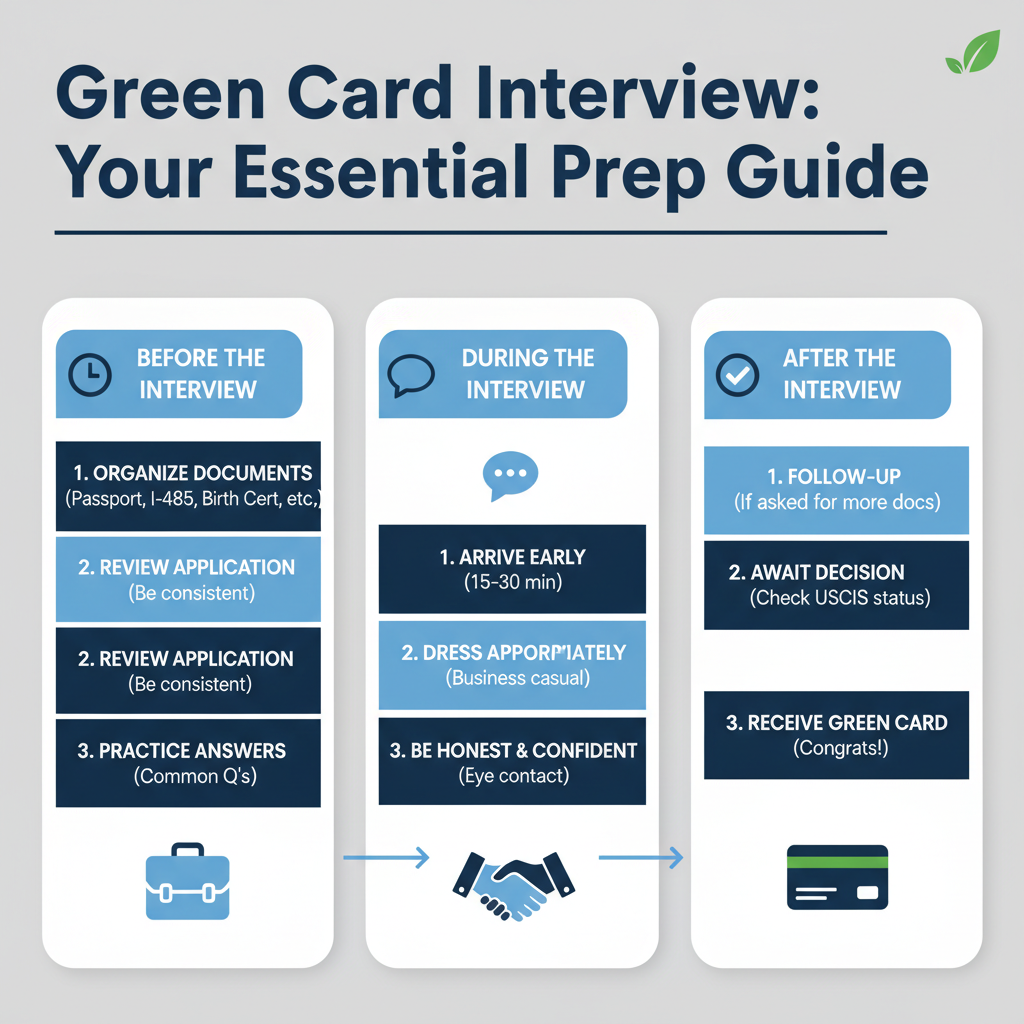
For countless individuals and families seeking to build a new life in the United States, the Green Card interview is a pivotal moment. It's the culmination of months, sometimes years, of application processes, document gathering, and anticipation. While not every Green Card application requires an interview, a significant number do, especially those based on family relationships or employment. The ongoing discussion in immigration law circles about interview preparation highlights its enduring importance and the continuous need for applicants to be thoroughly ready.
Why this news is showing up now
The topic of Green Card interview preparation is perennially relevant in immigration law. There's no single "new" policy that suddenly makes interviews more critical; rather, it's an evergreen subject because the interview process remains a cornerstone of the U.S. immigration system. Immigration authorities, primarily U.S. Citizenship and Immigration Services (USCIS), rely on these interviews to verify information, assess eligibility, and ensure the authenticity of applications. As immigration policies evolve and processing backlogs fluctuate, the interview's role in maintaining the integrity of the system remains constant. For applicants, staying informed about best practices for preparation is always timely, ensuring they can navigate this crucial step successfully, regardless of broader policy changes.
How it can affect Florida residents
For residents of Florida, particularly those in the Orlando area, understanding and preparing for your Green Card interview is especially pertinent. Florida is a melting pot of cultures and a major destination for immigrants from all over the world. This means that immigration services, including interviews, are in high demand. The Orlando USCIS Field Office, located at 5449 Forbes Pl, Orlando, FL 32812, handles a substantial volume of Adjustment of Status interviews for applicants residing in Central Florida and along the I-4 corridor. Being well-prepared not only increases your chances of a smooth interview process but can also help mitigate potential delays. Delays can be particularly frustrating given the state's vibrant economy and the desire of many immigrants to fully integrate into the workforce and community. Knowing what to expect and how to prepare can alleviate stress and streamline your path to permanent residency in the Sunshine State.
What the Green Card Interview Is (and Why It Matters)
The Green Card interview is a formal meeting with an immigration officer from USCIS (for Adjustment of Status cases within the U.S.) or a Consular Officer from the U.S. Department of State (for Consular Processing cases abroad). Its primary purpose is to verify the information provided in your Green Card application, assess your eligibility for permanent residency, and ensure that you meet all legal requirements. It's a critical step that can significantly impact the outcome of your application, making thorough preparation absolutely essential.
A plain-English definition
Think of the Green Card interview as your opportunity to personally present your case to an immigration officer. They will ask you questions about your application, your background, your family relationships (if applicable), and your intentions in the U.S. It’s a chance for them to confirm that everything you’ve stated in your forms is true and that you qualify for a Green Card under U.S. immigration law. It's not meant to trick you, but to ensure integrity in the immigration system. For family-based petitions, especially marriage-based ones, the interview is crucial for confirming that the relationship is genuine and not solely for immigration purposes.
Key terms you need to know
Navigating the immigration process means understanding specific terminology. Here are some key terms related to your Green Card interview:
- Adjustment of Status (AOS): The process of applying for lawful permanent resident status (a Green Card) while physically present in the United States. This is often an alternative to Consular Processing.
- Consular Processing: The process of applying for an immigrant visa at a U.S. Embassy or Consulate abroad, typically if you are outside the U.S. or ineligible for Adjustment of Status.
- USCIS Officer: The official from U.S. Citizenship and Immigration Services who conducts your interview for Adjustment of Status cases.
- Consular Officer: The official from the U.S. Department of State who conducts your interview for Consular Processing cases.
- Immigrant Visa Petition: The initial form filed by a U.S. citizen or lawful permanent resident (petitioner) on behalf of an eligible foreign national (beneficiary), such as Form I-130, Petition for Alien Relative.
- Application for Adjustment of Status: The form filed by the foreign national to apply for a Green Card, typically Form I-485.
- Affidavit of Support: A legally binding document, Form I-864, filed by the petitioner (or a joint sponsor) to demonstrate they can financially support the immigrant and prevent them from becoming a public charge.
- Bona Fide Marriage: A marriage entered into in good faith, not solely for immigration purposes. This is a critical element for marriage-based Green Cards.
- Conditional Green Card: A Green Card issued for two years if the marriage is less than two years old at the time of Adjustment of Status or immigrant visa approval. The couple must later file Form I-751, Petition to Remove Conditions on Residence.
- Priority Date: The date USCIS or the Department of State receives your immigrant visa petition. This date determines your place in the visa queue, especially for categories with annual limits.
- Notice of Interview: The official document (often Form I-797C, Notice of Action) from USCIS or the National Visa Center (NVC) informing you of your interview date, time, and location, and listing required documents.
Need Help? Our Orlando immigration team is ready to assist. Navigating these terms and processes can be complex. Call +1 786-791-3106 for a free consultation, or message us online. Se Habla Español.
Current Immigration Law: The Foundation for Your Green Card Interview
The Green Card interview, whether for Adjustment of Status or Consular Processing, is conducted under the authority of the Immigration and Nationality Act (INA). This comprehensive body of law dictates who is eligible for immigration benefits, the grounds for inadmissibility, and the procedures for obtaining lawful permanent residency.
Federal requirements
At the federal level, several key provisions of the INA govern Green Card eligibility and the interview process:
- INA § 201 and § 203: These sections outline the categories of immigrants (family-sponsored, employment-based, diversity lottery, etc.) and the numerical limitations for each. Your eligibility for a Green Card hinges on fitting into one of these categories.
- INA § 204: This section details the petitioning process, such as the filing of Form I-130, Petition for Alien Relative, by a U.S. citizen or lawful permanent resident on behalf of a family member. The validity of this petition is often a central point of inquiry during the interview.
- INA § 212: This is a critical section that lists the grounds of inadmissibility, which can prevent an applicant from receiving a Green Card. These grounds include health-related issues, criminal history, security concerns, public charge concerns (addressed by Form I-864, Affidavit of Support), misrepresentation, and prior immigration violations. The immigration officer will assess whether any of these grounds apply to you.
- INA § 245: This section specifically governs Adjustment of Status within the United States, outlining eligibility criteria such as lawful admission, maintaining a lawful status, and the immediate availability of an immigrant visa.
During the interview, the officer's role is to ensure that you meet all the positive eligibility requirements for your specific Green Card category and that you are not inadmissible under any of the INA's provisions. The burden of proof rests on the applicant to demonstrate eligibility.
Florida-specific considerations
While immigration law is federal, its administration has local impacts. For residents of Florida, especially those in the Orlando metro area, your Green Card interview will likely take place at the Orlando USCIS Field Office. This office serves a wide region, including Orange, Seminole, Osceola, Volusia, Brevard, and other surrounding counties. Understanding the local office's procedures, typical processing times (which can be checked on the USCIS Processing Times website), and common interview practices can be beneficial. While the legal framework remains consistent nationwide, the local environment can influence scheduling and specific officer approaches. For instance, the Orlando office, like many others, processes a high volume of family-based petitions, particularly marriage-based ones, so officers are highly experienced in evaluating the authenticity of such relationships. Preparing thoroughly for questions specific to your life in Central Florida – your address, employment, community ties – will demonstrate your integration and sincerity.
Important: Always refer to the USCIS official website for the most up-to-date forms, instructions, and policy guidance. Immigration laws and procedures can change, and relying on outdated information can jeopardize your application.
How to Prepare for Your Green Card Interview: A Complete Step-by-Step Guide
The Green Card interview is a critical juncture in your immigration journey. Proper preparation is key to a successful outcome. Follow this comprehensive step-by-step guide to ensure you are fully ready.
1) Understand Your Interview Notice (Form I-797C)
Your journey to interview preparation begins the moment you receive your Form I-797C, Notice of Action, which serves as your official interview notice. This document is not just a scheduling confirmation; it's a vital instruction sheet.
- Review Details Carefully: Check the date, time, and location of your interview. For Orlando residents, this will typically be the Orlando USCIS Field Office.
- List of Required Documents: The notice will include a specific list of documents you must bring. This list is crucial and often includes originals of documents you previously submitted copies of, as well as additional evidence. Do not overlook this section.
- Who Must Attend: The notice will specify who needs to attend the interview. For family-based petitions, this typically includes both the petitioner (U.S. citizen or LPR) and the beneficiary (immigrant applicant). Children included in the application may also need to attend.
- Fingerprint/Biometrics: Ensure you have attended your biometrics appointment as scheduled. If you missed it or have not received a notice, contact USCIS immediately.
2) Gather and Organize All Required Documents
This is arguably the most time-consuming but crucial step. Your goal is to bring a well-organized, complete set of documents to your interview. Create a checklist based on your interview notice and the general requirements for your Green Card category.
- Originals vs. Copies: Always bring the original of every document you submitted a copy of, plus extra copies. The officer will typically review the originals and keep the copies.
- Identification: Valid passport, driver’s license, state ID.
- Birth Certificates: Original birth certificates for both applicant and petitioner (if applicable), along with certified translations if not in English.
- Marriage Certificate: Original marriage certificate (if applicable), and divorce decrees/death certificates for any prior marriages of both spouses.
- Financial Documents:
- Form I-864, Affidavit of Support, with all supporting documents (e.g., tax transcripts/returns for the past three years, W-2s, pay stubs, employment verification letter, bank statements).
- If a joint sponsor is used, their Form I-864 and supporting financial documents.
- Medical Examination: The sealed envelope containing your Form I-693, Report of Medical Examination and Vaccination Record. Do NOT open this envelope. If you already submitted it, bring proof of submission.
- Photographs: Two U.S. passport-style photos for the applicant (and petitioner, if required).
- Police Certificates: If required for Consular Processing.
- Employment Authorization Document (EAD) & Advance Parole (AP): If you have them, bring your original cards.
- Any other documents listed on your interview notice.
- Evidence of Relationship (for Family-Based Petitions): This is especially vital for marriage-based Green Cards.
- Joint bank accounts, credit cards, leases, mortgages, utility bills.
- Birth certificates of children born to the marriage.
- Photos together (wedding, holidays, family events) with dates/locations.
- Affidavits from friends/family attesting to the bona fides of the marriage.
- Life insurance policies, wills, or other documents showing shared beneficiaries.
- Travel itineraries and tickets from joint trips.
- Any other evidence demonstrating that your marriage is genuine and ongoing.
- Copies of All Submitted Forms: Bring a complete copy of your entire application package (I-130, I-485, I-864, etc.) for your reference.
- Translations: Any document not in English must be accompanied by a certified English translation.
3) Review Your Application Forms (I-130, I-485, etc.)
Before your interview, thoroughly review every form you submitted. The officer will have your entire file and will ask questions based on the information you provided.
- Familiarize Yourself with Every Detail: Know the dates, addresses, employment history, travel history, and answers to all "yes/no" questions.
- Consistency is Key: Ensure your verbal answers during the interview are consistent with the information on your forms. Any discrepancies, even minor ones, could raise red flags and lead to further scrutiny or delays.
- Identify Potential Issues: If there are any errors or changes since you submitted your application (e.g., new address, new job, new child), be prepared to explain them clearly and truthfully. Bring documentation to support any changes.
4) Prepare for Potential Questions
While the exact questions vary, there are common themes. Anticipating these will help you formulate clear and concise answers.
- For all applicants:
- "Why do you want a Green Card?"
- "What is your current address and employment?"
- "Have you ever been arrested or convicted of a crime?"
- "Have you ever violated immigration laws?"
- Questions related to the "public charge" rule and your financial support.
- Questions about your medical history based on Form I-693.
- For family-based applicants (especially marriage-based):
- "How did you meet your spouse?"
- "When and where did you get married?"
- "Do you live together? Describe your daily routine."
- "What are your spouse's habits, likes, dislikes?"
- "Who handles the finances?"
- "Have you traveled together? Where?"
- Questions about your children, if any.
- The officer may ask very specific, sometimes personal, questions to gauge the authenticity of your relationship. Be prepared to answer truthfully and confidently.
- For employment-based applicants:
- Questions about your employer, job duties, salary, and qualifications.
- Verification of the job offer and your intent to work in that position.
5) Practice Your Responses
Rehearsing your answers can boost your confidence and help you articulate clearly. Practice with a trusted family member or, ideally, your immigration attorney.
- Speak Clearly and Truthfully: Always tell the truth. If you don't know an answer, say so. If you don't understand a question, ask for clarification.
- Be Concise: Answer the question asked, but avoid volunteering unnecessary information.
- Maintain Eye Contact: Show respect and confidence.
- Review Documents While Practicing: Refer back to your application forms to ensure consistency.
6) Dress Appropriately and Arrive Early
First impressions matter, even in a formal setting like an immigration interview.
- Dress Professionally: Business casual attire is generally recommended. It shows respect for the process and the interviewing officer.
- Arrive Early: Plan to arrive at least 30-45 minutes before your scheduled interview time, especially if your interview is at the Orlando USCIS Field Office, which can have security checks and a busy waiting area. This allows time for parking, security, and finding the correct waiting room without feeling rushed. Being late can lead to rescheduling or even denial.
- Bring Your Interview Notice: You will need this to check in.
7) Know What to Expect on Interview Day
Understanding the flow of the interview can reduce anxiety.
- Check-in and Waiting: You'll check in at the front desk and then wait for your name to be called.
- Oath: You will be asked to take an oath to tell the truth.
- Review of Documents: The officer will typically start by reviewing your original documents and comparing them to the copies in your file. They may ask for additional copies.
- Questioning: The officer will then proceed with questions about your application, background, and eligibility. For marriage-based cases, both spouses may be interviewed together or separately.
- Decision or Further Review: The officer may make a decision on the spot, or they may tell you that your case requires further review. They might issue a Request for Evidence (RFE) if they need more documents.
- Don't Be Afraid to Ask for Clarification: If you don't understand a question, politely ask the officer to repeat or rephrase it.
- Interpreter: If you need an interpreter and one was not provided or you are bringing your own (which must be a disinterested third party), ensure they are present and qualified.
Feeling Overwhelmed? The Green Card interview process can be daunting, but you don't have to face it alone. Imigrar's experienced attorneys in Orlando can help you prepare every step of the way. Call +1 786-791-3106 for a free consultation. Se Habla Español.
Practical Steps You Can Take Today for a Successful Interview
The best way to approach your Green Card interview is with proactive and diligent preparation. Here’s an actionable checklist to guide you:
Actionable Checklist for Interview Preparation:
- Review Your Entire Application Package: Go through every form you submitted (I-130, I-485, I-864, etc.) with a fine-tooth comb. Ensure you remember all the dates, addresses, and answers. Any inconsistencies between your application and your interview answers can cause problems.
- Gather All Original Documents: Create a separate folder for originals and ensure you have every document requested on your interview notice, plus any documents that support information in your application (e.g., all marriage certificates, birth certificates, divorce decrees, passports).
- Prepare Copies of All Documents: Make at least one, preferably two, complete sets of copies of all original documents. The USCIS officer will usually keep the copies and return your originals.
- Organize Your Evidence: If you are filing a marriage-based Green Card, organize your bona fide marriage evidence clearly. Use tabs or labels to categorize joint documents (bank accounts, leases, utility bills, photos, etc.).
- Anticipate and Practice Interview Questions: Use the list of potential questions from Step 4 above and practice your answers out loud. Focus on being truthful, clear, and concise.
- Consult with an Experienced Immigration Attorney: This is perhaps the most crucial step. An attorney can conduct a mock interview, review your entire application for potential issues, help you organize documents, and attend the interview with you. For Central Florida residents, an attorney familiar with the Orlando USCIS Field Office can provide invaluable insights.
- Check USCIS Processing Times: Regularly check the USCIS Processing Times for the Orlando Field Office to get an idea of how long it might take to receive a decision after your interview.
Document Preparation Guidance
Meticulous document preparation is paramount. Here’s how to approach it:
- Create a Master Checklist: Start with your interview notice and add every document you submitted or plan to submit.
- Use Binders or Folders: Organize documents logically in a binder with dividers or well-labeled folders. Categories might include: "Interview Notice," "Application Forms," "Personal Identification," "Financial Documents," "Relationship Evidence," "Medical Exam," "Additional Evidence."
- Originals Separate from Copies: Keep your original documents in a clearly marked section or separate folder so you can easily present them to the officer without fumbling.
- Certified Translations: Ensure all non-English documents have certified English translations. The translator must provide a statement certifying their competence and that the translation is accurate.
- New Evidence: If you have new evidence that has developed since you filed your application (e.g., new joint lease, new baby, updated bank statements), bring it and clearly label it as "New Evidence."
- Photos: For marriage-based cases, arrange photos chronologically with dates and locations, perhaps with brief captions. Don't bring hundreds; select 15-20 strong, representative photos.
Timeline Expectations
Understanding the general timeline can help manage expectations:
- Interview Notice: Typically, you will receive your interview notice (Form I-797C) several weeks to a few months before your scheduled interview date. For Orlando cases, this timeframe can vary based on caseloads.
- Interview Scheduling: The time from filing your Form I-485 to receiving an interview notice varies significantly based on your Green Card category, the USCIS field office, and current processing backlogs. You can monitor average times on the USCIS Processing Times page.
- Interview Day: The interview itself usually lasts between 20 minutes to an hour, though complex cases can take longer.
- Decision After Interview:
- Immediate Approval: Sometimes, the officer may tell you at the end of the interview that your Green Card is approved. You might receive a stamp in your passport as temporary proof of permanent residence, and the physical Green Card will be mailed within a few weeks.
- Decision in Mail: More commonly, the officer will state that a decision will be mailed to you within a few weeks or months.
- Request for Evidence (RFE): If the officer needs more information or documents, they will issue an RFE. You will have a specific deadline (usually 60 to 90 days) to submit the requested items.
- Notice of Intent to Deny (NOID): If the officer believes your application should be denied, they may issue a NOID, giving you an opportunity to respond before a final decision is made. This is a serious step and requires immediate legal counsel.
- Receiving Your Green Card: Once approved, your physical Green Card typically arrives by mail within 2-4 weeks.
Reminder: Processing times are estimates and can change without notice. Patience and proactive follow-up (through your attorney or USCIS inquiry) are essential.

How Imigrar Helps Immigrants in Orlando and Nationwide
At Imigrar, we understand that the Green Card interview is a high-stakes event. It’s a moment that can determine the future of your family and your ability to live and work in the United States. Our firm, based in Orlando, Florida, is dedicated to providing comprehensive, compassionate, and effective legal representation to immigrants not only in Central Florida but across the entire nation.
Our Experience and Expertise
Our team of experienced immigration attorneys brings a wealth of knowledge and a deep understanding of U.S. immigration law. We specialize in family-based immigration, including marriage-based Green Cards, which frequently involve intensive interviews. We know the intricacies of federal regulations and the specific considerations that apply to local USCIS field offices, such as the one here in Orlando. Our expertise includes:
- Thorough Application Review: We meticulously review your entire Green Card application package (Form I-130, Form I-485, Form I-864, etc.) to identify any potential issues or discrepancies before your interview.
- Comprehensive Document Preparation: We guide you through gathering and organizing all necessary documents, ensuring you have both originals and copies, and that all non-English documents are properly translated and certified.
- Personalized Interview Preparation: We conduct mock interviews, asking questions similar to what a USCIS officer might ask, helping you practice your answers, and build confidence. We prepare you for questions specific to your case, whether it's a marriage-based petition or another Green Card category.
- Addressing Complex Issues: If your case involves past immigration issues, criminal history, or other complexities, we help you prepare explanations and gather supporting documentation to address these concerns proactively.
- Attorney Representation at the Interview: One of the most significant benefits of hiring Imigrar is having an attorney accompany you to your Green Card interview. Your lawyer can clarify questions, ensure the officer follows proper procedures, and advocate on your behalf if any issues arise. This presence can significantly reduce stress and improve the outcome of your interview.
- Post-Interview Follow-Up: If an RFE or NOID is issued, we


