


The journey to obtaining a Green Card, or lawful permanent residency in the United States, is a monumental step for many individuals and families. While the application process can be lengthy and complex, one of the most critical stages is the Green Card interview. This interview is your opportunity to present your case directly to a U.S. Citizenship and Immigration Services (USCIS) officer, verify the information in your application, and demonstrate your eligibility for permanent residency.
For many, the thought of an immigration interview can be daunting. Questions about what to expect, what documents to bring, and how to present oneself can create significant anxiety. At Imigrar, we understand these concerns and are dedicated to providing clear, actionable guidance to help you navigate this pivotal moment successfully. This comprehensive guide will walk you through every aspect of preparing for your Green Card interview, ensuring you are confident and ready.
Feeling overwhelmed by your upcoming Green Card interview? Don't face it alone. Our experienced Orlando immigration team at Imigrar is here to provide personalized guidance and support. Call +1 786-791-3106 for a free consultation, or message us online. Se Habla Español.
The reporting that sparked this guide
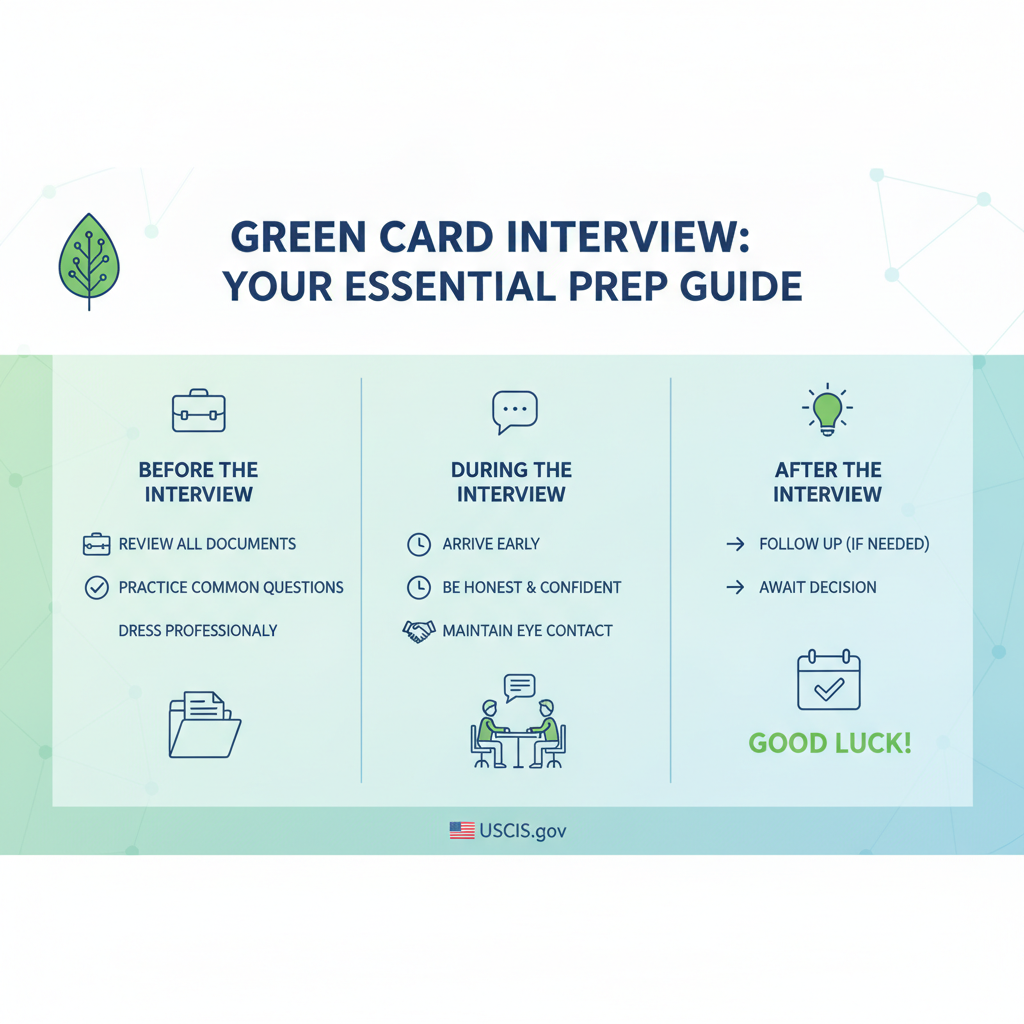
The ever-evolving landscape of immigration law and policy means that staying informed is crucial for anyone on the path to U.S. residency. Recent discussions and updates within Green Card Interview Preparation Tips (Immigration Law) highlight the consistent importance of thorough preparation for interviews. While the core process for Green Card interviews remains largely consistent, news reports frequently emphasize common pitfalls, processing delays, and the critical nature of a well-prepared interview.
This ongoing focus in immigration news underscores that even with minor policy shifts, the fundamental requirements for a successful interview — accuracy, completeness, and clear communication — are timeless. Our guide is designed to equip you with these essential tools, drawing on the most current best practices and legal standards.
What This News Means for Immigrants in Orlando and Across Florida
Understanding the current discussions around Green Card interviews is vital for immigrants residing in Orlando, across Central Florida, and throughout the entire state. While the federal government sets immigration policy, local USCIS field offices and their procedures directly impact your experience.
Why this news is showing up now
The topic of Green Card interview preparation is perennially relevant because it's a mandatory step for most individuals seeking lawful permanent residency, whether through family-based petitions, employment-based petitions, or asylum. The focus tends to intensify when USCIS processes experience backlogs, when there are efforts to streamline or enhance security measures, or when new guidance is issued to immigration officers. As of mid-2026, USCIS continues to process a significant volume of applications, making efficient and well-prepared interviews crucial for both applicants and the agency.
Furthermore, an increased focus on preventing fraud and ensuring the integrity of the immigration system means that officers are often more diligent in their questioning. This necessitates applicants being even more meticulous in their preparation and presentation of their case.
How it can affect Florida residents
For Florida residents, especially those in the Orlando metropolitan area and along the I-4 corridor, the impact of Green Card interview trends can be significant. The Orlando USCIS Field Office (located at 6680 Corporate Centre Blvd, Orlando, FL 32822) serves a large and diverse immigrant population. This means:
- Local Processing Times: While processing times are federal, the volume of cases at the Orlando office can influence how quickly interviews are scheduled and decisions are made. Being fully prepared helps prevent delays caused by requests for additional evidence (RFEs) or rescheduled interviews.
- Officer Familiarity: USCIS officers at the Orlando office are highly experienced in common types of petitions filed by local residents, such as family-based petitions (e.g., spouses of U.S. citizens). This means they are adept at identifying inconsistencies or areas that require further clarification.
- Community Resources: Florida has a robust network of immigrant support services, but navigating the legal complexities requires specialized expertise. Imigrar, based in Orlando, provides this critical support, understanding the specific needs and challenges faced by our local community.
Being well-prepared for your interview can directly influence the speed and outcome of your application, potentially saving you months of anxiety and uncertainty.
What Green Card Interviews Are (and Why They Matter)
A Green Card interview is a formal meeting with a USCIS officer where you, and often your petitioner, answer questions about your application for lawful permanent residency. The primary purpose of this interview is for the officer to verify the information provided in your application forms and supporting documents, confirm your eligibility, and ensure that you meet all legal requirements for a Green Card.
The interview is a critical juncture because it's often the final step before a decision is made on your application. It’s your opportunity to present yourself honestly, clearly, and compellingly, demonstrating that you deserve to become a permanent resident of the United States. A successful interview can lead to approval, while a poorly prepared or inconsistent interview can lead to delays, requests for additional evidence, or even denial.
A plain-English definition
Imagine your Green Card application is like a story you've written to USCIS. The interview is where you get to tell that story in person, answer any questions the officer has, and show them all the evidence that proves your story is true. It's a face-to-face meeting to confirm everything you've submitted and ensure you qualify for permanent residency.
Key terms you need to know
To navigate the Green Card process effectively, it’s helpful to understand some common immigration terms:
- Green Card: The common name for a U.S. Permanent Resident Card, which allows foreign nationals to live and work permanently in the United States.
- USCIS: U.S. Citizenship and Immigration Services, the federal agency that oversees lawful immigration to the United States.
- Adjustment of Status (AOS): The process of applying for a Green Card while physically present in the United States. This is typically what leads to an interview at a USCIS field office like the one in Orlando.
- Consular Processing: The process of applying for an immigrant visa (which leads to a Green Card) through a U.S. embassy or consulate abroad. This involves an interview at a consulate in your home country.
- Petitioner: The U.S. citizen or lawful permanent resident who files an immigrant petition (e.g., Form I-130) on behalf of a relative, or an employer who files for an employee.
- Beneficiary: The immigrant who is seeking a Green Card based on the petition filed by the petitioner.
- Form I-130, Petition for Alien Relative: The initial form filed by a U.S. citizen or LPR to establish a qualifying relationship with a foreign national relative.
- Form I-485, Application to Register Permanent Residence or Adjust Status: The primary form filed by the beneficiary to apply for a Green Card while in the U.S.
- Affidavit of Support (Form I-864): A legally binding document signed by the petitioner (and sometimes a joint sponsor) to accept financial responsibility for the immigrant. This is crucial to ensure the immigrant will not become a "public charge."
- Priority Date: The date USCIS receives your immigrant petition (e.g., Form I-130). This date determines your place in the visa queue for certain categories.
- Request for Evidence (RFE): A letter from USCIS asking for more information or documents to support your application.
Current Immigration Law: The Foundation
The legal framework for Green Card eligibility and the interview process is primarily governed by the Immigration and Nationality Act (INA). This comprehensive statute outlines who is eligible for various immigrant classifications and the procedures for obtaining lawful permanent residency.
Federal requirements
The core federal requirements for a Green Card interview stem from the INA and its implementing regulations. Key aspects include:
- Eligibility for the Immigrant Category: You must demonstrate that you meet the criteria for the immigrant visa category under which you are applying (e.g., immediate relative of a U.S. citizen, family preference category, employment-based category, asylum). This often involves proving a genuine relationship (for family petitions) or specific qualifications (for employment petitions). Relevant sections of the INA include:
- INA § 201-204: Define immigrant classifications and petitioning procedures.
- INA § 245: Governs Adjustment of Status for those already in the U.S.
- Admissibility: Applicants must be "admissible" to the United States, meaning they are not ineligible for a Green Card due to certain grounds, such as criminal history, health issues, prior immigration violations, or being deemed a "public charge." The "public charge" rule, which assesses an applicant's likelihood of relying on government benefits, remains a significant consideration for USCIS officers.
- INA § 212: Outlines grounds of inadmissibility.
- Lawful Entry and Status: For Adjustment of Status, applicants generally must have made a lawful entry into the U.S. and maintained lawful immigration status (though exceptions exist for immediate relatives of U.S. citizens).
- Financial Support: For most family-based Green Cards and some employment-based categories, an Affidavit of Support (Form I-864) is required from the petitioner and/or a joint sponsor to ensure the immigrant will not become a public charge. This demonstrates that the immigrant has adequate financial means or support.
All these requirements are meticulously reviewed during the interview. The USCIS officer will refer to your submitted forms, such as Form I-130, Form I-485, Form I-765 (Application for Employment Authorization), Form I-131 (Application for Travel Document), and especially Form I-864, along with all supporting documentation.
For detailed information on all forms and legal requirements, always refer to the USCIS official website.
Florida-specific considerations
While immigration law is federal, the local USCIS Field Office in Orlando handles interviews for residents of Central Florida. This means:
- Local Procedures: While core requirements are federal, the specific flow, interview style, and common questions can sometimes reflect the local office's practices. However, consistency across offices is a primary goal for USCIS.
- Resource Availability: For Central Florida residents, access to local legal counsel like Imigrar is invaluable. Our firm is familiar with the Orlando Field Office's processes and can provide tailored advice based on local nuances and our experience with officers in this region.
- Community Context: The Orlando area has a diverse population, including many immigrants from Latin America, the Caribbean, and other regions. This diversity can sometimes mean specific cultural or language considerations that our bilingual team (Se Habla Español) is well-equipped to handle.
Understanding these foundational laws and local considerations is your first step toward a successful interview.
How to Prepare for Your Green Card Interview: A Complete Step-by-Step Guide
Preparation is the single most important factor in a successful Green Card interview. Follow this detailed guide to ensure you are ready for every aspect of the process.
1) Understand Your Interview Notice (Form I-797C)
The first step is to carefully review your official interview notice, typically Form I-797C, Notice of Action. This document will specify:
- Date and Time: Mark your calendar and set reminders.
- Location: For Orlando residents, this will usually be the Orlando USCIS Field Office. Confirm the full address.
- Required Documents: The notice will list specific documents you MUST bring. This is not exhaustive; you should always bring *all* original documents related to your application.
- Participants: It will specify who must attend (e.g., both petitioner and beneficiary for marriage-based cases).
Important: Read every word of your interview notice. It contains crucial instructions and requirements specific to your case.
2) Gather All Required Documents
This is perhaps the most critical preparation step. You must bring originals of ALL documents you submitted with your application, plus copies, and any new evidence that has emerged since you filed. Organize them meticulously.
General Required Documents Checklist (Bring Originals and Copies):
- Interview Notice (Form I-797C)
- Government-Issued Photo Identification: Passport, driver's license, state ID.
- Birth Certificates: For you, your petitioner, and any children.
- Marriage Certificate (if applicable): For marriage-based Green Cards.
- Divorce Decrees or Death Certificates (if applicable): For all prior marriages of both you and your petitioner.
- Medical Examination Report (Form I-693): If not already submitted or expired. Must be in a sealed envelope.
- Affidavit of Support (Form I-864): And all supporting financial documents (tax returns, W-2s, pay stubs, employment verification letters) for the petitioner and any joint sponsors.
- Proof of U.S. Citizenship or Lawful Permanent Resident Status: For your petitioner (e.g., U.S. passport, birth certificate, naturalization certificate, Green Card).
- Passport and Travel History: Your current passport, all previous passports, and any travel documents (Form I-94, entry stamps, visas).
- Criminal Records (if applicable): Certified copies of any arrest records, court dispositions, or police reports, even if charges were dismissed or expunged.
- Proof of Relationship (for family-based petitions):
- Marriage-based: Joint bank accounts, utility bills, leases/mortgages, insurance policies, photos together, affidavits from friends/family, children's birth certificates, joint credit cards, travel itineraries together.
- Parent/Child: Birth certificates, school records, medical records.
- Employment-based: Original job offer letters, educational degrees, professional licenses, employer verification letters.
- Photographs: Two recent passport-style photographs (2x2 inches) meeting USCIS specifications.
- Any other documents requested in your interview notice.
Warning: Always bring the ORIGINAL documents, not just copies. The officer will want to see the originals and may keep copies. Ensure all foreign language documents are accompanied by certified English translations.
3) Organize Your Evidence
A well-organized application makes a strong impression. Use folders, binders, or dividers to categorize your documents. A common method is to organize by form number (e.g., all Form I-130 documents, then Form I-485 documents), then by type (e.g., identity, financial, relationship). Create a master checklist to ensure nothing is missed.
- Chronological Order: Arrange documents within categories chronologically, especially for relationship evidence like photos or bills.
- Labels: Use sticky notes or tabs to label sections for quick reference.
- Copies Separately: Keep original documents separate from copies.
4) Review Your Application (Form I-485, Form I-130, etc.) Thoroughly
You must be intimately familiar with every detail of your submitted application forms (especially Form I-485 and Form I-130) and supporting documents. The USCIS officer will ask questions directly from these forms.
- Read Everything: Go through every question and answer on your application forms.
- Check for Inconsistencies: Ensure your answers are consistent with your past immigration history, travel records, and any previous applications. Inconsistencies can raise red flags.
- Remember Dates and Addresses: Be able to recall exact dates of entry, previous addresses, employment history, and key life events.
- Review Relationship History: For marriage-based cases, review how you met, key dates (first date, engagement, marriage), and significant shared experiences.
Don't risk a misunderstanding or inconsistency in your Green Card interview. Let Imigrar's Orlando legal team help you review your application and prepare for difficult questions. Contact us at +1 786-791-3106 for a free consultation. Se Habla Español.
5) Practice for the Interview
Anticipate the types of questions you might be asked. Practice answering them aloud, either by yourself, with your petitioner, or with your attorney. This builds confidence and helps you articulate your answers clearly.
- General Questions: About your application, personal history, employment, education.
- Relationship Questions (for marriage-based): How you met, daily routines, shared activities, family interactions, future plans. These can be very detailed.
- Inadmissibility Questions: About any past criminal history, immigration violations, health issues, or public charge concerns.
- "Yes/No" Questions: The officer will often go through the "Yes/No" questions on Form I-485 again. Be prepared to answer truthfully and explain any "Yes" answers with supporting documentation.
Reminder: Answer truthfully and concisely. Do not volunteer unnecessary information. If you don't understand a question, politely ask the officer to repeat or rephrase it.
6) Dress Appropriately and Arrive on Time
First impressions matter. Treat this like a professional meeting.
- Attire: Dress in clean, neat, and conservative business or business-casual clothing.
- Punctuality: Arrive at the Orlando USCIS Field Office at least 30-45 minutes before your scheduled interview time. This allows time for parking, security screening, and finding the correct waiting area. Being late can lead to your interview being rescheduled or even your case being denied.
7) What to Expect During the Interview
Knowing the general flow can ease anxiety:
- Check-in: You'll check in at the front desk, show your notice and ID.
- Waiting Area: You'll wait until your name is called.
- Oath: The officer will call you (and your petitioner, if applicable) into a private office and administer an oath to tell the truth.
- Review of Application: The officer will typically start by reviewing your application forms, asking questions to confirm details.
- Document Review: They will examine your original documents and compare them to copies you submitted. Have them organized and ready.
- Specific Questions: Expect detailed questions related to your eligibility, relationship (for marriage cases), financial support, and background.
- Decision or Further Action: The officer may tell you if your case is approved, if a decision will be mailed, or if additional documents are needed (RFE). Sometimes, they may need to review further before making a decision.
Important: Remain calm, respectful, and honest throughout the entire process.
Practical Steps You Can Take Today
Don't wait until the last minute. Start your preparation now, even if your interview notice hasn't arrived yet.
Actionable Checklist:
- Review Your Entire Application Package: Obtain a copy of everything you submitted to USCIS (Form I-130, Form I-485, G-325A, medical exam, supporting documents). Read through it all carefully.
- Start Gathering Documents: Begin collecting original birth certificates, marriage certificates, passports, financial documents (tax returns, W-2s), and evidence of your relationship. Don't forget any previous divorce decrees or death certificates.
- Organize Your Evidence: Create a system for organizing originals, copies, and translations. A binder with labeled tabs is highly recommended.
- Identify Potential Weaknesses: Are there any gaps in your relationship evidence? Any past issues that might raise questions (e.g., minor traffic violations, previous overstays)? Prepare honest explanations and supporting documents.
- Practice Common Questions: Role-play the interview with a family member or friend. Focus on clarity, conciseness, and honesty.
- Consult with an Immigration Attorney: This is arguably the most crucial step. An attorney can identify issues you might miss, help you gather and organize documents, prepare you for specific questions, and even accompany you to the interview.
Document Preparation Guidance
- Originals vs. Copies: Always bring the original of every document, plus a clear photocopy of each. The officer will examine the originals and typically keep the copies.
- Translations: Any document not in English must be accompanied by a complete and certified English translation. The translator must certify that they are competent to translate and that the translation is accurate.
- Photographs: Ensure all photographs submitted and brought to the interview meet USCIS specifications (2x2 inches, white background, no glasses, recent).
- Digital Evidence: If you have digital evidence (e.g., text messages, social media conversations, videos), print out relevant sections clearly and concisely. Do not bring electronic devices expecting the officer to view them.
Timeline Expectations
- After Filing: After filing Form I-485 (and often Form I-130 concurrently), you'll typically receive a receipt notice, then a biometric appointment notice (for fingerprints and photos).
- Interview Scheduling: The time between filing and receiving an interview notice varies significantly based on the USCIS field office and case type. For the Orlando USCIS Field Office, this could range from several months to over a year. You can check estimated processing times on the USCIS Processing Times page.
- Interview Day: The interview itself usually lasts between 20 minutes to an hour, sometimes longer for complex cases.
- Decision: Some officers may approve your case on the spot. More often, a decision notice will be mailed to you within a few weeks or months. If an RFE is issued, it will detail what additional evidence is needed and the deadline for submission (often 30 to 90 days).
Important: Be patient but proactive. If you don't hear anything for an extended period, you or your attorney can inquire about your case status online or through USCIS customer service.
How Imigrar Helps Immigrants in Orlando
Navigating the Green Card interview process can be complex and intimidating, especially when your future in the U.S. is on the line. At Imigrar, our mission is to "Keep Families Together" by providing dedicated, expert legal assistance to immigrants in Orlando and nationwide.
Our experience and expertise
Our team of experienced immigration attorneys has a deep understanding of U.S. immigration law and the specific procedures of the Orlando USCIS Field Office. We have successfully guided countless clients through their Green Card interviews, ensuring they are fully prepared and confident. Our expertise includes:
- Thorough Application Review: We meticulously review your entire application package (Form I-130, Form I-485, Form I-864, etc.) to identify and correct any potential issues before the interview.
- Comprehensive Document Organization: We help you gather, organize, and present all necessary documents and evidence in a clear and compelling manner, including certified translations.
- Personalized Interview Preparation: We conduct mock interviews, preparing you for the types of questions USCIS officers typically ask, specifically tailored to your case and the local office's practices. We help you articulate your answers clearly and confidently.
- Addressing Complex Issues: If you have a complicated case involving inadmissibility issues, previous immigration violations, or other challenges, we develop strategies to address these concerns effectively.
- Attorney Representation: In many cases, an Imigrar attorney can accompany you to your interview, providing legal support, clarifying questions, and advocating on your behalf directly to the USCIS officer. This can significantly reduce stress and improve outcomes.
Free consultation offer
We believe that everyone deserves access to quality legal advice. That's why Imigrar offers a free initial consultation to discuss your Green Card case. During this consultation, we will:
- Review your specific situation and application status.
- Explain the interview process and what to expect.
- Answer your preliminary questions.
- Outline how our services can benefit you.
Don't leave your Green Card approval to chance. Let our dedicated team provide the peace of mind and expert guidance you need.
Se Habla Español. Nuestro equipo bilingüe está listo para atenderle en su idioma y asegurar que su proceso sea lo más claro y exitoso posible.
Ready to secure your future in the U.S.? Imigrar is your trusted partner for Green Card interview success in Orlando and across Florida. Schedule your free consultation today! Call +1 786-791-3106 or contact us online. Se Habla Español.
Frequently Asked Questions
Q: Am I eligible for a Green Card interview, and how do I know if I'll have one?
A: Most applicants for a Green Card through Adjustment of Status (applying while in the U.S.) will have an interview. Applicants through Consular Processing (applying from abroad) will also have an interview at a U.S. embassy or consulate. Certain categories, such as some employment-based cases where the applicant is a child


