


The journey to obtaining a Green Card, also known as lawful permanent residency, is a pivotal moment for many immigrants seeking to build a life in the United States. While the application process itself involves extensive paperwork and strict requirements, one of the most critical steps for many applicants is the Green Card interview. This interview, conducted by a U.S. Citizenship and Immigration Services (USCIS) officer or a Consular Officer abroad, is your opportunity to demonstrate your eligibility and provide clarity on your application.
At Imigrar, an immigration law firm based in Orlando, Florida, we understand the anxieties and questions that surround this crucial stage. Our mission is to "Keep Families Together" by providing expert legal guidance and support throughout every step of the immigration process. This comprehensive guide is designed to arm you with the knowledge and confidence needed to navigate your Green Card interview successfully.
Feeling Anxious About Your Green Card Interview? Don't face it alone. Our experienced Orlando immigration team at Imigrar is here to help you prepare thoroughly. Call +1 786-791-3106 for a free consultation, or message us online. Se Habla Español.
The reporting that sparked this guide
Recent discussions and trends in Green Card Interview Preparation Tips (Immigration Law) highlight the ongoing importance of thorough preparation for all applicants. The emphasis remains on applicants demonstrating their eligibility clearly, honestly, and with robust documentation, underscoring the need for comprehensive guidance.
What This News Means for Immigrants in Orlando and Across Florida
The consistent focus on the Green Card interview process in immigration news underscores its enduring significance in the journey to permanent residency. For immigrants across Florida, particularly those in vibrant, diverse communities like Orlando, understanding and preparing for this interview is not just a recommendation—it's a necessity.
Why this news is showing up now
While Green Card interviews have always been a standard part of the immigration process, the continued discussion around preparation tips reflects several factors as of 2026-04-10:
- Increased Scrutiny: Immigration policies can shift, and even without major legislative changes, the level of scrutiny applied during interviews can intensify. Officers are continually trained to identify potential issues, making thorough preparation more critical than ever.
- Processing Backlogs and Efficiency Drives: As USCIS works through backlogs, there's often an emphasis on making interview processes as efficient and conclusive as possible. This means applicants are expected to be fully prepared to avoid delays or requests for further evidence (RFEs).
- Evolving Digital Landscape: While interviews are in-person, the digital submission of documents and increased reliance on online portals for case status updates means applicants need to be equally organized with both physical and digital records.
- Public Charge Rule Updates: Although the Public Charge Rule has seen changes, its underlying principles regarding self-sufficiency remain relevant, prompting officers to scrutinize financial documentation and affidavits of support carefully.
- Fraud Prevention: USCIS continues its efforts to prevent fraud, particularly in marriage-based petitions. Interviewers are trained to delve deeply into the authenticity of relationships, making genuine and consistent evidence paramount.
How it can affect Florida residents
For individuals residing in Florida, the general importance of Green Card interview preparation is magnified by several local factors:
- Orlando USCIS Field Office: If you are applying for Adjustment of Status (changing your status from a nonimmigrant to a permanent resident while in the U.S.), your interview will likely take place at the Orlando USCIS Field Office, or another field office within Florida. This means navigating local procedures, understanding wait times specific to this office, and being familiar with the interview environment.
- High Volume of Applicants: Florida, especially Central Florida, is a popular destination for immigrants from around the world. This high volume can sometimes lead to longer processing times or a more streamlined, yet still rigorous, interview process.
- Diverse Community Needs: Orlando is a melting pot of cultures and languages. While USCIS provides interpreters, relying solely on them without personal preparation can be risky. Imigrar is proud to offer services in both English and Spanish (Se Habla Español), bridging language gaps for our community.
- Access to Legal Expertise: Being in a hub like Orlando means access to specialized legal services. Imigrar's physical presence allows us to provide personalized, localized support, guiding clients through the nuances of the local USCIS office and ensuring they are fully prepared for their specific interview.
The takeaway for Florida residents is clear: proactive, thorough preparation is your best defense against potential complications and delays. Understanding the process, organizing your documents, and practicing your responses are crucial steps towards a successful interview and securing your future in the Sunshine State.
What Green Card Interview Preparation Is (and Why It Matters)
The Green Card interview is a formal meeting with an immigration officer designed to verify the information provided in your Green Card application and to determine your eligibility for lawful permanent residency. It is a critical step for most individuals applying for a Green Card, particularly those seeking Adjustment of Status within the United States or those undergoing Consular Processing abroad.
A plain-English definition
Simply put, the Green Card interview is your chance to sit down with a U.S. government official and explain why you qualify to live permanently in the United States. Think of it as a verification meeting where you present your case, answer questions about your application, and provide original documents to back up your claims. The officer's job is to ensure you meet all legal requirements and that there are no reasons (such as past immigration violations or criminal history) that would make you ineligible.
For family-based petitions, especially marriage-based ones, the interview also serves to confirm the authenticity of the relationship. The officer wants to ensure your marriage is legitimate and not entered into solely for immigration benefits.
Key terms you need to know
Navigating the immigration process means encountering specific terminology. Understanding these terms will empower you as you prepare for your interview:
- Green Card: The common name for a Permanent Resident Card, which proves that you are authorized to live and work permanently in the United States.
- Adjustment of Status (AoS): The process of applying for a Green Card while physically present in the United States. If approved, you "adjust" your immigration status from a nonimmigrant to a lawful permanent resident. This typically involves an interview at a USCIS Field Office, like the one in Orlando.
- Consular Processing: The process of applying for an immigrant visa (which leads to a Green Card) through a U.S. embassy or consulate in your home country. If approved, you enter the U.S. as a permanent resident. The interview occurs abroad.
- USCIS (U.S. Citizenship and Immigration Services): The government agency responsible for administering immigration and naturalization benefits, including Green Cards, within the United States.
- Petitioner: The U.S. citizen or lawful permanent resident who files an immigrant petition (e.g., Form I-130) on behalf of an eligible relative.
- Beneficiary: The foreign national who is seeking an immigration benefit (e.g., a Green Card) based on a petition filed by a petitioner.
- Affidavit of Support (Form I-864): A legally binding document signed by the petitioner (and sometimes a joint sponsor) promising to financially support the immigrant beneficiary if needed, ensuring they do not become a "public charge."
- Public Charge Rule: A long-standing provision in immigration law that allows the U.S. government to deny admission or a Green Card to individuals deemed likely to become primarily dependent on government assistance. While the rule has been refined, financial self-sufficiency remains a key consideration.
- Priority Date: The date USCIS receives your immigrant petition (e.g., Form I-130). This date is crucial for visa categories that have annual limits, as it determines your place in the queue for an available Green Card visa number.
- Request for Evidence (RFE): A letter from USCIS asking for additional documents or information to support your application. Receiving an RFE can delay your case.
- Notice of Intent to Deny (NOID): A letter from USCIS indicating that they intend to deny your application unless you provide specific information or evidence to overcome their concerns. This is a serious notification.
Understanding these terms is the first step in demystifying the Green Card interview process and preparing effectively for your meeting with USCIS.
Current Immigration Law: The Foundation
The Green Card interview is conducted under the authority of various sections of the Immigration and Nationality Act (INA), which is the primary body of U.S. immigration law. The officer's role is to ensure that the applicant meets all statutory and regulatory requirements for the specific Green Card category they are applying under and that no grounds of inadmissibility apply.
Federal requirements
The legal framework for Green Cards is complex, but several key federal requirements are universally applied:
- Eligibility for the Specific Green Card Category: This is fundamental. Whether you are applying based on family ties (e.g., spouse of a U.S. citizen, parent of a U.S. citizen), employment, asylum, or another category, you must meet all the specific criteria for that category. For example, marriage-based Green Cards require proof of a bona fide, legal marriage (INA Section 201, 204).
- Admissibility: Applicants must be admissible to the United States. The INA outlines various grounds of inadmissibility (INA Section 212), which can include certain criminal convictions, past immigration violations, health-related issues, security concerns, and being deemed a "public charge." If a ground of inadmissibility applies, a waiver may be required.
- Identity and Background Checks: All applicants undergo extensive background checks and security clearances. The interview is a final opportunity to confirm identity and review any discrepancies that may have arisen during these checks.
- Proper Documentation: The law requires applicants to submit specific forms and supporting documents. The interview verifies the authenticity and accuracy of these documents.
Key forms referenced in the Green Card process include:
- Form I-130, Petition for Alien Relative: Filed by a U.S. citizen or lawful permanent resident to establish the relationship with a foreign relative.
- Form I-485, Application to Register Permanent Residence or Adjust Status: Filed by individuals already in the U.S. to adjust their status to lawful permanent resident.
- Form I-864, Affidavit of Support: A legally binding contract where the petitioner (and sometimes a joint sponsor) pledges financial support to the immigrant.
- Form I-693, Report of Medical Examination and Vaccination Record: Completed by a USCIS-approved civil surgeon to ensure the applicant meets health-related standards.
- Form I-765, Application for Employment Authorization: Often filed concurrently with Form I-485 to allow the applicant to work while their Green Card application is pending.
- Form I-131, Application for Travel Document: Often filed concurrently with Form I-485 for "Advance Parole," allowing the applicant to travel outside the U.S. while their Green Card application is pending without abandoning their AoS application.
For the most up-to-date forms and instructions, always refer to the USCIS Forms page on the USCIS official website.
Florida-specific considerations
While immigration law is federal, the practical application often involves local USCIS field offices. For residents of Orlando and Central Florida, your interview for Adjustment of Status will typically be conducted at the Orlando USCIS Field Office. While the legal requirements remain the same nationwide, the specific procedures, wait times, and even the demeanor of officers can vary slightly from office to office.
- Orlando Field Office Focus: The Orlando office processes a significant number of family-based petitions, particularly marriage-based Green Cards. Officers here are experienced in assessing the authenticity of relationships.
- Local Resources: Florida has a robust network of community organizations and legal aid groups that can offer support, particularly for those with limited resources. Imigrar is proud to be a key part of this network, offering expert legal services tailored to the needs of the Orlando community.
- Travel to Interview: For those living in Orange County or along the I-4 corridor, accessibility to the Orlando Field Office is generally straightforward. However, planning your commute to arrive early is always advised.
Understanding these foundational legal principles and local considerations is paramount to approaching your Green Card interview with confidence and preparedness. It’s not just about answering questions; it’s about demonstrating your eligibility within the bounds of federal law.
Overwhelmed by Immigration Law? Imigrar simplifies the complex. Our Orlando-based lawyers provide clear, actionable advice for your Green Card journey. Get your free consultation today: call +1 786-791-3106 or contact us online. Se Habla Español.
How to Prepare for Your Green Card Interview: A Complete Step-by-Step Guide
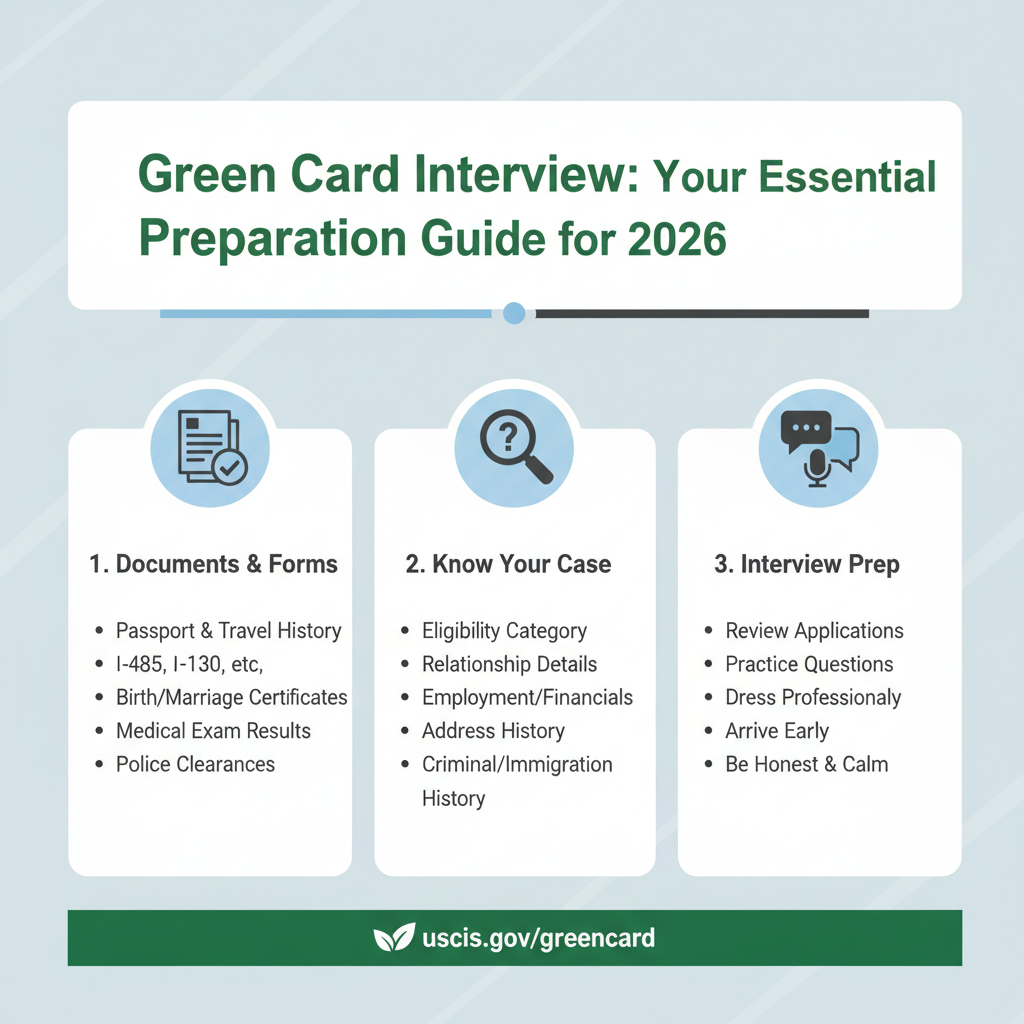
The key to a successful Green Card interview lies in meticulous preparation. This step-by-step guide will walk you through the essential actions you need to take to ensure you are ready.
1) Understand Your Interview Notice (Form I-797C)
Your journey to the interview begins with receiving Form I-797C, Notice of Action, from USCIS. This document will specify the date, time, and location of your interview. It will also list any specific documents you must bring with you, beyond what you already submitted.
- Review Immediately: Check the date, time, and address. Make sure you know exactly where and when to be present. For Orlando residents, this will likely be the Orlando USCIS Field Office.
- Required Documents List: Pay close attention to the "Bring with you" section. This list is crucial and often includes original versions of documents you previously submitted as copies.
- Rescheduling: If you absolutely cannot make your appointment, you must request a reschedule as soon as possible. Doing so without a valid reason can delay your case significantly. Contacting an attorney at Imigrar immediately is advisable if rescheduling is necessary.
2) Gather All Original Documents and Copies
This is arguably the most critical step. You must bring all original documents related to your application, along with a complete set of photocopies. The officer will review the originals and may keep the copies.
- Identification:
- Valid passport (and any expired passports)
- Birth certificate (original and certified translation if not in English)
- Driver's license or state ID (especially for Florida residents)
- Immigration Documents:
- Current Form I-94 Arrival/Departure Record
- All previous immigration documents (e.g., I-20s, I-797 approval notices for previous visas)
- Your Interview Notice (Form I-797C)
- Employment Authorization Document (EAD or "work permit"), if you have one (Form I-765)
- Advance Parole document, if you have one (Form I-131)
- Application Forms:
- A complete copy of your entire Green Card application package (Form I-485, Form I-130, Form I-864, etc.) as filed.
- Medical Examination:
- Sealed Form I-693, Report of Medical Examination and Vaccination Record, if you haven't already submitted it or if USCIS requested a new one.
- Financial Documents (for Petitioner and any Joint Sponsor):
- Most recent federal income tax returns (e.g., Form 1040) with all schedules and W-2s/1099s for the past three years.
- Employment verification letter, recent pay stubs.
- Proof of assets (bank statements, property deeds, etc.), if relying on assets to meet income requirements.
- Marriage-Based Specific Documents (for both spouses):
- Original marriage certificate.
- Proof of termination of ALL prior marriages for both spouses (divorce decrees, death certificates).
- Extensive evidence of a bona fide marriage (THIS IS CRITICAL):
- Joint bank accounts (statements).
- Joint credit cards (statements).
- Joint leases or mortgage statements.
- Joint utility bills (electricity, water, internet).
- Birth certificates of children born to the marriage.
- Life insurance policies, wills, or trusts naming each other as beneficiaries.
- Joint health, auto, or home insurance policies.
- Photos together from different times (dating, engagement, wedding, family events, vacations).
- Affidavits from friends/family attesting to the bona Fides of the marriage.
- Correspondence (emails, texts, social media posts) showing ongoing relationship.
- Travel itineraries or tickets from trips taken together.
- Other Documents:
- Police clearance certificates, if applicable.
- Court disposition documents for any arrests or convictions (even if expunged).
- Military records, if applicable.
Important: Organize your documents in a clear, tabbed binder. This shows preparedness and makes it easy for the officer to review.
3) Review Your Application Forms (Form I-485, Form I-130, etc.)
Before the interview, thoroughly read through every application form you submitted. The officer will have your entire file and will ask questions based on the information provided.
- Familiarize Yourself: Know every answer you provided.
- Identify Discrepancies: If you find any errors or if your situation has changed (e.g., new address, new job), be prepared to explain these clearly and honestly. Bring documentation to support any changes.
- Practice Recalling Dates and Details: Be ready to state dates of entry, previous addresses, employment history, and other biographical information without hesitation.
4) Prepare for Potential Questions
While the exact questions vary, common themes emerge. Practice answering these questions truthfully and concisely. This is not a test of memory, but of consistency and honesty.
- General Questions:
- "What is your full name and date of birth?"
- "When and where did you enter the U.S.?"
- "What is your current address?"
- "Have you ever been arrested or convicted of a crime?" (Review the "Part 8: General Questions" section of Form I-485 thoroughly).
- "Do you have any children?"
- Family-Based (especially marriage-based) Questions:
- "How did you and your spouse meet?"
- "When and where was your first date?"
- "What are your spouse's parents' names?"
- "Who wakes up first in the morning?"
- "What did you do last weekend?"
- "Where do you keep your toothbrush?"
- "What gifts have you exchanged?"
- "Do you have joint accounts or assets?"
- "What are your future plans together?"
- Employment-Based Questions:
- "What is your job title and duties?"
- "What is your salary?"
- "How long have you worked for this company?"
Reminder: Answer only the question asked. Do not volunteer extra information unless it directly clarifies your answer. Be honest; lying or misrepresenting facts can lead to denial and severe immigration consequences.
5) Arrange for an Interpreter (If Needed)
If you or your petitioner (for family-based cases) are not fluent in English, you have the right to bring a neutral, fluent interpreter. The interpreter cannot be your attorney, a witness, or the petitioner/beneficiary. USCIS may provide an interpreter, but bringing your own ensures comfort and clarity.
- Inform USCIS: If you plan to bring an interpreter, you should indicate this in advance if possible, or at least be prepared to explain at the interview.
- Professional Interpreter: Ensure your interpreter is experienced and professional.
- Imigrar Support: At Imigrar, our team includes Spanish-speaking attorneys (Se Habla Español) who can assist clients throughout the process, including accompanying them to interviews.
6) Dress Appropriately and Arrive Early
Your appearance and punctuality reflect your respect for the process and the interviewing officer.
- Professional Attire: Dress as you would for a job interview or an important business meeting. Conservative, clean, and neat clothing is best.
- Arrive Early: Plan to arrive at the Orlando USCIS Field Office at least 30-45 minutes before your scheduled interview time. This allows for security checks, finding parking, and settling in. Being late can lead to automatic rescheduling or even denial.
- What NOT to Bring: Avoid bringing large bags, unnecessary electronics, or weapons. Check the specific rules of the USCIS office regarding prohibited items.
7) Know What Happens After the Interview
The interview is not always the final step. Understanding the potential outcomes can help manage expectations.
- Immediate Decision: Sometimes, the officer may approve your application on the spot, or tell you a decision will be mailed soon.
- Request for Evidence (RFE): If the officer needs more information or documents, they will issue an RFE, usually giving you a specific deadline (e.g., 87 days).
- Notice of Intent to Deny (NOID): If the officer believes you are ineligible, they may issue a NOID, giving you a chance to rebut their findings.
- Denial: In some cases, the application may be denied. This can be challenged through appeals or new applications, but it's a serious setback.
- Conditional Green Card: For marriage-based Green Cards where the marriage is less than two years old at the time of approval, you will receive a 2-year conditional Green Card. You'll need to file Form I-751, Petition to Remove Conditions on Residence, within the 90-day window before your conditional Green Card expires.
Important: Your attorney from Imigrar can accompany you to the interview, providing legal support and guidance, and helping you understand what to expect afterward.

Practical Steps You Can Take Today
Don't wait until the last minute to prepare. Start taking these practical steps today to ensure a smooth Green Card interview process.
- Organize Your Documents: Create a physical and digital checklist of all required documents. Start gathering originals and making copies. Use folders and labels to keep everything tidy.
- Review Your Application: Print out your entire application package and read through it carefully. Highlight any areas where you might need to refresh your memory or clarify information.
- Practice Answering Questions: Have a trusted friend, family member, or your attorney conduct a mock interview. Focus on clear, concise, and truthful answers. For marriage-based cases, practice separately with your spouse to ensure consistency.
- Update Your Medical Exam (if needed): If your Form I-693 is older than two years or about to expire, consult with your attorney about getting a new medical exam from a USCIS-approved civil surgeon.
- Check USCIS Processing Times: While not directly related to interview preparation, keeping an eye on USCIS Processing Times for the Orlando Field Office can help you manage your expectations regarding when you might receive an interview notice or a final decision.
- Consult with an Immigration Attorney: This is perhaps the most crucial step. An experienced attorney can review your application, identify potential issues, help you gather documents, conduct a mock interview, and even accompany you to the actual interview.
Document preparation guidance
- Originals vs. Copies: Always bring originals. The officer will want to see them. Have a complete set of photocopies ready for the officer to keep.
- Order and Tabs: Organize your documents in the same order as they appear on your application or the interview notice. Use tabs to clearly label sections (e.g., "Passports," "Birth Certificates," "Marriage Evidence").
- Supplemental Evidence: For marriage-based cases, bring more evidence than you think you need. USCIS officers are looking for a genuine, ongoing marital relationship.
- Translations: Any document not in English must be accompanied by a certified English translation and a certificate from the translator stating their competency.
Timeline expectations
The timeline for receiving an interview notice and a final decision can vary significantly based on the USCIS field office (e.g., Orlando), the type of Green Card, and current processing backlogs.
- Interview Scheduling: After filing Form I-485, it can take anywhere from several months to over a year to receive an interview notice.
- Interview to Decision: A decision can be made on the spot, or it may take several weeks to a few


