


What This News Means for Immigrants in Orlando and Across Florida
The journey to obtaining a Green Card in the United States is a significant milestone for countless individuals and families. For many, this path culminates in a pivotal moment: the Green Card interview. Recent discussions and an ongoing focus within immigration law circles highlight the critical importance of thorough preparation for this interview. At Imigrar, we understand that this stage can be daunting, but with the right guidance, it can be a smooth and successful step towards your future in America.Why this news is showing up now
The topic of Green Card interview preparation is perennially relevant in immigration law, but its prominence often fluctuates with changes in immigration policy, processing efficiencies, and public awareness. As of 2026, USCIS continues to streamline its processes, and while this can lead to faster interview scheduling for some, it also means that applicants must be ready on shorter notice. Furthermore, with evolving security protocols and a renewed emphasis on the integrity of the immigration system, interview officers are often more meticulous in their questioning. This increased scrutiny means that applicants must be more prepared than ever to demonstrate their eligibility clearly and consistently. The continuous flow of new immigrants and the constant evolution of their cases mean that "Green Card Interview Preparation Tips" remains a trending and vital search for those navigating the system.How it can affect Florida residents
For immigrants residing in Florida, particularly those in the bustling Orlando area and across Central Florida, the Green Card interview is typically conducted at the **Orlando USCIS Field Office**. This local context adds a layer of specific considerations. The Orlando office handles a high volume of cases, reflecting the diverse and growing immigrant population in Orange County and along the I-4 corridor. This means wait times can vary, but the interview standards remain consistent with federal guidelines. Being prepared for your interview not only helps ensure a positive outcome but can also prevent unnecessary delays or requests for additional evidence, which can prolong your stay in the often-busy Florida processing queue. Knowing what to expect and having all your documents in order can significantly ease the process, whether you’re adjusting status from within the U.S. or coming from abroad through consular processing.Need Expert Guidance for Your Green Card Interview? Don't face the interview alone. Our Orlando immigration team at Imigrar is ready to assist you with comprehensive preparation. Call +1 786-791-3106 for a free consultation, or message us online. Se Habla Español.
What Green Card Interviews Are (and Why They Matter)
A Green Card interview is a mandatory step for most individuals seeking lawful permanent resident status in the United States. It is a formal meeting with an immigration officer (either from **USCIS** for **Adjustment of Status** cases or a Consular Officer for **Consular Processing** cases abroad) to verify the information provided in your application and to determine your eligibility for a Green Card. This interview is not just a formality; it is often the final opportunity for the government to assess your case directly and ensure that you meet all legal requirements.A plain-English definition
Think of the Green Card interview as a conversation where an immigration official asks you questions about your application, your background, and your relationship (if applicable) to make sure everything is truthful and that you qualify for a Green Card. It’s their chance to put a face to the paperwork and confirm that you meet all the legal criteria to live permanently in the U.S.Key terms you need to know
Understanding the terminology can demystify the process:- Green Card (Form I-551): The official document showing you are a lawful permanent resident of the U.S., granting you permission to live and work permanently in the country.
- Adjustment of Status (AOS): The process of applying for a Green Card from *within* the United States without having to return to your home country. This typically involves filing Form I-485.
- Consular Processing: The process of applying for a Green Card from *outside* the United States at a U.S. embassy or consulate in your home country.
- USCIS (U.S. Citizenship and Immigration Services): The government agency responsible for adjudicating immigration benefits, including Green Cards.
- Petitioner: The U.S. citizen or lawful permanent resident who files an immigration petition (e.g., Form I-130) on behalf of an eligible foreign national.
- Beneficiary: The foreign national seeking an immigration benefit, such as a Green Card.
- Affidavit of Support (Form I-864): A legally binding document signed by a petitioner (sponsor) to accept financial responsibility for the immigrant. This ensures the immigrant will not become a public charge.
- Priority Date: The date USCIS or the Department of State receives your visa petition. This date determines when an immigrant visa becomes available, especially for preference categories.
- Request for Evidence (RFE): A letter from USCIS asking for more documents or information to support your application.
- Notice of Intent to Deny (NOID): A letter from USCIS indicating their intention to deny your application unless you provide specific information or explanations.
Current Immigration Law: The Foundation for Your Green Card Interview
The Green Card interview is rooted in specific federal immigration laws, primarily the Immigration and Nationality Act (INA). These laws dictate who is eligible for a Green Card, the procedures for application, and the criteria an immigration officer must use to make a decision.Federal requirements
The primary purpose of the interview is to ensure that the applicant meets the eligibility requirements outlined in the INA. For family-based Green Cards, for example, the interview verifies the authenticity of the relationship between the petitioner and the beneficiary (INA §204(a)(1)(A)-(C)). For employment-based Green Cards, it confirms the details of the job offer and the applicant's qualifications (INA §203(b)). Key legal aspects an officer will assess include:- Admissibility: Whether the applicant is admissible to the U.S. under INA §212. This involves checking for criminal records, certain health conditions, prior immigration violations, or being deemed a "public charge."
- Eligibility: Confirming the applicant meets the specific criteria for the Green Card category they applied under (e.g., marriage to a U.S. citizen, sponsored by an employer, asylum status).
- Truthfulness: Verifying that all information provided in the application forms (such as Form I-130, Petition for Alien Relative, and Form I-485, Application to Register Permanent Residence or Adjust Status) is accurate and consistent.
Florida-specific considerations
While federal law governs the fundamental requirements, the interview experience can have local nuances. If your case is in Orlando, your interview will be conducted at the **Orlando USCIS Field Office**. The officers there are highly trained in federal immigration law. There are no "Florida-specific laws" that change Green Card eligibility or interview requirements; however, local offices can have different scheduling backlogs and administrative procedures. For Central Florida residents, understanding the specific procedures of the Orlando office can be beneficial, though the core legal principles remain the same nationwide. USCIS Forms you should be familiar with:- Form I-130, Petition for Alien Relative
- Form I-485, Application to Register Permanent Residence or Adjust Status
- Form I-864, Affidavit of Support Under Section 213A of the INA
- Form I-693, Report of Medical Examination and Vaccination Record
- Form I-765, Application for Employment Authorization (often filed concurrently with Form I-485)
- Form I-131, Application for Travel Document (often filed concurrently with Form I-485)
Navigating Complex Immigration Laws? Imigrar has the expertise to guide you. Our Orlando-based firm serves clients nationwide, ensuring your application meets all federal and local requirements. Contact us for a free consultation at +1 786-791-3106. Se Habla Español.
How to Prepare for Your Green Card Interview: A Complete Step-by-Step Guide
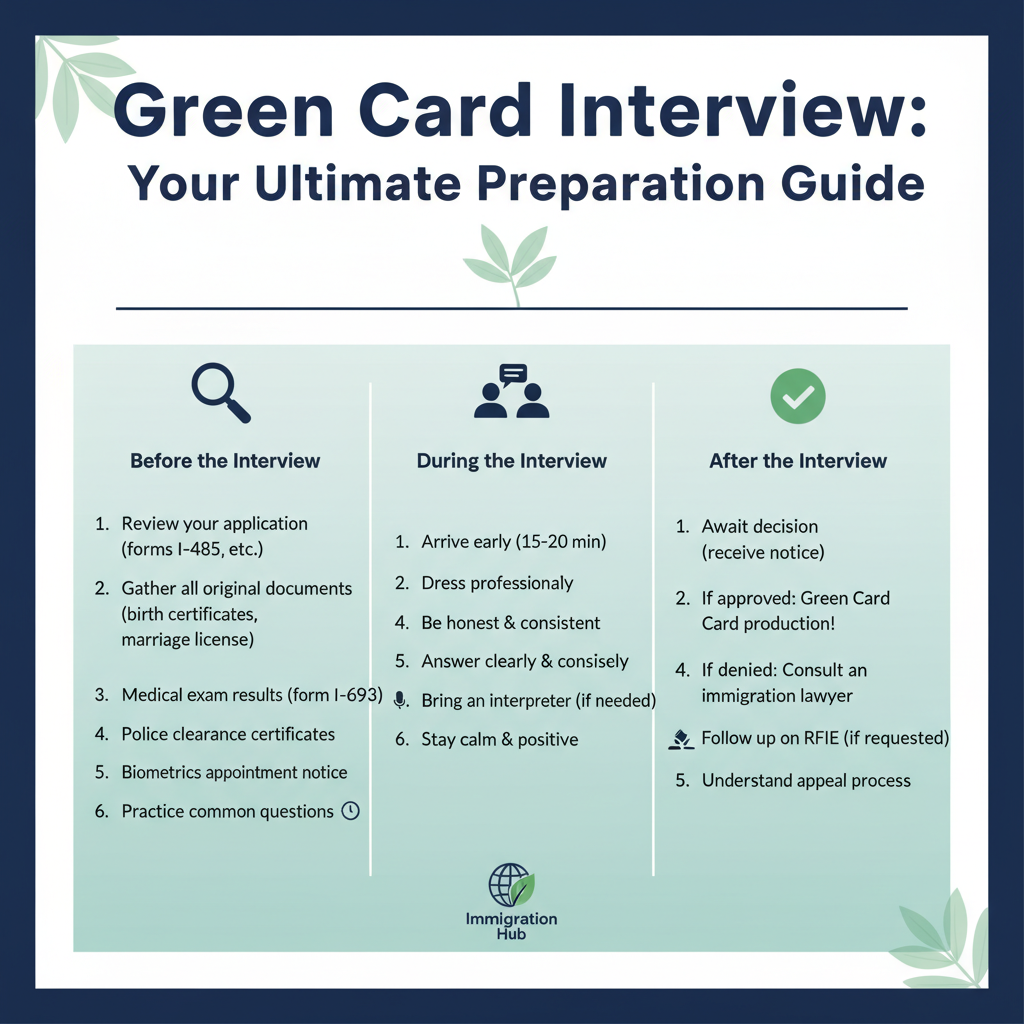
Preparation is the cornerstone of a successful Green Card interview. This detailed guide will walk you through the essential steps to ensure you’re ready for your big day.1) Understand Your Interview Notice (Form I-797C)
Your first step upon receiving your interview notice (typically **Form I-797C**, Notice of Action) is to read it carefully.- Date, Time, and Location: Note these immediately. For Orlando residents, this will likely be the **Orlando USCIS Field Office**. Plan your travel to arrive at least 30 minutes early.
- Required Documents List: The notice will include a specific list of documents you *must* bring. This list is crucial and often includes original documents, not just copies.
- Who Must Attend: It will specify who needs to attend (e.g., both petitioner and beneficiary for marriage-based cases, or just the beneficiary for others).
2) Gather ALL Original Documents and Copies
This is perhaps the most critical step. Organize your documents meticulously.- Personal Identification & Travel Documents:
- Valid passport and any expired passports
- Birth certificates (for both petitioner and beneficiary, if applicable)
- Driver's license or state ID
- Any previous U.S. visas or entry stamps
- Form I-94, Arrival/Departure Record
- Marriage-Based Green Card Specifics (if applicable):
- Original marriage certificate
- Divorce decrees or death certificates for all prior marriages of both spouses
- Evidence of bona fide marriage (proof that your marriage is real and not just for immigration purposes):
- Joint bank accounts statements
- Joint utility bills (electric, water, internet)
- Lease agreements or property deeds showing joint residency
- Joint tax returns (IRS Form 1040)
- Birth certificates of children born to the marriage
- Photos together (over time, with family/friends, from special occasions)
- Affidavits from friends/family attesting to the relationship
- Life insurance policies, wills, or retirement accounts listing spouse as beneficiary
- Credit card statements showing joint accounts
- Financial Documents:
- Form I-864, Affidavit of Support (original, signed)
- Sponsor's most recent federal income tax returns (IRS Form 1040) and W-2s/1099s for the last three years
- Proof of sponsor's current employment (employment letter, pay stubs)
- Proof of assets (bank statements, property deeds) if income is insufficient
- Medical Examination:
- Original sealed **Form I-693**, Report of Medical Examination and Vaccination Record (if not already submitted or if expired). Make sure it’s still valid (typically 2 years from the date of the civil surgeon's signature).
- All USCIS Forms Filed:
- Copies of all forms you submitted (Form I-130, Form I-485, Form I-765, Form I-131, etc.)
- All supporting documents submitted with these forms.
- Police Certificates & Court Records:
- If you have any arrests or convictions, bring certified copies of court dispositions and police records.
- Other:
- Original foreign language documents with certified English translations.
- Any additional documents requested by USCIS in an RFE or NOID.
- Passport-style photos if requested (usually two).
3) Review Your Application Forms Thoroughly
The immigration officer will compare your interview answers to the information on your submitted forms.- Go through every question on your Form I-130 and Form I-485.
- Ensure you remember all dates, addresses, employment history, and travel history exactly as stated.
- If there are any discrepancies or changes since filing (e.g., new address, new job), be prepared to explain them honestly and provide supporting documentation.
4) Practice Answering Potential Questions
Anticipate the types of questions you might be asked. The questions will vary based on your Green Card category.- General Questions:
- "What is your full name and date of birth?"
- "What is your current address?"
- "When and how did you enter the U.S.?"
- "Have you ever been arrested or convicted of a crime?"
- "Have you ever violated immigration laws?"
- "Do you understand the oath you just took to tell the truth?"
- Marriage-Based Specific Questions (for both spouses):
- "How and when did you meet?"
- "Who proposed?"
- "What did you do on your first date?"
- "What are your spouse's parents' names?"
- "Where do you live?" "Describe your home."
- "What do you do for fun together?"
- "When is your spouse's birthday?"
- "Do you have joint bank accounts? Where?"
- "Who pays the bills?"
- "Have you taken any trips together?"
- Sponsor Questions (for the Petitioner/Sponsor):
- "What is your relationship to the applicant?"
- "What is your current employment and income?"
- "Do you understand your financial responsibility as a sponsor?"
5) Prepare for the Interview Day Logistics
The interview day itself requires careful planning.- Dress Code: Dress professionally, as if for a job interview. This shows respect for the process.
- Arrival Time: Arrive at least 30 minutes before your scheduled appointment. The **Orlando USCIS Field Office** can be busy, and you'll need time for security checks.
- Transportation: Plan your route to the **Orlando USCIS Field Office** in advance, considering traffic, especially during peak hours on the I-4 corridor.
- Interpreter: If you are not fluent in English, bring a professional, neutral interpreter. Your attorney can often provide one or arrange one. Do not rely on family members unless specifically permitted by USCIS.
6) Consider Bringing an Attorney
While not legally required, having an experienced immigration attorney from Imigrar accompany you to your Green Card interview can be immensely beneficial.- Legal Guidance: Your attorney can answer legal questions posed by the officer, clarify complex issues, and object to inappropriate questions.
- Reassurance: Their presence can provide peace of mind and help you feel more confident.
- Problem Solving: If unexpected issues arise (e.g., an RFE is issued on the spot, or a misunderstanding occurs), your attorney can address them immediately.
- Review: An attorney will conduct a thorough review of your application and documents beforehand.
7) What to Expect During and After the Interview
Knowing the flow of the interview can reduce anxiety.- Waiting Area: You will check in and wait for your name to be called.
- Oath: You will be asked to swear or affirm that your testimony will be truthful.
- Questioning: The officer will ask questions based on your application and supporting documents. Be honest, concise, and answer only what is asked. Do not volunteer extra information unless it directly clarifies an answer.
- Document Review: The officer will review your original documents and may ask for copies.
- Decision: Sometimes, the officer will tell you a decision immediately. More often, they will say they need to review your case further. You will typically receive a decision by mail within a few weeks to a few months.
- Possible Outcomes:
- Approval: You will receive a welcome notice and your Green Card by mail.
- Request for Evidence (RFE): USCIS needs more information to make a decision.
- Notice of Intent to Deny (NOID): USCIS intends to deny your application but gives you a chance to respond.
- Denial: Your application is denied. This is rare if properly prepared, but appeal options may exist.
Practical Steps You Can Take Today for a Successful Interview
Don’t wait until the last minute. Start your preparation now. * Organize Your Documents: Create a physical and digital checklist of all required documents. Start collecting them, making sure you have originals and copies. * Review Your Application: Sit down with your filed application forms and supporting documents. Familiarize yourself with every detail. * Practice Your Answers: Think about how you would answer common questions for your specific Green Card category. * Confirm Your Medical Exam: Check the validity date of your **Form I-693**. If it’s expired or close to expiring, schedule a new one with a USCIS-approved civil surgeon immediately. * Seek Legal Counsel: Schedule a free consultation with an experienced immigration attorney at Imigrar. They can help you identify potential issues and ensure you are fully prepared. * Check Processing Times: Visit the USCIS Processing Times page for the **Orlando Field Office** to get an estimate of how long similar cases are taking. * Plan Your Interview Day: Map out your route, consider parking, and plan to arrive early. * Gather Bona Fide Relationship Evidence (for marriage cases): Continuously collect evidence of your genuine marriage, even after filing. New photos, joint statements, and updated leases are always valuable. Timeline Expectations: The time from filing your **Form I-485** to receiving an interview notice can vary widely, from a few months to over a year, depending on the USCIS field office and your specific case category. After the interview, a decision can take anywhere from a few days to several months. **Important:** Remain patient but proactive. If you don't hear back within a reasonable timeframe, your attorney can help you inquire about your case status.How Imigrar Helps Immigrants in Orlando Prepare for Their Green Card Interview
At Imigrar, we understand the profound importance of your Green Card interview. Based in Orlando, Florida, our firm is dedicated to keeping families together by providing expert legal guidance throughout the immigration process. Our experienced team offers:- Comprehensive Document Review: We meticulously examine all your application forms and supporting documents to ensure accuracy and completeness, identifying any potential red flags.
- Personalized Interview Preparation: We conduct mock interviews tailored to your specific case, preparing you for the types of questions you'll face and advising you on how to answer honestly and effectively.
- Legal Representation at the Interview: An Imigrar attorney can accompany you to your interview at the **Orlando USCIS Field Office**, providing crucial support, clarifying legal points, and intervening if necessary.
- Guidance on Complex Cases: Whether you have a criminal history, previous immigration violations, or other complexities, we provide strategic advice to address these issues proactively.
- Post-Interview Follow-Up: If an RFE is issued or your case is delayed, we handle all communications with USCIS and help you respond promptly.
Ready to Face Your Interview with Confidence? Imigrar is here to help. Schedule your free consultation with our dedicated immigration lawyers. Call +1 786-791-3106 today, or contact us online. Se Habla Español.
Frequently Asked Questions About Green Card Interviews
Q: Who needs a green card interview?
A: Most applicants for a Green Card, whether through **Adjustment of Status** (within the U.S.) or **Consular Processing** (abroad), will undergo an interview. This includes family-based petitions (spouses, parents, children of U.S. citizens/LPRs) and most employment-based petitions. There are limited exceptions, such as for certain children adjusting status, or some derivative beneficiaries, but generally, assume an interview is required.
Q: Does my current immigration status impact the interview process?
A: Yes, your current immigration status can significantly impact the interview. For **Adjustment of Status**, you must generally be in a valid nonimmigrant status (e.g., H-1B, F-1) or have entered lawfully and be eligible to adjust under INA §245(a). If you have overstayed your visa or are out of status, you might still be eligible to adjust if you are an immediate relative of a U.S. citizen (spouse, unmarried child under 21, or parent of a U.S. citizen over 21), but it will be a major point of discussion. Any prior immigration violations will be scrutinized. For **Consular Processing**, your status in your home country is less relevant, but your history of U.S. entries and departures will be reviewed.
Q: How long after filing will I get an interview notice, and how long does it take to get a decision?
A: The timeline varies greatly. After filing your **Form I-485**, you'll typically receive a receipt notice, then a biometric appointment notice, and sometimes an Employment Authorization Document (EAD) or Advance Parole (AP) travel document. The interview notice can arrive anywhere from 6 months to over 2 years after filing, depending on the **USCIS Field Office** caseload (like the **Orlando USCIS Field Office**) and your specific Green Card category. After the interview, some officers may give an immediate decision, but often, it takes a few weeks to several months to receive a final decision by mail. You can check average processing times on the USCIS Processing Times website.
Q: What if I don't have all the required documents on the interview day?
A: It is **critical** to bring *all* requested documents and any additional supporting evidence. If you are missing a document, the officer may issue a **Request for Evidence (RFE)**, which will significantly delay your case. In some cases, if crucial documents are missing and you cannot provide them quickly, your application could be denied. If you anticipate not having a document, discuss it with your attorney beforehand to strategize the best approach, which might include bringing a sworn affidavit explaining why it's unavailable and what steps you've taken to obtain it.
Q: Are there additional fees for the interview itself?
A: No, there are no separate fees specifically for the Green Card interview. The interview fee is included in the filing fees you paid for **Form I-485** (Application to Register Permanent Residence or Adjust Status) and **Form I-130** (Petition for Alien Relative), as well as the biometrics fee. However, you will incur costs for document preparation, translations, medical exams (**Form I-693**), and potentially legal representation.
Q: What happens if my green card application is denied after the interview?
A: If your Green Card application is denied, it's a serious setback, but not always the end of the road. USCIS will issue a denial letter explaining the reasons. Depending on the reason for denial, you may have options:
- Motion to Reopen or Reconsider: If you believe the denial was based on a factual error or a misapplication of law, you can file a motion.
- Appeal: Some denials can be appealed to the Administrative Appeals Office (AAO).
- Refile: If the basis for denial can be remedied (e.g., insufficient evidence of relationship), you might be able to file a new application.
- Seek Legal Advice: This is paramount. An experienced immigration attorney can review the denial letter, assess your options, and advise on the best course of action to protect your immigration status and future in the U.S.

Common Mistakes (and How to Avoid Them)
Many applicants make avoidable errors that can jeopardize their Green Card application.Mistake #1: Incomplete or Disorganized Documentation
Many applicants fail to bring all required original documents and copies, or they present them in a chaotic manner. This wastes time, frustrates the officer, and often leads to an RFE or a delayed decision.How to Avoid: Create a comprehensive checklist. Start gathering documents months in advance. Organize them in a binder with clear tabs for each category (e.g., "Passports," "Birth Certificates," "Marriage Evidence," "Financial Documents"). Bring both originals and a complete set of photocopies. Have certified English translations for all foreign language documents.
Mistake #2: Inconsistent or Dishonest Answers
Giving answers that contradict information on your application forms, or worse, providing dishonest answers, is a surefire way to invite scrutiny and potential denial. Immigration officers are trained to detect inconsistencies and fraud.How to Avoid:


