

The reporting that sparked this guide: Green Card Interview Preparation Tips (Immigration Law)
What This News Means for Immigrants in Orlando and Across Florida
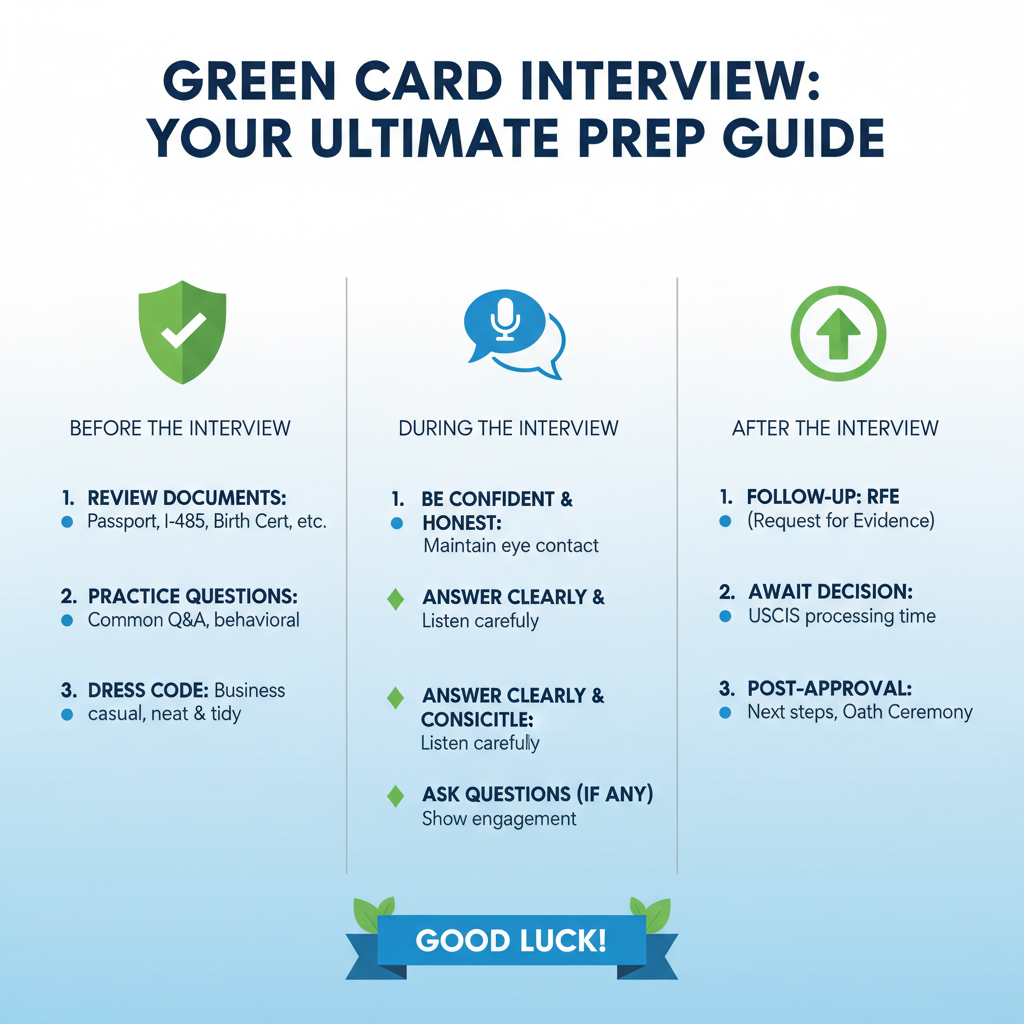
The journey to obtaining a Green Card, or lawful permanent residency, is a pivotal moment for many individuals and families seeking to build a life in the United States. A critical step in this process for many applicants is the Green Card interview with U.S. Citizenship and Immigration Services (USCIS). Recent discussions and increased focus on immigration law highlight the ongoing importance of thorough preparation for this interview. For immigrants residing in Orlando, Central Florida, and throughout the nation, understanding the nuances of this interview can be the key to a successful outcome.
Why this news is showing up now
Immigration law and policy are constantly evolving, leading to continuous public interest and reporting. While the Green Card interview itself is a long-standing component of the immigration process, its significance remains undiminished. News outlets frequently cover immigration topics, from policy changes to processing times, keeping the spotlight on the experiences of immigrants. The current emphasis on "Green Card Interview Preparation Tips" reflects a perennial concern among applicants: how to navigate this high-stakes meeting successfully. As of 2026, USCIS continues to refine its procedures, making up-to-date, accurate information more valuable than ever. The sheer volume of applications processed by USCIS, including those through the Orlando Field Office, means that efficient and prepared interviews are beneficial for both applicants and the agency.
How it can affect Florida residents
For individuals and families living in Florida, particularly in bustling metropolitan areas like Orlando, Tampa, and Miami, the Green Card interview is a tangible step on their path to permanent residency. Florida is home to a vast and diverse immigrant population, making the successful navigation of immigration processes a daily reality for thousands. The Orlando USCIS Field Office, located at 5450 S. Semoran Blvd, serves many residents across Orange County and the wider Central Florida region. Proper preparation can significantly reduce stress, avoid unnecessary delays, and increase the likelihood of a positive outcome. Conversely, inadequate preparation can lead to requests for additional evidence, rescheduled interviews, or even denials, creating significant setbacks for Florida families striving to keep their loved ones together. Imigrar, based right here in Orlando, understands these local challenges and is dedicated to providing tailored support.
Need Help Preparing for Your Green Card Interview? Our Orlando immigration team is ready to assist. Call +1 786-791-3106 for a free consultation, or message us online. Se Habla Español.
What a Green Card Interview Is (and Why It Matters)
A plain-English definition
A Green Card interview is a mandatory meeting with a USCIS officer, or occasionally a Consular Officer abroad, to determine your eligibility for lawful permanent residency in the United States. Think of it as the final review of your application. The officer will ask you questions about the information you provided in your application forms, verify your identity, and confirm that you meet all legal requirements for a Green Card. This interview is a crucial step for most applicants, especially those applying for Adjustment of Status (applying for a Green Card while already in the U.S.) or an Immigrant Visa (applying from outside the U.S. through a U.S. consulate or embassy).
Key terms you need to know
- Green Card: Official document (Form I-551) proving a person has been granted lawful permanent resident status in the United States.
- Adjustment of Status (AOS): The process allowing eligible individuals already in the United States to apply for lawful permanent resident status without having to return to their home country to complete visa processing. This typically involves filing Form I-485.
- Immigrant Visa: A visa issued to a foreign national who intends to live permanently in the United States. This process is handled by the U.S. Department of State and typically involves an interview at a U.S. embassy or consulate abroad.
- Petitioner: The U.S. citizen or lawful permanent resident who files an immigrant petition (e.g., Form I-130, Petition for Alien Relative) on behalf of a foreign national relative.
- Beneficiary: The foreign national on whose behalf an immigrant petition is filed. This is the person seeking the Green Card.
- Affidavit of Support (Form I-864): A legally enforceable contract an individual signs to accept financial responsibility for the intending immigrant. This ensures the immigrant will not become a "public charge" and relies on public assistance.
- Public Charge: A term in immigration law referring to individuals who are likely to become primarily dependent on the government for subsistence, as demonstrated by receipt of public cash assistance for income maintenance or long-term institutionalization at government expense.
- Priority Date: The date USCIS or the Department of State receives an immigrant petition. This date is used to determine when an immigrant visa becomes available, especially for preference categories with annual limits.
- Request for Evidence (RFE): A letter from USCIS asking for more information or documents to support an application or petition.
- Notice of Intent to Deny (NOID): A letter from USCIS indicating that the agency intends to deny an application or petition and providing the applicant an opportunity to submit additional evidence or arguments.
Current Immigration Law: The Foundation
The Green Card interview process is rooted in the Immigration and Nationality Act (INA), the body of law governing immigration to the United States. This comprehensive law outlines who is eligible for a Green Card, the various categories for obtaining one, and the procedures involved. Most family-based Green Card applications, whether through Adjustment of Status or Consular Processing, fall under specific sections of the INA.
Federal requirements
The primary federal agency overseeing most Green Card applications and interviews within the U.S. is USCIS, part of the Department of Homeland Security. Key legal frameworks include:
- INA Section 245 (Adjustment of Status): This section permits certain foreign nationals who are physically present in the United States to apply for lawful permanent resident status. To be eligible, applicants must generally have been inspected and admitted or paroled into the U.S. and meet specific eligibility criteria for a visa.
- INA Section 201 (Immediate Relatives): This section defines "immediate relatives" of U.S. citizens (spouses, unmarried children under 21, and parents) who are not subject to numerical limitations and can often obtain Green Cards more quickly.
- INA Section 203 (Preference Categories): This section establishes categories for other family members (e.g., adult children, siblings) and employment-based immigrants, who are subject to annual numerical limits and often have longer waiting times based on their Priority Date.
- INA Section 212 (Inadmissibility Grounds): This section lists reasons why an applicant might be deemed "inadmissible" to the U.S. and therefore ineligible for a Green Card. These grounds can include health-related issues, criminal history, security concerns, prior immigration violations, and the likelihood of becoming a public charge. Applicants must demonstrate they are not inadmissible or have obtained a waiver if applicable.
- Affidavit of Support Requirements (INA Section 213A): For most family-based Green Cards, the U.S. citizen or lawful permanent resident petitioner must complete Form I-864, Affidavit of Support, demonstrating they can financially support the intending immigrant at 125% of the federal poverty guidelines. This is a critical document reviewed during the interview.
All forms and requirements are detailed on the USCIS official website. Applicants must submit specific forms, such as Form I-130, Petition for Alien Relative (filed by the petitioner), and Form I-485, Application to Register Permanent Residence or Adjust Status (filed by the beneficiary). Other essential forms often include Form I-765 (Employment Authorization) and Form I-131 (Travel Document) if seeking interim benefits.
Florida-specific considerations
While immigration law is federal, the practical application often involves local USCIS Field Offices. For Central Florida residents, the Orlando Field Office is where interviews for Adjustment of Status are conducted. The officers at this office are experienced in handling a wide range of cases, from family-based petitions to asylum applications. While the law itself doesn't change from state to state, understanding local procedures, wait times (which can be checked at USCIS Processing Times), and specific document requests that might be common in Orlando can be advantageous. For instance, the Orlando office may have specific preferences for how documents are organized or presented. Ensuring all state-issued documents, like Florida birth certificates or marriage licenses, are readily available and properly translated (if applicable) is also vital.
Don't navigate complex immigration laws alone. Imigrar's experienced attorneys in Orlando can guide you. Call +1 786-791-3106 for a free consultation. Se Habla Español.
How to Prepare for Your Green Card Interview: A Complete Step-by-Step Guide
Preparing for your Green Card interview is paramount to a successful outcome. This detailed guide will walk you through the essential steps, ensuring you are well-equipped to face the USCIS officer.
1) Understand Your Interview Notice and Schedule
Your first step begins when you receive your interview notice, typically Form I-797C, Notice of Action. This document will specify the date, time, and location of your interview, usually at a USCIS Field Office (e.g., the Orlando Field Office for Central Florida residents) or a U.S. consulate abroad.
- Review Immediately: Check all details carefully. If you cannot attend, you must promptly request a rescheduling. Delays in responding can lead to application denial.
- Identify Attendees: The notice will indicate who must attend. For family-based petitions, both the petitioner and the beneficiary are usually required. If the beneficiary is a child, they may also need to attend.
- Required Documents List: The notice often includes a list of documents to bring. This list is not exhaustive; you should always bring all original documents related to your application.
2) Gather All Required Documents (Originals & Copies)
This is arguably the most critical step. Organize your documents meticulously. Create a binder or folder with clearly labeled sections. You should bring ALL original documents submitted with your application, plus copies.
- Identity and Travel Documents:
- Passport (current and expired, if applicable)
- Birth Certificate (original and certified translation if not in English)
- National Identity Card (if applicable)
- Any previous U.S. visas or entry stamps
- Form I-94, Arrival/Departure Record
- Advance Parole document (Form I-512), if you traveled outside the U.S. after filing for Adjustment of Status.
- Immigration Forms and Filing Receipts:
- Your interview notice (Form I-797C)
- Copies of all forms you submitted (e.g., Form I-130, Form I-485, Form I-864, Form I-765, Form I-131, Form I-693 - Medical Examination)
- Receipt notices (Form I-797) for all filed applications and petitions.
- Proof of Relationship (for Family-Based Petitions):
- Marriage Certificate (original for spouse petitions)
- Birth Certificates of children (original)
- Divorce decrees or death certificates for any previous marriages of both petitioner and beneficiary.
- Joint Financial Documents: Joint bank accounts, joint credit card statements, joint tax returns (IRS transcripts preferred), joint utility bills, joint mortgage or lease agreements.
- Joint Property: Deeds, titles, or registrations showing joint ownership of assets (e.g., car title, house deed).
- Proof of Cohabitation: Utility bills addressed to both, joint leases, shared insurance policies.
- Other Evidence: Photos together (family, friends, events), correspondence (emails, texts, cards), affidavits from friends/family attesting to the relationship, travel itineraries for trips taken together, life insurance policies with spouse as beneficiary, wills naming spouse.
- Financial Documents:
- Form I-864, Affidavit of Support (original, signed)
- Petitioner's most recent tax returns (IRS transcripts recommended for the last 3 years)
- Proof of income (pay stubs, employment verification letter) for the petitioner and any joint sponsor.
- Bank statements, property deeds, or other asset documentation if income alone is insufficient.
- Medical Examination:
- Sealed Form I-693, Report of Medical Examination and Vaccination Record, completed by a USCIS-approved civil surgeon, if you haven't already submitted it. Do NOT open the sealed envelope.
- Police Records/Court Documents:
- Certified copies of any arrest records, court dispositions, or conviction records for both petitioner and beneficiary, even if charges were dropped or expunged.
- If you have ever been arrested in Florida, ensure you have all relevant documentation from the Orange County Clerk of Courts or other jurisdictions.
- Photographs:
- Two passport-style photos of the beneficiary (and petitioner, if required by the notice).
3) Review Your Application Forms Thoroughly
Before your interview, meticulously review every form you submitted, especially Form I-130 and Form I-485. The interviewing officer will primarily use these forms as the basis for their questions.
- Know Your Answers: Be familiar with every answer you provided. Ensure consistency between your verbal answers and what's written on the forms.
- Identify Discrepancies: If you find any errors or omissions, make a note of them. You can explain them politely and clearly to the officer during the interview. It's better to disclose minor errors than to be caught off guard.
- Understand the "Why": Be prepared to explain why you answered certain questions the way you did, especially those related to your personal history, immigration history, or relationship details.
4) Prepare for Interview Questions
While you cannot predict every question, common themes emerge based on your application type. Practice answering potential questions aloud.
- General Questions:
- Verify your identity (name, date of birth, place of birth).
- Confirm your address and contact information.
- "Why do you want a Green Card?"
- Relationship-Specific Questions (for spouse-based petitions):
- "How and when did you meet?"
- "Where did you get married?"
- "Do you live together? Describe your home."
- "What are your spouse's hobbies? Favorite food? Parents' names?" (These are designed to test the authenticity of your relationship.)
- "Describe a typical day together."
- Questions about your wedding, honeymoon, and shared life.
- Immigration History Questions:
- "When did you first enter the U.S.?" "How?"
- "Have you ever been out of status?"
- "Have you ever violated immigration laws?"
- Questions from the "Part 8. General Information" section of Form I-485 regarding criminal history, national security, and public charge concerns.
- Financial Questions:
- About the Affidavit of Support (Form I-864) – income, assets of the petitioner.
5) Attend the Interview with Confidence and Professionalism
The day of the interview is when all your preparation comes to fruition.
- Dress Appropriately: Business casual attire is recommended. It shows respect for the process and the interviewing officer.
- Be Punctual: Arrive early. For the Orlando USCIS Field Office, allow extra time for traffic and parking.
- Be Honest and Truthful: Always tell the truth. Providing false information can lead to severe penalties, including denial and future inadmissibility.
- Answer Clearly and Concisely: Answer only the question asked. Avoid volunteering unnecessary information unless specifically asked.
- Maintain Respectful Demeanor: Be polite and cooperative. Address the officer respectfully.
- Bring an Interpreter (if needed): If you are not fluent in English, bring a professional, certified interpreter. Do not rely on family members or friends unless USCIS explicitly allows it (which is rare). Imigrar can help arrange an interpreter if you are comfortable speaking Spanish or other languages.
- Consider Legal Representation: You have the right to have an attorney present at your interview. An attorney from Imigrar can provide invaluable support, ensuring your rights are protected, clarifying questions, and addressing any complex issues that may arise.
6) Follow Up Post-Interview (If Necessary)
Sometimes, the officer may not make an immediate decision.
- Request for Evidence (RFE): If the officer needs more documents or clarification, they will issue an RFE. Respond promptly and thoroughly by the deadline provided. Failure to do so can lead to denial.
- Notice of Intent to Deny (NOID): In more serious cases, USCIS might issue a NOID. This means they intend to deny your application unless you provide compelling evidence to overcome their concerns. This is a critical stage where legal counsel is highly recommended.
- Check Status Online: You can track your case status using the receipt number on the USCIS official website.
7) What to Expect After Approval
If your interview is successful and your application is approved, congratulations!
- Approval Notice: You will typically receive an approval notice (Form I-797) in the mail.
- Welcome Notice: Shortly after, you will receive a Welcome Notice.
- Green Card Delivery: Your physical Green Card (Form I-551) will be mailed to your address, usually within a few weeks of approval. Ensure your address is always up to date with USCIS.
- Conditional Green Card: If you obtained your Green Card through marriage to a U.S. citizen and your marriage was less than two years old at the time of approval, you will receive a Conditional Green Card, valid for two years. You will need to file Form I-751, Petition to Remove Conditions on Residence, within the 90-day window before your conditional Green Card expires.
Practical Steps You Can Take Today
Don't wait until the last minute to prepare for your Green Card interview. Here are actionable steps you can start taking today:
- Organize Your Documents: Start compiling all original documents and making copies. Use a binder with dividers for different categories (personal, financial, relationship, immigration history).
- Review Your Application: Print out copies of all forms you submitted (Form I-130, Form I-485, Form I-864, etc.) and read through them carefully. Highlight any areas where you might need to provide further explanation or clarification.
- Gather Relationship Evidence (if applicable): If you're applying based on marriage, continuously collect evidence of your bona fide relationship. This includes recent photos, joint bills, travel tickets, and communication records. For Central Florida couples, show evidence of your life together in Orlando or surrounding areas.
- Financial Documentation: Ensure your petitioner has all necessary financial documents ready, including recent tax transcripts (available from the IRS website), pay stubs, and employment letters.
- Medical Exam: If you haven't already, research and schedule your medical examination with a USCIS-approved civil surgeon. Ensure it's completed and sealed well before your interview.
- Practice Interview Questions: Ask a trusted friend or family member to conduct a mock interview with you, focusing on the types of questions outlined above. Practice answering clearly and concisely.
- Consult an Attorney: Even if you plan to attend the interview alone, a consultation with an experienced immigration attorney can provide invaluable insights, identify potential issues, and ensure your preparation is comprehensive. Imigrar offers free consultations to help you assess your readiness.
Timeline Expectations: The time from filing your application to receiving an interview notice can vary significantly. You can monitor average processing times for your specific form and field office (e.g., Orlando Field Office) on the USCIS Processing Times page. Once you receive the notice, you typically have several weeks to prepare, but this window can be shorter. It’s crucial to start preparing as soon as you file your initial application, not just when you receive the interview notice.
How Imigrar Helps Immigrants in Orlando
At Imigrar, we understand that the Green Card interview can be one of the most stressful parts of the immigration process. Our mission is to "Keep Families Together" by providing expert legal guidance and compassionate support every step of the way. Based in Orlando, Florida, our firm serves clients nationwide, with a deep understanding of local nuances and federal immigration law.
Our experienced immigration attorneys specialize in family-based Green Card applications, Adjustment of Status, Consular Processing, and more. We offer:
- Comprehensive Document Review: We meticulously review all your submitted forms and supporting documents to ensure accuracy and completeness, identifying any potential red flags before your interview.
- Personalized Interview Preparation: We conduct thorough mock interviews, preparing you for the types of questions you'll face and helping you articulate your answers clearly and confidently.
- Legal Representation at the Interview: Our attorneys can accompany you to your interview at the Orlando USCIS Field Office, providing a reassuring presence, clarifying complex questions, and advocating on your behalf if issues arise.
- Responsive Communication: We keep you informed throughout the process, answering your questions and addressing your concerns promptly.
- Post-Interview Support: Should you receive an RFE or NOID, we will guide you through the process of responding effectively.
We believe that every immigrant deserves competent and caring legal representation. We are proud to offer our services in both English and Spanish, ensuring clear communication for our diverse clientele. Se Habla Español.
Don't face this critical interview alone. Let Imigrar be your trusted partner.
Ready to prepare for your Green Card interview with confidence? Contact Imigrar today for a free, no-obligation consultation. Call us at +1 786-791-3106 or reach out online. Se Habla Español.

Frequently Asked Questions
Q: Who needs to attend the Green Card interview?
A: For most family-based Green Card applications (Adjustment of Status), both the beneficiary (the immigrant seeking the Green Card) and the petitioner (the U.S. citizen or lawful permanent resident who filed the petition) must attend the interview. If the beneficiary is a child, they may also be required to attend, depending on their age and the specific case. Your interview notice (Form I-797C) will clearly state who is required to be present. It is crucial to adhere to these instructions to avoid delays or rescheduling.
Q: What if I don't speak English well? Can I bring an interpreter?
A: Yes, if you are not fluent in English, you should bring a qualified interpreter to your Green Card interview. The interpreter must be at least 18 years old, fluent in both English and your native language, and cannot be your attorney or a witness in your case. It is highly recommended to use a professional, certified interpreter to ensure accuracy. USCIS will not provide an interpreter for you at the interview. If you need assistance finding a reliable interpreter in the Orlando area, Imigrar can help.
Q: How long does the Green Card interview typically last?
A: The duration of a Green Card interview can vary widely, but most interviews last between 20 to 60 minutes. Some complex cases, or those with many questions or discrepancies, might take longer. Simpler, well-prepared cases might be shorter. It is always wise to allocate at least 2-3 hours for the entire visit to the USCIS Field Office, considering check-in, waiting times, and the interview itself. For the Orlando office, this also means factoring in travel time on congested routes like the I-4 corridor.
Q: What kind of documents should I bring to prove my marriage is real (bona fide)?
A: To prove your marriage is bona fide (entered into for love, not just for immigration benefits), you should bring extensive joint documentation. This includes joint bank statements, joint utility bills, joint leases or mortgage agreements, joint tax returns (IRS transcripts for the last 3 years are excellent), joint health or car insurance policies, photos together over time (including with family and friends), travel itineraries from shared vacations, and correspondence (emails, texts). Any document showing you share a life together is valuable. The more evidence you have of commingling your lives, the stronger your case.
Q: What are the costs associated with the Green Card interview itself?
A: There is no separate fee specifically for the Green Card interview. The interview is part of the overall application process for which you would have already paid filing fees when submitting Form I-485 (Application to Register Permanent Residence or Adjust Status) and Form I-130 (Petition for Alien Relative), among others. However, you might incur costs for preparing for the interview, such as fees for certified translations, obtaining original documents, or legal representation. The
You may also be interested in: Understand the critical H-1B visa lottery changes for FY2027. Imigrar breaks down the new beneficiary-centric selection process, eligibility, timeline... Critical updates on Temporary Protected Status (TPS) extensions for designated countries. Learn how these changes impact your immigration journey in F... Understand the crucial H-1B visa lottery changes for FY2027, including the new beneficiary-centric selection process. Imigrar guides you through eligi... Prepare confidently for your Green Card interview with Imigrar's comprehensive guide. Learn essential tips, required documents, and what to expect fro...Related Articles


