


The journey to obtaining a Green Card, or lawful permanent residence in the United States, is a pivotal moment for countless individuals and families. A critical step in this process for many is the Green Card interview with U.S. Citizenship and Immigration Services (USCIS). This interview is your opportunity to demonstrate your eligibility and provide clarity on your application. For immigrants in Orlando, across Florida, and throughout the nation, thorough preparation is not just recommended—it’s essential for a successful outcome.
Need Expert Green Card Interview Preparation? Our Orlando immigration team at Imigrar is ready to assist. Call +1 786-791-3106 for a free consultation, or message us online. Se Habla Español.
The reporting that sparked this guide
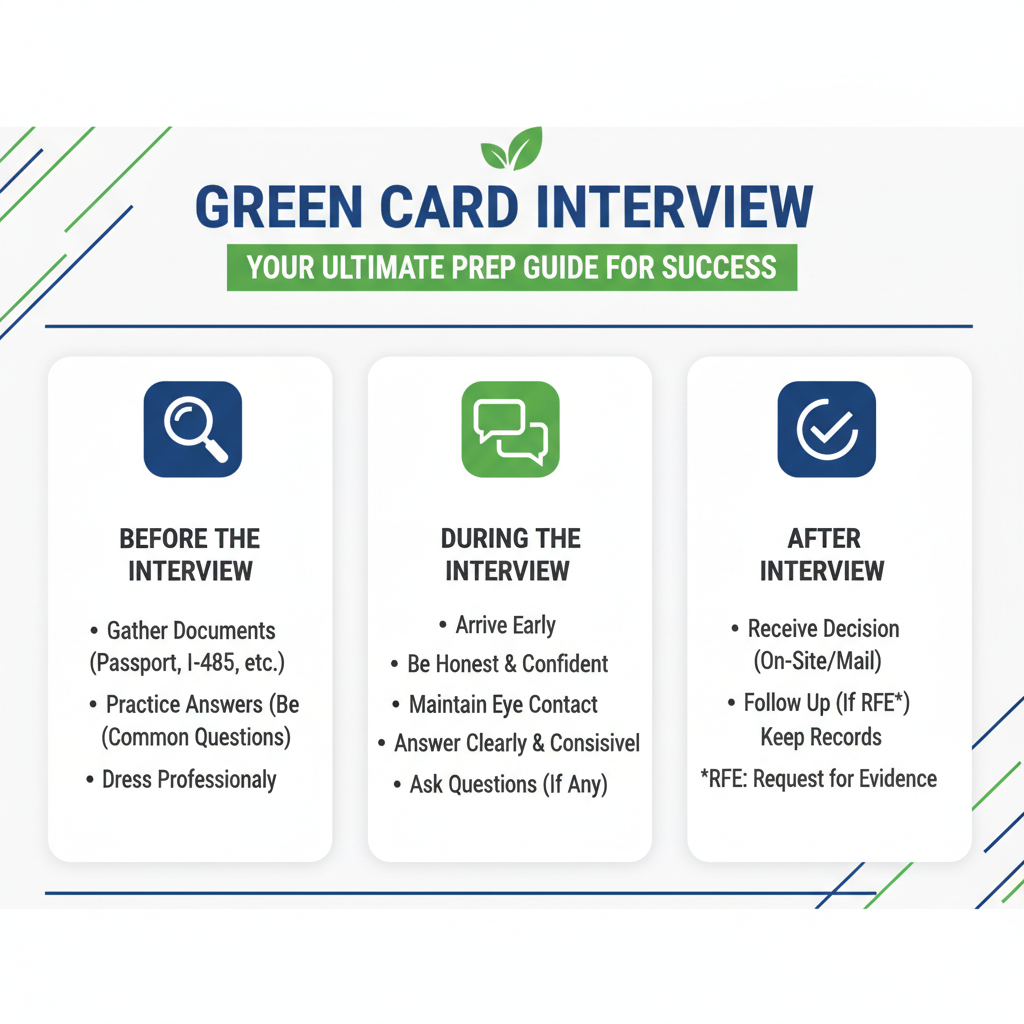
Recent discussions and information surrounding the immigration process, particularly the importance of interview preparation, highlight a consistent and vital need for applicants. The insights gathered from general Green Card Interview Preparation Tips (Immigration Law) underscore that while immigration laws evolve, the fundamental requirement for applicants to present a clear, truthful, and well-supported case remains unwavering. This guide aims to distill that consistent advice into actionable steps for your journey.
What This News Means for Immigrants in Orlando and Across Florida
For individuals and families pursuing permanent residency, the Green Card interview represents the culmination of a lengthy application process. Its consistent prominence in immigration law discussions signifies its enduring importance and the need for applicants to approach it with diligence and care. Imigrar, rooted in Orlando, Florida, understands the unique landscape facing immigrants in our state and provides tailored guidance.
Why this news is showing up now
The emphasis on Green Card interview preparation is not tied to a single new law or policy change, but rather reflects the evergreen nature of this critical step in the immigration process. USCIS conducts millions of interviews annually, and the stakes for each applicant are incredibly high. As processing times fluctuate and USCIS policies are refined, the focus on thorough preparation becomes even more pronounced. It’s a constant reminder that while the government handles the procedure, the applicant bears the responsibility of presenting a compelling and accurate case. This persistent "news" cycle around interview tips simply reinforces that a well-prepared interview is often the final hurdle to overcome.
How it can affect Florida residents
Florida is home to one of the largest and most diverse immigrant populations in the United States. For residents of Orlando, Miami, Tampa, and other cities along the I-4 corridor and beyond, the **Orlando USCIS Field Office** and other regional offices are key touchpoints for their immigration journey. This means a high volume of interviews are conducted locally, often leading to varying wait times and specific procedural nuances that can differ slightly from other states. The importance of preparing for your interview in Florida is amplified by the sheer number of applicants and the potential for increased scrutiny in certain types of cases, such as marriage-based applications. Understanding the local context, including the specific expectations of the **Orlando Field Office**, can provide a distinct advantage. Imigrar’s local presence and experience allow us to offer insights specific to Central Florida residents, helping you navigate these regional dynamics effectively.
What a Green Card Interview Is (and Why It Matters)
The Green Card interview is a mandatory meeting with a **USCIS** immigration officer to review your application for lawful permanent residence, verify the information you’ve provided, and confirm your eligibility. It’s a formal proceeding that serves as a final check before a decision is made on your Green Card application.
A plain-English definition
Think of the Green Card interview as your final exam for permanent residency. It’s a face-to-face conversation where a government official asks you questions about your life, your background, and the details of your application to make sure you qualify for a Green Card. For family-based applications, especially those based on marriage, the interview is crucial for confirming that your relationship is real and not just for immigration purposes.
Key terms you need to know
- Green Card: The official name for a Permanent Resident Card, which allows foreign nationals to live and work permanently in the United States.
- Adjustment of Status (AOS): The process of applying for a Green Card from within the United States. Your interview will typically be at a USCIS Field Office, like the one in Orlando.
- Consular Processing: The process of applying for a Green Card from outside the United States. Your interview will be at a U.S. embassy or consulate in your home country.
- USCIS: U.S. Citizenship and Immigration Services, the government agency responsible for processing immigration benefits.
- Petitioner/Sponsor: The U.S. citizen or lawful permanent resident (LPR) who files an immigrant petition (e.g., for a relative or employee) on behalf of the beneficiary.
- Beneficiary: The foreign national seeking the Green Card.
- Bona Fide Marriage: A marriage entered into in good faith, with the intention of establishing a life together, not solely for immigration benefits. This is a critical aspect of marriage-based Green Card interviews.
- Affidavit of Support (Form I-864): A legally enforceable contract signed by a sponsor (usually the petitioner) to accept financial responsibility for the immigrant.
- Inadmissibility: Grounds under immigration law that can prevent someone from entering the U.S. or obtaining a Green Card (e.g., certain criminal convictions, health issues, prior immigration violations).
The interview matters immensely because it’s often the final opportunity to present your case directly to a USCIS officer. It allows you to clarify any discrepancies, provide additional evidence, and personally attest to the truthfulness of your application. A strong, well-prepared interview can lead to a quick approval, while a poorly handled one can result in delays, requests for more evidence (RFE), or even a denial.
Current Immigration Law: The Foundation
The legal framework for Green Card eligibility and the interview process is primarily governed by the Immigration and Nationality Act (INA). This comprehensive body of law outlines who is eligible for permanent residence, the various pathways to obtaining it, and the procedures involved.
Federal requirements
At the federal level, the **INA** sets forth the general requirements for all Green Card applicants. Key sections of the INA dictate:
- Eligibility for Immigrant Visas: Sections 201-204 of the INA define the categories of immigrants (e.g., family-sponsored, employment-based, diversity lottery) and the numerical limitations for each.
- Adjustment of Status (INA § 245): This crucial section outlines the conditions under which an individual physically present in the U.S. can apply for permanent residence without leaving the country. Generally, applicants must have been lawfully admitted or paroled, be eligible for an immigrant visa, and be admissible to the U.S.
- Inadmissibility Grounds (INA § 212): This section details various reasons why an individual might be denied a Green Card, including health-related grounds, criminal grounds, security and related grounds, public charge considerations, and prior immigration violations.
- Affidavit of Support (INA § 213A): Requires a financial sponsor to file **Form I-864** to demonstrate they can support the immigrant at 125% of the federal poverty guidelines, preventing the immigrant from becoming a "public charge."
The Green Card interview serves as a mechanism for USCIS to ensure that applicants meet all these federal requirements. The officer will review your application forms, including the foundational **Form I-130** (Petition for Alien Relative) or **Form I-140** (Immigrant Petition for Alien Worker), and your **Form I-485** (Application to Register Permanent Residence or Adjust Status), along with all supporting documentation.
Other critical forms involved in the process include:
- Form I-693 (Report of Medical Examination and Vaccination Record): This must be completed by a USCIS-approved civil surgeon.
- Form I-765 (Application for Employment Authorization): Often filed concurrently with **Form I-485** to allow work authorization while the Green Card is pending.
- Form I-131 (Application for Travel Document): Filed concurrently with **Form I-485** to obtain "advance parole" for international travel without abandoning the AOS application.
For official information and to download forms, always refer to the USCIS official website.
Florida-specific considerations
While immigration law is federal, the practical application can have regional nuances. Florida, with its large immigrant population, experiences a high volume of Green Card applications and interviews. The **Orlando USCIS Field Office**, located at 5449 Forbes Pl, Orlando, FL 32812, is a primary location for interviews for Central Florida residents. While the legal requirements remain the same nationwide, local offices may have particular ways of scheduling, processing, or officers with specific areas of focus. For example, in areas with higher rates of marriage-based applications, officers may be particularly adept at identifying potential fraud, making strong evidence of a **bona fide marriage** even more crucial.
There are no Florida-specific immigration laws that affect the federal Green Card process. However, local resources, community organizations, and the availability of experienced immigration attorneys like Imigrar can significantly impact an applicant's ability to navigate the process successfully. Understanding the local office's procedures and potential backlogs (which can be checked via USCIS Processing Times) is a practical consideration for Florida residents.
How to Prepare for Your Green Card Interview: A Complete Step-by-Step Guide
The Green Card interview is arguably the most important step in your journey to permanent residency. Proper preparation can significantly increase your chances of a successful outcome. Here’s a detailed guide to help you get ready, whether your interview is in Orlando or elsewhere.
1) Understand Your Interview Notice (Form I-797C)
The first step begins the moment you receive your interview notice, typically **Form I-797C, Notice of Action**. This document is vital and contains all the essential information about your interview. Carefully review it to understand:
- Date and Time: Mark it clearly on your calendar. Arriving late can have severe consequences, including potential cancellation or abandonment of your application.
- Location: Confirm the exact address of the USCIS Field Office. For Central Florida residents, this is usually the **Orlando USCIS Field Office**. Plan your travel in advance, considering traffic, especially if you're coming from Orange County or along the I-4 corridor.
- Required Documents: The notice will list specific documents you *must* bring. This usually includes your original birth certificate, marriage certificate (if applicable), passport, travel documents, and often, updated financial and medical records.
- Participants: It will specify who must attend (typically the applicant, and for marriage-based cases, the petitioner/spouse).
Required documents for this step:
- Your original **Form I-797C** interview notice.
- A valid government-issued photo identification (e.g., passport, driver's license).
2) Gather and Organize ALL Original Documents
This is perhaps the most critical preparation step. You must bring originals of every document submitted with your application, plus copies, and often additional evidence. Organize everything meticulously in a binder or folders, clearly labeled. Create a checklist based on your **Form I-797C** and your submitted application package.
Key categories of documents to gather:
- Identity and Civil Documents:
- Original birth certificates for you and your petitioner/spouse.
- Original marriage certificate (if applicable).
- Original divorce decrees or death certificates for any previous marriages for both you and your petitioner/spouse.
- Passports and all previous visas.
- Any travel documents (e.g., **Form I-94** arrival/departure record).
- Financial Documents:
- Updated **Form I-864** (Affidavit of Support) if requested, or if your income/assets have changed significantly since filing.
- Most recent tax transcripts (IRS Form 1040) for the petitioner/sponsor for the last three years.
- W-2s, 1099s, pay stubs, and employment verification letters.
- Bank statements and proof of assets (e.g., property deeds, stock statements).
- Medical Documents:
- Original sealed **Form I-693** (Report of Medical Examination and Vaccination Record), if not already submitted. If submitted, bring a copy for your records.
- Any vaccination records.
- Police and Court Documents:
- Certified copies of arrest records, court dispositions, and police clearances, even for minor incidents.
- Evidence of rehabilitation if applicable.
- Relationship Evidence (for marriage-based Green Cards - most crucial):
- Joint bank accounts statements.
- Joint utility bills, leases, or mortgage statements.
- Joint tax returns.
- Birth certificates of any children you have together.
- Photos together (dating, engagement, wedding, family events) with dates.
- Affidavits from friends/family attesting to the **bona fide marriage**.
- Life insurance policies, health insurance, or wills listing each other as beneficiaries.
- Travel itineraries or tickets from trips taken together.
- Correspondence (emails, texts, social media posts) that demonstrate an ongoing relationship.
- Evidence of gifts exchanged.
- Updated Information:
- Any new addresses (ensure you filed **Form AR-11** with USCIS if you moved).
- New employment details, if applicable.
- Any new criminal history or immigration issues.
Important: Bring all originals, plus one full set of copies of everything. The officer will review originals and may keep the copies.
3) Review Your Submitted Applications Thoroughly
Before your interview, meticulously review every form you submitted, especially **Form I-130** and **Form I-485**. You should know every answer you provided. The immigration officer will be comparing your interview answers to the information on these forms. Any inconsistencies, even minor ones, can raise red flags and lead to further questioning or delays.
- Read through your **Form I-130**, **Form I-485**, and any supplementary forms.
- If you filed with an attorney, they should provide you with copies of all submitted documents.
- Pay close attention to dates, addresses, employment history, and answers to questions about criminal history or previous immigration violations.
- If you discover any errors or omissions, discuss them immediately with your attorney. Do NOT wait until the interview to reveal discrepancies.
4) Prepare for Common Interview Questions
While questions vary based on your case type, some themes are universal. For family-based cases, particularly marriage-based, the officer will focus heavily on the authenticity of your relationship. For employment-based cases, the focus will be on your qualifications and the legitimacy of the job offer.
Sample questions (marriage-based):
- How did you meet? When and where was your first date?
- When did you get married? Who attended the wedding?
- What does your spouse do for a living? What are your work hours?
- Describe your daily routine together.
- What did you do last weekend? What did you have for breakfast?
- Do you live together? Show me evidence of your shared residence.
- Do you have joint bank accounts? Do you share bills?
- What are your spouse's family members' names?
- Have you traveled together? Where?
- What are your future plans as a couple?
Sample questions (general eligibility):
- What is your full name and date of birth?
- When did you last enter the U.S.? How did you enter?
- Have you ever been arrested or convicted of a crime?
- Have you ever violated immigration laws? (e.g., overstayed a visa, worked without authorization)
- Have you ever claimed to be a U.S. citizen?
- Are you a member of any political organizations?
Reminder: Answer truthfully and directly. If you don't understand a question, ask the officer to rephrase it.
5) Practice with Your Attorney (and Spouse, if applicable)
A mock interview with your immigration attorney is invaluable. They can simulate the interview environment, ask challenging questions, and identify areas where you might be weak or inconsistent. For marriage-based cases, practicing with your spouse is crucial to ensure your answers are consistent and to help you both feel more comfortable. An experienced Orlando immigration lawyer will know the types of questions typically asked at the **Orlando USCIS Field Office**.
- Conduct several practice sessions.
- Focus on clarity, consistency, and confidence.
- Review potential issues or red flags in your application with your attorney.
6) Understand the Role of Your Attorney and Interpreter
If you have an attorney, they will attend the interview with you. Their role is to provide legal counsel, clarify questions, ensure fairness, and address any legal issues that may arise. However, your attorney cannot answer questions *for* you. You must answer truthfully and directly.
If you require an interpreter, USCIS provides official interpreters for free. You cannot bring your own interpreter unless specifically approved by USCIS. Ensure you can communicate effectively in English or request an interpreter in advance if your native language is not English or Spanish (though Imigrar offers services in both English and Spanish).
- Your attorney is there to protect your rights, not to speak for you.
- Only speak through the official interpreter if one is provided.
- Always speak clearly and directly to the USCIS officer.
7) What to Do on Interview Day
The day of your interview can be nerve-wracking, but following these steps can help ease the stress:
- Arrive Early: Aim to arrive at least 30-45 minutes before your scheduled time. This allows for parking, security checks, and finding the correct waiting area. For the **Orlando USCIS Field Office**, parking can sometimes be challenging.
- Dress Professionally: While not a job interview, dressing neatly shows respect for the process and the officer.
- Be Honest and Truthful: Always tell the truth. Providing false information or misrepresenting facts can lead to a denial, permanent inadmissibility, or even criminal penalties.
- Stay Calm and Confident: It's natural to be nervous, but try to remain composed. Answer questions clearly and concisely. If you don't know an answer, it's okay to say so. If you need a moment to think, ask for it.
- Listen Carefully: Pay close attention to each question before answering. Don't interrupt the officer.
- Provide Documents When Asked: Do not volunteer documents unless specifically requested by the officer. Have your organized binder ready to quickly retrieve any requested evidence.
- Review and Sign: At the end of the interview, the officer may ask you to review and sign an affidavit or a summary of your testimony. Read it carefully before signing.
Warning: Missing your interview without a valid reason can lead to your application being denied for abandonment. If you have an emergency, contact USCIS and your attorney immediately.
Facing a Green Card Interview? Don't Go It Alone. Imigrar’s experienced Orlando immigration attorneys offer comprehensive preparation. Call +1 786-791-3106 for a free consultation. Se Habla Español.

Practical Steps You Can Take Today for Interview Success
Preparing for your Green Card interview doesn't start the week before; it's an ongoing process. Here are actionable steps you can implement immediately to build a strong case:
Actionable Checklist:
- Start a Dedicated "Immigration File": Create a physical and/or digital folder exclusively for your Green Card application. Keep all correspondence, copies of submitted forms, and original documents here.
- Gather Documents Continuously: Don't wait for the interview notice. Begin collecting birth certificates, marriage licenses, financial records, and relationship evidence (photos, joint bills, etc.) now.
- Consult an Immigration Attorney Early: Even if you think your case is straightforward, an attorney can identify potential issues and guide your preparation from the outset. Imigrar offers free consultations for this very purpose.
- Review All Past Submissions: Get copies of every form you’ve ever submitted to USCIS. Read them thoroughly to ensure you're familiar with every detail.
- Practice Answering Questions: Rehearse answers to common interview questions (see Step 4 above) with a friend, family member, or your attorney. Focus on clear, concise, and honest responses.
- Maintain Consistent Records: For marriage-based cases, continuously collect evidence of your shared life. This includes new joint bank statements, utility bills, holiday photos, and any other documentation that proves your **bona fide marriage**.
- Update Your Address with USCIS: If you move, immediately file **Form AR-11** (Alien's Change of Address Card) online or by mail, and also update the address on any pending applications. Failure to do so can result in missed notices and critical delays.
- Check USCIS Processing Times: Regularly monitor the USCIS Processing Times website for your specific form and field office (e.g., **Orlando USCIS Field Office**) to get an idea of when to expect an interview notice.
Document Preparation Guidance:
- Originals vs. Copies: Always bring the original of every document, along with a high-quality photocopy. The officer will typically review the original and keep the copy.
- Translations: Any document not in English must be accompanied by a complete and accurate English translation. The translator must certify that they are competent to


