

The journey to obtaining a Green Card, or permanent residency in the United States, is a significant milestone for many immigrants and their families. While the application process itself can be complex, one of the most crucial stages is the Green Card interview. This interview serves as an opportunity for U.S. Citizenship and Immigration Services (USCIS) to verify the information provided in your application, confirm your eligibility, and ensure you meet all legal requirements for permanent residency.
For many, the prospect of an interview with an immigration officer can be daunting. Questions about documentation, potential challenges, and the overall process often arise. At Imigrar, an Orlando-based immigration law firm, we understand these concerns. Our mission is to "Keep Families Together" by providing clear, professional, and actionable guidance throughout every step of your immigration journey, especially during critical moments like your Green Card interview.
The reporting that sparked this guide: Green Card Interview Preparation Tips (Immigration Law)
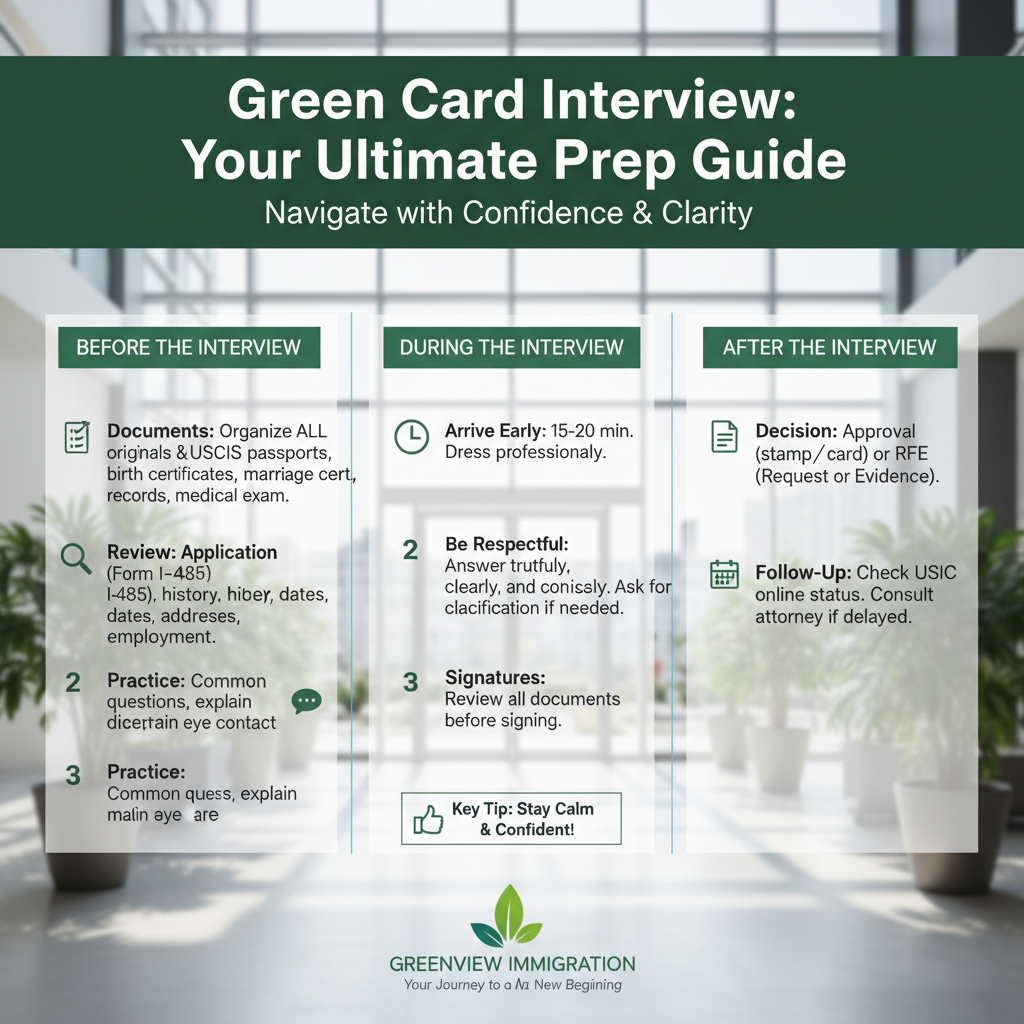
In the dynamic world of immigration law, staying informed is key. Recent discussions and search trends around "immigration law" often highlight the critical importance of proper preparation for the Green Card interview. While the interview itself is a long-standing component of the immigration process, the emphasis on thoroughness and accuracy continues to be a trending topic, reflecting the ongoing need for applicants to be fully ready.
What This News Means for Immigrants in Orlando and Across Florida
For those living in Orlando, Central Florida, and across the Sunshine State, the focus on Green Card interview preparation is particularly relevant. Florida is a melting pot of cultures and a major hub for immigrants from around the world. The Orlando USCIS Field Office, like others nationwide, conducts countless Green Card interviews annually, making expert preparation a local imperative.
Why this news is showing up now
The Green Card interview is not a new requirement; it has been a cornerstone of the permanent residency process for decades. However, the continuous discussion and "trending" nature of interview preparation tips stem from several factors:
- Increased Scrutiny: USCIS officers are often under pressure to thoroughly vet applications to prevent fraud and ensure compliance with immigration laws. This means interviews can be more detailed and require robust evidence.
- Complexity of Cases: As immigration laws evolve and personal circumstances become more intricate, applicants need more sophisticated guidance to navigate their specific situations.
- Digital Age Information Overload: While information is abundant online, distinguishing accurate, up-to-date, and personalized advice from general or outdated content is crucial. People are actively seeking reliable sources.
- Applicant Anxiety: The interview is often the final hurdle before approval, and the stakes are incredibly high. This inherent anxiety drives people to seek every possible advantage through preparation.
- Policy Changes: While the interview itself remains, USCIS policies on evidentiary standards, interview protocols, or even the types of questions asked can subtly shift, making continuous updates on best practices essential.
How it can affect Florida residents
For residents of Orlando, Orange County, and the broader Florida region, understanding the importance of interview preparation has direct implications:
- Local USCIS Office Procedures: While federal law governs the interview, individual USCIS Field Offices, such as the one in Orlando, may have slight variations in how they conduct interviews, what types of questions they emphasize, or their preferred way of organizing documents. Being prepared for general procedures and adapting to local nuances is key.
- Diverse Applicant Pool: Florida's diverse population means a wide range of Green Card categories are processed, from family-based (marriage, parent-child) to employment-based, asylum-based, and special immigrant visas. Each category has unique interview considerations.
- High Volume of Cases: Given Florida's large immigrant population, USCIS offices in the state handle a significant volume of applications. Thorough preparation can help your case stand out positively and potentially expedite a decision, though processing times vary.
- Access to Legal Support: With a robust legal community, Florida residents have access to experienced immigration attorneys who can provide tailored interview preparation, which is vital given the potential for high stakes.
In essence, the ongoing conversation about Green Card interview preparation is a constant reminder that this step is not a mere formality but a critical examination of your eligibility. For Florida residents, especially those navigating the I-4 corridor towards Orlando, taking this preparation seriously is paramount to achieving a successful outcome.
Need Expert Guidance for Your Green Card Interview? Don't face this critical step alone. Our Orlando immigration team at Imigrar has extensive experience preparing clients for successful interviews. Call +1 786-791-3106 for a free consultation, or message us online. Se Habla Español.
What Green Card Interviews Are (and Why They Matter)
A Green Card interview is a mandatory step for most individuals seeking permanent residency in the United States, particularly those applying for Adjustment of Status (applying from within the U.S.) or undergoing Consular Processing (applying from outside the U.S. at a U.S. embassy or consulate). It's a face-to-face meeting with an immigration officer who will review your application, verify your eligibility, and assess your credibility.
A plain-English definition
Think of the Green Card interview as a final, comprehensive check-up on your entire application. It's where you, and often your petitioning family member or employer, answer questions under oath about the information you've submitted. The officer's goal is to ensure you genuinely qualify for a Green Card, that your relationship (if family-based) is authentic, and that you are not inadmissible to the U.S. under any immigration laws.
For example, in a marriage-based Green Card interview, the officer wants to confirm that your marriage is legitimate and not entered into solely for immigration benefits. For employment-based Green Cards, they'll verify the job offer and your qualifications. It’s a chance for USCIS to put a face to the application and ensure all details align.
Key terms you need to know
To navigate the Green Card process and your interview effectively, understanding these key terms is essential:
- Green Card: Also known as a Permanent Resident Card, it grants an individual official authorization to live and work permanently in the United States.
- Adjustment of Status (AOS): The process of applying for a Green Card while physically present in the United States. The interview for AOS usually takes place at a USCIS Field Office, such as the one in Orlando.
- Consular Processing: The process of applying for a Green Card through a U.S. embassy or consulate abroad. The interview takes place in your home country.
- Petitioner: The U.S. citizen or lawful permanent resident (LPR) who files an immigrant petition (e.g., Form I-130) on behalf of a foreign national. For employment-based cases, this would be the employer.
- Beneficiary: The foreign national who is seeking the Green Card and for whom the petition is filed.
- Priority Date: The date USCIS receives your immigrant petition (e.g., Form I-130 or Form I-140). This date determines your place in the visa queue, especially for categories with annual limits.
- Affidavit of Support (Form I-864): A legally binding document signed by the petitioner (and sometimes a joint sponsor) to accept financial responsibility for the immigrant. It's crucial evidence that the immigrant will not become a public charge.
- Public Charge: A ground of inadmissibility for individuals who are likely to primarily depend on the government for subsistence. The Affidavit of Support is designed to mitigate this concern.
- Request for Evidence (RFE): A letter from USCIS requesting additional documents or information to support your application. An RFE can be issued before or after an interview.
- Notice of Intent to Deny (NOID): A letter from USCIS indicating their intention to deny your application unless you provide compelling evidence to overcome their concerns. This is a serious warning.
Current Immigration Law: The Foundation of Your Green Card Interview
The Green Card interview is not an arbitrary process; it is firmly rooted in U.S. immigration law, primarily the Immigration and Nationality Act (INA). The officer conducting your interview is tasked with ensuring your application complies with these federal statutes and regulations.
Federal requirements
The legal framework for Green Card eligibility is complex, but key sections of the INA dictate who can apply and under what conditions. Most Green Card applications fall under:
- INA § 245 (Adjustment of Status): This section outlines the general requirements for individuals seeking to adjust their status to lawful permanent resident while in the U.S. Key conditions include being inspected and admitted or paroled into the U.S., being eligible for an immigrant visa, and having an immigrant visa immediately available.
- INA § 212 (General Classes of Aliens Ineligible to Receive Visas and Ineligible for Admission): This critical section lists grounds of "inadmissibility," which can prevent an applicant from receiving a Green Card. These grounds include health-related issues, criminal history, security-related grounds, public charge concerns, misrepresentation or fraud, and prior immigration violations. During the interview, the officer will assess if any of these grounds apply to you.
- INA § 201-204 (Immigrant Visas): These sections define the categories for immigrant visas, such as family-sponsored (e.g., immediate relatives of U.S. citizens, family preference categories) and employment-based visas, and establish annual numerical limits for most categories (except for immediate relatives).
During your interview, the officer will directly or indirectly evaluate whether you meet the specific eligibility criteria for your Green Card category and whether any grounds of inadmissibility apply to your case. This is why thorough preparation and understanding your application's legal basis are paramount.
Florida-specific considerations
It is important to understand that immigration law is federal law. There are no "Florida-specific" immigration laws that govern Green Card eligibility or interview procedures. However, what *is* specific to Florida residents is the location where your interview will likely take place and the particular nuances of that office.
- Orlando USCIS Field Office: If you are an Orlando or Central Florida resident applying for Adjustment of Status, your interview will most likely be scheduled at the Orlando USCIS Field Office. Familiarizing yourself with its location, parking, and general procedures is practical advice. While the law is federal, the local office environment can impact your experience.
- Local Resources: Florida has a robust network of legal and community resources for immigrants. Leveraging these, especially legal counsel from firms like Imigrar in Orlando, can provide invaluable localized support and insights into the practical aspects of navigating the system in this region.
Important: Always rely on official government sources for immigration information. The USCIS official website is your primary resource for forms, instructions, and policy updates. Key forms relevant to Green Card applications and interviews include:
- Form I-130, Petition for Alien Relative: Filed by a U.S. citizen or LPR to establish a qualifying relationship with a foreign national.
- Form I-485, Application to Register Permanent Residence or Adjust Status: The primary application for a Green Card when applying from within the U.S.
- Form I-864, Affidavit of Support: Required for most family-based and some employment-based Green Cards to demonstrate the applicant will not become a public charge.
- Form I-765, Application for Employment Authorization: Often filed concurrently with Form I-485 to allow work authorization while the Green Card application is pending.
- Form I-131, Application for Travel Document: Often filed concurrently with Form I-485 to allow travel outside the U.S. while the Green Card application is pending (Advance Parole).
Confused by USCIS Forms and Legal Requirements? Imigrar's expert attorneys can help you understand the current immigration laws and prepare all necessary forms accurately. Contact our Orlando office at +1 786-791-3106 for a free consultation. Se Habla Español.
How to Prepare for Your Green Card Interview: A Complete Step-by-Step Guide
Preparation is the single most important factor for a successful Green Card interview. Follow this detailed guide to ensure you are fully ready.
1) Review Your Entire Application Package Thoroughly
The first and most critical step is to re-familiarize yourself with every document you submitted to USCIS. This includes the initial petition (e.g., Form I-130 or Form I-140), your Green Card application (Form I-485), and all supporting evidence. The interviewing officer will have your entire file, and they will expect your answers to be consistent with what's in it.
- Read every form: Go through each question and your answer.
- Review all supporting documents: Birth certificates, marriage certificates, previous divorce decrees, educational documents, employment letters, financial statements, affidavits, photographs, etc.
- Identify potential discrepancies: If there are any minor inconsistencies (e.g., a typo in a date on an old document), make a note and be prepared to explain it honestly.
- Understand your personal history: Be ready to discuss your entry into the U.S., previous immigration history, employment, education, and any significant life events.
Reminder: USCIS officers are trained to spot inconsistencies. Honesty and consistency are paramount.
2) Gather All Original Documents and Their Copies
On the day of your interview, you must bring all original documents that you submitted as copies with your application, plus any additional evidence you wish to present. Organize them meticulously.
- Primary Identification:
- Valid Passport (from your home country)
- Driver's License or State ID (e.g., Florida Driver's License)
- Any previous U.S. visas or entry stamps
- Birth Records:
- Original Birth Certificate for both the beneficiary and the petitioner (if applicable)
- Birth Certificates for all children (if applicable)
- Marriage Records (if applicable, for marriage-based Green Cards):
- Original Marriage Certificate
- Divorce Decrees or Death Certificates for all prior marriages of both spouses
- Financial Documents:
- Original Form I-864, Affidavit of Support, with all supporting documents (tax transcripts for the last three years, W-2s, pay stubs, employment verification letter) for the petitioner and any joint sponsors.
- Proof of assets (bank statements, property deeds) if income alone is insufficient.
- Immigration Documents:
- Original Form I-485 receipt notice
- Original Form I-797 Approval Notices for any previous petitions (e.g., I-130, I-140)
- Employment Authorization Document (EAD card, if you have one)
- Advance Parole document (if you have one)
- All I-94 Arrival/Departure Records
- Police Records/Court Documents:
- Certified copies of any arrest records, court dispositions, or conviction records, even if charges were dropped or expunged. This applies to both the applicant and petitioner.
- Medical Exam:
- Sealed Form I-693, Report of Medical Examination and Vaccination Record (if not already submitted, or if it has expired). Do NOT open this envelope.
- Additional Evidence for Relationship (marriage-based):
- Joint bank accounts (statements)
- Joint leases or property deeds (e.g., for a home in Orlando)
- Joint utility bills (e.g., electricity, water, internet for your Florida residence)
- Joint health or car insurance policies
- Children's birth certificates (if applicable)
- Affidavits from friends/family attesting to the bona fides of the marriage
- Photographs of the couple together over time, with family, at events, etc.
- Travel itineraries, tickets, hotel bookings for trips taken together.
- Correspondence (emails, texts, social media posts, cards)
- Additional Evidence for Employment-based (if applicable):
- Original job offer letter
- Educational degrees, transcripts, professional licenses
- Letters from previous employers
Important: Bring both the original and a clear photocopy of *every* document. Organize them in a binder with tabs for easy access.
3) Organize Your Evidence Logically and Professionally
A well-organized set of documents makes a positive impression and helps the interview flow smoothly. USCIS officers appreciate efficiency.
- Use a Binder: A three-ring binder with dividers and clear page protectors is ideal.
- Label Sections: Create tabs for each category of documents (e.g., "Identification," "Marriage," "Financial," "Joint Assets," "Photos").
- Chronological Order: Within each section, arrange documents chronologically, usually from newest to oldest.
- Table of Contents: Consider creating a simple table of contents at the beginning of your binder.
- Highlight Key Information: For lengthy documents like tax transcripts, use a highlighter to mark the most relevant figures or dates.
4) Practice Answering Common Interview Questions
Anticipating questions and practicing your answers will boost your confidence and help ensure consistency.
- General Questions:
- What is your full name and date of birth?
- What is your address (e.g., in Orlando)?
- How did you enter the U.S.?
- What is your highest level of education?
- What is your current employment?
- Have you ever been arrested or convicted of a crime?
- Have you ever violated immigration laws?
- Do you understand and agree to uphold the U.S. Constitution?
- Marriage-Based Questions:
- How and when did you meet your spouse?
- When and where did you get married?
- Who attended the wedding?
- Describe your daily routine together.
- What are your spouse's hobbies?
- Who handles the finances?
- Where do you both work?
- What did you do last weekend?
- Have you traveled together? Where?
- Employment-Based Questions:
- Describe your job duties.
- What is your salary?
- How long have you worked for this employer?
- What are your qualifications for this position?
Tip: Practice with your spouse (if applicable) or a friend. Ask them to act as the immigration officer. Be truthful, concise, and consistent with your application.
5) Dress Professionally and Arrive Early
First impressions matter, and punctuality is a sign of respect.
- Dress Code: Opt for business casual or professional attire. Avoid overly casual clothing.
- Arrive Early: Plan to arrive at the Orlando USCIS Field Office at least 30-45 minutes before your scheduled appointment. This allows time for parking, security checks, and finding your way. Being late can lead to rescheduling or even denial.
- Bring your appointment notice: You will need this to enter the building.
6) Know What to Expect on Interview Day
Understanding the flow of the interview can reduce anxiety.
- Security Check: Be prepared for airport-style security. Leave prohibited items at home.
- Waiting Area: You will check in and wait for your name to be called.
- Oath: The officer will ask you to raise your right hand and swear to tell the truth.
- Questions: The officer will review your application, ask questions, and examine your original documents. Answer truthfully and directly. If you don't understand a question, ask for clarification.
- Interpreter: If you need an interpreter (and requested one in advance), a certified interpreter will be present or available by phone. Do not bring a family member to interpret unless specifically instructed and approved by USCIS. Imigrar offers services in English and Spanish (Se Habla Español).
- Decision: The officer may make a decision on the spot, but often, cases require further review. You might receive a decision notice in the mail or an RFE.
7) Follow Up After the Interview (If Necessary)
The interview is not always the final step. Be prepared for potential next actions.
- Approval: If approved, you will likely receive a welcome notice and your Green Card in the mail within a few weeks.
- Request for Evidence (RFE): If the officer needs more information, they will send an RFE. Respond promptly and thoroughly.
- Notice of Intent to Deny (NOID): This is serious. You will have a limited time to submit evidence to overcome the grounds for denial.
- Denial: If denied, you will receive a written explanation. You may have options to appeal or refile, depending on the reason for denial. This is where experienced legal counsel from Imigrar is crucial.
Practical Steps You Can Take Today for a Successful Interview
Don't wait until the last minute. Start your preparation now, even if your interview notice hasn't arrived yet.
Actionable checklist for your Green Card interview:
- Locate Your Entire Application Package: Gather all copies of forms and supporting documents you submitted to USCIS.
- Start a "Green Card Interview" Binder: Purchase a binder, dividers, and page protectors. Begin organizing your original documents and their copies.
- Create a Document Checklist: Based on your specific case (family, employment, etc.), list every original document you need to bring.
- Gather New Evidence: Especially for marriage-based cases, collect recent joint bills, photos, or correspondence that demonstrate the ongoing bona fides of your marriage since your application was filed.
- Check Document Expiration Dates: Ensure passports, IDs, and any other time-sensitive documents are still valid.
- Review Your Medical Exam: If you submitted Form I-693 more than two years ago, it might be expired. Check the validity period on the USCIS Forms page. You may need a new one.
- Know Your Travel Route: If your interview is at the Orlando USCIS Field Office, plan your route, parking, and estimated travel time, considering Central Florida traffic, particularly along the I-4 corridor.
- Schedule a Consultation with Imigrar: An attorney can review your case, identify potential issues, and conduct mock interviews.
Document preparation guidance
- Originals and Copies: Always bring both. The officer will review originals and keep copies for the file.
- Translations: Any document not in English must be accompanied by a certified English translation.
- Affidavits: Ensure any affidavits from friends or family are signed, dated, and notarized, including their full contact information.
- Photographs: For marriage-based cases, present a diverse set of photos (different occasions, with family/friends, over time) in chronological order. Avoid presenting hundreds; a curated selection of 20-30 well-captioned photos is usually sufficient.
Timeline expectations
The timeline for receiving an interview notice and a decision can vary significantly. You can check general processing times on the USCIS Processing Times page. For Adjustment of Status cases, after filing Form I-485, it can take several months to over a year to receive an interview notice. After the interview, some receive an immediate decision, while others might wait weeks or months for an RFE or final decision notice. Be patient, but also proactive in following up with USCIS if delays are excessive (though generally, wait until after the posted processing times).

How Imigrar Helps Immigrants in Orlando Prepare for Their Green Card Interview
At Imigrar, we understand that the Green Card interview is a pivotal moment in your immigration journey. Our dedicated team of immigration attorneys in Orlando is committed to providing comprehensive support to ensure you are fully prepared and confident.
Our experience and expertise
With years of experience serving clients nationwide, and a strong presence in Orlando and Central Florida, Imigrar has a deep understanding of USCIS procedures and the nuances of immigration law. We specialize in family-based and employment-based Green Card applications and have successfully guided countless individuals and families through their interviews.
Our services include:
- Case Review: We conduct a thorough review of your entire application, identifying any potential weaknesses or areas that require additional evidence.
- Document Organization: We help you organize your original documents and supporting evidence in a clear, logical manner that will impress the immigration officer.
- Mock Interviews: Our attorneys conduct realistic mock interviews, asking questions similar to those you'll face. This helps you practice your answers, manage nervousness, and ensure consistency. We provide constructive feedback to boost your confidence.
- Addressing Complex Issues: If your case involves previous immigration violations, criminal history, or other complex issues, we develop strategies to address these proactively and prepare you to explain them clearly and truthfully.
- Attorney Presence: In many Adjustment of Status interviews, an Imigrar attorney can accompany you to the Orlando USCIS Field Office. While the attorney cannot answer questions for you, their presence provides peace of mind, ensures your rights are protected, and can help clarify procedural matters.
- Post-Interview Support: Whether it's responding to an RFE or appealing a denial, we stand by you until your case is resolved.


