

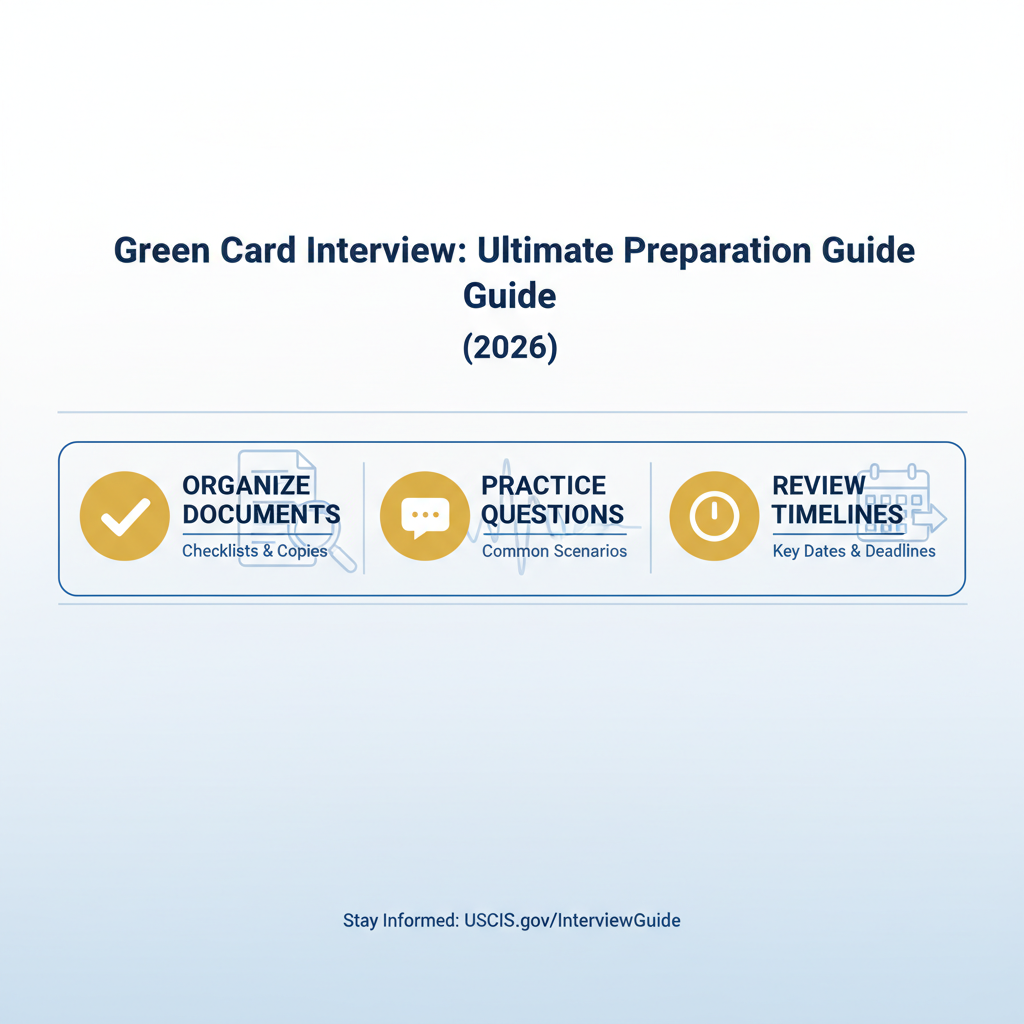
What This News Means for Immigrants in Orlando and Across Florida
The journey to obtaining a Green Card, or lawful permanent residency, is a pivotal moment for countless individuals and families seeking to build a new life in the United States. A critical and often nerve-wracking stage in this process is the Green Card interview. While the specific nuances of immigration law are constantly evolving, the fundamental requirement and importance of this interview remain a constant, central pillar for most Green Card applicants.
Why this news is showing up now
Discussion around Green Card interview preparation is perennially relevant because it's a mandatory step for most applicants for permanent residency, whether they are applying through Adjustment of Status within the U.S. or through Consular Processing abroad. In 2026, as immigration processes continue to adapt to new technologies and policy shifts, the emphasis on thorough preparation has only grown. USCIS (U.S. Citizenship and Immigration Services) and consular officers rely heavily on these interviews to verify information, assess eligibility, and ensure the integrity of the immigration system. As application volumes fluctuate and processing times evolve, applicants are increasingly seeking clear, actionable advice to navigate this essential hurdle effectively. The ongoing conversation in immigration law circles, often reflected in news and legal publications, frequently highlights the need for applicants to be well-prepared to avoid delays or denials, making "Green Card Interview Preparation Tips" a consistently trending and vital topic.
How it can affect Florida residents
For immigrants residing in Florida, particularly those in the bustling Orlando metropolitan area and along the I-4 corridor, the need for meticulous Green Card interview preparation is especially pertinent. Florida is home to one of the nation's largest immigrant populations, and many applicants will have their interviews scheduled at the Orlando USCIS Field Office. This local context means that understanding the specific procedures, potential wait times, and the expectations of officers at this particular office can be incredibly beneficial. For Central Florida residents, preparing adequately ensures that their case proceeds smoothly, minimizing the risk of requests for evidence (RFEs) or, worse, denials that could prolong their separation from family or delay their ability to contribute fully to their communities. Furthermore, Florida's diverse population often means a variety of family-based and employment-based Green Card applications, each with its unique documentation and interview considerations. Being prepared is not just about passing the interview; it's about securing your future in the Sunshine State.
Need Help? Our Orlando immigration team is ready to assist. Call +1 786-791-3106 for a free consultation, or message us online. Se Habla Español.
What Green Card Interviews Are (and Why They Matter)
The Green Card interview is a mandatory step for most individuals seeking lawful permanent residency in the United States. It is a face-to-face meeting with an immigration officer (either from USCIS for Adjustment of Status cases or a consular officer from the U.S. Department of State for Consular Processing cases) designed to verify the information provided in your application, confirm your eligibility, and ensure you are not inadmissible to the U.S. It is a critical juncture where your application transitions from a paper file to a personal assessment of your credibility and intent.
A plain-English definition
Think of the Green Card interview as a final check-up before you get your permanent residency. It's a conversation where an immigration officer asks you questions about your application, your background, and your relationship (if it's a family-based Green Card) to make sure everything is truthful and that you meet all the legal requirements. It's their chance to put a face to the name on the forms and ensure there are no red flags.
Key terms you need to know
- Green Card: Also known as a Permanent Resident Card, it's an identification document that proves an individual is authorized to live permanently in the United States.
- Adjustment of Status (AOS): The process by which an eligible immigrant already in the United States can apply for lawful permanent resident status (a Green Card) without having to return to their home country. This typically involves filing Form I-485.
- Consular Processing: The process by which an eligible immigrant living outside the United States applies for an immigrant visa at a U.S. embassy or consulate in their home country. Once approved, they enter the U.S. as a permanent resident. This typically involves filing Form DS-260.
- Petitioner: The U.S. citizen or lawful permanent resident who sponsors an immigrant for a Green Card (e.g., a spouse, parent, or employer).
- Beneficiary: The immigrant who is being sponsored for a Green Card.
- Form I-130, Petition for Alien Relative: The initial form filed by a U.S. citizen or LPR to establish a qualifying relationship with a foreign relative who wishes to immigrate to the United States.
- Form I-485, Application to Register Permanent Residence or Adjust Status: The primary application form filed by an immigrant who is already in the U.S. to adjust their status to a lawful permanent resident.
- Form DS-260, Immigrant Visa Application: The online application form used by immigrants applying for a Green Card through Consular Processing.
- Request for Evidence (RFE): A letter from USCIS or a consular office requesting additional documents or information to support your application.
- Notice of Intent to Deny (NOID): A letter from USCIS indicating that they intend to deny your application unless you provide specific information or evidence to overcome the grounds for denial.
- Affidavit of Support (Form I-864): A legally binding document signed by the petitioner, promising to financially support the beneficiary if needed.
- Inadmissibility: Grounds under U.S. immigration law that can make an individual ineligible to enter the U.S. or obtain a Green Card (e.g., certain criminal convictions, health issues, past immigration violations).
Current Immigration Law: The Foundation
The framework for Green Card interviews and eligibility is deeply rooted in the Immigration and Nationality Act (INA), the primary body of U.S. immigration law. Understanding these legal foundations is crucial for successful preparation.
Federal requirements
The core legal requirements for obtaining a Green Card are established by federal law. For family-based immigrants, the process typically begins with a U.S. citizen or lawful permanent resident (LPR) filing Form I-130, Petition for Alien Relative, on behalf of their qualifying family member. This form establishes the legitimate family relationship. Once approved, the beneficiary can then apply for their Green Card either through Adjustment of Status (if in the U.S.) or Consular Processing (if abroad).
Key statutes governing eligibility include:
- Immigration and Nationality Act (INA) Section 201 & 203: These sections define who is eligible for immigrant visas, establishing categories for family-sponsored, employment-based, and diversity immigrants, and setting annual limits for most categories.
- INA Section 212: This critical section outlines the grounds of inadmissibility, which are reasons an individual might be barred from entering the U.S. or obtaining a Green Card. These grounds can include health-related issues, criminal history, security concerns, public charge concerns (formerly), and prior immigration violations. Applicants must demonstrate they are not inadmissible or, if applicable, obtain a waiver.
- INA Section 245: This section specifically governs Adjustment of Status for individuals already present in the U.S. It outlines the eligibility criteria, such as having been lawfully admitted or paroled, and having an immigrant visa immediately available. The interview is a direct application of this section, where USCIS officers verify compliance with these requirements.
- INA Section 221 & 222: These sections pertain to immigrant visas issued abroad through consular processing, detailing the application process and requirements for interviews at U.S. embassies and consulates.
During the interview, officers are specifically looking to verify:
- The legitimacy of the relationship (for family-based petitions).
- The accuracy of all information provided in Form I-130, Form I-485, or Form DS-260.
- That the applicant is not subject to any grounds of inadmissibility under INA 212.
- That the petitioner has the financial capacity to support the applicant, as demonstrated by Form I-864, Affidavit of Support.
For the most up-to-date forms, guidance, and policy manuals, always refer to the USCIS official website.
Florida-specific considerations
While immigration law is federal, the practical application often has local nuances. For applicants in Florida seeking Adjustment of Status, your interview will likely be scheduled at the Orlando USCIS Field Office or, depending on your exact location, potentially another field office within the state (e.g., Miami, Tampa, Jacksonville). Each field office has its own scheduling patterns and processing times, although the core legal requirements remain the same.
Reminder: The Orlando USCIS Field Office is located at 6680 Corporate Centre Blvd, Orlando, FL 32822. Familiarizing yourself with the location, parking, and security procedures for your specific interview location is a crucial aspect of preparation that Florida residents should not overlook. The experience at a local field office can sometimes differ slightly from consular interviews abroad due to variations in officer caseloads and local operational procedures.
Need Help? Our Orlando immigration team is ready to assist. Call +1 786-791-3106 for a free consultation, or message us online. Se Habla Español.
How to Prepare for Your Green Card Interview: A Complete Step-by-Step Guide
The Green Card interview is a critical step in your immigration journey. Thorough preparation can significantly increase your chances of a smooth and successful outcome. Here’s a detailed, step-by-step guide to help you get ready.
1) Understand Your Case and Review All Submitted Applications
Before anything else, you must have a crystal-clear understanding of every document you (or your petitioner) have submitted. This includes the initial petition (e.g., Form I-130), the Green Card application (Form I-485 for AOS or Form DS-260 for Consular Processing), and any supporting documents.
- Review Every Form: Read through every question and your corresponding answer on all submitted forms. Ensure you remember the dates, addresses, employment history, and personal details exactly as they were written. Inconsistencies, even minor ones, can raise red flags.
- Understand the Basis of Your Petition: For family-based cases, know the history of your relationship. For employment-based cases, understand the job offer and your qualifications.
- Know Your Timeline: Be familiar with important dates: when you met, when you married, when forms were filed, when you entered the U.S., etc.
Required Documents for Review:
- Copies of all submitted forms (Form I-130, Form I-485, Form DS-260, Form I-864, etc.).
- Any USCIS or NVC notices, including interview notices.
- Your personal notes or timeline of events related to your case.
2) Gather and Organize All Necessary Documents (Originals and Copies)
This is arguably the most crucial step. You must bring originals of all documents you submitted copies of, plus new evidence that has accumulated since your application was filed. Organize everything neatly in a binder or folder with clear dividers.
- Originals of All Previously Submitted Documents: This includes birth certificates, marriage certificates, divorce decrees, passports, visas, I-94 records, previous EADs or Advance Parole documents.
- Copies of All Previously Submitted Documents: Have a complete set of copies for the officer, even if they don't ask for them.
- New Evidence of Relationship (for family-based cases): Photos (dated, with people identified), joint bank accounts, joint leases/mortgages, utility bills in both names, joint insurance policies, tax returns filed jointly, affidavits from friends/family, travel itineraries together, communication records (texts, emails, call logs).
- Financial Documents: Updated Form I-864, Affidavit of Support (if requested or if there have been significant changes), petitioner's most recent tax returns (Form 1040, W-2s, 1099s), pay stubs, employment verification letter. If the petitioner is self-employed, bring business tax returns and profit/loss statements.
- Medical Examination Report: If you underwent a medical exam (Form I-693), ensure you have the sealed envelope. Do NOT open it. If it’s expired, you may need a new one.
- Police Records: If you have any arrests or convictions, bring certified court dispositions for every incident, even if charges were dropped or expunged.
- Translations: Any document not in English must be accompanied by a certified English translation.
- Passport Photos: Bring two recent, passport-style photos, even if you submitted them previously.
Important: For those in Orlando, remember to bring your interview notice. Without it, you may not be allowed into the USCIS field office.
3) Practice Answering Common Interview Questions
While you can't predict every question, many are standard. Practicing your answers aloud will help you articulate clearly and confidently.
- Personal History: Date of birth, place of birth, parents' names, previous addresses, education, employment history.
- Immigration History: How and when you entered the U.S., previous visas, any prior immigration applications or denials.
- Relationship Details (for marriage-based Green Cards): How you met, when you started dating, proposal story, wedding details, daily life together, future plans, names of in-laws, shared holidays.
- Petitioner's Details: Their full name, date of birth, place of employment, parents' names.
- Inadmissibility Questions: Questions about criminal history, health issues, past immigration violations, or membership in certain organizations. Always answer truthfully.
Tip: Have a mock interview with a trusted friend or family member. For complex cases or if you're nervous, consider a consultation with an immigration attorney who can conduct a realistic mock interview.
4) Arrange Logistics and Plan for Interview Day
The day of the interview is stressful enough without last-minute logistical hurdles.
- Location and Time: Confirm the exact address of the USCIS Field Office (e.g., the Orlando USCIS Field Office) or consulate and the interview time.
- Travel: Plan your route, considering traffic (especially if traveling on the I-4 corridor in Orlando) and parking. Aim to arrive at least 30 minutes before your scheduled appointment.
- Attire: Dress professionally. This shows respect for the process and the officer. Business casual is generally appropriate.
- Childcare: If possible, arrange for childcare. While children can attend, it can be distracting during an important interview.
- Attorney Presence: If you have an attorney, confirm their availability and plan to meet them before entering the building.
5) During the Interview: Demeanor and Disclosure
Your conduct during the interview is as important as your documents.
- Be Truthful: This is paramount. Any misrepresentation or false statement can lead to severe consequences, including permanent bars from the U.S.
- Be Polite and Respectful: Address the officer respectfully.
- Answer Clearly and Concisely: Answer only the question asked. Do not volunteer extra information unless it directly clarifies your answer.
- Listen Carefully: If you don't understand a question, ask for clarification. Do not guess.
- Provide Documents When Asked: Only present documents when specifically requested by the officer.
- Remain Calm: It's natural to be nervous, but try to remain composed. If you feel overwhelmed, take a deep breath.
- Interpreter: If you require an interpreter, ensure they are fluent in both English and your native language and are a neutral party (not your petitioner or a witness to your case).
Warning: Never offer bribes or gifts. This is a severe criminal offense.
6) Post-Interview Actions and Follow-Up
The interview isn't always the final step.
- Request for Evidence (RFE): If the officer requests additional documents, submit them promptly and accurately. The RFE letter will specify the deadline, often 87 days (84 days plus 3 for mailing).
- Decision: You might receive a decision on the spot, or it could take weeks or months. You can check your case status online using your receipt number on the USCIS Case Status website.
- Approval: If approved, you will typically receive a welcome notice and your Green Card will be mailed to you within a few weeks.
- Denial: If denied, consult an immigration attorney immediately to understand the reasons and explore options for appeal or refiling.
Practical Steps You Can Take Today
Don't wait until the last minute to prepare for your Green Card interview. Here are actionable steps you can start taking right now:
- Review Your Application Package: Pull out copies of your Form I-130, Form I-485, Form I-864, and all supporting documents. Read through them carefully.
- Start a "Green Card Interview" Folder: Create a physical and/or digital folder to organize all relevant documents.
- Update Your Evidence: For family-based cases, continuously collect new joint documents, photos, and communication records. For employment-based cases, gather recent pay stubs and employment verification letters.
- Check Document Expiration Dates: Ensure your passport, birth certificates, and any other official documents are valid. Renew anything that is close to expiring.
- Consult an Immigration Attorney: Especially if your case has complexities (e.g., previous denials, criminal history, overstays), seeking legal counsel early can make a significant difference. Imigrar offers free consultations to discuss your case.
- Familiarize Yourself with the Interview Location: If your interview is at the Orlando USCIS Field Office, look up its location, parking options, and public transportation routes.
- Practice English (if applicable): If English is not your first language and you plan to speak for yourself, practice conversational English. If you need an interpreter, secure one in advance.
Document Preparation Guidance
Organization is key. Use a binder with labeled tabs for categories like:
- Originals (birth certificates, marriage certificates, passports)
- Copies of Originals
- Relationship Evidence (photos, joint accounts, bills)
- Financial Documents (tax returns, pay stubs, Form I-864)
- Medical Exam (sealed envelope)
- Police/Court Records
- Translation Certificates
- Interview Notice
Always bring both the original documents and a complete set of photocopies. The officer may want to keep the copies and return your originals. For photos, label them on the back with dates and names of individuals. For digital evidence like text messages, print them out clearly.
Timeline Expectations
The time between filing your Green Card application and receiving an interview notice can vary significantly. Processing times depend on the type of Green Card, the specific USCIS field office or consulate, and current caseloads. You can check estimated processing times on the USCIS Processing Times website. Once an interview is scheduled, you typically receive a notice 3-6 weeks in advance. It’s crucial to use this window for intensive preparation. After the interview, a decision can be made on the spot, or it could take several weeks to months. If an RFE is issued, you generally have 87 days to respond. Staying informed and prepared for potential delays is part of the process.
Need Help? Our Orlando immigration team is ready to assist. Call +1 786-791-3106 for a free consultation, or message us online. Se Habla Español.
How Imigrar Helps Immigrants in Orlando
At Imigrar, we understand that the Green Card interview can be one of the most stressful stages in the immigration process. Our mission is to "Keep Families Together" by providing expert legal guidance and compassionate support every step of the way. Based in Orlando, Florida, we proudly serve clients not just in Central Florida but nationwide, offering a local touch with national reach.
Our experience and expertise
Our team of dedicated immigration attorneys has extensive experience guiding thousands of individuals and families through the complexities of Green Card interviews, both for Adjustment of Status cases at the Orlando USCIS Field Office and for Consular Processing cases around the world. We are intimately familiar with the requirements of USCIS and the Department of State, and we stay abreast of the latest policy changes and legal precedents.
When you choose Imigrar, you gain a partner who will:
- Thoroughly Review Your Case: We meticulously examine your entire application package to identify any potential issues or areas for strengthening your case.
- Provide Comprehensive Document Preparation: We help you organize and compile all necessary original and supporting documents, ensuring nothing is missed.
- Conduct Realistic Mock Interviews: Our attorneys will conduct a detailed mock interview, asking common and challenging questions, providing feedback on your answers, demeanor, and presentation.
- Prepare You for Difficult Questions: We help you anticipate and formulate truthful, consistent answers to questions about your relationship, immigration history, or any potential inadmissibility issues.
- Accompany You to the Interview: In many cases, an Imigrar attorney can attend the interview with you, providing legal representation and immediate support should any unexpected issues arise. This presence often provides immense peace of mind.
- Respond to RFEs and NOIDs: If USCIS issues a Request for Evidence or a Notice of Intent to Deny, we strategically prepare and submit a strong response on your behalf.
Free consultation offer
We believe that everyone deserves access to quality legal advice. That's why Imigrar offers a free, no-obligation consultation to discuss your Green Card interview preparation. During this consultation, we can assess your specific situation, answer your initial questions, and outline how our services can best support you. Don't face this critical interview alone – let our expertise be your guide.
Se Habla Español. Our bilingual team is ready to serve the diverse immigrant communities in Orlando and beyond, ensuring clear communication and understanding throughout your legal journey.
Frequently Asked Questions
Q: What is the purpose of the Green Card interview?
A: The primary purpose of the Green Card interview is for an immigration officer (either USCIS or consular) to verify the information provided in your application, confirm your eligibility for permanent residency, and ensure you are not inadmissible to the United States under current immigration law. It allows the officer to assess your credibility, the legitimacy of your relationship (for family-based cases), and your intent to abide by U.S. laws.
Q: Who needs to attend the Green Card interview?
A: Generally, the Green Card applicant (beneficiary) must attend. For family-based applications, the U.S. citizen or lawful permanent resident petitioner is also usually required to attend the interview, especially for marriage-based Green Cards, to jointly answer questions about the relationship. In some cases, children applying with their parents may also need to attend. Your interview notice will specify who must be present.
Q: How long does a typical Green Card interview last?
A: The duration of a Green Card interview can vary significantly. Some interviews are very brief, lasting only 15-20 minutes if the officer finds everything in order and has no further questions. Others, particularly complex cases or those requiring extensive questioning about a relationship, can last 45 minutes to over an hour. It's best to allocate at least 2-3 hours for the entire appointment, including waiting times at the USCIS field office or consulate.
Q: What documents are absolutely essential to bring to the interview?
A: You MUST bring your interview notice, all original birth certificates, marriage certificates, passports, and any other identity documents. Also, bring the original sealed envelope of your medical exam (Form I-693) if you haven't submitted it already, and your Form I-94 (Arrival/Departure Record). For family-based cases, bring comprehensive, updated evidence of your bona fide relationship, such as joint bank statements, utility bills, photos, and leases. Always bring a complete set of copies for the officer. Refer to your interview notice for a specific list.
Q: How much does it cost to prepare for a Green Card interview?
A: The direct cost for the interview itself is included in the filing fees for Form I-485 or Form DS-260. However, there are indirect costs associated with preparation, such as obtaining new copies of documents, certified translations, updated medical exams (if needed), and travel expenses to the interview location (e.g., the Orlando USCIS Field Office). If you hire an immigration attorney like Imigrar, there will be legal fees for their services, which can be a significant investment but often provides invaluable assistance and peace of mind.
Q: What happens if my Green Card application is denied after the interview?
A: If your Green Card application is denied, you will receive a written decision explaining the reasons for the denial. Your options typically depend on these reasons. You may be able to file a motion to reconsider or reopen the case, file an appeal, or, in some situations, refile a new application. It is crucial to consult with an experienced immigration attorney immediately after a denial to understand your legal options and the potential impact on your immigration status. Do not delay, as strict deadlines apply to appeals and motions.

Common Mistakes (and How to Avoid Them)
Preparing for your Green Card interview is a detailed process, and it's easy to overlook crucial aspects. Avoiding these common mistakes can significantly improve your chances of success.
Mistake #1: Insufficient Document Preparation
Many applicants underestimate the sheer volume and organization required for their documents. Showing up with a disorganized pile of papers, or worse, missing critical originals or updated evidence, can lead to significant delays or even a denial. USCIS officers have strict guidelines, and if you can't readily provide requested documents, it casts doubt on your preparation and credibility.
How to Avoid: Start gathering and organizing your documents as soon as you receive your interview notice. Create a detailed checklist based on your interview notice and your application. Use a binder with labeled dividers for originals, copies, and specific categories of evidence (e.g., "Marriage Certificate," "Joint Bank Statements," "Tax Returns"). Bring updated evidence that has accumulated since you filed your application, especially for marriage-


