


The reporting that sparked this guide
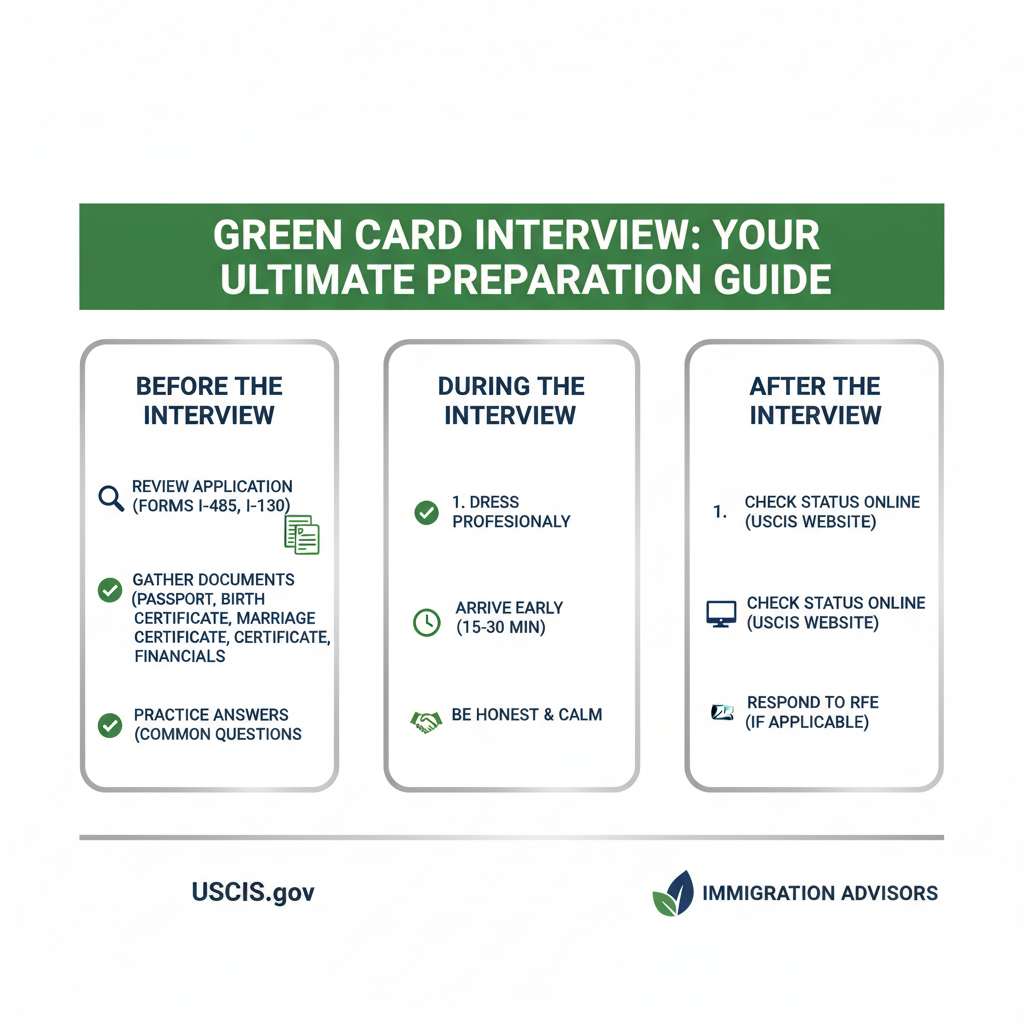
Understanding the ever-evolving landscape of immigration law is crucial for anyone navigating the path to a Green Card. This comprehensive guide draws insights from the ongoing discussions and reports concerning Green Card interview processes and preparation strategies in the broader context of immigration law. For more general news on immigration law, you can refer to: Green Card Interview Preparation Tips (Immigration Law)
What This News Means for Immigrants in Orlando and Across Florida
The Green Card interview is a pivotal step for many individuals and families seeking permanent residency in the United States. While the core process remains consistent, the emphasis on thorough preparation, accurate documentation, and honest communication is continually highlighted in immigration discourse. For individuals and families in Orlando, Central Florida, and throughout the Sunshine State, understanding these nuances is critical for a successful outcome.
Why this news is showing up now
Discussions around Green Card interviews are perennial in immigration law because they represent the final, often most nerve-wracking, stage for many applicants. Recent trends in immigration policy, increased processing times, and a continued focus on national security and preventing fraud mean that USCIS (U.S. Citizenship and Immigration Services) officers are often conducting interviews with heightened scrutiny. As the immigration system adapts, so too must applicants. News and legal analyses frequently emphasize the importance of preparation, not just as good practice, but as a necessity in today's environment. This ongoing conversation underscores the need for applicants to be exceptionally well-prepared, leaving no stone unturned.
How it can affect Florida residents
For Florida residents, particularly those in vibrant, diverse areas like Orlando and its surrounding counties (Orange, Seminole, Osceola), the implications are significant. Florida is a major hub for immigrants, and the Orlando USCIS Field Office handles a substantial volume of Green Card interviews. This means that local applicants must be acutely aware of the standards and expectations. Increased scrutiny nationwide translates directly to interviews conducted in Orlando, where officers are dedicated to upholding federal immigration standards. Additionally, local factors, such as the volume of cases and specific regional policies, can influence processing times and interview scheduling. Residents along the I-4 corridor, for instance, often rely on the Orlando office, making localized, expert advice invaluable. Imigrar, based in Orlando, is uniquely positioned to understand these local dynamics while serving clients nationwide.
Need Help? Our Orlando immigration team is ready to assist. Call +1 786-791-3106 for a free consultation, or message us online. Se Habla Español.
What the Green Card Interview Is (and Why It Matters)
The Green Card interview is a mandatory step for most individuals applying for permanent residency in the United States, whether through Adjustment of Status (applying from within the U.S.) or Consular Processing (applying from outside the U.S.). It is your opportunity to demonstrate your eligibility, verify the information in your application, and prove that you are not inadmissible to the U.S. It is often the final hurdle before receiving your Green Card, making it an incredibly important and often nerve-wracking experience.
A plain-English definition
Simply put, the Green Card interview is a meeting with a U.S. government official (either a USCIS officer for Adjustment of Status cases or a Consular Officer for Consular Processing) who will review your application, ask you questions about your background, your relationship (if applicable), and your intentions. Their primary goal is to ensure that you meet all legal requirements for permanent residency and that there are no grounds for inadmissibility that would prevent you from becoming a lawful permanent resident. It’s a chance for the government to put a face to the file and confirm everything you’ve submitted in writing.
Key terms you need to know
- Green Card (Form I-551): The official identification card proving your status as a lawful permanent resident of the United States.
- Adjustment of Status (AOS): The process of applying for a Green Card from within the United United States without having to return to your home country. This typically involves filing Form I-485.
- Consular Processing: The process of applying for a Green Card through a U.S. Embassy or Consulate in your home country.
- USCIS (U.S. Citizenship and Immigration Services): The government agency responsible for administering immigration and naturalization benefits.
- USCIS Officer: The official who conducts your Green Card interview if you are adjusting status in the U.S.
- Consular Officer: The official who conducts your Green Card interview if you are undergoing Consular Processing abroad.
- Sponsor/Petitioner: The U.S. citizen or lawful permanent resident who files an immigration petition on your behalf (e.g., Form I-130).
- Beneficiary/Applicant: The foreign national seeking a Green Card.
- Affidavit of Support (Form I-864): A legally binding document signed by a sponsor to accept financial responsibility for the applicant.
- Bona Fide Marriage: A marriage entered into in good faith, not solely for immigration purposes. This is crucial for marriage-based Green Cards.
- Inadmissibility: Grounds under immigration law that can prevent an individual from being granted a Green Card (e.g., certain criminal convictions, health issues, immigration violations, public charge concerns).
- Priority Date: The date your immigration petition (e.g., Form I-130) was properly filed. This date determines when your Green Card becomes available.
- Request for Evidence (RFE): A letter from USCIS requesting additional documents or information to support your application.
Current Immigration Law: The Foundation of Your Green Card Interview
The Green Card interview process is deeply rooted in the Immigration and Nationality Act (INA), which is the body of law governing immigration to the United States. Understanding the legal framework is essential for appreciating why certain questions are asked and why specific documents are required.
Federal requirements
The primary legal framework for Green Card eligibility and the interview process can be found in several sections of the INA:
- INA Section 245: Governs Adjustment of Status for individuals already present in the U.S. It outlines the general requirements for adjusting status, including lawful admission or parole, being eligible for an immigrant visa, and being admissible to the U.S.
- INA Section 212: Details the grounds of inadmissibility, which are reasons a foreign national may be denied entry or a Green Card. These include health-related grounds, criminal grounds, security and related grounds, public charge grounds, illegal entry and immigration violations, and others. The USCIS officer will assess whether any of these apply to you during the interview.
- INA Section 204: Pertains to the filing of immigrant petitions (e.g., Form I-130 for family-based immigration). The validity of this petition forms the basis of your Green Card application.
- INA Section 213A: Mandates the Affidavit of Support (Form I-864) for most family-based immigrants and some employment-based immigrants to ensure they will not become a "public charge." The sponsor must demonstrate they can support the applicant at 125% of the poverty line.
During your interview, the USCIS officer will be verifying that you meet the eligibility criteria under these laws and that none of the inadmissibility grounds apply to your specific situation. This involves a thorough review of your submitted forms, such as Form I-130 (Petition for Alien Relative), Form I-485 (Application to Register Permanent Residence or Adjust Status), Form I-765 (Application for Employment Authorization), and Form I-131 (Application for Travel Document), as well as the Affidavit of Support, Form I-864.
For comprehensive information on these and other forms, always refer to the USCIS official website.
Florida-specific considerations
While federal law governs the Green Card process, the practicalities of your interview will be handled by a local USCIS Field Office. For many Central Florida residents, this means the Orlando USCIS Field Office, located at 6650 Forum Drive, Orlando, FL 32821. This office serves applicants from Orange County, Seminole County, Osceola County, and surrounding areas.
There are no Florida-specific immigration laws that affect Green Card eligibility directly. However, local offices may have particular administrative practices or backlogs that can influence processing times. For instance, the Orlando office, like others, has its own scheduling patterns for interviews. Being familiar with the specific location, parking, and security procedures for the Orlando Field Office is a practical step every applicant should take. Imigrar, located in Orlando, is intimately familiar with the procedures and expectations of the local USCIS office, offering clients a distinct advantage.
Need Help? Our Orlando immigration team is ready to assist. Call +1 786-791-3106 for a free consultation, or message us online. Se Habla Español.
How to Prepare for Your Green Card Interview: A Complete Step-by-Step Guide
Preparing for your Green Card interview is crucial for a successful outcome. This comprehensive guide breaks down the process into actionable steps to ensure you are ready.
1) Understand Your Case and Application Thoroughly
Before anything else, you must be intimately familiar with every document you've submitted to USCIS. This includes your initial petition (e.g., Form I-130), your Green Card application (Form I-485), and any supporting documents.
- Review all submitted forms: Read through every question and answer on your Form I-130, Form I-485, and any other associated forms (e.g., Form I-765, Form I-131, Form I-864). Pay attention to dates, addresses, employment history, and travel history.
- Familiarize yourself with your personal history: Be prepared to discuss your birthdate, place of birth, parents’ names, current address, previous addresses, employment history, educational background, and travel history to and from the U.S.
- For marriage-based cases, understand your relationship history: Review key dates such as when you met, started dating, got engaged, married, and moved in together. Think about shared experiences, vacations, and daily life together.
- Identify potential red flags: Consider any past immigration issues, criminal history, or health-related concerns that might arise. Be prepared to explain them honestly and concisely.
2) Gather All Required Documents (Originals and Copies)
This is arguably the most critical step. You must bring originals and copies of every document you submitted, plus new evidence if your case has evolved. Organize everything meticulously in a binder or folder.
- Interview Notice: The original interview notice (Form I-797C).
- Photo Identification: Your passport, driver’s license, or other government-issued photo ID.
- Travel Documents: All current and expired passports, visas, and Form I-94 Arrival/Departure Records.
- Birth Certificates: Original birth certificates for both applicant and petitioner (if applicable), with certified English translations if not in English.
- Marriage Certificate: Original marriage certificate (if applicable), with certified English translation.
- Divorce Decrees/Death Certificates: Originals of any prior divorce decrees or death certificates for previous spouses of both applicant and petitioner (if applicable), with certified English translations.
- Medical Exam Results: Original sealed Form I-693, Report of Medical Examination and Vaccination Record, if you haven’t submitted it already or if it has expired.
- Affidavit of Support (Form I-864) Package:
- Original Form I-864, signed by the petitioner.
- Petitioner’s most recent federal income tax returns (IRS transcripts preferred) and W-2s/1099s.
- Proof of petitioner’s current employment and income (e.g., recent pay stubs, employment verification letter).
- Proof of U.S. citizenship or LPR status for the petitioner.
- Applicant’s Biographical Documents: Original copies of your birth certificate, national identity card, military records (if applicable), and police certificates from all countries where you lived for 6+ months since age 16.
- Photos: Two passport-style photos meeting USCIS specifications, even if you submitted them previously.
- For Employment-Based Cases: Employment offer letter, academic degrees, professional licenses, and letters from previous employers.
Important: Bring both the original documents and a complete set of photocopies for the USCIS officer. Do NOT submit originals unless specifically requested; the officer will usually make copies and return your originals.
For a comprehensive list of required forms, visit USCIS Forms.
3) Prepare for Interview Questions
While you cannot predict every question, many common themes arise. Practice answering these questions honestly and concisely.
- General Biographical Questions: Name, date of birth, place of birth, parents' names, addresses, education, employment, travel history.
- Immigration History: How you entered the U.S., previous visas, any prior immigration applications, any arrests or citations.
- For Marriage-Based Cases (Bona Fide Marriage):
- How and when you met your spouse.
- Details about your wedding.
- Shared living arrangements (current and past addresses).
- Daily routines, hobbies, and activities you share.
- Family interactions and holidays.
- Future plans together (children, home, career).
- Questions about your spouse’s family and background.
- Inadmissibility Questions: Questions related to criminal history, health issues, public charge concerns, or past immigration violations. Be prepared to explain any "yes" answers on your application forms truthfully.
Reminder: Answer truthfully and consistently with your application. If you don't understand a question, ask for clarification.
4) Organize Your Evidence (Especially for Marriage-Based Cases)
Beyond the required documents, compelling evidence of a bona fide marriage is vital. This evidence should demonstrate commingling of finances, shared responsibilities, and ongoing relationship.
- Financial Commingling:
- Joint bank accounts (statements showing activity).
- Joint credit cards.
- Joint leases or mortgage statements.
- Joint utility bills (electricity, water, internet).
- Joint tax returns.
- Life insurance policies with spouse as beneficiary.
- Health insurance policies with spouse as beneficiary.
- Joint vehicle titles or loans.
- Shared Life and Responsibilities:
- Photos together (family events, vacations, daily life) with dates and captions.
- Correspondence (emails, texts, cards) between you and your spouse.
- Affidavits from friends, family, or employers attesting to your relationship.
- Travel itineraries or tickets from joint trips.
- Children’s birth certificates (if any) showing both spouses as parents.
- Joint memberships (gym, clubs).
- Proof of gifts exchanged.
Arrange these documents logically, perhaps in separate sections of your binder, to present them easily if requested.
5) Plan Your Interview Day Logistics
Don't let logistics add stress to an already important day.
- Location: Know exactly where the Orlando USCIS Field Office is located (6650 Forum Drive, Orlando, FL 32821). Plan your route.
- Time: Arrive at least 30 minutes before your scheduled interview time. Security checks can take time.
- Attire: Dress professionally, as you would for a job interview. It shows respect for the process.
- Support: If you have an immigration attorney, they will accompany you. If you need an interpreter (and did not request one with your application), you may bring one, but ensure they are fluent and impartial. For cases involving an attorney, such as those handled by Imigrar, your legal counsel will guide you through the entire process and be present at the interview.
- Children: If you have children from the marriage, you may bring them to the interview, as their presence can serve as additional proof of a bona fide marriage. Inform your attorney beforehand.
6) Attend the Interview with Confidence and Honesty
During the interview, maintain a calm and respectful demeanor.
- Oath: You will be sworn in to tell the truth.
- Listen Carefully: Pay close attention to each question. If you don't understand, ask for clarification.
- Answer Truthfully and Concisely: Provide direct answers. Do not volunteer information that wasn't asked, but do not withhold information either.
- Consistency: Your answers should be consistent with the information in your application. If there are discrepancies, be prepared to explain them honestly.
- Present Documents: Only present documents when asked. Have them organized and readily accessible.
- Attorney's Role: If you have an attorney, they are there to represent you, clarify questions, and protect your rights. They cannot answer for you but can object to improper questions or provide legal context.
Warning: Lying or providing false information to an immigration officer can lead to severe penalties, including denial of your Green Card and potential deportation.
7) Post-Interview Actions
The interview is not always the final step for a decision.
- Decision: The officer may make a decision on the spot, or they may tell you that a decision will be mailed to you.
- Request for Evidence (RFE): If the officer needs more information, they will issue an RFE. Respond promptly and thoroughly by the deadline. Your attorney can assist with this.
- Follow-Up: If you don't hear back within a reasonable timeframe (check USCIS Processing Times), you or your attorney can follow up with USCIS.
- Approval: If approved, your Green Card will be mailed to you, typically within a few weeks.
Practical Steps You Can Take Today for Interview Success
Don't wait until the last minute. Start preparing now to ensure a smooth Green Card interview process.
- Review Your Entire Application Package: Gather all copies of forms (Form I-130, Form I-485, etc.) and supporting documents you submitted. Make sure you remember all the details.
- Create a Master Document Checklist: Based on your specific case type (family-based, employment-based, etc.), make a detailed list of every original document and copy you will need for the interview.
- Start Gathering Originals: Locate all original birth certificates, marriage certificates, passports, divorce decrees, etc. If any are missing, begin the process of obtaining certified copies immediately.
- Organize Your Evidence: If it’s a marriage-based case, begin compiling evidence of your bona fide marriage. This includes joint bank statements, utility bills, photos, and letters. Chronological order often works best.
- Practice Answering Questions: Have a trusted friend, family member, or your attorney conduct a mock interview. Focus on clear, concise, and truthful answers.
- Consult with an Immigration Attorney: Even if you started your application independently, an attorney can review your case, identify potential issues, and prepare you thoroughly for the interview. This is especially vital for residents in Orlando and Central Florida, where local expertise can make a difference.
- Check USCIS Processing Times: Regularly monitor the USCIS Processing Times for your specific form and field office (e.g., Orlando Field Office) to manage your expectations for when your interview notice might arrive.
Document preparation guidance
When preparing documents, remember these key points:
- Originals and Copies: Always bring both. The officer will typically review originals and keep copies.
- Translations: Any document not in English must be accompanied by a complete and accurate English translation, certified by the translator as competent to translate and that the translation is accurate.
- Organization: Use a binder with dividers and labels for different categories (e.g., "Applicant's Docs," "Petitioner's Docs," "Joint Financial," "Relationship Evidence"). This demonstrates preparedness and makes it easy for the officer to review.
- Completeness: Ensure all forms are signed, dated, and fully completed. Missing signatures or information can lead to delays or RFEs.
Timeline expectations
The timeline for a Green Card interview can vary significantly based on the type of petition, your country of origin, and the specific USCIS Field Office or Consulate processing your case. For Adjustment of Status applicants in Orlando:
- Filing to Interview Notice: After filing Form I-485, it can take several months to over a year to receive your interview notice. Check USCIS Processing Times regularly.
- Interview Scheduling: Once your case is "interview ready," the Orlando Field Office will schedule it based on availability.
- Interview to Decision: Sometimes a decision is made immediately. Other times, it can take weeks or even months, especially if an RFE is issued.
Patience and proactive preparation are your best allies throughout this process.
How Imigrar Helps Immigrants in Orlando Prepare for Their Green Card Interview
Navigating the complexities of a Green Card interview can be daunting, but you don't have to face it alone. At Imigrar, an immigration law firm based in Orlando, Florida, we are dedicated to helping families stay together by providing expert legal guidance and support throughout the entire Green Card process.
Our experience and expertise
Our team of experienced immigration attorneys possesses in-depth knowledge of U.S. immigration law and the specific procedures of the Orlando USCIS Field Office. We have successfully guided countless clients through their Green Card interviews, understanding the unique challenges and nuances of each case. We pride ourselves on:
- Comprehensive Case Review: We thoroughly review your entire application package to ensure accuracy and identify any potential issues before your interview.
- Personalized Interview Preparation: We conduct mock interviews, providing you with tailored advice on what questions to expect, how to answer them truthfully and effectively, and how to present your evidence confidently.
- Document Organization: We assist you in organizing all necessary documents, ensuring you have both originals and copies, and that all translations meet USCIS requirements.
- Attorney Representation: One of our knowledgeable attorneys will accompany you to your interview at the Orlando USCIS Field Office, providing legal support, clarifying questions, and protecting your rights throughout the process.
- Post-Interview Support: We continue to assist you with any follow-up actions, such as responding to a Request for Evidence (RFE), until your Green Card is approved.
Our tagline, "Keep Families Together," is not just a motto; it's our mission. We understand the emotional significance of this journey and are committed to providing compassionate and effective legal representation to our clients in Orlando, Central Florida, and nationwide.
Free consultation offer
If you have an upcoming Green Card interview or are considering applying for a Green Card, we invite you to take advantage of our free consultation. This is an opportunity to discuss your specific situation, understand your options, and learn how Imigrar can assist you. Our team is ready to provide the clarity and confidence you need.
Se Habla Español. We are proud to serve the diverse communities of Florida and beyond, ensuring that language is never a barrier to quality legal representation.
Ready to Prepare? Let Imigrar guide you through your Green Card interview. Call +1 786-791-3106 for your free consultation today, or reach out online. Se Habla Español.

Frequently Asked Questions About Green Card Interviews
Q: Who needs to attend the Green Card interview?
A: Typically, both the applicant (beneficiary) and the petitioner (sponsor) must attend the Green Card interview, especially for marriage-based cases. For other family-based categories, generally only the applicant needs to attend, but the petitioner may be required if the USCIS officer deems it necessary. For employment-based cases, only the applicant attends. Your interview notice will specify who must be present. If your attorney from Imigrar accompanies you, they will be present as well.
Q: What if I don't speak English well enough for the interview?
A: If you are not fluent in English, you must bring a reliable, impartial interpreter to your interview. You cannot use your spouse, petitioner, or attorney as your interpreter. It's best to inform USCIS when you file your application that you will need an interpreter. If you hire Imigrar, we can advise you on finding a qualified interpreter or, in some cases, USCIS may provide one, though it's not guaranteed. Se Habla Español at Imigrar, so we can discuss your needs in Spanish.
Q: How long does the Green Card interview usually last?
A: The duration of a Green Card interview can vary significantly. Some interviews may conclude in 15-20 minutes, particularly for straightforward cases. Others, especially complex marriage-based interviews or those with previous immigration issues, can last an hour or more. It's best to allocate at least 2-3 hours for the entire visit to the USCIS Field Office (including waiting, security, and the interview itself).
Q: What kind of documents should I bring to prove a "bona fide" marriage?
A: To prove a bona fide marriage, you should bring a wide range of documents demonstrating your shared life and financial commingling. This includes joint bank statements, joint utility bills, joint leases or mortgage documents, joint tax returns, life insurance policies with your spouse as beneficiary, health insurance policies covering both of you, photos together (with family, friends, on trips), travel itineraries, and affidavits from people who know you as a couple. The more evidence you have, the stronger your case for a real, loving


