


The reporting that sparked this guide
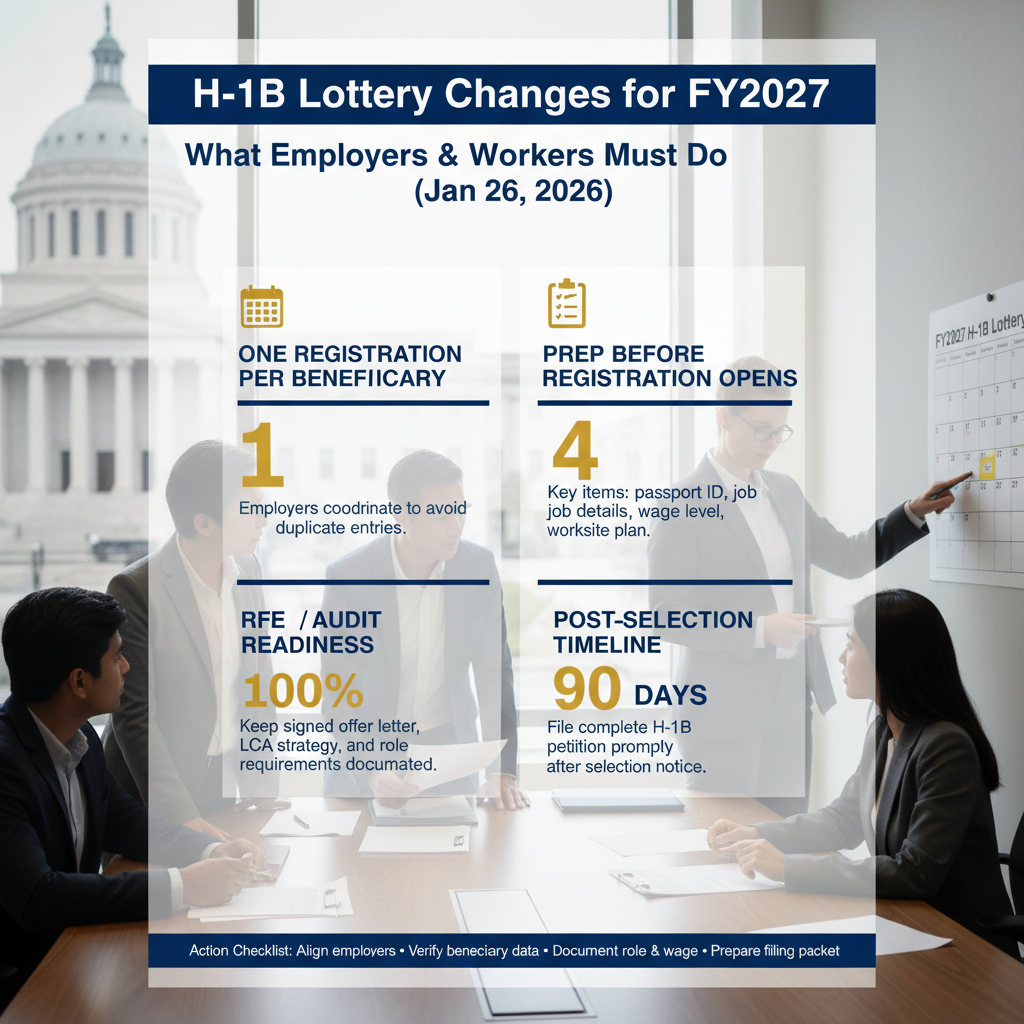
The reporting that sparked this guide: H-1B Visa Lottery Changes for FY2027 (Legal News)
Important: News coverage often summarizes proposed rules, agency announcements, and stakeholder commentary. The practical impact depends on what DHS/USCIS finalizes and publishes. In this guide, we translate the trend into actionable planning steps you can take now—especially if you live or work in Florida.
Need Help? Our Orlando immigration team is ready to assist. Call +1 786-791-3106 for a free consultation, or message us online. Se Habla Español.
What This News Means for Immigrants in Orlando and Across Florida
Why this news is showing up now
The H-1B program is one of the most competitive employment-based visa pathways in the United States. Each year, USCIS runs an electronic registration process (commonly called the “H-1B lottery”) because demand far exceeds the annual cap. When USCIS changes how registrations are submitted, validated, or selected, it can meaningfully affect:
- Whether a worker gets selected at all
- How employers structure offers, start dates, and onboarding
- Compliance risk (Requests for Evidence, denials, fraud findings)
- Backup plans for maintaining lawful status (F-1 OPT/STEM OPT, O-1, TN, L-1, etc.)
FY2027 is trending because employers, universities, and foreign national professionals are planning earlier than ever. Many companies in Florida—especially along the I-4 corridor—are hiring in tech, healthcare, aerospace/defense contracting, tourism analytics, and finance. These sectors rely heavily on cap-subject H-1Bs.
Reminder: “FY2027” refers to the federal fiscal year that begins October 1, 2026. The H-1B cap season for FY2027 typically starts months earlier with electronic registration in the spring of 2026.
How it can affect Florida residents
For Central Florida residents—especially those in Orange County and the broader Orlando metro—H-1B changes can affect both workers and employers:
- F-1 students graduating from UCF, Valencia College pathways, Full Sail, and other schools who need cap-gap coverage or a bridge from OPT to H-1B
- Florida employers that must align start dates, wage offers, and job duties with H-1B compliance
- Families planning around H-4 dependent status, travel, and work authorization rules
If your case is in Orlando, you may also be thinking about downstream steps like Adjustment of Status through employment-based green cards later. While H-1B is a nonimmigrant classification, it often becomes the ��work bridge” to permanent residence depending on your employer and category.
What H-1B Visa Lottery Changes for FY2027 Is (and Why It Matters)
A plain-English definition
The “H-1B lottery” is USCIS’s selection system for cap-subject H-1B petitions. Because Congress limits the number of new H-1Bs each fiscal year, USCIS first collects online registrations from employers during a short registration period. If a registration is selected, the employer can then file the full H-1B petition for that worker.
“H-1B Visa Lottery Changes for FY2027” refers to new or anticipated rules that may change how USCIS:
- Accepts and validates registrations
- Determines eligibility at the registration stage
- Selects registrations (including measures to reduce duplicate or improper entries)
- Reviews specialty occupation, employer-employee relationship, and wage compliance in adjudication
Warning: Even small changes—like stricter identity validation, new attestation language, or revised selection mechanics—can cause avoidable denials if employers and workers rely on last year’s assumptions.
Key terms you need to know
- Cap-subject: H-1B petitions counted toward the annual limit (regular cap + advanced degree exemption).
- Registration: The initial online entry submitted by the employer to request a chance in the selection process.
- Selection notice: USCIS notice that allows the employer to file the full H-1B petition during a filing window.
- Specialty occupation: The H-1B job must normally require at least a bachelor’s degree (or equivalent) in a specific specialty.
- LCA (Labor Condition Application): A Department of Labor filing where the employer attests to wage, working conditions, and notice obligations.
- Cap-gap: A period that may extend an F-1 student’s work authorization/status when an H-1B is timely filed and requests change of status.
- RFE: Request for Evidence—USCIS asks for more documentation before deciding.
- Consular processing: Getting the H-1B visa stamp abroad and entering the U.S. in H-1B status, rather than changing status inside the U.S.
- Priority Date: Usually tied to green card processing (PERM/I-140). Not an H-1B “lottery” date, but crucial for long-term planning.
Current Immigration Law: The Foundation
H-1B rules sit at the intersection of federal statutes, DHS/USCIS regulations, and Department of Labor enforcement. Even when the “lottery” mechanics change, the legal foundation remains the same: the job must qualify, the worker must qualify, and the employer must comply with wage and notice rules.
Federal requirements
Key federal authorities include:
- The Immigration and Nationality Act (INA), including H-1B classification authority under INA §101(a)(15)(H)(i)(b)
- Annual numerical limits under INA §214(g)
- DHS/USCIS regulations at 8 C.F.R. §214.2(h)
- Department of Labor LCA rules generally found at 20 C.F.R. Part 655, Subparts H and I
USCIS is the agency that runs the registration system and adjudicates the petition. Official resources you should use (not social media screenshots) include the USCIS official website, USCIS Forms, and USCIS Processing Times.
The primary petition form for H-1B is Form I-129 (Petition for a Nonimmigrant Worker). Depending on the worker’s situation, other forms may matter later, including Form I-140 (immigrant petition) and Form I-485 for Adjustment of Status. Family-based pathways involve Form I-130, and some individuals may have concurrent or alternative strategies that include Form I-485 as well.
Florida-specific considerations
Immigration law is federal, but Florida-specific realities still matter in H-1B planning:
- Worksite location and wage levels: H-1B wages are tied to the worksite’s geographic area. Orlando/Orange County prevailing wage data can differ from Miami-Dade, Tampa, or Jacksonville.
- Multi-site assignments: Consulting, healthcare, and hospitality analytics roles often involve multiple client sites along the I-4 corridor. That can trigger additional LCA posting and amendment requirements.
- The Orlando USCIS Field Office: While H-1B petitions are generally adjudicated at USCIS service centers, related applications (like Form I-485 interviews) may involve the local field office later.
- Travel planning: Florida’s international connectivity can be a plus, but travel during cap season can also complicate “change of status” strategies.
Important: If your employer is filing H-1B with a change of status, travel outside the U.S. after filing can affect that request. Always confirm your travel plan with counsel before booking.
Need Help? Our Orlando immigration team is ready to assist. Call +1 786-791-3106 for a free consultation, or message us online. Se Habla Español.
How to Prepare for the FY2027 H-1B Lottery Changes: A Complete Step-by-Step Guide
This step-by-step framework is designed for both employers and foreign national professionals. Because the news trend focuses on “new rules affecting H-1B visa applications,” the safest approach is to build a compliance-ready case file before the registration window opens.
1) Confirm the job qualifies as a specialty occupation
Before you worry about the lottery mechanics, confirm the role qualifies. USCIS scrutinizes whether the position normally requires at least a bachelor’s degree in a specific field and whether the duties match that standard.
Documents to prepare:
- Detailed job description (day-to-day duties with percentages)
- Org chart showing where the role sits and who supervises the worker
- Job posting(s) and internal job requisition
- Offer letter with title, salary, worksite address(es), and start date
- Evidence of tools/technologies used (for tech roles) or licensing needs (for healthcare roles)
2) Confirm the worker qualifies (degree, equivalency, and licensing)
USCIS evaluates the beneficiary’s education and experience against the job’s requirements. For foreign degrees, credential evaluations are often essential. If the occupation requires a license, timing matters—some licenses take months.
Documents to prepare:
- Passport biographic page and immigration documents (I-94, prior approvals)
- Diplomas, transcripts, and credential evaluation (if applicable)
- Resume/CV and detailed experience letters from prior employers
- Professional licenses (or proof of eligibility/steps taken)
- If in F-1: I-20s, OPT/STEM OPT EAD, and SEVIS history
3) Build a compliant wage/worksite plan (LCA strategy)
The LCA is not a formality—it is a compliance cornerstone. Your wage must meet or exceed the prevailing wage (or actual wage) for the worksite area. Multi-site work along the I-4 corridor can require careful planning.
Documents to prepare:
- Worksite addresses (including remote work arrangements)
- Proposed salary and compensation breakdown
- Benefits summary (health insurance, bonuses, equity, etc.)
- Internal wage memo showing how pay was set
- Posting notices and proof of posting (physical or electronic, as applicable)
Reminder: A change in worksite location can trigger an amended H-1B. Plan ahead if the worker may move within Florida (e.g., from Orange County to Tampa or Miami).
4) Prepare for registration integrity rules (duplicate prevention, attestations, identity checks)
Recent policy direction has focused on reducing duplicate registrations and improving the integrity of the selection process. If FY2027 introduces stricter validation, employers should assume USCIS will cross-check employer identity and beneficiary information more aggressively.
Documents to prepare:
- Employer FEIN confirmation (IRS letter if available)
- Corporate documents (articles of incorporation, business license)
- Recent payroll records (to show active operations, when needed)
- Signed internal policy confirming “one registration per employer per beneficiary”
- Beneficiary identifiers exactly matching passport and prior filings
Warning: If multiple related entities try to register the same person without a legitimate, independent job offer from each entity, you risk denial and potential fraud findings. Get legal review before any related-company strategy.
5) If selected, file the H-1B petition correctly and on time
Selection only gives you the right to file—USCIS can still deny the petition if the evidence is weak or inconsistent. Filing includes Form I-129 with the H supplement, certified LCA, and supporting documentation.
Documents to prepare:
- USCIS selection notice and registration confirmation
- Completed Form I-129 packet and H Classification Supplement
- Certified LCA
- Employer support letter describing duties, requirements, and worksite
- Beneficiary support documents (degree, evaluation, experience letters)
- Company evidence (financials, contracts, client letters if relevant)
Important: Watch the filing window on the selection notice. Missing it means losing the selection.
6) Plan the start date, status bridge, and travel strategy
Many FY2027 beneficiaries will be in F-1 OPT/STEM OPT or another status. The filing strategy (change of status vs. consular processing) affects travel, work authorization continuity, and risk management.
Documents to prepare:
- Current I-94 and status documents
- Proof of maintenance of status (paystubs, transcripts, enrollment evidence)
- Travel history and upcoming travel plans
- Prior approval notices and visa stamps
- Dependent documents for H-4 (marriage/birth certificates)
Reminder: If you are relying on cap-gap, timing is everything. Don’t assume you have extra time—confirm deadlines with counsel and your designated school official (DSO).
7) Prepare for the “next step” beyond H-1B (long-term planning)
H-1B can be extended, but many professionals want a green card strategy. That’s where Priority Date planning matters. Even if FY2027 lottery rules change, your long-term pathway may involve PERM labor certification, Form I-140, and eventually Form I-485 Adjustment of Status (if eligible).
Documents to prepare:
- Updated resume and role progression plan
- Degree evaluations (if needed for immigrant categories)
- Passport validity plan (renew early)
- Marriage and birth records (for derivatives)
- Prior immigration filings and notices
Practical Steps You Can Take Today
Whether you’re an employer in Central Florida or a professional hoping to be selected, the best defense against rule changes is preparation. Here is an actionable checklist you can start now.
Actionable checklist (do these now)
- Confirm passport validity through at least October 2027 (renew early if needed).
- Standardize your job description with clear duties and a degree field that matches those duties.
- Collect experience letters with exact dates, titles, duties, and supervisor contact info.
- Get a credential evaluation for foreign degrees (and gather syllabi if your major is not obvious).
- Map worksites (Orlando, Lake Mary, Kissimmee, Sanford, Tampa client visits, remote work) and decide where the “primary” location is.
- Budget for fees and premium processing if timing is tight (and confirm who legally pays what).
- Create a backup plan if not selected (STEM OPT extension timing, O-1 profile building, cap-exempt options).
Document preparation guidance
Create a single PDF folder (securely stored) with:
- All I-20s (if F-1), EAD cards, and I-94 history
- All prior approval notices
- Degree documents + translations
- Prior paystubs (to show maintenance of status)
- Employer offer letter and job description
Important: Inconsistent dates, titles, or job duties across documents are a common cause of RFEs. Consistency is a “silent requirement” in USCIS adjudications.
Timeline expectations (planning backward)
While exact dates vary each year, you should plan like this:
- 3–6 months before registration: finalize job description, wage strategy, and beneficiary documentation.
- Registration period (typically spring): employer submits registration(s) for eligible candidates.
- Post-selection filing window: file the full H-1B petition with Form I-129 and evidence.
- Start date: cap-subject H-1B employment typically begins October 1 (fiscal year start) if approved and status allows.
Track case timing using USCIS Processing Times, and confirm travel/visa stamping guidance through the U.S. Department of State.
Need Help? Our Orlando immigration team is ready to assist. Call +1 786-791-3106 for a free consultation, or message us online. Se Habla Español.
How Imigrar Helps Immigrants in Orlando
At Imigrar, our mission is to Keep Families Together while helping professionals and employers navigate complex immigration rules with clarity and confidence. H-1B strategy is not just paperwork—it’s timing, compliance, and risk management.
We help by:
- Evaluating whether the role qualifies as a specialty occupation and how to document it
- Building strong evidence packages to reduce RFEs
- Advising on wage/worksite compliance and amendment risk
- Coordinating cap-gap, travel strategy, and dependent planning
- Creating long-term plans that connect H-1B to green card options (when appropriate)
If you’re an employer hiring in Orlando or a professional living anywhere in Florida, we can assess how FY2027 changes may affect your specific profile and timeline.
Call +1 786-791-3106 for a free consultation. Se Habla Español.
Frequently Asked Questions
Q: Who is eligible to be entered in the FY2027 H-1B lottery?
A: The employer (not the worker) submits the electronic registration for a specific beneficiary. Eligibility generally requires (1) a real job offer in a qualifying specialty occupation, and (2) a beneficiary who meets the job’s education/experience requirements. After selection, the employer files Form I-129 with the certified LCA and supporting evidence. If you’re unsure whether your degree matches the role, get a credential evaluation and legal review before registration.
Q: Can the FY2027 changes affect my current immigration status (F-1, TPS, H-4, etc.)?
A: The lottery rules themselves don’t automatically change your current status, but your strategy can. For example, an F-1 student may rely on cap-gap if the H-1B petition is timely filed and requests change of status. A worker in another status may choose consular processing to avoid change-of-status complications. Warning: Travel after filing a change of status can disrupt that request—confirm your plan before leaving the U.S.
Q: When should Florida employers and workers start preparing for FY2027?
A: Start 3–6 months before the expected registration period. That gives time to finalize the job description, wage/worksite plan, and beneficiary documentation. If your case is in Orlando and you’re coordinating graduation, OPT/STEM OPT, and an October 1 start date, earlier planning can prevent gaps. Use USCIS Processing Times to set expectations after filing.
Q: What documents are most important if USCIS increases scrutiny under new FY2027 rules?
A: The most important documents usually include: a detailed employer support letter, a credible job description with degree requirements tied to duties, proof the company is operating (payroll/tax/financial evidence where relevant), the beneficiary’s degree and transcripts (plus evaluation if foreign), and proof of maintenance of status (I-94, paystubs, I-20s/EADs for F-1). Consistency across documents is critical.
Q: How much does an H-1B case cost, and who pays?
A: Costs typically include USCIS filing fees, optional premium processing, and legal fees. Some fees must be paid by the employer under Department of Labor rules. Because fee structures can change, confirm current fee amounts and payment rules before filing using the USCIS Forms page and USCIS fee instructions. We can provide a clear cost estimate after reviewing your case.
Q: What happens if my registration is not selected or my H-1B petition is denied?
A: If not selected, you generally cannot file a cap-subject H-1B petition for that fiscal year (unless later selections occur). If denied after selection, you may need a rapid backup plan to maintain lawful status—such as extending eligible F-1 STEM OPT, changing to another nonimmigrant classification, or pursuing a cap-exempt H-1B if you qualify. If denial raises status issues, you may also need to understand removal proceedings processes handled by the Executive Office for Immigration Review (EOIR), though most H-1B denials do not automatically place someone in proceedings. Talk to counsel immediately to protect timing and options.
Q: Do FY2027 lottery changes affect green card timelines and my Priority Date?
A: Indirectly. The H-1B lottery impacts whether you can remain employed in H-1B status, which often supports an employer-sponsored green card plan. Your Priority Date is tied to immigrant processing (PERM or I-140 filing date, depending on category), not the H-1B registration. But delays in obtaining H-1B status can delay when an employer starts PERM/I-140. If you’re thinking long-term, discuss a coordinated plan that may later include Form I-485 Adjustment of Status when a visa number is available.
Common Mistakes (and How to Avoid Them)
Mistake #1: Treating the registration like a “simple lottery entry”
Employers sometimes submit registrations without confirming specialty occupation fit, wage strategy, or the beneficiary’s credentials. If FY2027 rules increase front-end validation, weak registrations may become riskier.
How to avoid it: Prepare the case as if you will file tomorrow: job description, degree match analysis, and clean identity data.
Mistake #2: Inconsistent information across documents
Small inconsistencies—like different job titles, mismatched dates of employment, or different worksite addresses—can trigger RFEs or credibility concerns.
How to avoid it: Create a master fact sheet and ensure every document matches it (title, duties, salary, dates, addresses).
Mistake #3: Waiting until the last minute (and losing options)
Last-minute preparation can lead to missing the filing window, rushing credential evaluations, or failing to coordinate cap-gap and travel.
How to avoid it: Start 3–6 months early and build a backup plan if not selected (especially for F-1 students approaching OPT end dates).
Need Help? Our Orlando immigration team is ready to assist. Call +1 786-791-3106 for a free consultation, or message us online. Se Habla Español.
Official Resources and Where to Verify Updates
Because FY2027 changes may evolve, verify developments using official sources:
- USCIS official website (H-1B cap season announcements and policy updates)
- USCIS Forms (current editions and filing addresses)
- USCIS Processing Times (case timing estimates)
- U.S. Department of State (visa stamping and consular procedures)
- Executive Office for Immigration Review (immigration court information, when relevant)
Reminder: If a headline claims a “new rule,” look for the underlying DHS/USCIS announcement, Federal Register notice, or USCIS policy guidance.

Closing: Protect Your FY2027 H-1B Strategy Now
H-1B cap season is unforgiving: short registration windows, strict filing deadlines, and evolving integrity measures. If FY2027 introduces meaningful lottery or adjudication changes, the winners will be the employers and professionals who prepare early, document thoroughly, and choose the right filing strategy.
For Central Florida residents, the stakes are often personal—careers, spouses, children, and long-term stability. Imigrar is here to help you build a compliant plan that supports both work authorization today and future options like Adjustment of Status through Form I-485 when the time is right.
Need legal guidance for the FY2027 H-1B lottery? Call Imigrar at +1 786-791-3106 for a free consultation, or message us online. Se Habla Español. Our Orlando team proudly serves clients nationwide.
Need Help? Our Orlando immigration team is ready to assist. Call +1 786-791-3106 for a free consultation, or message us online. Se Habla Español.


