


The reporting that sparked this guide
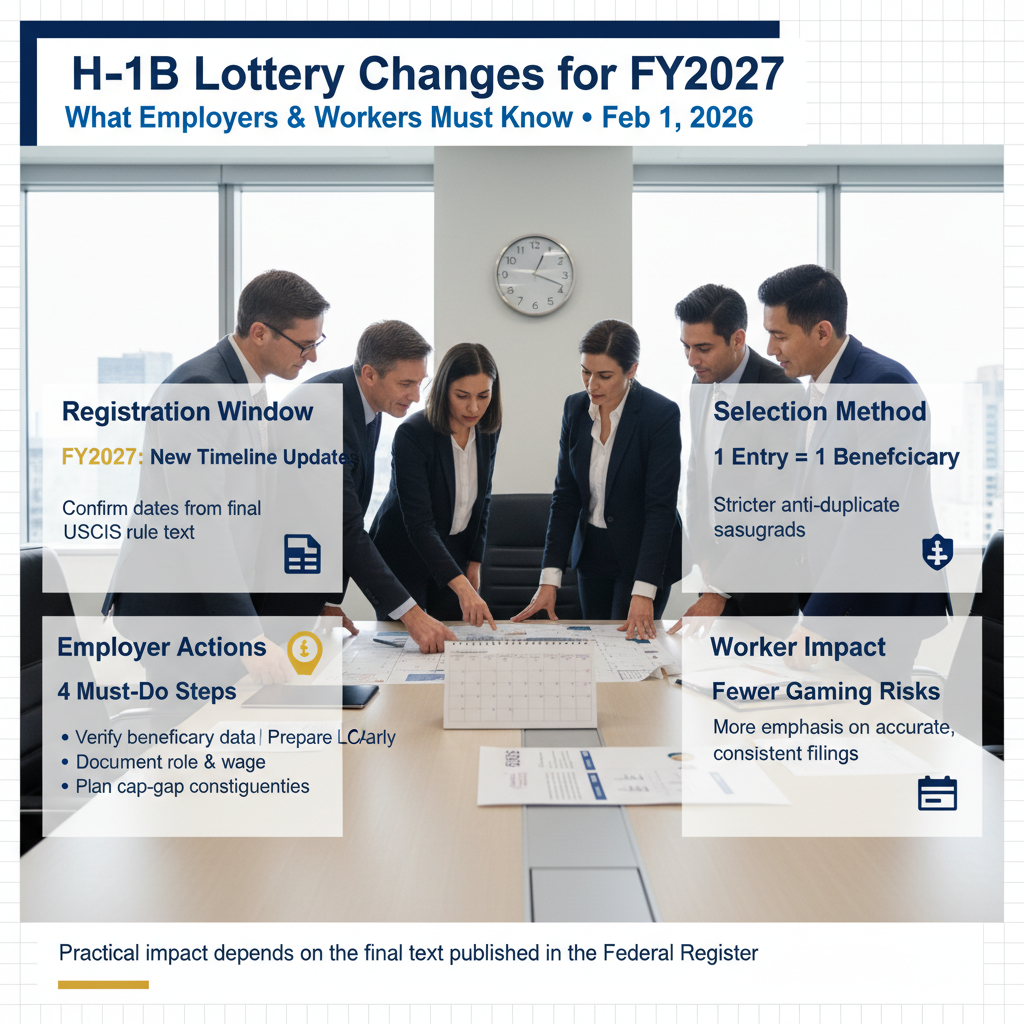
This article is based on trending coverage and ongoing updates in immigration law reporting, including: H-1B Visa Lottery Changes for FY2027 (Legal News).
Important: News coverage often summarizes proposed or recently finalized rules. The practical impact depends on the final text published in the Federal Register and how USCIS implements it in the H-1B registration system for the FY2027 cap season.
Need Help? Our Orlando immigration team is ready to assist. Call +1 786-791-3106 for a free consultation, or message us online. Se Habla Español.
What This News Means for Immigrants in Orlando and Across Florida
Why this news is showing up now
Every year, the H-1B cap season creates intense demand because the number of applicants typically far exceeds the annual limit (the “cap”). USCIS has been modernizing the selection process to reduce fraud, improve fairness, and better match selections to real jobs and real workers. As FY2027 planning begins, employers, universities, staffing companies, and foreign national professionals are watching for:
- Changes to how USCIS counts “entries” in the lottery (for example, focusing on the worker rather than multiple registrations).
- New integrity measures that increase scrutiny of duplicate or coordinated filings.
- Registration system updates and timing changes that affect preparation and budgeting.
- Policy shifts that can change approval trends, Requests for Evidence (RFEs), and compliance expectations.
Reminder: Even when “lottery rules” change, employers must still prove the underlying H-1B case: a real specialty occupation, a qualified worker, and compliance with wage and worksite rules.
How it can affect Florida residents
Florida—especially Central Florida along the I-4 corridor—has a growing technology, healthcare, hospitality, aerospace/defense, and logistics economy. That means many H-1B roles are concentrated in:
- Software and IT (developers, analysts, cybersecurity).
- Engineering (industrial, electrical, mechanical, aerospace).
- Healthcare (certain specialized roles, health informatics, researchers).
- Finance and data analytics.
- Higher education and affiliated research institutions.
If your case is in Orlando, these changes may impact how your employer plans registrations, how early you must prepare documents, and how carefully your job description and worksite plans must be documented. For Central Florida residents, timing is critical: leases, driver’s license renewals, travel, OPT/STEM OPT expiration dates, and family planning can all depend on whether you are selected and when an H-1B petition is filed.
Need Help? Our Orlando immigration team is ready to assist. Call +1 786-791-3106 for a free consultation, or message us online. Se Habla Español.
What H-1B Visa Lottery Changes for FY2027 Is (and Why It Matters)
A plain-English definition
The “H-1B lottery” is USCIS’s selection process for cap-subject H-1B petitions when more employers want to sponsor workers than the law allows each fiscal year. “H-1B Visa Lottery Changes for FY2027” refers to new or updated rules and procedures that may change:
- How USCIS accepts registrations (who can register, what information is required, and how duplicates are handled).
- How USCIS selects registrations (for example, whether selection is tied to the worker rather than multiple employer entries).
- How USCIS reviews and enforces compliance (more audits, more RFEs, stricter documentation expectations).
- How filing timelines work after selection (deadlines, evidence, and system logistics).
Why it matters: If you miss a registration deadline, submit inconsistent information, or your employer’s registration strategy violates new integrity rules, you may lose your chance for the entire year—even if you are otherwise fully eligible.
Key terms you need to know
- Cap-subject H-1B: Most private-sector H-1B filings subject to the annual limit.
- Cap-exempt H-1B: Certain employers (universities, nonprofit research organizations, and some affiliated entities) not subject to the cap.
- H-1B registration: The electronic pre-registration step employers submit to USCIS before filing a full petition.
- Beneficiary: The foreign national worker the employer wants to sponsor.
- Specialty occupation: A job that normally requires at least a bachelor’s degree (or equivalent) in a specific specialty.
- LCA (Labor Condition Application): A Department of Labor filing that attests to wage and working condition requirements.
- RFE: Request for Evidence—USCIS asks for more proof before deciding.
- Consular processing: Getting the H-1B visa stamp abroad and entering the U.S. in H-1B status.
- Change of status: Switching to H-1B status inside the U.S. (commonly from F-1/OPT).
- Warning: Terms like Adjustment of Status and Priority Date are usually associated with green cards (not H-1B), but they often matter in long-term planning because many H-1B workers later pursue permanent residence through employment-based categories.
Current Immigration Law: The Foundation
Even if USCIS updates lottery mechanics for FY2027, H-1B eligibility still comes from federal statutes, regulations, and agency guidance. The main legal framework includes:
- Immigration and Nationality Act (INA) provisions governing nonimmigrant workers (H classification).
- Regulations at 8 C.F.R. § 214.2(h) (H-1B requirements and petition rules).
- Department of Labor rules for LCAs (wage, notice, and working conditions) under 20 C.F.R. Part 655.
Federal requirements
At a minimum, a cap-subject H-1B case typically requires:
- A U.S. employer offering a qualifying job in a specialty occupation.
- Evidence the worker has the required degree (or equivalent) related to the position.
- An approved LCA for the correct worksite(s), wage level, and job classification.
- A properly filed petition with USCIS—most commonly Form I-129 (Petition for a Nonimmigrant Worker) with the H Classification Supplement and H-1B Data Collection.
USCIS may also evaluate whether the employer-employee relationship is real, whether the job is available for the requested period, and whether third-party placement is properly documented.
Official resources to monitor: USCIS official website, USCIS Processing Times, and USCIS Forms.
For visa stamping and travel rules, see: U.S. Department of State.
Florida-specific considerations
Immigration is federal, but Florida-based cases often have local, practical issues that affect success:
- Worksite documentation: For employers with worksites across Orange County and the I-4 corridor (Orlando, Lake Mary, Sanford, Kissimmee, Celebration, Lakeland, Tampa), it’s crucial that the LCA matches where the employee will actually work.
- Hybrid/remote work: If the worker will work from home in Florida, the LCA and public access file steps must be done correctly.
- Compliance culture: Florida employers should prepare for potential audits—especially if the business uses staffing models or third-party client placements.
- The Orlando USCIS Field Office: While many H-1B petitions are adjudicated at service centers, local field offices can become relevant for related filings (dependents, changes/adjustments, interviews, or compliance issues). Planning should account for local logistics and travel time.
Important: This article includes references to common family-based forms like Form I-130 and Form I-485, and terms like Adjustment of Status and Priority Date, because many H-1B workers later transition to permanent residence. But the primary H-1B petition form is typically Form I-129.
Need Help? Our Orlando immigration team is ready to assist. Call +1 786-791-3106 for a free consultation, or message us online. Se Habla Español.
How to Prepare for the FY2027 H-1B Lottery Changes: A Complete Step-by-Step Guide
Below is a practical roadmap for workers and employers preparing for the FY2027 cap season in light of heightened scrutiny and potential lottery process updates. Because USCIS can change exact dates and procedures, treat this as a planning framework and confirm details on the USCIS official website.
1) Confirm the job qualifies as a “specialty occupation” (before registration opens)
The best lottery strategy starts with a strong underlying case. USCIS can deny even a selected case if the job duties and degree requirements are not specific and credible.
Documents to gather:
- Detailed job description (day-to-day duties, tools/technologies, reporting structure).
- Minimum requirements (degree field(s), years of experience, certifications).
- Organizational chart showing where the role fits.
- Evidence of business operations (website, marketing materials, contracts, invoices as relevant).
- Comparable job postings (internal and industry examples).
2) Identify the correct wage level and worksite plan (LCA strategy)
The LCA is not just a formality. Wage levels, SOC codes, and worksites must match reality. If FY2027 changes increase enforcement, mismatches can trigger RFEs or denials.
Documents to gather:
- Worksite addresses (office, client site, home office if remote).
- Work schedule and hybrid policy.
- Proposed salary and compensation breakdown.
- Evidence supporting wage level selection (duties complexity, supervision, experience requirements).
- Client letters and statements of work (if third-party placement applies).
3) Prepare beneficiary eligibility evidence (degree, equivalency, licensing)
USCIS focuses heavily on whether the worker’s education matches the job. If the degree is foreign, credential evaluation may be needed. If the role requires a professional license, timing matters.
Documents to gather:
- Diplomas and transcripts (all post-secondary education).
- Foreign credential evaluation (if applicable).
- Resume/CV and reference letters verifying experience.
- Professional licenses (if required) and proof of eligibility for licensure.
- Immigration documents: passport biographic page, current I-94, prior approval notices, EAD (if any).
4) Submit a compliant H-1B registration and avoid duplicate/coordination pitfalls
FY2027-related news suggests continued tightening around duplicate registrations and coordinated filings. If USCIS detects improper behavior—such as multiple related entities filing to increase selection odds—USCIS may deny or revoke approvals.
Documents/info to gather:
- Exact legal name, passport details, and country of citizenship for the beneficiary.
- Employer FEIN, legal name, address, and authorized signatory.
- Corporate relationship documents if there are related entities (to assess risk).
- Internal compliance memo documenting why the registration is legitimate (best practice).
Warning: “Gaming the system” can lead to denial, revocation, and potential findings of misrepresentation. A clean, well-documented filing strategy is safer than an aggressive one.
5) If selected, file the full H-1B petition correctly and on time (the filing window)
Selection is only the beginning. The employer must file the complete H-1B petition within USCIS’s stated filing period (often described as a 90-day window after selection, though USCIS sets exact dates each year).
Documents to gather:
- Certified LCA.
- Form I-129 package with supplements and filing fees.
- Employer support letter explaining specialty occupation and need.
- Beneficiary degree/evaluation and immigration status documents.
- Employer financials and business evidence (as appropriate to the case).
- Third-party work evidence (contracts, SOWs, end-client letter) if applicable.
Reminder: If the worker is in F-1 OPT/STEM OPT, timing may determine whether “cap-gap” benefits apply and whether the worker can keep working while the H-1B is pending.
6) Track the case, respond to RFEs, and plan travel carefully
After filing, USCIS may issue an RFE. Strong RFE responses often decide the outcome. Also, travel can be risky during change-of-status processing.
Documents to gather:
- USCIS receipt notice and tracking.
- Evidence updates (new projects, updated org charts, paystubs).
- If RFE: detailed exhibits addressing each point with citations and proof.
- For travel: valid passport, valid visa stamp (if needed), I-797 approval, and employment verification letter.
7) Coordinate long-term planning (dependents, extensions, green card strategy)
Many H-1B workers eventually pursue permanent residence. Planning early can reduce gaps and stress—especially for nationals facing backlogs where Priority Date becomes crucial.
Documents to gather:
- Marriage certificate and children’s birth certificates (for H-4 dependents).
- Prior immigration history and prior petitions.
- Employment history and performance documentation (for future PERM/EB cases).
- Family-based options (if any), which may involve Form I-130 and later Form I-485 for Adjustment of Status when eligible.
Practical Steps You Can Take Today
Whether you are an employer in Orange County or a professional living in Orlando, preparation is the best protection against shifting lottery rules and stricter scrutiny.
Actionable checklist (do this now)
- Confirm your passport validity (aim for at least 6+ months beyond the intended H-1B start date).
- Standardize your name and identity data across passports, diplomas, evaluations, and USCIS filings to avoid mismatches.
- Update your resume and role description to match the specialty occupation narrative (duties + degree field alignment).
- Collect transcripts early (some universities take weeks to issue official copies).
- Request reference letters from prior employers to document specialized experience (especially if using experience equivalency).
- For employers: audit worksites and remote-work addresses and confirm the LCA posting process.
- Budget for filing fees and legal support and confirm who pays what (employer vs. employee) under wage and fee rules.
Document preparation guidance
Create a single secure folder (digital + backup) that includes:
- Passport, visa stamps, I-94, prior I-797 approvals.
- All I-20s/DS-2019s (if applicable), EAD cards, paystubs, and offer letters.
- Degree documents + credential evaluation (if foreign degree).
- Employer job description and organizational chart.
Timeline expectations (typical cap season planning)
- 2–4 months before registration: role review, wage strategy, degree evaluation, compliance planning.
- Registration period: employer submits registration in USCIS system (USCIS announces dates).
- After selection: petition filing during USCIS’s stated period (often a 90-day window).
- Adjudication: varies by service center and premium processing availability; check USCIS Processing Times.
- Start date: for cap-subject cases, commonly October 1 of the fiscal year (unless rules change).
Important: If you are in a time-sensitive situation (OPT expiring, status change pending, prior denials), speak with counsel early—waiting can remove options.
How Imigrar Helps Immigrants in Orlando
At Imigrar, we help employers and professionals navigate complex immigration processes with a focus on compliance, clarity, and long-term stability—so families can plan their lives with confidence. Our tagline is “Keep Families Together”, and that includes helping work-authorized pathways succeed while protecting dependent spouses and children.
Our support typically includes:
- H-1B case strategy (specialty occupation analysis, wage/worksite planning, evidence mapping).
- Registration risk review (duplicate/related-entity issues and integrity compliance).
- Full petition preparation and RFE responses.
- Coordination for H-4 dependents and long-term planning toward permanent residence (including cases that later involve Form I-130, Form I-485, Adjustment of Status, and Priority Date strategy).
- Guidance if your matter intersects with proceedings—resources may include the Executive Office for Immigration Review.
If your case is in Orlando, we can also help you plan around local logistics and deadlines affecting work, travel, and family stability in Orange County and across the I-4 corridor.
Call for a free consultation: +1 786-791-3106. Se Habla Español.
Need Help? Our Orlando immigration team is ready to assist. Call +1 786-791-3106 for a free consultation, or message us online. Se Habla Español.
Frequently Asked Questions
Q: Who is eligible for the H-1B lottery under the FY2027 rules?
A: Eligibility still generally requires (1) a U.S. employer willing to sponsor you, (2) a qualifying specialty occupation job, and (3) proof you meet the job’s minimum requirements (usually at least a bachelor’s degree in a related field or equivalent). FY2027 changes may affect how USCIS counts registrations and screens duplicates, but the underlying eligibility standards remain tied to 8 C.F.R. § 214.2(h) and the LCA rules under 20 C.F.R. Part 655. If you are unsure whether your degree matches your role, get a legal review before registration.
Q: Can multiple employers register me to improve my chances?
A: Multiple legitimate, unrelated job offers can be lawful, but it is high-risk if filings appear coordinated, duplicative, or designed to game the selection system. USCIS has increased scrutiny of duplicate registrations in recent years, and FY2027 news suggests continued integrity enforcement. Warning: If USCIS believes registrations were not bona fide, it can deny or revoke. The safest approach is to ensure each registration reflects a real, independent job offer with real work and a real hiring need.
Q: How does this affect my current immigration status (F-1 OPT, STEM OPT, H-4, etc.)?
A: The impact depends on whether you are selected and whether your employer files a change-of-status H-1B petition on time. F-1 students may rely on “cap-gap” rules if eligible, but timing is critical. If you are in H-4 or another status, you may pursue a change of status or consular processing depending on your situation. If you are also planning a green card path, concepts like Priority Date and Adjustment of Status (often through Form I-485) may later become relevant—even though they are separate from the H-1B process.
Q: What is the expected timeline for the FY2027 H-1B season?
A: USCIS typically opens registration in the spring and announces selections shortly after the registration period closes, followed by a filing period that is often described as a 90-day window. Processing times vary—check USCIS Processing Times. Reminder: Cap-subject H-1B start dates are commonly October 1, but you must confirm the exact calendar USCIS publishes for FY2027.
Q: What documents are most important to avoid delays or RFEs?
A: The most common “make-or-break” evidence includes: (1) a strong employer support letter explaining specialty occupation duties, (2) degree transcripts/diplomas and any credential evaluation, (3) a properly prepared LCA that matches the worksite(s), wage, and SOC code, and (4) third-party documentation if you will work at a client site. Inconsistent job titles, vague duties, and missing proof of the employer-employee relationship are frequent RFE triggers.
Q: How much does an H-1B case cost?
A: Costs can include USCIS filing fees, optional premium processing, attorney fees, and related expenses (like credential evaluations). Who pays what matters: certain fees are required to be paid by the employer and cannot be shifted to the employee in a way that reduces the wage below required levels. Because fee structures can change, confirm current amounts on the USCIS Forms page and consult counsel for a compliant cost plan.
Q: What happens if my registration is not selected or my petition is denied?
A: If not selected, you generally cannot file a cap-subject H-1B petition for that fiscal year unless USCIS runs additional selection rounds. If denied after selection, options may include refiling (if still within the filing period and the issue is fixable), changing employers, exploring cap-exempt H-1B options, or considering other classifications (O-1, L-1, TN for eligible Canadians/Mexicans, etc.). If your status is expiring, you must act quickly to avoid unlawful presence. Important: If you are considering family-based options, processes may involve Form I-130 and potentially Form I-485 for Adjustment of Status when a visa is available and your Priority Date is current.
Common Mistakes (and How to Avoid Them)
Mistake #1: Treating selection as “approval”
Lottery selection only gives the employer the chance to file. USCIS can still deny if the job is not a specialty occupation, the wage/worksite plan is inconsistent, or the worker’s degree does not match. Avoid this by building the case like it will be audited: clear duties, clear degree link, and clean documentation.
Mistake #2: Duplicate or coordinated registrations that trigger integrity flags
USCIS has been focused on suspicious patterns—especially where multiple related entities register the same beneficiary. Avoid this by documenting legitimate business reasons, ensuring each registration reflects a bona fide job, and getting legal review when corporate relationships or staffing models exist.
Mistake #3: Worksite and remote-work mismatches (LCA errors)
A common RFE/denial driver is an LCA that doesn’t reflect where the employee will actually work—especially with hybrid schedules. Avoid this by confirming all worksites (including home addresses when needed) and keeping a compliant public access file.
Additional Official Resources to Monitor
Because FY2027 changes may be implemented through agency updates, always confirm details using official sources:
- USCIS official website
- USCIS Processing Times
- USCIS Forms
- U.S. Department of State
- Executive Office for Immigration Review
Reminder: If you later pursue permanent residence, you may encounter Priority Date tracking and Adjustment of Status steps (often involving Form I-485). Family-based pathways may involve Form I-130.
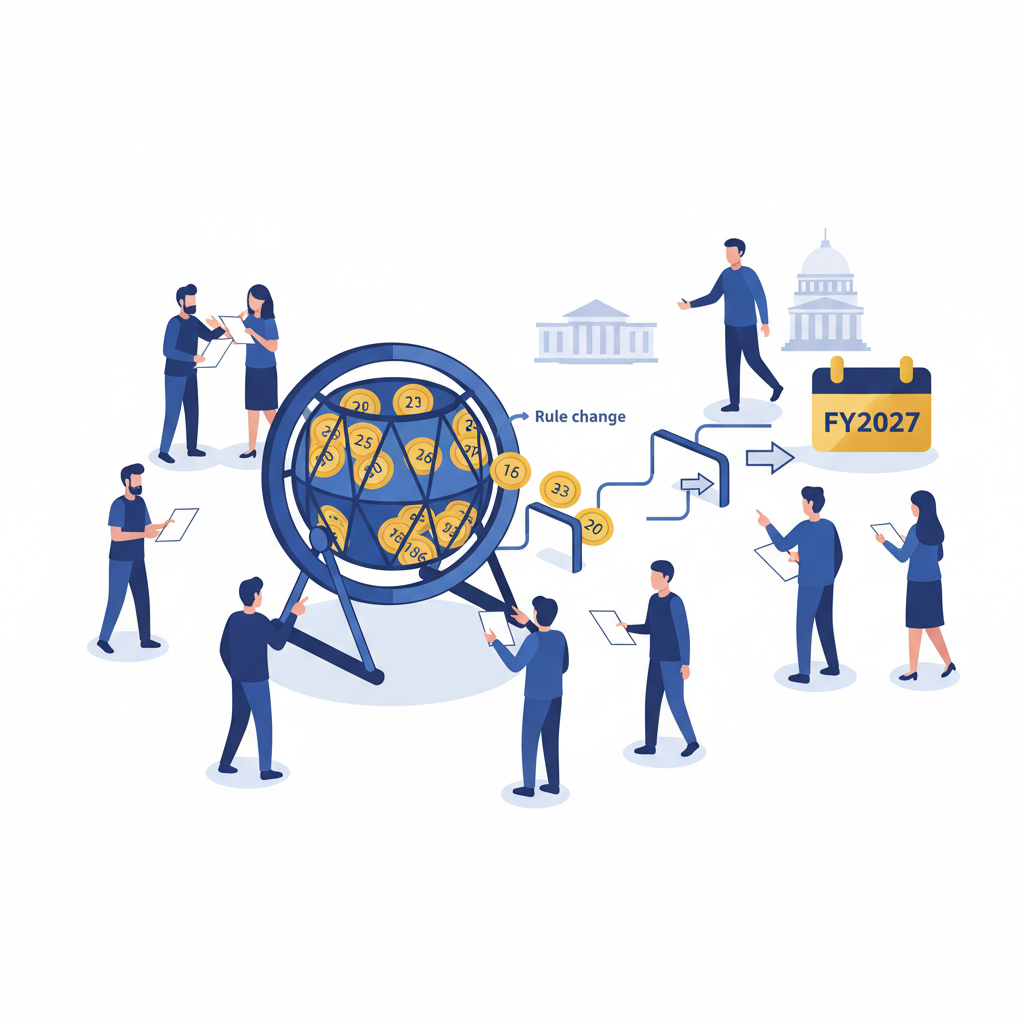
Plan Now for FY2027: Protect Your Job, Status, and Family
The biggest risk with lottery changes is waiting until the last minute. If you are an employer hiring talent in Orlando or across Florida—or a professional trying to stay employed lawfully—your best advantage is early preparation, clean documentation, and a compliant strategy.
For Central Florida residents, planning is especially important when your OPT/STEM OPT end date, lease, travel plans, or family needs depend on a timely filing. If your case is in Orlando, our team can help you build a strong, well-documented petition designed to withstand increased scrutiny.
Need Help? Our Orlando immigration team is ready to assist. Call +1 786-791-3106 for a free consultation, or message us online. Se Habla Español.
Closing call to action
To discuss FY2027 H-1B lottery planning, compliance concerns, or backup options if you are not selected, contact Imigrar today. Call +1 786-791-3106 or message us online for a free consultation. Se Habla Español.


