


The reporting that sparked this guide
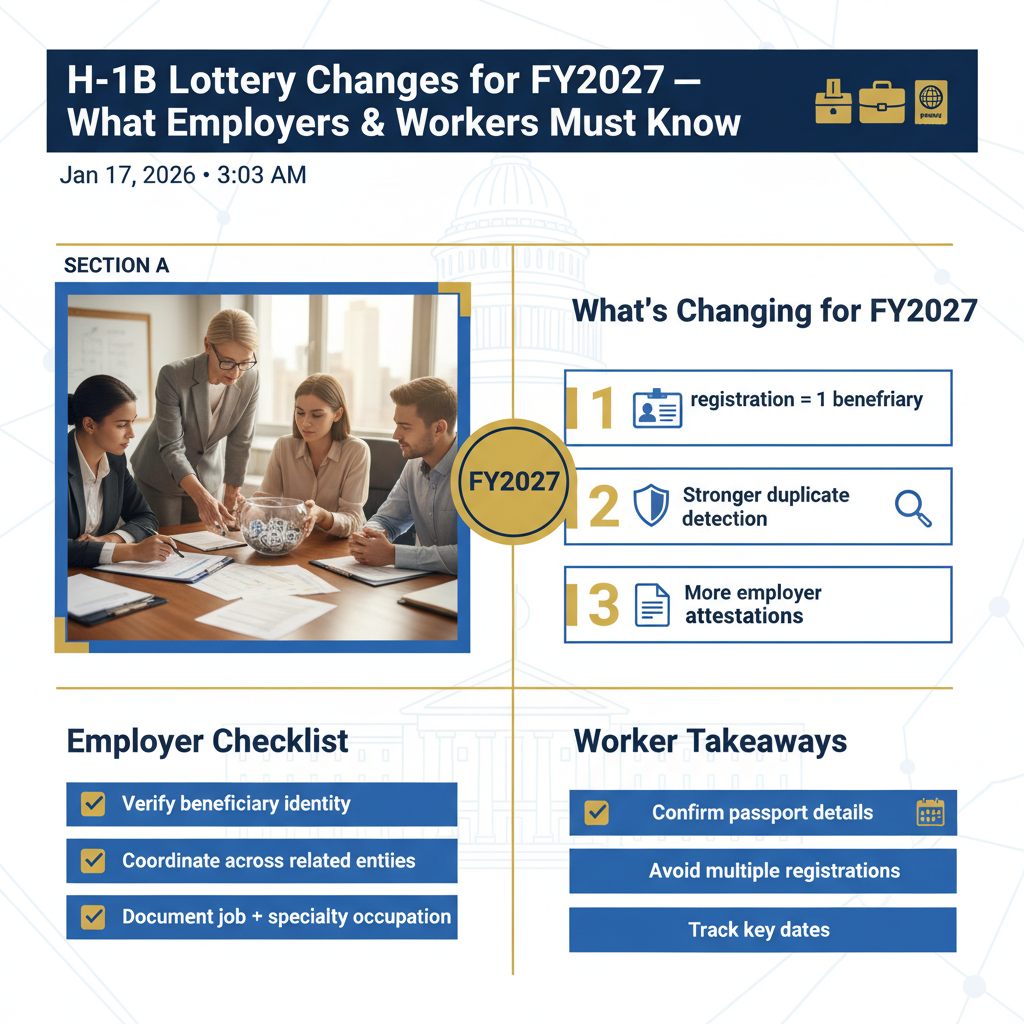
We’re tracking the latest developments on H-1B policy and procedure based on ongoing coverage in legal and immigration reporting. Here is the news reference that prompted this in-depth, practical guide:
H-1B Visa Lottery Changes for FY2027 (Legal News)
Important: News coverage often summarizes proposed rules, agency announcements, stakeholder commentary, and litigation. The most reliable “final word” is always the official agency text and instructions published by USCIS and the Department of Homeland Security (DHS). We link those official sources throughout this article.
Need Help? Our Orlando immigration team is ready to assist. Call +1 786-791-3106 for a free consultation, or message us online. Se Habla Español.
What This News Means for Immigrants in Orlando and Across Florida
Why this news is showing up now
The H-1B program is one of the most competitive employment-based pathways in the U.S. Each year, USCIS runs an electronic registration process and then conducts a random selection (“lottery”) for the annual numerical cap. Because demand far exceeds supply, even small procedural changes can have major real-world effects—especially for:
- International students in F-1 status using OPT/STEM OPT
- Healthcare, engineering, hospitality, and IT professionals across Florida
- Startups and mid-sized employers along the I-4 corridor (Orlando–Lakeland–Tampa)
- Employers trying to prevent work authorization gaps and keep teams stable
For FY2027, “lottery changes” typically refer to adjustments in how USCIS manages registrations, detects duplicate or improper filings, verifies employer/beneficiary information, and adjudicates cap-subject petitions after selection. These changes may be driven by:
- USCIS fraud prevention and integrity initiatives
- Operational updates to the online registration system
- Rulemaking or policy guidance clarifying eligibility and documentation
- Ongoing scrutiny of duplicate registrations and related-party filings
Reminder: FY2027 H-1B refers to employment starting on or after October 1, 2026 (the start of federal Fiscal Year 2027). Planning often begins months earlier.
How it can affect Florida residents
Florida’s economy includes major demand for specialty occupation talent in tourism technology, simulation and defense contracting, healthcare systems, higher education, and logistics. If your case is in Orlando or you work for an employer headquartered in Central Florida, the practical impacts of lottery changes can include:
- Selection odds: Changes to registration integrity rules can reduce “gaming” and may improve fairness for legitimate candidates.
- More scrutiny after selection: Employers may face increased Requests for Evidence (RFEs) on specialty occupation, employer-employee relationship, and wage level alignment.
- Timing pressure: If USCIS tightens deadlines or documentation expectations, missing a window can mean waiting another year.
- Status planning: F-1 OPT holders may need careful cap-gap and STEM OPT planning to avoid work interruptions.
For Central Florida residents, even when USCIS processing occurs at a service center, your broader immigration strategy—travel, extensions, family plans, and Adjustment of Status timing—often depends on a stable H-1B pathway.
What H-1B Visa Lottery Changes for FY2027 Is (and Why It Matters)
A plain-English definition
The “H-1B lottery” is USCIS’s random selection process used when more employers want to sponsor workers than the annual cap allows. Most cap-subject employers must first submit an electronic registration for each intended worker during a designated registration period. If selected, the employer may then file the full H-1B petition.
“Lottery changes for FY2027” generally means USCIS may update:
- How registrations are submitted, validated, and linked to employers and beneficiaries
- How USCIS identifies duplicate or improper registrations
- What evidence is required after selection to prove eligibility
- How USCIS manages multiple rounds of selection and filing windows
Warning: Many people confuse “registration selection” with “visa approval.” Being selected only gives the employer the chance to file a full H-1B petition; USCIS can still deny the case if eligibility is not proven.
Key terms you need to know
- Cap-subject H-1B: H-1B petitions counted toward the annual 65,000 regular cap.
- Master’s cap: An additional 20,000 slots for beneficiaries with qualifying U.S. master’s (or higher) degrees.
- USCIS registration: The pre-petition electronic entry that places a beneficiary into the selection process.
- Specialty occupation: A job that normally requires at least a bachelor’s degree in a specific specialty or its equivalent.
- LCA (Labor Condition Application): The employer’s wage and working conditions attestation filed with the Department of Labor (DOL) before the H-1B petition.
- RFE: Request for Evidence—USCIS asks for more documents before deciding.
- Consular processing: Applying for the H-1B visa stamp abroad via the U.S. Department of State.
- Change of status: Moving from one U.S. status (like F-1) to H-1B without leaving the U.S., if eligible.
- Priority Date and Adjustment of Status:
Even though Priority Date and Adjustment of Status are more closely tied to green card processes (e.g., PERM/I-140/Form I-485), H-1B strategy often supports long-term plans to become a permanent resident and keep families together.
Need Help? Our Orlando immigration team is ready to assist. Call +1 786-791-3106 for a free consultation, or message us online. Se Habla Español.
Current Immigration Law: The Foundation
Even when procedures change, the H-1B program is grounded in federal statutes, regulations, and agency guidance. Understanding the foundation helps you respond to FY2027 changes without panic.
Federal requirements
Key legal authorities include:
- Immigration and Nationality Act (INA) § 214 (nonimmigrant admissions and conditions)
- 8 U.S.C. § 1184 (statutory basis for H nonimmigrants, including H-1B)
- 8 C.F.R. § 214.2(h) (primary H-1B regulatory rules, including specialty occupation standards and petition requirements)
- DOL labor condition rules at 20 C.F.R. Part 655, Subparts H and I (LCAs, wage obligations, notice requirements)
USCIS administers the petition process using forms and instructions found on the USCIS official website. Common forms connected to H-1B strategy include:
- Form I-129 (Petition for a Nonimmigrant Worker) — the core H-1B petition
- Form I-907 (Premium Processing) — optional expedited processing when available
- Form I-539 (Extension/Change of Status) — often relevant for dependents
- Form I-765 (Employment Authorization) — commonly used by F-1 OPT holders and certain dependents (e.g., H-4 EAD in eligible cases)
- Form I-130 and Form I-485 — family or employment-based permanent residence processes that may run in parallel with H-1B planning
Reminder: Official form editions and filing addresses change. Always confirm on USCIS Forms.
Florida-specific considerations
H-1B is federal law, so Florida doesn’t create separate H-1B eligibility rules. However, Florida-based workers and employers often face practical, local considerations:
- Industry concentration: Central Florida has large hospitality and simulation/defense sectors; job descriptions must still meet “specialty occupation” standards.
- Multi-site worksites: If you work across Orange County and nearby counties along the I-4 corridor, LCA posting and worksite location details must be accurate.
- Local adjudication touchpoints: The Orlando USCIS Field Office generally handles in-person services for certain benefit types (like interviews for Adjustment of Status), while H-1B petitions are usually adjudicated at USCIS service centers. Still, your overall immigration journey may involve both.
- Removal defense overlap: If someone falls out of status due to a denied petition, immigration court may become relevant. The Executive Office for Immigration Review provides official information on immigration court procedures.
How to Prepare for the FY2027 H-1B Lottery: A Complete Step-by-Step Guide
This guide is designed for beneficiaries (workers) and employers. It focuses on the cap-subject process that begins with electronic registration and then moves to a full H-1B filing if selected.
Important: Exact dates for FY2027 registration and filing windows will be announced by USCIS. Historically, registration occurs in March, selections are released shortly after, and filing windows open in April for an October 1 start date.
1) Confirm you and the job qualify as “H-1B specialty occupation”
Before lottery strategy, confirm the basics: the job must normally require a bachelor’s degree (or higher) in a specific specialty, and you must have the required degree (or equivalent) related to the job.
Documents to gather (worker):
- Passport biographic page and current U.S. visa (if any)
- Current I-94 record (print from CBP if applicable)
- Resume/CV and detailed experience letters
- Diplomas and transcripts (U.S. and foreign)
- Credential evaluation (if foreign degree equivalency is needed)
- Licenses (if the occupation requires one)
Documents to gather (employer):
- Detailed job description (duties, tools, technologies, % time allocation)
- Minimum requirements for the role (degree field, experience)
- Worksite location(s) and remote work plan
- Organizational chart and reporting structure
- Evidence of business operations (website, brochures, contracts, invoices)
2) Build a compliant wage and worksite plan (LCA strategy)
The LCA is not optional. The employer must commit to paying at least the prevailing wage (or the actual wage, whichever is higher) and to meeting notice obligations.
Documents to gather (employer):
- Proposed salary and compensation breakdown
- Worksite address(es) including remote arrangements
- Internal wage documentation (to support “actual wage”)
- Prevailing wage data source documentation (as used by counsel)
- FEIN confirmation and company address
Practical note for Orlando employers: If your employee will work from home in Orange County, the home location can matter for prevailing wage and posting. Plan early to avoid last-minute corrections.
3) Prepare the USCIS registration information carefully (accuracy matters)
USCIS registration is short—but mistakes can be fatal. FY2027 “lottery changes” discussions often emphasize integrity controls and data validation. That means errors, inconsistencies, or duplicate entries may be more likely to be flagged.
Documents/info to gather (worker):
- Legal name exactly as in passport
- Date of birth, country of birth, country of citizenship
- Passport number (and expiration date)
- U.S. degree details (if claiming master’s cap eligibility)
Documents/info to gather (employer):
- Legal business name, DBA (if any), and EIN
- Authorized signatory details
- Attorney/representative information (if represented)
- Internal tracking list to prevent accidental duplicates
Warning: Duplicate or coordinated registrations filed to manipulate selection can lead to denial or revocation—even after selection. Employers should use a centralized process to control submissions.
4) If selected, file a strong H-1B petition package (don’t “wing it”)
Selection is only the beginning. The petition must prove eligibility with evidence. A well-prepared package reduces RFEs and denials.
Documents to gather (employer/petition):
- Certified LCA
- Support letter describing the company, role, duties, and specialty occupation basis
- Company documents (incorporation, business license, tax filings as appropriate)
- Client letters/contracts/work orders (if working at third-party sites)
- Itinerary and supervision plan (especially for consulting/placements)
Documents to gather (worker/beneficiary):
- Degree evidence and evaluations
- Transcripts and course descriptions (if degree-field relevance could be questioned)
- Prior immigration documents (I-20s, EAD cards, DS-160/visa stamps)
- Pay statements (if currently working in the U.S.)
Reminder: Consider premium processing (Form I-907) when timing is critical, but confirm eligibility and availability for your filing type.
5) Plan your status timeline: cap-gap, travel, dependents, and start date
Many Florida-based beneficiaries are F-1 students graduating from UCF, Full Sail, Valencia College pathways, or other institutions, working under OPT. A denied or delayed petition can create work authorization gaps. Planning should include:
- Cap-gap eligibility and documentation coordination with your school (DSO)
- STEM OPT extension timing (if eligible) as a backup plan
- Travel strategy (avoid travel that could disrupt change of status)
- Dependent planning (H-4 filings, school enrollment, driver’s license timing)
Documents to gather (F-1/OPT holders):
- All I-20s (especially the OPT and STEM OPT I-20s)
- EAD card(s) and OPT approval notices
- SEVIS employment updates and training plan (for STEM OPT)
- Recent paystubs and offer letter
Timeline tip: Track the 90-day window around key events (graduation, OPT start/end, STEM filing windows, and employer onboarding). Missing a school reporting deadline can create downstream immigration problems.
6) Monitor case progress and respond quickly to RFEs or notices
Once filed, you should track receipts, notices, and processing times. Use official tools and keep copies of everything.
Tools and references:
- USCIS Processing Times
- USCIS official website
- U.S. Department of State (for visa stamping information if consular processing is needed)
Documents to gather (for RFE response readiness):
- Updated org chart and project documentation
- Updated pay statements and proof of maintenance of status
- Expert opinion letters (in some specialty occupation cases)
- Additional evidence of degree-job nexus (coursework mapping)
Important: Many RFEs have strict deadlines. Missing an RFE response deadline can lead to denial.
Need Help? Our Orlando immigration team is ready to assist. Call +1 786-791-3106 for a free consultation, or message us online. Se Habla Español.
Practical Steps You Can Take Today
Whether you’re a worker hoping to be sponsored or an employer preparing to register candidates, the best outcomes usually come from early preparation—well before registration opens.
Actionable checklist (do these now)
- Confirm degree-job alignment: Make sure your degree field matches the role. If it’s not obvious, gather syllabi, course descriptions, and projects that show relevance.
- Update your passport: If it expires soon, renew early—data consistency matters.
- Standardize your job description: Employers should create a detailed, consistent job description with duty percentages and required skills.
- Map worksites (including remote): Identify where the employee will actually work in Florida (Orange County, Seminole, Osceola, etc.) and any travel expectations.
- Prepare a “no-duplicate” protocol: Employers with multiple departments or related entities should centralize registration decisions to avoid accidental duplicates.
- Budget for the full process: Registration is only the first cost; plan for filing fees, legal fees, and potential premium processing.
- Track timing carefully: Create a shared calendar for the registration period, selection notices, LCA timing, and the petition filing window.
Document preparation guidance
Organize documents into two folders: “Registration” and “Full Petition.” Keep file names consistent (e.g., Passport_LastName, Transcript_University, OfferLetter_Company).
Reminder: Use official sources for forms and instructions: USCIS Forms.
Timeline expectations (typical—not guaranteed)
- January–February: Eligibility review, job description finalization, wage analysis
- March: Electronic registration period (USCIS announces exact dates)
- Late March–April: Selection notifications; LCA filing and certification; petition assembly
- April–June: Filing window for selected registrations (exact window set by USCIS)
- June–September: Adjudication period (varies; premium may speed up)
- October 1: Earliest start date for cap-subject H-1B in FY2027
Important: If you’re relying on OPT work authorization, plan around end dates and possible cap-gap. Don’t assume selection equals uninterrupted employment authorization.
How Imigrar Helps Immigrants in Orlando
At Imigrar, we help employers and professionals navigate high-stakes work visa processes with a strategy-first approach—because your job stability often affects your spouse, children, and long-term path to a green card. Our tagline is “Keep Families Together”, and that includes protecting lawful status while pursuing career opportunities.
How we support H-1B candidates and employers:
- Eligibility analysis for specialty occupation and degree equivalency
- End-to-end cap registration planning and compliance controls
- Petition preparation with strong documentation to reduce RFEs
- Status planning (F-1 to H-1B change of status, cap-gap, dependents)
- Long-term planning toward permanent residence, including timelines tied to Priority Date and Adjustment of Status using Form I-485 when eligible
If your case is in Orlando, we can also help you coordinate broader immigration needs that may later involve the Orlando USCIS Field Office (for example, family-based filings like Form I-130 and future Adjustment of Status steps).
Free consultation available. Call +1 786-791-3106. Se Habla Español.
Frequently Asked Questions
Q: Who is eligible to be entered in the FY2027 H-1B lottery?
A: Generally, you must have a U.S. employer willing to sponsor you for a qualifying specialty occupation role, and you must have at least a bachelor’s degree (or equivalent) in a field related to the job. The employer—not the worker—submits the electronic registration and later files Form I-129 if selected. If you have a qualifying U.S. master’s degree or higher, you may also be considered under the advanced degree (master’s) cap.
Q: How do FY2027 “lottery changes” affect my chances of selection?
A: If USCIS tightens controls on duplicates and improves validation, it can reduce improper registrations and may improve fairness for legitimate applicants. However, selection is still random and demand-driven. The best way to protect your chances is compliance: accurate data, a real job offer, and a petition-ready case if selected.
Q: If I’m in Orlando on F-1 OPT, will my immigration status be impacted if I’m not selected?
A: Not being selected does not automatically harm your status. Your status depends on maintaining F-1 requirements (employment reporting, unemployment limits, valid EAD dates, etc.). If you’re not selected, you may consider STEM OPT (if eligible), another employer strategy, or a different visa category. For Central Florida residents, planning early is crucial to avoid a last-minute status crisis.
Q: How long does the H-1B process take after selection?
A: After selection, the employer must file the full petition within the USCIS filing window. Processing time varies by service center and workload. You can check estimates at USCIS Processing Times. Premium processing (via Form I-907) may be available for faster adjudication, but it does not guarantee approval—only faster review.
Q: What documents are most important for an H-1B petition to avoid RFEs?
A: The most common pressure points are specialty occupation and employer-employee relationship. Strong petitions often include: a detailed support letter, a clear job description with duty percentages, proof of the company’s business and ability to pay, the certified LCA, and degree evidence showing a direct connection between the beneficiary’s education and the role. If the worker will be placed at a client site, contracts, work orders, and a supervision plan are often critical.
Q: How much does an H-1B case cost?
A: Costs typically include the USCIS registration fee, USCIS filing fees for Form I-129, potential fraud prevention and ACWIA fees (depending on employer size and case type), optional premium processing fees, and attorney fees. Employers usually must pay certain required fees by law and cannot shift them to the worker in a way that violates wage rules. Because fee structures can change, confirm current fees on the USCIS official website and consult counsel for a compliant payment plan.
Q: What happens if my H-1B petition is denied after selection?
A: A denial means USCIS did not find eligibility proven. Options may include filing a motion or appeal (case-specific), refiling if permitted and within time limits, or switching strategies (STEM OPT extension, another visa category, or consular processing strategies if appropriate). If you fall out of status, consequences can escalate quickly. If removal proceedings become a risk, information about immigration court is available through the Executive Office for Immigration Review. Speak with an immigration attorney immediately to protect lawful presence and future eligibility.
Common Mistakes (and How to Avoid Them)
Mistake #1: Treating registration like a “placeholder” and ignoring petition readiness
Some employers register first and only later try to figure out whether the job truly qualifies or whether the worker’s degree matches. If selected, they rush and submit a weak petition��inviting an RFE or denial.
How to avoid it: Do a pre-registration eligibility review, gather degree evidence, and draft a defensible job description before registration opens.
Mistake #2: Duplicate or uncoordinated registrations across related entities
When companies have multiple subsidiaries, departments, or staffing partners, it’s easy to accidentally submit multiple registrations for the same person in a way USCIS may view as improper.
How to avoid it: Use a single internal owner for the H-1B process, keep a centralized list of beneficiaries, and coordinate with counsel.
Mistake #3: Inconsistent worksite/remote work details that undermine the LCA and petition
With hybrid work common across the I-4 corridor, employers sometimes list one location in the LCA but describe another in the support letter or offer letter.
How to avoid it: Align the offer letter, LCA, and petition narrative. If remote work is expected in Orange County or elsewhere, plan and document it correctly from the start.
Additional Official Resources (Bookmark These)
- USCIS official website
- USCIS Forms
- USCIS Processing Times
- U.S. Department of State
- Executive Office for Immigration Review
Reminder: If you are also exploring family-based options (like Form I-130) or future Adjustment of Status (Form I-485), coordinate strategies carefully so you don’t create unintended travel or status issues.
Need Help? Our Orlando immigration team is ready to assist. Call +1 786-791-3106 for a free consultation, or message us online. Se Habla Español.

Closing: Get a Clear FY2027 H-1B Plan (Before Deadlines Hit)
H-1B “lottery changes” for FY2027 are a reminder that the process is not just about luck—it’s about preparation, compliance, and timing. The strongest cases are built early: a specialty occupation role with a clear degree connection, a compliant wage plan, accurate registration data, and a petition package ready to file immediately if selected.
If your case is in Orlando, or you’re an employer hiring along the I-4 corridor, Imigrar can help you create a practical, defensible plan that protects lawful status and supports long-term goals for you and your family—because we work to Keep Families Together.
Call Imigrar today: +1 786-791-3106 for a free consultation. Se Habla Español. Or message us online.


