


The reporting that sparked this guide
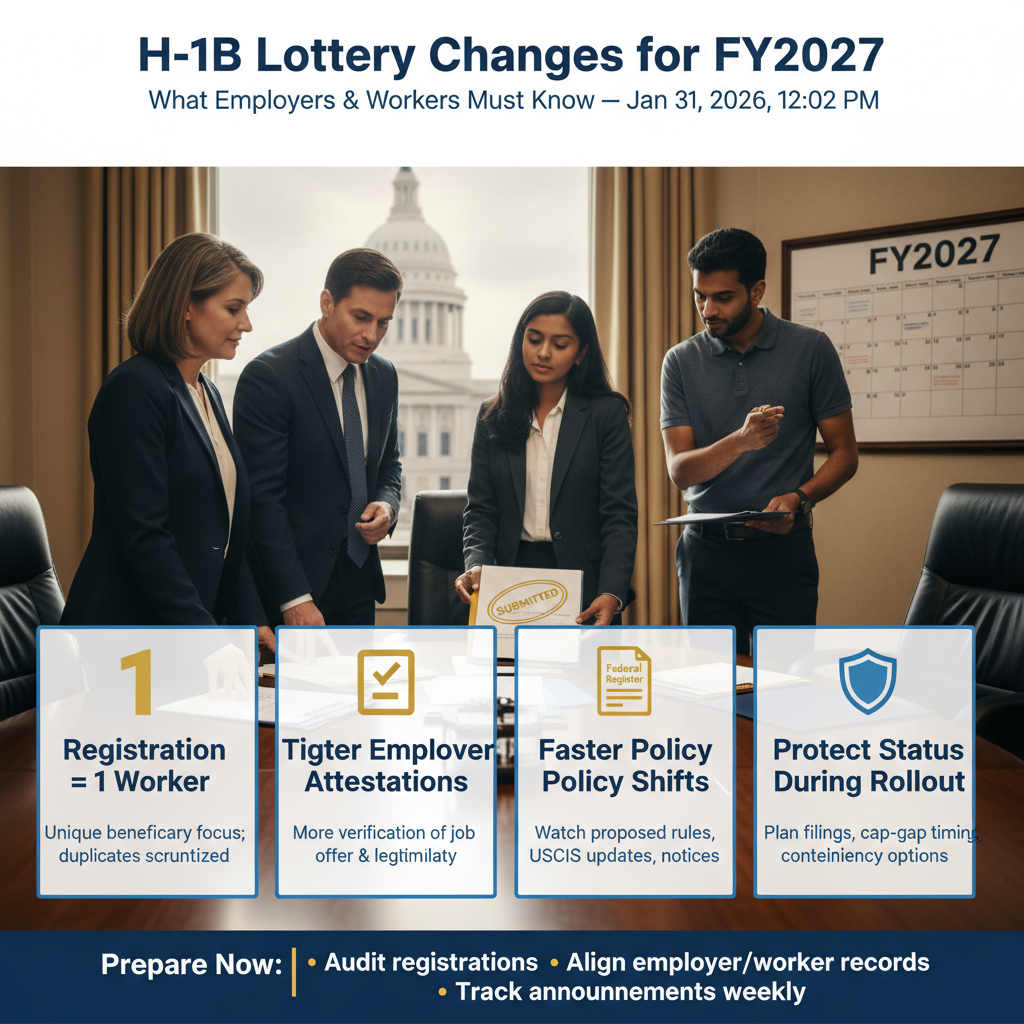
This article is informed by trending coverage in Legal News and related reporting aggregated by Google News. Because immigration rules can move quickly—sometimes through proposed rules, final rules, USCIS policy updates, or Federal Register notices—this guide focuses on what to watch, how to prepare, and how to protect your status while changes roll out.
Need Help? Our Orlando immigration team is ready to assist. Call +1 786-791-3106 for a free consultation, or message us online. Se Habla Español.
What This News Means for Immigrants in Orlando and Across Florida
Why this news is showing up now
Every year, the H-1B “cap season” creates a surge of attention because demand far exceeds supply. Most cap-subject H-1B petitions are selected through an electronic lottery run by U.S. Citizenship and Immigration Services (USCIS). For FY2027, “lottery changes” are trending because USCIS and the Department of Homeland Security (DHS) have been modernizing the process to reduce fraud, increase fairness, and improve integrity in the registration system.
Important: Some “changes” appear first as proposals, stakeholder announcements, or enforcement trends before they show up as final rules. The practical takeaway is that employers and workers should plan early, keep documentation consistent, and avoid shortcuts that can trigger denials, Requests for Evidence (RFEs), or even fraud findings.
To confirm updates as they become official, monitor the USCIS official website and USCIS announcements during the registration season.
How it can affect Florida residents
Florida—especially the I-4 corridor (Orlando–Lakeland–Tampa) and major metro areas—has a large population of international students, tech workers, healthcare professionals, hospitality managers, engineers, and entrepreneurs who rely on H-1B pathways. If lottery rules tighten or documentation requirements increase:
- For Central Florida residents, job offers may need more detailed role descriptions, wage data, and degree-to-job “nexus” evidence.
- Employers may become more cautious about sponsoring first-time H-1Bs, affecting new graduates on F-1 OPT and STEM OPT.
- Workers may need stronger status-protection planning (cap-gap, change of status vs. consular processing, travel timing).
- Companies with multiple related entities (common in hospitality, staffing, healthcare networks) must avoid duplicate or improper registrations.
If your case is in Orlando, planning is especially important because timing interacts with school calendars, start dates, and travel. While H-1B filings are handled by USCIS service centers, local strategy often involves the Orlando job market and status maintenance while you remain physically in Florida.
Need Help? Our Orlando immigration team is ready to assist. Call +1 786-791-3106 for a free consultation, or message us online. Se Habla Español.
What H-1B Visa Lottery Changes for FY2027 Is (and Why It Matters)
A plain-English definition
The H-1B cap lottery is USCIS’s selection process for deciding which employers may file H-1B cap-subject petitions when more registrations are submitted than the annual quota allows. “Lottery changes for FY2027” refers to updates in how USCIS may:
- Collect and validate registrations
- Prevent duplicate or coordinated submissions
- Verify beneficiary identity
- Scrutinize job offers and employer eligibility
- Enforce penalties for misrepresentation
Even small procedural adjustments can have big consequences. If your registration is rejected, invalidated, or selected but later denied, you may lose work authorization timing and, in some cases, your ability to remain in lawful status.
Key terms you need to know
- H-1B Cap: The annual limit for new H-1Bs (generally 65,000 regular cap plus 20,000 for U.S. master’s or higher—often called the “master’s cap”).
- Electronic Registration: The online pre-registration process employers use before filing a full petition.
- Beneficiary: The worker sponsored by the employer.
- Petitioner: The U.S. employer filing the H-1B petition.
- Specialty Occupation: A role that normally requires at least a bachelor’s degree in a specific specialty (or equivalent) related to the job.
- LCA (Labor Condition Application): The employer’s filing with the Department of Labor (DOL) confirming wage and working conditions compliance (submitted via DOL systems, then used in the USCIS petition).
- Change of Status: Switching to H-1B without leaving the U.S. (common for F-1 OPT holders).
- Consular Processing: Getting an H-1B visa stamp abroad and entering in H-1B status.
- Cap-Gap: Extension of F-1 status/work authorization for certain students with timely filed H-1B change of status petitions.
- Warning: Duplicate or improper registrations—especially coordinated filings by related companies—can trigger denial and potentially broader scrutiny.
Although this article focuses on H-1B, many readers are also navigating family-based processes like Form I-130 and Form I-485, including Adjustment of Status and Priority Date tracking. If you are juggling both (for example, married to a U.S. citizen while on F-1/OPT), strategy matters.
Current Immigration Law: The Foundation
H-1B rules come primarily from the Immigration and Nationality Act (INA) and implementing regulations under DHS/USCIS and the Department of Labor. The “lottery” exists because Congress set numerical limits on new H-1B approvals each fiscal year.
Federal requirements
At a high level, to qualify for an H-1B specialty occupation petition, the employer generally must show:
- A real U.S. job offer in a specialty occupation
- The worker meets the degree (or equivalent) requirements
- The employer will pay the required wage and comply with LCA terms
- The petition is properly filed after selection (for cap cases)
Forms and filings you may see in H-1B cases:
- Form I-129 (Petition for a Nonimmigrant Worker) — primary H-1B petition form
- Form I-907 (Request for Premium Processing Service) — optional, if eligible
- Form I-94 (Arrival/Departure Record) — status evidence for change of status cases
For official instructions and updates, use the USCIS official website and the USCIS Forms page.
Reminder: If you are also pursuing permanent residence through family or employment, timelines may overlap with concepts like Priority Date and steps like Adjustment of Status using Form I-485. H-1B can be a “bridge” status, but it must be maintained carefully.
Florida-specific considerations
Immigration law is federal, so Florida does not create separate H-1B eligibility rules. However, Florida-specific factors can affect your case:
- Industry mix: Central Florida has strong hospitality, healthcare, simulation/defense, and growing tech—each has different “specialty occupation” documentation patterns.
- Staffing and third-party worksites: The I-4 corridor includes many contracting models; these can trigger higher scrutiny on specialty occupation, supervision, and worksite control.
- If your case is in Orlando... you may need careful planning around travel (airport hubs), school schedules (UCF and other institutions), and employer start dates.
- The Orlando USCIS Field Office typically handles in-person services for certain benefits (like interviews for Form I-485 cases), but most H-1B petitions are adjudicated by USCIS service centers. Still, local counsel helps coordinate status strategy and supporting evidence.
For broader immigration court-related resources (not usually part of H-1B, but relevant for some families), see the Executive Office for Immigration Review.
How to Prepare for FY2027 H-1B Lottery Changes: A Complete Step-by-Step Guide
This guide is written for both employers and foreign national workers. The steps assume a cap-subject case (the common “lottery” scenario). Cap-exempt H-1Bs (certain universities, nonprofit research organizations, etc.) follow a different path and may avoid the lottery.
1) Confirm the job qualifies as a specialty occupation (and document it early)
Before registration, treat the case like it will be audited. USCIS trends show increasing scrutiny of whether the role truly requires a specific degree and whether the beneficiary’s education matches.
Documents to prepare:
- Detailed job description (duties, percentage breakdown, tools/technologies used)
- Organizational chart showing where the role fits
- Minimum requirements for the role (degree field, experience)
- Evidence of similar hires (job postings, prior hiring records)
- Client letters / statements of work (for third-party placement, if applicable)
- Beneficiary resume and prior experience letters
Warning: Generic job descriptions and “one-size-fits-all” duty lists are a top trigger for RFEs.
2) Verify the beneficiary’s identity and eligibility details (consistency is everything)
Lottery integrity measures increasingly focus on beneficiary identity and preventing multiple registrations for the same person by the same employer or through coordinated entities.
Documents to prepare:
- Passport biographic page (valid, clear scan)
- Current U.S. status documents (visa stamp, Form I-94, approval notices)
- All prior I-20s (F-1) and EAD cards (OPT/STEM OPT), if applicable
- Degree documents: diploma, transcripts, evaluations (if foreign degree)
- Name variation list (any alternate spellings used in prior filings)
Important: If your name, passport number, or date of birth has been entered inconsistently in past filings, fix it now with a documented explanation. Inconsistencies can delay adjudication or cause mismatches.
3) Plan the employer compliance pieces: wage, worksite, and the LCA strategy
Even though the LCA is filed later (typically after selection, before the petition), the wage level and worksite details should be planned upfront. If rules tighten for FY2027, expect more emphasis on whether the job details match the wage level and location(s).
Documents to prepare:
- Proposed worksite address(es) and remote-work plan
- Prevailing wage data support (internal notes, wage source references)
- Offer letter with salary, job title, start date, and location
- Company documents: FEIN verification, business licenses, website, brochures
- Payroll records (for established companies) showing ability to pay
Reminder: If remote work is involved, document supervision, reporting lines, and how the employer maintains control.
4) Submit the H-1B electronic registration correctly (and avoid duplicate-registration traps)
The registration window is typically a short period in March (USCIS announces exact dates each year). Employers submit registrations and pay the registration fee per beneficiary.
Documents to prepare:
- Beneficiary passport info and personal details
- Employer legal name, DBA (if any), FEIN, address
- Authorized signatory information
- Internal compliance memo confirming no duplicate registrations by the same employer
Warning: If related entities are involved (parent/subsidiary/affiliate), coordinate carefully. Multiple registrations for the same beneficiary can be scrutinized for improper purpose.
5) If selected, file the full H-1B petition on time (within the selection filing window)
Selection is not approval. After selection, USCIS provides a filing window (often about 90 days, but follow the notice). Missing the window can forfeit the selection.
Documents to prepare:
- Form I-129 with H Supplement and supporting letter
- Certified LCA
- Company support letter describing duties, requirements, and supervision
- Beneficiary degree evidence (U.S. or foreign + evaluation)
- Evidence of maintenance of status (I-94, paystubs, transcripts if F-1)
- Filing fees checks and fee breakdown sheet
Important: If you are changing status from F-1 to H-1B, ensure you remain in valid status up to the filing date and through adjudication. Cap-gap may help, but it must be handled precisely.
6) Prepare for RFEs, site visits, and post-filing compliance
With integrity-focused changes, employers should assume more post-filing scrutiny. That can include RFEs asking for specialty occupation proof, employer-employee relationship proof, and evidence the job will exist as described.
Documents to prepare:
- Updated organizational chart and project documentation
- Work product examples (redacted), project plans, or SOPs
- Timesheets and supervision records (especially for third-party worksites)
- Payroll setup documentation and onboarding materials
- Public Access File (PAF) compliance checklist for the LCA
Reminder: Keep copies of what was filed. Consistency between the registration, LCA, petition letter, and actual job conditions is critical.
7) Start date, travel, and long-term planning (extensions, green card strategy)
Many cap-subject H-1Bs start on October 1 of the fiscal year (unless cap-exempt or otherwise eligible). Travel and stamping plans should be coordinated to avoid gaps.
Documents to prepare:
- USCIS approval notice (Form I-797)
- Updated employment verification letter
- Paystubs (once employment begins)
- Visa stamping documents if consular processing (DS-160 confirmation, appointment letter)
- Long-term plan notes: PERM timeline or family-based options (if applicable)
For visa stamping and consular information, use the U.S. Department of State.
Need Help? Our Orlando immigration team is ready to assist. Call +1 786-791-3106 for a free consultation, or message us online. Se Habla Español.
Practical Steps You Can Take Today
Whether you’re an employer in Orange County hiring talent or a worker on OPT hoping to stay in the U.S., preparation is the difference between a clean filing and a stressful RFE season.
- Checklist item #1: Build a “specialty occupation packet” now (job description + degree requirement rationale + org chart).
- Checklist item #2: Collect identity and education documents in one folder (passport, transcripts, diploma, evaluations, experience letters).
- Checklist item #3: Confirm your current status and expiration dates (I-94, EAD, I-20). Mark key deadlines like 90-day window filing periods and internal HR cutoffs.
- Checklist item #4: Align the offered wage with the role and location(s). If hybrid/remote, document where the employee will actually work.
- Checklist item #5: For corporate groups, create a written policy to prevent duplicate registrations and define when separate entities can sponsor.
- Checklist item #6: Plan a backup if not selected (STEM OPT extension, cap-exempt options, O-1, L-1, or family pathways if eligible).
Timeline expectations (typical cap case):
- January–February: role review, document collection, internal approvals
- March: registration window and lottery selection
- April–June (often): petition filing window if selected
- June–September: adjudication (varies; premium processing may shorten)
- October 1: common start date for cap-subject H-1B change of status
To track adjudication timing, consult USCIS Processing Times. Processing times fluctuate, so plan conservatively.
How Imigrar Helps Immigrants in Orlando
Imigrar is an immigration law firm based in Orlando, Florida, serving clients nationwide. Our mission is to Keep Families Together—and for many families, stable work authorization is a key part of that stability.
We help H-1B employers and workers by:
- Assessing whether the position qualifies as a specialty occupation and strengthening the evidence
- Reducing RFE risk by aligning job duties, wage level, and degree requirements
- Coordinating status strategy for F-1 OPT/STEM OPT holders (including cap-gap timing)
- Supporting employers with compliance planning and clean documentation
- Advising on long-term options, including family-based filings like Form I-130 and Form I-485, Adjustment of Status, and Priority Date strategy when applicable
Se Habla Español. We offer a free consultation to help you understand your options and next steps.
Frequently Asked Questions
Q: Who is eligible for the H-1B lottery for FY2027?
A: Generally, you need (1) a U.S. employer willing to sponsor you, (2) a job that qualifies as a specialty occupation, and (3) your credentials (degree or equivalent) that match the job’s requirements. If you have a U.S. master’s degree or higher, you may qualify for the advanced degree cap. Reminder: Eligibility is not just about your degree—USCIS also evaluates whether the job truly requires that specialty degree.
Q: Will these FY2027 lottery changes affect my current immigration status (F-1, OPT, STEM OPT, etc.)?
A: The lottery rules themselves do not automatically change your current status, but they can affect your planning. If you are on OPT/STEM OPT, a non-selection may require a backup plan before your work authorization ends. If you are selected and file a change of status H-1B, you must maintain valid status through filing and comply with cap-gap rules. If you are pursuing Adjustment of Status via Form I-485 separately, coordinate timing carefully to avoid travel or work authorization conflicts.
Q: What is the timeline for the FY2027 H-1B process?
A: Most cap seasons follow a predictable rhythm: registration in March, selection notifications shortly after, filing in spring/early summer, and an October 1 start date for cap-subject change of status cases. Adjudication time varies. Check USCIS Processing Times for current estimates and ask whether premium processing is available for your case.
Q: What documents will I need if I’m selected?
A: Common documents include: passport, Form I-94, prior approval notices, resume, transcripts and diploma, credential evaluation (if foreign degree), experience letters (if needed to meet requirements), and employer documents like an offer letter, job description, organizational chart, and the certified LCA. Important: If you work at a third-party site, you may also need contracts, work orders, or client letters showing the role, location, and supervision.
Q: How much does an H-1B case cost?
A: Costs typically include (1) USCIS filing fees, (2) optional premium processing fees (if used), (3) attorney fees, and (4) ancillary costs like credential evaluations. Fee rules can change, and which party must pay certain fees can depend on the fee type and compliance rules. We recommend budgeting early and confirming the exact fee schedule at filing time on the USCIS official website.
Q: What happens if my H-1B registration is selected but the petition is denied?
A: A denial can end the H-1B path for that fiscal year and may impact your ability to remain in the U.S. if your underlying status expires soon. Next steps depend on your status: you might remain in F-1 (if still valid), use remaining OPT/STEM OPT time, depart and pursue consular options, or explore alternatives. Warning: If the denial involves misrepresentation findings, consequences can be severe. Get legal advice before refiling or changing employers.
Q: If I live in Orlando, will my case be handled by the Orlando USCIS Field Office?
A: Typically, H-1B petitions are adjudicated by USCIS service centers, not the local field office. However, local factors still matter—like maintaining status while living in Central Florida, coordinating employer documentation, and planning travel. The Orlando USCIS Field Office may be relevant for other benefits (for example, some Form I-485 interview processes), so a coordinated strategy can be helpful for families managing multiple filings.
Common Mistakes (and How to Avoid Them)
Mistake #1: Treating registration like a “placeholder” and fixing details later
USCIS can compare registration data to the petition. If details don’t align, you may invite questions about credibility. How to avoid it: Validate identity data, employer information, and role details before submitting.
Mistake #2: Weak specialty-occupation evidence (generic duties, unclear degree requirement)
Many RFEs focus on whether the job truly requires a specific degree. How to avoid it: Use a tailored duty breakdown, explain tools/technologies, and show how the degree aligns to the duties.
Mistake #3: Duplicate registrations or “coordinated filings” among related companies
Integrity efforts increasingly target duplicate submissions that appear designed to game the lottery. How to avoid it: Create a corporate policy, document legitimate business need, and get legal review before multiple entities sponsor the same worker.
Official Resources and Where to Verify Updates
Because FY2027 changes may be implemented through different mechanisms, verify information through official channels:
- USCIS official website
- USCIS Forms
- USCIS Processing Times
- U.S. Department of State
- Executive Office for Immigration Review
Need Help? Our Orlando immigration team is ready to assist. Call +1 786-791-3106 for a free consultation, or message us online. Se Habla Español.

Closing: Get a Personalized H-1B Plan for FY2027
H-1B lottery changes can create new risks—but also new opportunities for well-prepared employers and workers. If you’re hiring in Orange County, living along the I-4 corridor, or trying to protect your status while building your career in Central Florida, the safest approach is to plan early, document thoroughly, and file consistently.
Need help now? Call Imigrar at +1 786-791-3106 for a free consultation, or message us online. Se Habla Español. We’re here to help you move forward—and to Keep Families Together.


