


As expert legal content writers for Imigrar, an immigration law firm based in Orlando, Florida, we understand the critical importance of timely and accurate information for immigrants and their families. The H-1B visa program is a cornerstone for many skilled foreign professionals seeking to contribute their talents to the U.S. economy, and changes to its lottery system can have profound effects.
Today, we delve into the significant H-1B visa lottery changes set to impact the upcoming Fiscal Year 2027 (FY2027) application cycle. These new rules, aimed at enhancing program integrity and fairness, are essential knowledge for prospective H-1B beneficiaries and sponsoring employers across the nation, particularly here in Florida.
The reporting that sparked this guide:
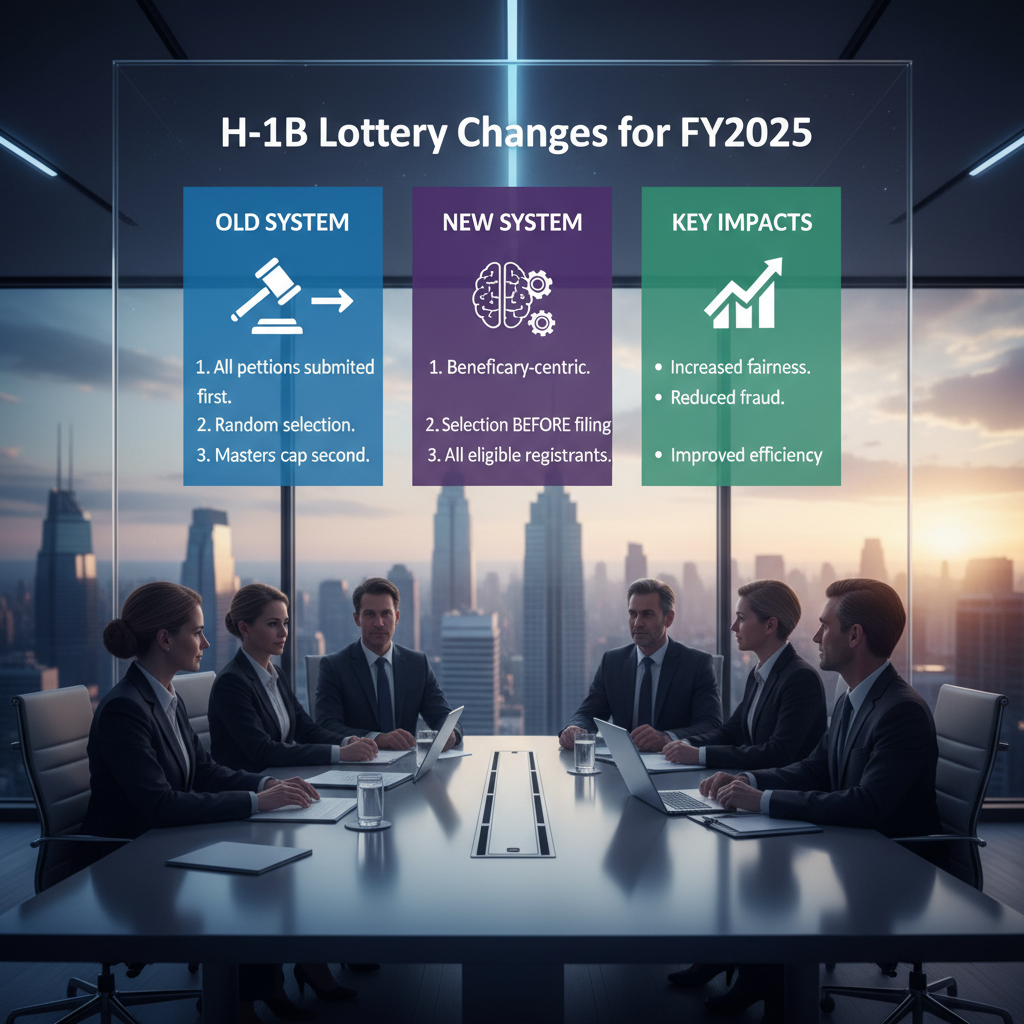
H-1B Visa Lottery Changes for FY2027 (Legal News)
What This News Means for Immigrants in Orlando and Across Florida
The H-1B visa program is a lifeline for many highly skilled foreign professionals seeking to work in specialty occupations in the United States. For businesses, especially those in fast-growing sectors like technology, healthcare, and engineering, the H-1B program is vital for securing top global talent. Recent changes announced for the Fiscal Year 2027 (FY2027) H-1B lottery are designed to streamline the process, combat fraud, and ensure a fairer selection system for everyone involved. For immigrants living in or considering moving to Orlando and other parts of Florida, understanding these adjustments is paramount.
Why this news is showing up now
The United States Citizenship and Immigration Services (USCIS) consistently reviews and updates its immigration policies to adapt to evolving needs, address program vulnerabilities, and respond to legislative directives. The H-1B visa program, with its annual cap and overwhelming demand, has historically been susceptible to certain forms of abuse, particularly regarding multiple registrations for the same beneficiary by different employers. In recent years, USCIS has intensified its efforts to prevent fraud and ensure that the lottery system operates as intended – giving all eligible beneficiaries an equal and fair chance at selection.
The changes for FY2027 are a direct result of these ongoing integrity efforts. Building on reforms implemented in prior years, USCIS has refined the H-1B registration process to focus on the individual beneficiary rather than the number of registrations submitted on their behalf. This shift aims to eliminate the unfair advantage gained by beneficiaries who had multiple employers submit registrations for them, thereby artificially inflating their chances of selection and reducing opportunities for others. The announcement of these changes now—in February 2026—is timely, as the registration period for FY2027 is expected to open in March 2026, making it crucial for employers and prospective beneficiaries to be fully informed and prepared.
How it can affect Florida residents
Florida, particularly Central Florida with its burgeoning tech industry, growing healthcare sector, and vibrant tourism and simulation industries, is a significant destination for H-1B visa holders. Cities like Orlando, Tampa, and Miami are home to numerous companies that rely on skilled foreign professionals to fill critical roles. Universities across the state, including the University of Central Florida (UCF), the University of Florida (UF), and the University of South Florida (USF), also sponsor H-1B visas for researchers, professors, and other essential personnel.
For Florida residents who are prospective H-1B beneficiaries—such as international students on F-1 visas completing Optional Practical Training (OPT) in Orlando or professionals already working under different non-immigrant visas—these changes mean a more level playing field. If you are an individual with multiple job offers from different Florida-based employers, your chances of selection are now streamlined to a single entry in the lottery, preventing others from being disadvantaged. This emphasizes the importance of ensuring that your chosen sponsoring employer submits an accurate and complete registration.
For Florida employers, particularly those located along the I-4 corridor in Orlando and beyond, the new beneficiary-centric selection process requires a strategic approach. Employers must ensure they are working with legitimate candidates and that their registrations are free from any intent to defraud the system. While the overall number of H-1B visas remains capped, these changes aim to ensure that the available visas are distributed more equitably among genuinely interested and qualified beneficiaries. Imigrar, located in Orlando, is uniquely positioned to assist both individuals and businesses in navigating these changes, ensuring compliance and maximizing opportunities within Florida's dynamic economic landscape.
Need Help Navigating H-1B Changes? Our Orlando immigration team is ready to assist. The FY2027 H-1B lottery is fast approaching. Call +1 786-791-3106 for a free consultation, or message us online to ensure your application is perfectly prepared. Se Habla Español.
What H-1B Visa Lottery Is (and Why It Matters)
The H-1B visa program is a non-immigrant visa category that allows U.S. employers to temporarily employ foreign workers in specialty occupations. These occupations generally require a bachelor's degree or higher in a specific field. The program is crucial for U.S. companies that need to fill highly skilled positions for which there isn't a sufficient supply of qualified U.S. workers.
The "lottery" aspect comes into play because there is an annual limit, or "cap," on the number of H-1B visas issued each fiscal year. Demand almost always far exceeds this cap, necessitating a random selection process. The news about "H-1B Visa Lottery Changes for FY2027" refers to the latest modifications to this critical selection mechanism, specifically designed to address integrity concerns and ensure a fairer distribution of these highly sought-after visas.
A plain-English definition
Simply put, an H-1B visa allows a U.S. employer to hire you if you have a bachelor's degree (or its equivalent in work experience) and a job offer in a field that typically requires that degree. This is called a "specialty occupation." Examples include software developers, engineers, doctors, architects, and certain types of analysts. Because there are more applicants than available visas each year, USCIS uses a lottery system to select who gets to apply. The recent "changes" are about *how* that lottery is conducted, specifically making it more fair by focusing on the individual applicant rather than allowing multiple entries for one person.
Key terms you need to know
Understanding the H-1B process requires familiarity with several key terms:
- H-1B Visa: A non-immigrant visa that permits U.S. employers to temporarily employ foreign workers in specialty occupations.
- Specialty Occupation: An occupation that requires a theoretical and practical application of a body of highly specialized knowledge, and a bachelor's degree or higher in the specific specialty (or its equivalent) as a minimum for entry into the occupation in the United States.
- Annual Cap: The legal limit on the number of H-1B visas issued each fiscal year. Congress sets this cap. Currently, it's 65,000 for the regular cap, plus an additional 20,000 for beneficiaries who hold a U.S. master's degree or higher from an accredited U.S. institution (the "master's cap").
- H-1B Lottery (or Selection Process): When the number of eligible H-1B registrations exceeds the annual cap, USCIS conducts a random selection process to determine which beneficiaries are eligible to have an H-1B petition filed on their behalf.
- Beneficiary: The foreign national worker who will be employed in the specialty occupation.
- Petitioner: The U.S. employer sponsoring the foreign national for the H-1B visa.
- H-1B Registration: An electronic process where prospective petitioners (employers) submit basic information about the company and the prospective H-1B beneficiary to USCIS during a designated registration period. This is the first step before the lottery.
- Beneficiary-Centric Selection: The core of the recent changes. This means that each unique beneficiary is entered into the lottery only once, regardless of how many employers register on their behalf. If a beneficiary is selected, all employers who registered for them are notified, and any one of them can then file a petition. This prevents multiple entries from inflating a single individual's chances.
- Cap-Exempt: Certain employers are exempt from the annual H-1B cap. These typically include institutions of higher education, non-profit organizations affiliated with institutions of higher education, and non-profit research organizations or governmental research organizations. H-1B visas sponsored by these entities can be filed at any time of the year.
- LCA (Labor Condition Application): Form ETA-9035. An application filed with the U.S. Department of Labor (DOL) by an employer, attesting that it will pay the H-1B worker at least the prevailing wage or the actual wage paid to similarly qualified workers, and will provide working conditions that will not adversely affect other workers. This must be certified before filing the H-1B petition.
- Form I-129, Petition for a Nonimmigrant Worker: The primary form filed with USCIS by the employer after a beneficiary has been selected in the lottery, or if they are cap-exempt.
Current Immigration Law: The Foundation
The H-1B visa program is governed by the Immigration and Nationality Act (INA), specifically Section 101(a)(15)(H)(i)(b), which defines the H-1B nonimmigrant classification, and Section 214(g), which establishes the annual cap. These statutory provisions form the bedrock upon which all H-1B regulations and processes are built.
Federal requirements
Under federal law, several key requirements must be met for an H-1B petition:
- Specialty Occupation: The job must qualify as a specialty occupation, meaning it requires a bachelor's degree or higher in a specific field.
- Educational/Experiential Qualifications: The beneficiary must possess at least a bachelor's degree or its equivalent, or hold an unrestricted state license, or have work experience equivalent to a bachelor's degree in the specialty occupation.
- Employer-Employee Relationship: A valid employer-employee relationship must exist between the petitioning U.S. employer and the beneficiary.
- Labor Condition Application (LCA): The employer must file and have certified by the U.S. Department of Labor (DOL) a Form ETA-9035. This form attests to compliance with wage and working condition requirements, ensuring that the H-1B worker is paid at least the prevailing wage for the occupation in the area of employment or the actual wage paid to other employees with similar experience and qualifications, whichever is higher. The LCA also confirms that the employment of the H-1B worker will not adversely affect the working conditions of similarly employed U.S. workers.
- Annual Cap Compliance: Unless the employer is cap-exempt, the petition must be filed after the beneficiary has been selected in the annual H-1B lottery. The current annual regular cap is 65,000, with an additional 20,000 visas reserved for those with a U.S. master's degree or higher.
All H-1B petitions are filed with USCIS using Form I-129, Petition for a Nonimmigrant Worker, along with various supplements and supporting documentation.
For official information and forms, always refer to the USCIS official website.
Florida-specific considerations
While H-1B law is federal, its impact is felt locally. In Florida, particularly in innovation hubs like Orlando, Tampa, and Miami, the H-1B program is vital for sectors such as:
- Technology: Software development, IT consulting, cybersecurity, and simulation industries are booming in Central Florida, creating a high demand for skilled tech professionals.
- Healthcare: Hospitals, clinics, and research institutions across the state, including Orlando's "Medical City" at Lake Nona, rely on H-1B physicians, nurses (though often through other visa types), and medical researchers.
- Engineering: Aerospace, civil, and electrical engineering roles are prevalent, especially around defense contractors and infrastructure projects.
- Academia: Florida's large public university system and private colleges frequently sponsor H-1B visas for professors, post-doctoral researchers, and other academic staff, often under cap-exempt provisions.
The Orlando USCIS Field Office, located at 5440 Diplomat Cir, Orlando, FL 32810, handles many immigration matters for Central Florida residents, though H-1B petitions are generally processed at designated USCIS service centers. However, if an H-1B change of status is approved and the beneficiary later needs to apply for an Adjustment of Status (green card), local field offices like Orlando's would become relevant. For Central Florida residents, understanding the state's economic landscape helps in identifying potential sponsoring employers and recognizing the demand for specialty occupations.
Confused by H-1B Law? Imigrar's legal experts simplify complex immigration regulations for you. Don't risk your future on outdated information. Contact our Orlando office today at +1 786-791-3106 for guidance tailored to your situation. Se Habla Español.
How to Navigate the H-1B Lottery Changes for FY2027: A Complete Step-by-Step Guide
The H-1B process, especially with the FY2027 lottery changes, requires meticulous preparation and strict adherence to deadlines. Here’s a comprehensive step-by-step guide:
1) Employer Assessment and Labor Condition Application (LCA) Filing
Before any H-1B registration can be considered, the petitioning employer must ensure the job qualifies as a specialty occupation and that they can meet wage requirements. This initial assessment is critical.
- Employer Action:
- Determine if the position meets the definition of a specialty occupation. This involves analyzing the job duties, required qualifications, and industry standards.
- Research the prevailing wage for the occupation in the specific geographic area of employment (e.g., Orlando, FL) using resources like the Department of Labor's Foreign Labor Certification Data Center.
- Prepare and file Form ETA-9035, Labor Condition Application (LCA), with the U.S. Department of Labor (DOL).
- Required Documents/Information for LCA:
- Employer's legal name, address, and Federal Employer Identification Number (FEIN).
- Job title and duties.
- Proposed wage rate (must meet or exceed the prevailing wage).
- Period of employment.
- Location(s) of employment.
- Number of H-1B workers sought.
- Timeline: The LCA must be certified by the DOL before the H-1B petition can be filed. This process typically takes 7-10 business days, so it should be initiated well in advance of the H-1B registration period.
Important: The LCA must be certified by the DOL before the H-1B petition can be submitted to USCIS. While the LCA is not needed for the *registration* phase, it is a prerequisite for the *petition filing* phase, so employers should start this early.
2) H-1B Registration for FY2027 (March 2026)
This is where the new beneficiary-centric lottery system comes into play. The H-1B registration period typically opens in early March for the fiscal year beginning October 1st. For FY2027, this means the registration window will likely be in March 2026.
- Employer Action:
- Create or access a USCIS online account.
- Enter information about the prospective H-1B beneficiary and the petitioning employer.
- Pay the $10 H-1B registration fee for each beneficiary.
- Crucial: Under the new rules for FY2027, each unique beneficiary can only be submitted *once* in the lottery, regardless of how many employers register on their behalf. If multiple employers register for the same beneficiary, all those registrations are linked to that beneficiary's single entry in the lottery. This significantly reduces the incentive for multiple registrations from different employers to increase a single individual's chances.
- Required Information for Registration:
- Beneficiary's full legal name, date of birth, country of birth, country of citizenship, passport number.
- Beneficiary's master's degree (if applicable, for the master's cap).
- Employer's legal name, FEIN, and address.
- Employer's attorney or representative information (if applicable).
- Timeline: The H-1B registration period for FY2027 is expected to be in March 2026, typically for about two to three weeks. USCIS will announce the exact dates well in advance.
Reminder: Accuracy in registration data is paramount. Any discrepancies found later could lead to petition denial.
3) Lottery Selection and Petition Preparation
After the registration period closes, USCIS conducts the lottery. Under the beneficiary-centric selection process for FY2027, if a beneficiary is selected, all employers who submitted a registration for that individual will be notified of the selection. This allows any of those employers to proceed with filing an H-1B petition on behalf of the selected beneficiary.
- USCIS Action:
- Conducts the lottery, usually starting with the master's cap, then the regular cap.
- Notifies selected registrants (employers) through their USCIS online accounts.
- Provides a filing window for selected petitions, typically from April 1st to June 30th.
- Employer/Beneficiary Action (if selected):
- The selected employer (or one of the selected employers) must decide to proceed with filing the H-1B petition.
- Begin compiling all necessary supporting documents for the Form I-129 petition.
- Timeline: Lottery results are typically announced by the end of March. The filing window usually begins on April 1st.
4) Filing the H-1B Petition (Form I-129)
Once a beneficiary is selected, the employer can proceed with filing the complete H-1B petition package with USCIS.
- Employer Action:
- Prepare Form I-129, Petition for a Nonimmigrant Worker, and its H-1B supplement.
- Include the certified LCA (Form ETA-9035).
- Gather all supporting documentation.
- Pay all required filing fees.
- Mail the complete petition package to the correct USCIS Service Center.
- Required Documents for Form I-129 Package:
- Copy of the H-1B registration selection notice.
- Certified LCA (Form ETA-9035).
- Beneficiary's educational documents (degrees, transcripts, evaluations of foreign degrees).
- Beneficiary's resume/CV and letters of experience.
- Beneficiary's passport biographical page, visa stamps, I-94 records, and previous I-797 approval notices (if applicable).
- Employer's federal tax ID number (FEIN).
- Employer's business license and financial statements.
- Detailed job description, including duties and required qualifications.
- Organizational charts and other evidence of a valid employer-employee relationship.
- Client letters or contracts (for consulting firms).
- Any required affidavits or statements.
- Filing fees (check or money order).
- Timeline: Petitions must be filed within the window specified by USCIS (typically April 1st to June 30th for FY2027).
Warning: Filing outside the designated window or submitting an incomplete petition will lead to rejection or denial.
5) USCIS Processing and Approval
After receiving the petition, USCIS will process it. Processing times can vary significantly depending on the service center and caseload. Premium Processing is an option for faster adjudication.
- USCIS Action:
- Issues a receipt notice (Form I-797C).
- Reviews the petition and supporting evidence.
- May issue a Request for Evidence (RFE) if more information is needed.
- Issues an approval or denial notice (Form I-797A/B).
- Employer/Beneficiary Action:
- Respond promptly and thoroughly to any RFEs.
- Monitor petition status via the USCIS website using the receipt number.
- Timeline: Regular processing can take several months. Premium Processing guarantees a response within 15 calendar days for an additional fee. You can check USCIS Processing Times for current estimates.
6) Visa Stamping (Consular Processing) or Change of Status
Upon approval, the beneficiary will either undergo consular processing abroad or, if already in the U.S. in another valid non-immigrant status, have their status changed.
- If outside the U.S. or needing a new visa stamp (Consular Processing):
- The approved petition (Form I-797B) is sent to the Department of State's National Visa Center (NVC).
- Beneficiary schedules an interview at a U.S. Embassy or Consulate in their home country.
- Attends the interview with required documents (passport, DS-160 confirmation, visa fee receipts, I-797B, employer letter, degrees).
- If approved, the visa stamp is placed in the passport.
- If already in the U.S. and changing status (e.g., from F-1 OPT to H-1B):
- If the H-1B petition was filed with a "change of status" request, the approved Form I-797A will indicate the change and new H-1B status.
- The beneficiary can begin working for the H-1B employer on October 1st (or the petition's start date) without leaving the U.S.
- Timeline: Consular processing times vary by embassy. Change of status is effective October 1st (for cap-subject petitions).
7) Starting Employment
Once the H-1B visa is obtained or the change of status is effective, the beneficiary can commence employment with the petitioning employer.
- Beneficiary Action:
- Begin work on the designated start date (typically October 1st for cap-subject H-1B visas).
- Maintain H-1B status by working for the sponsoring employer in the approved specialty occupation.
- Inform the employer and immigration attorney of any material changes (e.g., job duties, work location).
- Employer Action:
- Maintain public access file as required by DOL.
- Comply with all LCA attestations, including wage and working conditions.
Practical Steps You Can Take Today
The H-1B process is complex and competitive. Taking proactive steps can significantly improve your chances of success, especially with the FY2027 changes.
Actionable Checklist:
- Start Early: If you are a prospective H-1B beneficiary, identify potential sponsoring employers in Orlando, across Florida, or nationwide, and begin discussions about H-1B sponsorship well before March 2026. Employers, start your internal planning now.
- Verify Eligibility: Ensure the job offer truly qualifies as a specialty occupation and that the beneficiary's educational background meets the


