


What This News Means for Immigrants in Orlando and Across Florida
Why this news is showing up now
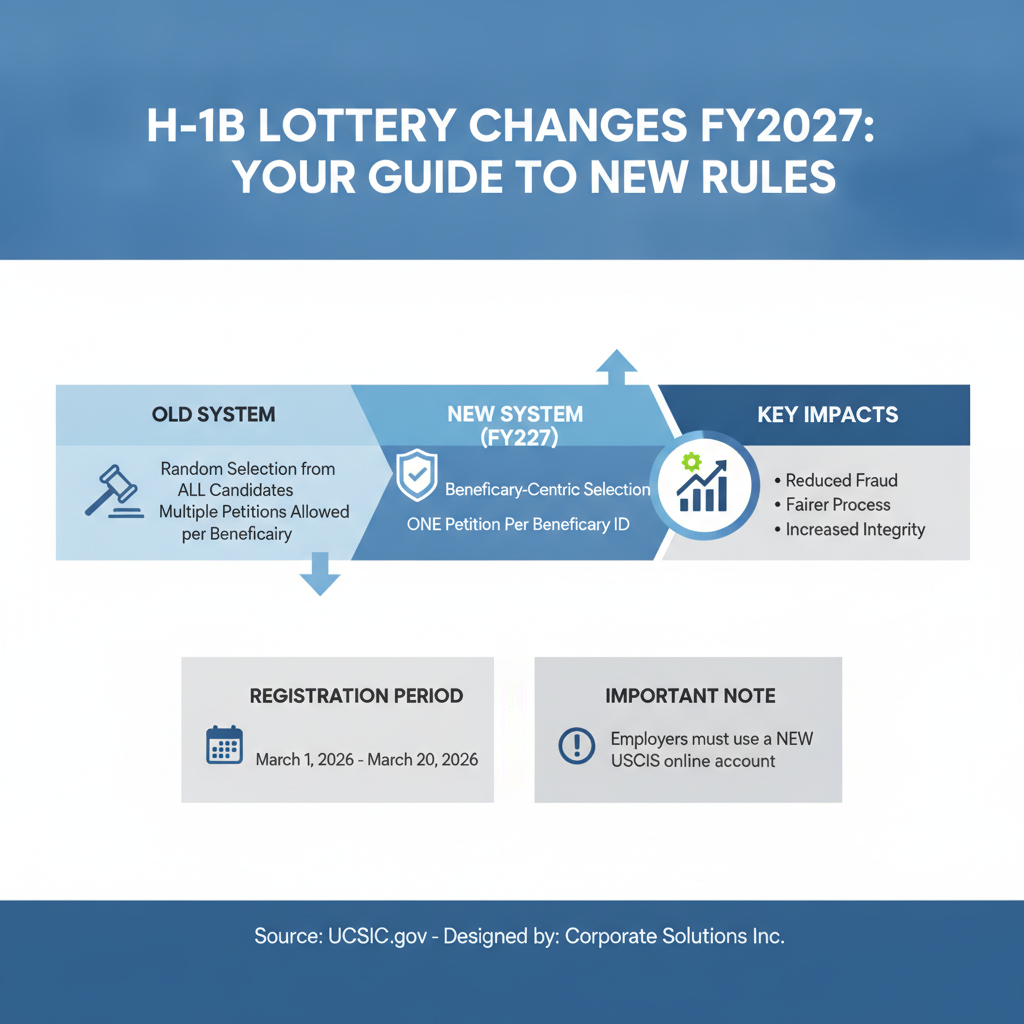
The United States Citizenship and Immigration Services (USCIS) typically announces policy updates and procedural changes well in advance of the annual H-1B cap season. As we approach the anticipated **FY2027 H-1B cap registration period** (which usually occurs in March of the preceding fiscal year, meaning March 2026 for FY2027), USCIS has begun to roll out details regarding modifications to the lottery system. These changes are a response to ongoing efforts to enhance program integrity, combat fraud, and streamline the application process. Previous years have seen a shift towards a beneficiary-centric registration system and increased scrutiny on multiple registrations, and the FY2027 updates build upon these foundations, often introducing more stringent requirements or procedural adjustments. For employers and prospective H-1B beneficiaries, understanding these changes now, in June 2026, is crucial for timely and compliant preparation.How it can affect Florida residents
Florida, particularly the Orlando metropolitan area, is a hub for innovation, tourism, healthcare, and technology. Companies along the **I-4 corridor**, from Tampa to Orlando to Daytona, rely heavily on skilled foreign talent to fill critical roles in IT, engineering, medical research, and finance. Universities like the University of Central Florida (UCF), the University of Florida (UF), and Florida International University (FIU) also attract a significant number of international students who often seek H-1B sponsorship upon graduation. For Florida residents who are prospective H-1B beneficiaries, these changes can mean: * **Increased Competition and Complexity**: New rules, especially those aimed at preventing fraud, can make the process more intricate. While the overall cap remains fixed by Congress, procedural changes can impact your odds of selection. * **Employer Preparation**: Florida businesses will need to adapt their recruitment and sponsorship strategies to comply with the new regulations, potentially requiring more detailed documentation or earlier preparation. * **Strategic Planning**: If you are a student or a professional in Orlando or Central Florida considering an H-1B, these changes necessitate even more careful planning with your potential employer and legal counsel. * **Anti-Fraud Measures**: Stricter anti-fraud measures may lead to more Requests for Evidence (RFEs) or even denials if petitions are not meticulously prepared. This particularly impacts individuals in industries prone to scrutiny or those with complex employment structures. Navigating these new rules requires expert guidance. Imigrar is here to provide clarity and support to Florida's vibrant immigrant community.Need Help? Our Orlando immigration team is ready to assist. Call +1 786-791-3106 for a free consultation, or message us online. Se Habla Español.
What H-1B Visa Lottery Changes for FY2027 Is (and Why It Matters)
The **H-1B visa** is a nonimmigrant visa that allows U.S. employers to temporarily employ foreign workers in specialty occupations. A specialty occupation is defined as one that requires theoretical and practical application of a body of highly specialized knowledge, and a bachelor's degree or higher in a specific specialty (or its equivalent) as a minimum for entry into the occupation in the United States. Every year, demand for H-1B visas far outstrips the supply, necessitating a lottery system. The U.S. Congress sets an annual cap of **65,000 H-1B visas** for the general category and an additional **20,000 visas** for beneficiaries who hold a U.S. master's degree or higher (the "Master's Cap"). Due to overwhelming demand, USCIS conducts an electronic lottery to select eligible registrations for petition filing. The "H-1B visa lottery changes for FY2027" refers to the specific modifications USCIS has announced or implemented for the upcoming fiscal year's lottery process and subsequent petition adjudication. These changes are crucial because they directly impact the eligibility, process, and chances of success for thousands of applicants and their sponsoring employers.A plain-English definition
Think of the H-1B visa as a special pass for skilled workers to come to the U.S. and work in jobs that require a college degree or higher, like engineering, IT, medicine, or finance. Because so many people want this pass, the government holds a **"lottery"** each year to decide who gets to apply. The "changes for FY2027" mean the rules for entering and winning that lottery, and what happens *after* you win, have been updated. These updates are usually designed to make the system fairer, prevent people from cheating, or make the application process clearer, but they can also add new hurdles or requirements. For FY2027, the focus is largely on reinforcing the **beneficiary-centric selection process** and increasing scrutiny on the validity of job offers and employer-employee relationships.Key terms you need to know
To fully grasp the implications of these changes, it's essential to understand the following terms: * **USCIS (U.S. Citizenship and Immigration Services)**: The government agency responsible for administering immigration and naturalization benefits. They manage the H-1B program. * **H-1B Cap**: The annual limit on the number of H-1B visas issued. Currently, it's 65,000 for the general category and 20,000 for the Master's Cap. * **Fiscal Year (FY)**: The U.S. government's fiscal year runs from October 1 to September 30. H-1B visas for FY2027 will become available on **October 1, 2026**. * **Beneficiary**: The foreign national worker who will hold the H-1B visa. * **Petitioner/Sponsor**: The U.S. employer who files the H-1B petition on behalf of the beneficiary. * **Specialty Occupation**: An occupation that requires a theoretical and practical application of a body of highly specialized knowledge, and a bachelor's degree or higher in a specific specialty (or its equivalent) for entry. * **LCA (Labor Condition Application)**: **Form ETA-9035**. An application filed with the Department of Labor (DOL) by the employer, attesting that they will pay the H-1B worker the prevailing wage or actual wage, whichever is higher, and provide working conditions that will not adversely affect other workers. This must be certified before filing the H-1B petition. * **H-1B Registration**: The initial electronic process where prospective petitioners (employers) register beneficiaries for the lottery. This is the first step before a full petition can be filed. * **Selection Notice**: If a registration is selected in the lottery, USCIS issues a selection notice, allowing the employer to proceed with filing the H-1B petition. * **Premium Processing**: An optional service offered by USCIS that guarantees processing of certain petitions (including H-1B) within **15 calendar days** for an additional fee. * **Cap-Subject**: Petitions subject to the annual H-1B cap. * **Cap-Exempt**: Certain employers (e.g., institutions of higher education, non-profit research organizations) or certain H-1B petitions (e.g., extensions, transfers) are exempt from the annual cap. * **Beneficiary-Centric Selection**: A system, reinforced for FY2027, where each unique beneficiary is entered into the lottery only once, regardless of how many employers register them. If selected, any registered employer can file a petition on that beneficiary's behalf. This significantly reduces the chances of fraud through multiple registrations for the same individual. Understanding these terms is your first step in navigating the H-1B landscape.Current Immigration Law: The Foundation
The **H-1B visa program** operates under the authority of the **Immigration and Nationality Act (INA)**, specifically **Section 101(a)(15)(H)(i)(b)**, which defines the H-1B nonimmigrant classification. Further regulations are codified in **8 CFR Part 214.2(h)**. These laws establish the framework for who is eligible, what employers must do, and the general process for obtaining an H-1B visa. The annual cap is set by Congress, and USCIS implements the regulations and procedures, including the lottery system and subsequent changes.Federal requirements
To qualify for an H-1B visa, both the beneficiary and the petitioning employer must meet specific federal requirements: **For the Beneficiary:** * Hold a U.S. bachelor's degree or its equivalent, or a license in a specialty occupation field, or work experience equivalent to a bachelor's degree. * Be coming to the U.S. to perform services in a specialty occupation. * Have an employer-employee relationship with the petitioning U.S. employer. **For the Employer (Petitioner):** * Offer a job in a specialty occupation that requires a bachelor's degree or higher in a specific field. * Pay the H-1B worker at least the **prevailing wage** for the occupation in the area of intended employment, or the actual wage paid to other employees with similar experience and qualifications, whichever is higher. * File a certified **Labor Condition Application (LCA)**, **Form ETA-9035**, with the U.S. Department of Labor (DOL) before filing the H-1B petition. * Maintain an employer-employee relationship with the H-1B worker. * File **Form I-129, Petition for a Nonimmigrant Worker**, with USCIS. The **FY2027 changes** emphasize these foundational requirements even more, particularly the scrutiny of the bona fide job offer, the specialty occupation nature of the role, and the authenticity of the employer-employee relationship. USCIS aims to ensure that H-1B visas are used for their intended purpose: to bring highly skilled foreign talent to fill genuine needs in the U.S. workforce.Florida-specific considerations
While H-1B laws are federal, their impact is felt locally. Florida's economic landscape offers unique opportunities and challenges: * **Tech Hubs**: Orlando is a growing tech hub, with a demand for software developers, IT professionals, and engineers. Tampa and Miami also boast strong tech and finance sectors. The new H-1B rules will affect how these companies recruit and retain talent. * **Healthcare**: Florida has a significant healthcare industry, often seeking medical professionals who qualify for H-1B visas. * **Universities**: Many international students graduate from Florida universities like UCF, UF, FIU, and USF, making the H-1B a crucial post-graduation path. **Important:** The Master's Cap is highly competitive, and changes impacting eligibility or selection for U.S. Master's degree holders are closely watched in Florida. * **Orlando USCIS Field Office**: While H-1B petitions are processed centrally, local field offices like the **Orlando USCIS Field Office** handle other immigration matters. It's important for residents to understand the distinction between national processing centers and local offices. For Central Florida residents and businesses, staying informed about these changes is paramount. Imigrar, based in Orlando, is uniquely positioned to assist clients navigating these complexities within the local context. USCIS official website is your primary source for official forms and updates. Always refer to the latest guidance there.How to Navigate the H-1B Visa Lottery Changes for FY2027: A Complete Step-by-Step Guide
The H-1B process is complex, and with the new FY2027 changes, it demands even more meticulous attention. This guide outlines the essential steps.1) Understand the New Rules & Eligibility
Before anything else, both prospective beneficiaries and employers must thoroughly understand the latest **H-1B visa lottery changes for FY2027**. This includes any modifications to the registration process, fee structures, eligibility criteria, and anti-fraud measures. * **Key Action**: Review the latest USCIS announcements regarding FY2027. Pay close attention to changes in the definition of "beneficiary-centric" selection, any new requirements for proof of a bona fide job offer, and updated fee schedules. * **Documents/Information Needed**: * Beneficiary's educational credentials (degrees, transcripts, evaluations). * Beneficiary's resume/CV detailing work experience. * Job description for the offered position. * Employer's business details (FEIN, business registration).2) Employer-Sponsor Identification & LCA Filing
If you are a foreign national, identify an employer willing to sponsor you. If you are an employer, identify a qualified candidate. Once an employer-employee relationship is established for an H-1B specialty occupation, the employer must file an **LCA (Labor Condition Application)** with the Department of Labor. * **Key Action**: The employer must determine the appropriate wage level and prevailing wage for the position and location (e.g., Orlando, FL). They then electronically file **Form ETA-9035** with the DOL. This form attests to compliance with wage and working condition requirements. * **Timeline**: The LCA must be certified by the DOL before the H-1B petition can be filed. This typically takes **7-10 business days**, but can vary. * **Documents Needed for LCA**: * Employer's Federal Employer Identification Number (FEIN). * Employer's contact information and address. * Job title, duties, and minimum educational requirements. * Proposed salary and work location. * Prevailing wage determination (often from DOL's FLCDataCenter).3) H-1B Registration Process (The Lottery)
The H-1B cap-subject process begins with electronic registration. This is where the **beneficiary-centric selection** for FY2027 is critical. * **Key Action**: During the designated registration period (typically in March preceding the fiscal year, e.g., March 2026 for FY2027), the petitioning employer (or their authorized representative, like Imigrar) creates a USCIS online account and registers the beneficiary. Each beneficiary can only be registered once, even if multiple employers are interested in sponsoring them. * **Important**: For FY2027, USCIS may further refine the anti-fraud mechanisms tied to the beneficiary-centric system. Ensure all information is accurate and consistent across any potential registrations. * **Timeline**: The registration period usually lasts **2-3 weeks**. Selection notices are typically issued by the end of March. * **Documents/Information Needed for Registration**: * Beneficiary's full legal name, date of birth, country of birth, country of citizenship, passport number. * Beneficiary's highest degree (U.S. master's or higher for Master's Cap eligibility). * Employer's legal name, FEIN, and mailing address. * Attorney or representative information (if applicable). * A **non-refundable $10 registration fee** (subject to change for FY2027, always verify current fees).4) Petition Filing (for Selected Beneficiaries)
If your registration is selected in the lottery, USCIS will issue a selection notice. Only then can the employer prepare and file the full H-1B petition. * **Key Action**: The employer, with legal counsel, compiles a comprehensive petition package, including **Form I-129, Petition for a Nonimmigrant Worker**, along with all supporting documentation. This package must be sent to USCIS within the filing window specified on the selection notice (typically a **90-day window**). * **Documents Needed for Petition Filing**: * Certified **LCA (Form ETA-9035)**. * Original H-1B registration selection notice. * **Form I-129** and H-1B Supplement. * Employer letter detailing the job offer, specialty occupation, and why the beneficiary is qualified. * Beneficiary's educational degrees, transcripts, and any foreign degree evaluations. * Beneficiary's resume/CV and professional licenses (if applicable). * Evidence of beneficiary's professional experience (e.g., letters from previous employers). * Copies of beneficiary's passport, visa, I-94, and current immigration documents (if in the U.S.). * Employer's business documents (e.g., articles of incorporation, tax returns, financial statements, office lease, client contracts) to prove ability to pay and legitimate business operations. * Organizational charts and detailed job descriptions to prove specialty occupation. * G-28 (Notice of Entry of Appearance as Attorney) if represented by counsel. * Required filing fees (base fee, ACWIA fee, fraud prevention and detection fee, public law 114-113 fee if applicable). **Warning:** These fees are substantial and subject to change for FY2027.5) Premium Processing (Optional)
For an additional fee, employers can opt for premium processing for **Form I-129**. * **Key Action**: File **Form I-907, Request for Premium Processing Service**, along with the required fee. USCIS guarantees processing within **15 calendar days** (or 10 business days for some petition types). * **Timeline**: **15 calendar days** from receipt. * **Documents Needed**: * **Form I-907**. * Copy of **Form I-129** receipt notice (if filed separately). * Required premium processing fee.6) Adjudication and Approval
After USCIS receives the petition, it will be reviewed. USCIS may issue a **Request for Evidence (RFE)** if they need more information or clarification. * **Key Action**: Respond promptly and thoroughly to any RFEs. If approved, USCIS will send an approval notice (**Form I-797B** for consular processing or **Form I-797A** with a new I-94 for change of status). * **Timeline**: Varies greatly depending on processing times and whether premium processing is used. Non-premium processing can take **several months**. * **Documents Needed**: Timely and comprehensive responses to RFEs, often requiring additional evidence related to specialty occupation, employer-employee relationship, or beneficiary qualifications. USCIS Processing Times is an essential resource for current estimates.Feeling Overwhelmed? The H-1B process is intricate, especially with new changes. Let Imigrar guide you. Call +1 786-791-3106 for a free consultation. Se Habla Español.
Practical Steps You Can Take Today
Preparing for the H-1B lottery, especially with the FY2027 changes, requires foresight and diligent action. Here are practical steps you can take right now: * **Consult an Experienced Immigration Attorney**: This is your most crucial step. An attorney from Imigrar can assess your eligibility, explain the nuances of the FY2027 changes, and guide both beneficiaries and employers through the entire process. They can help identify potential issues and strengthen your case. * **Gather All Educational and Professional Documents**: Start compiling your diplomas, transcripts, degree evaluations (if applicable), professional licenses, and detailed resumes/CVs. Ensure all foreign documents are translated and certified. * **Verify Employer Sponsorship and Job Offer**: If you are a beneficiary, confirm your employer's commitment to sponsorship and ensure the job offer truly qualifies as a specialty occupation. Employers should review their recruitment strategies and ensure the job description aligns with H-1B requirements. * **Understand the New Beneficiary-Centric Registration**: For FY2027, if multiple employers register you, only one entry will be counted. This means you must communicate openly with all potential employers and your attorney to avoid confusion or issues. Employers must also understand this to avoid inadvertently jeopardizing a beneficiary's chances. * **Monitor USCIS Announcements**: Stay updated on official USCIS releases regarding the FY2027 H-1B cap season. These will provide precise dates for registration, filing, and any further procedural modifications. * **Prepare for Potential Fees**: H-1B filing fees are substantial and can change. Budget accordingly for the registration fee, base filing fee, ACWIA fee, fraud prevention fee, and potentially premium processing fees. * **Document Preparation Guidance**: * **Academic Credentials**: Ensure all university degrees and transcripts are readily available. If your degree is from outside the U.S., obtain a professional evaluation from a reputable credential evaluation service to determine its U.S. equivalency. * **Experience Letters**: If relying on work experience in lieu of a degree, gather detailed letters from previous employers specifying your duties, dates of employment, and any specialized knowledge applied. * **Employer Documentation**: Employers should have their business registration, tax IDs, financial statements, and detailed job descriptions ready. Proof of a legitimate, active business is vital. **Timeline Expectations for FY2027 (Approximate based on historical patterns):** * **October 2025 - February 2026**: Employers and beneficiaries prepare, consult attorneys, gather documents, and file LCAs. * **March 2026 (Early-Mid)**: H-1B electronic registration period opens and closes. * **March 2026 (Late)**: Lottery results announced, and selection notices issued. * **April 1, 2026 - June 30, 2026 (Approx.)**: Filing window for selected H-1B cap-subject petitions. * **October 1, 2026**: FY2027 begins; approved H-1B petitions take effect. **Reminder:** These are estimated timelines. Always refer to official USCIS announcements for precise dates.How Imigrar Helps Immigrants in Orlando
At Imigrar, our mission is to "Keep Families Together." We understand that navigating the complex and ever-changing landscape of U.S. immigration law can be daunting, especially with significant updates like the **H-1B visa lottery changes for FY2027**. Our Orlando-based team of experienced immigration attorneys is dedicated to providing comprehensive, compassionate, and effective legal representation to individuals and families across Florida and nationwide. **Our experience and expertise** in H-1B visas mean we are uniquely equipped to: * **Interpret and Apply New Regulations**: We stay abreast of all USCIS updates and policy changes, ensuring your application is compliant with the latest FY2027 rules, including the beneficiary-centric selection process and enhanced anti-fraud measures. * **Strategic Planning**: We work closely with both employers and beneficiaries to develop robust strategies for H-1B registration and petition filing, minimizing risks and maximizing chances of success. * **Meticulous Document Preparation**: We guide you through gathering and organizing all necessary documentation, ensuring accuracy and completeness to avoid RFEs or denials. This is particularly crucial for proving specialty occupation and a bona fide employer-employee relationship. * **Response to RFEs**: Should USCIS issue a Request for Evidence, our team will meticulously prepare a strong and timely response, addressing all concerns raised by the agency. * **Comprehensive Support**: From initial consultation to final approval, we are your partners, providing clear communication and unwavering support throughout the entire H-1B journey. * **Local Insight**: For clients in Orlando, Central Florida, and Orange County, we understand the local economic landscape, common industries, and specific challenges faced by businesses and skilled professionals in this region. We offer a **free consultation offer** to help you understand your options and how the FY2027 H-1B changes might specifically impact your situation. Don't face these complex regulations alone. Se Habla Español: Our team is fluent in both English and Spanish, ensuring that language is never a barrier to receiving expert legal advice. We are here to serve our diverse community.
Frequently Asked Questions
Q: What is the biggest change for the H-1B FY2027 lottery compared to previous years?
A: The most significant ongoing change, which will be reinforced for FY2027, is the **beneficiary-centric selection process**. This means that each unique beneficiary is entered into the lottery only once, regardless of how many employers submit registrations on their behalf. If selected, any employer who registered that beneficiary can file a petition. This aims to prevent fraud where multiple employers would register the same individual to inflate their chances of selection. For FY2027, expect even stricter enforcement and potentially new mechanisms to verify the bona fide nature of multiple registrations for a single beneficiary.
Q: How will the FY2027 changes impact my eligibility for the H-1B visa?
A: The core eligibility requirements (specialty occupation, bachelor's degree or equivalent, employer-employee relationship) remain the same. However, the FY2027 changes may introduce stricter scrutiny on how these requirements are demonstrated. For example, USCIS might demand more robust evidence of the specialty nature of the job or a more concrete employer-employee relationship. If you have a U.S. master's degree or higher, your eligibility for the Master's Cap is still valid, but the selection process itself adheres to the beneficiary-centric model.
Q: What is the timeline for the FY2027 H-1B lottery and petition processing?
A:


