


The landscape of U.S. immigration is constantly evolving, and for skilled foreign workers and their sponsoring employers, few changes are as impactful as those affecting the H-1B visa program. As we look towards the Fiscal Year 2027 (FY2027) H-1B cap season, new rules and refined processes are set to significantly shape the application journey. At Imigrar, your trusted immigration law firm in Orlando, Florida, we are committed to keeping you informed and prepared.
Today, 2026-05-06, we delve into the latest updates surrounding the H-1B visa lottery for FY2027, explaining what these changes mean for you, whether you’re a prospective beneficiary or an employer in Orlando, across Florida, or anywhere nationwide. Our goal is to provide clear, actionable insights to help you navigate this complex, yet vital, immigration pathway.
Considering an H-1B Visa Application for FY2027? Don't leave your future to chance. Our experienced Orlando immigration team at Imigrar is here to guide you through every step of the process, ensuring compliance with the new rules. Call us today for a free, confidential consultation. +1 786-791-3106. Se Habla Español.
The reporting that sparked this guide
Our insights are informed by ongoing developments in immigration policy and reporting from reputable legal news sources, indicating significant shifts in the H-1B visa lottery process. For the latest updates, you can refer to broad legal news coverage:
H-1B Visa Lottery Changes for FY2027 (Legal News)
What This News Means for Immigrants in Orlando and Across Florida
The H-1B visa program is a cornerstone for many skilled foreign workers seeking to contribute their talents to the U.S. economy, particularly in high-tech, medical, and specialized fields prevalent in Florida. The recent changes, while aimed at improving the integrity and fairness of the lottery system, introduce new complexities that demand careful attention.
Why this news is showing up now
The U.S. Citizenship and Immigration Services (USCIS) continuously evaluates and refines its processes, especially for programs like the H-1B visa, which consistently see demand far outstrip the available supply of visas. The H-1B cap for regular petitions remains at 65,000, with an additional 20,000 visas reserved for those with a U.S. master’s degree or higher. This fixed supply against overwhelming demand (often hundreds of thousands of registrations) necessitates a lottery system, which USCIS is continually working to make more robust and fraud-resistant.
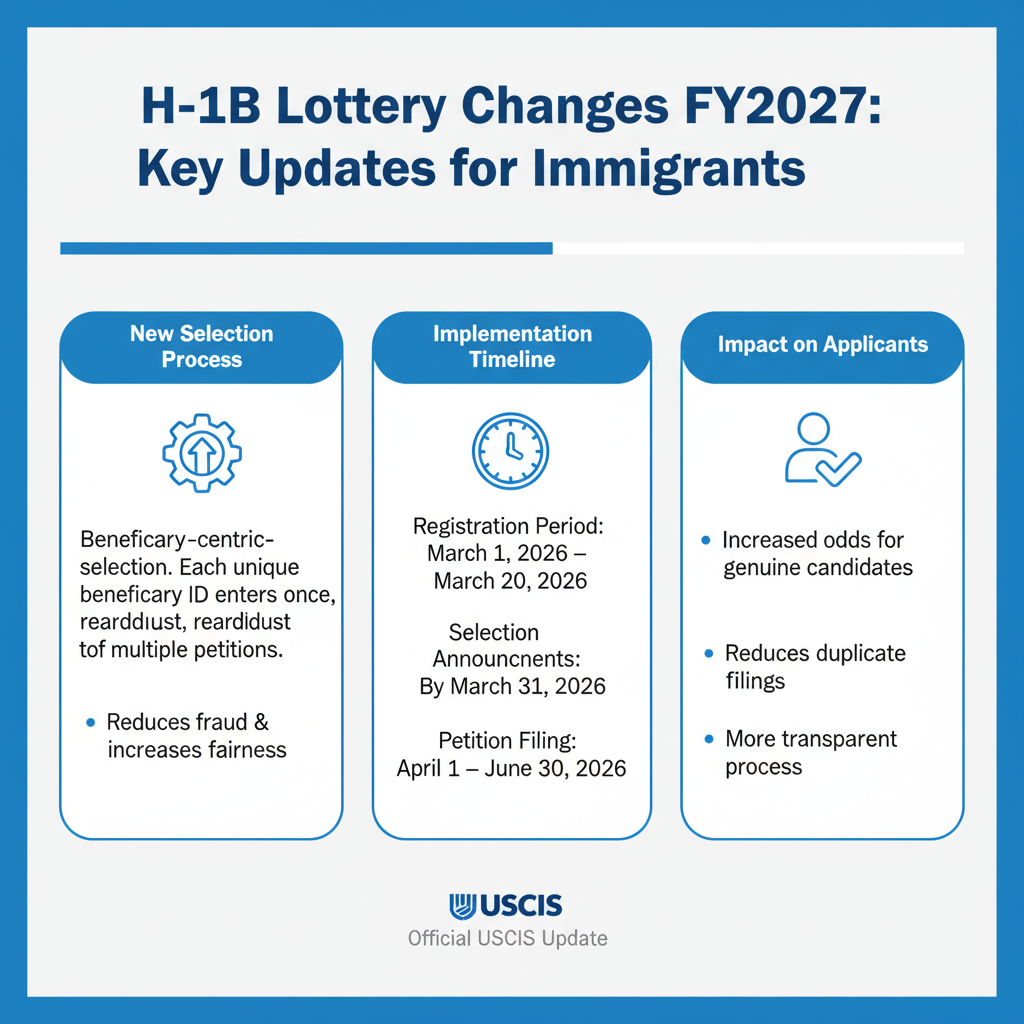
The changes for FY2027, building upon the beneficiary-centric registration model introduced for FY2025, are a direct response to past issues such as multiple registrations for the same individual by different, often related, employers, aiming to unfairly increase selection odds. USCIS has been proactive in implementing measures to combat fraud and ensure that every eligible beneficiary has an equal and fair chance in the lottery. These ongoing refinements are crucial for maintaining the integrity of the program and ensuring that the H-1B visa serves its intended purpose.
How it can affect Florida residents
Florida, with its booming tech industry, robust healthcare sector, and growing economy, is a significant destination for H-1B professionals. Cities like Orlando, Miami, Tampa, and Jacksonville attract a diverse pool of talent, from IT specialists and engineers to medical researchers and financial analysts. For Florida residents, both prospective H-1B beneficiaries and sponsoring employers, these changes have several key implications:
- Increased Scrutiny: USCIS will likely implement more rigorous checks on both employers and beneficiaries. Employers, particularly those with a history of multiple registrations for the same individual, may face enhanced scrutiny.
- Focus on Beneficiary: The beneficiary-centric model, now firmly established for FY2027, means that each unique beneficiary will only have one chance in the lottery, regardless of how many employers register them. This levels the playing field but shifts the strategy for those with multiple job offers.
- Employer Responsibility: Florida employers must ensure their H-1B registration practices are fully compliant with the new rules, avoiding any actions that could be construed as an attempt to circumvent the lottery process. This includes careful consideration of related entities and their registration strategies.
- Timely Preparation: Given the increased complexity and potential for enhanced verification, both beneficiaries and employers in Florida must start preparing their documentation and strategies much earlier. Delays or errors could prove costly.
- Local Economic Impact: A more equitable H-1B system could mean that genuine Florida-based companies have a fairer chance of securing talent, fostering innovation and economic growth within the state.
For those in Central Florida, including Orlando and surrounding Orange County, understanding these shifts is paramount. The Orlando USCIS Field Office may see increased inquiries related to H-1B post-selection processes, making expert legal guidance from a firm like Imigrar even more valuable.
What H-1B Visa Lottery Changes Are (and Why It Matters)
The H-1B visa is a non-immigrant visa that allows U.S. employers to temporarily employ foreign workers in specialty occupations. A specialty occupation generally requires a bachelor's degree or higher in a specific specialty, or its equivalent.
A plain-English definition
Think of the H-1B visa as a special work permit for highly skilled professionals. Companies in the U.S. use it to hire people from other countries who have specific expertise, often in fields like technology, engineering, medicine, or science. Because there are more people who want these visas than there are available each year, USCIS uses a lottery system to decide who gets a chance to apply. The "changes" we're discussing for FY2027 are new rules for how this lottery works, primarily aimed at making it fairer and preventing fraud, ensuring that each individual has only one legitimate chance in the lottery.
Key terms you need to know
- H-1B Visa: A non-immigrant visa that permits U.S. employers to temporarily employ foreign workers in specialty occupations.
- Specialty Occupation: An occupation that requires theoretical and practical application of a body of highly specialized knowledge, and a bachelor's or higher degree in the specific specialty (or its equivalent) as a minimum for entry into the occupation.
- H-1B Cap: The annual limit on the number of H-1B visas issued. Currently, it's 65,000 for the regular cap and an additional 20,000 for those with a U.S. master's degree or higher (the "master's cap").
- H-1B Lottery (Cap Lottery): The random selection process USCIS uses when the number of H-1B registrations exceeds the annual cap.
- Fiscal Year (FY): The U.S. government's fiscal year runs from October 1 to September 30. H-1B visas for FY2027 will become available on October 1, 2026.
- H-1B Registration Period: The annual period, typically in March, when employers submit electronic registrations for prospective H-1B workers. This is when the lottery takes place.
- Beneficiary: The foreign national who seeks to obtain the H-1B visa.
- Petitioner: The U.S. employer who files the H-1B petition on behalf of the beneficiary.
- Beneficiary-Centric Registration: The new system where each unique beneficiary is entered into the lottery only once, regardless of the number of registrations submitted on their behalf by different employers. If selected, all petitions filed on behalf of that beneficiary are considered valid. This is a critical change for FY2027.
- Form I-129, Petition for a Nonimmigrant Worker: The primary form filed by employers to request H-1B classification.
These changes matter because they directly impact the probability of securing an H-1B visa, the strategies employers must adopt, and the overall integrity of the program. For many, an H-1B visa is the first step towards a long-term career and life in the U.S., making these lottery modifications critical for their future.
Navigating the H-1B Lottery? Imigrar's team is well-versed in the latest H-1B regulations and can help your business or yourself prepare for the FY2027 season. Get expert advice tailored to your situation. Call +1 786-791-3106 for a free consultation. Se Habla Español.
Current Immigration Law: The Foundation
The H-1B visa program is governed by the Immigration and Nationality Act (INA), specifically Section 101(a)(15)(H)(i)(b) and Section 214(g). These statutes establish the framework for specialty occupation visas, including annual numerical limitations (the "cap") and general eligibility requirements. Regulations found in 8 CFR Part 214 further elaborate on these statutory provisions, detailing the application process, employer obligations, and beneficiary qualifications.
Federal requirements
The core federal requirements for an H-1B visa remain consistent, even with changes to the lottery process:
- Specialty Occupation: The job offered must qualify as a specialty occupation, meaning it requires a bachelor's degree or higher in a specific field.
- Educational Qualifications: The beneficiary must hold a bachelor's degree or its equivalent, or possess a license, or have work experience equivalent to a bachelor's degree in the specialty occupation field.
- Employer-Employee Relationship: A valid employer-employee relationship must exist between the petitioner and the beneficiary.
- Prevailing Wage: The employer must pay the H-1B worker at least the prevailing wage for the occupation in the area of employment, or the actual wage paid to other employees with similar experience and qualifications, whichever is higher. This is certified through a Labor Condition Application (LCA).
- Cap-Subject: Most H-1B petitions are subject to the annual cap, unless the employer is cap-exempt (e.g., institutions of higher education, non-profit research organizations).
USCIS is the federal agency responsible for administering these laws and regulations. You can find comprehensive information and official forms on the USCIS official website.
Key forms involved in the H-1B process include:
- Form ETA-9035/9035E, Labor Condition Application (LCA): Filed with the Department of Labor.
- Form I-129, Petition for a Nonimmigrant Worker: Filed with USCIS.
- Form I-797, Notice of Action: Various notices from USCIS, including receipt notices and approval notices.
Florida-specific considerations
While the H-1B visa program is federal, certain aspects can have localized implications for Florida residents and businesses:
- Prevailing Wage Areas: The prevailing wage determination is specific to the geographic area of employment. For a position in Orlando, the prevailing wage will be different than for a position in Miami or Pensacola. Employers must ensure they are using the correct wage data for their specific location.
- Local Economic Demand: Florida's growing sectors, such as aerospace, simulation, advanced manufacturing, and biomedical industries, have a high demand for specialty occupation workers. This often translates to competitive H-1B filings from Florida-based companies.
- Orlando USCIS Field Office: While H-1B petitions are processed at Service Centers, the Orlando Field Office handles other immigration matters. Understanding the overall immigration landscape in Central Florida is crucial for comprehensive planning.
- State-Specific Licenses: For certain professions (e.g., healthcare, engineering), Florida requires state-specific occupational licenses. An H-1B beneficiary must meet these state licensing requirements to practice their profession in Florida.
It's important to remember that H-1B petitions are adjudicated based on federal law and regulations, but local conditions and requirements can influence parts of the application process, particularly regarding prevailing wages and occupational licensing.
How to Navigate the H-1B Lottery Changes for FY2027: A Complete Step-by-Step Guide
The H-1B cap season for FY2027 will largely follow the electronic registration process, but with the enhanced beneficiary-centric approach and potential additional integrity measures. Here’s a detailed guide:
1) Employer and Beneficiary Preparation (Ongoing – typically October-February)
This initial phase is critical for both the sponsoring employer and the prospective H-1B beneficiary. Given the increased scrutiny, thorough preparation is more important than ever.
- Employer Actions:
- Identify Need: Determine the specific need for a specialty occupation worker.
- Verify Eligibility: Ensure the position qualifies as a specialty occupation and the beneficiary meets the educational/experiential requirements.
- Wage Determination: Research the prevailing wage for the occupation in the intended area of employment (e.g., Orlando, FL) using the Department of Labor's Foreign Labor Certification Data Center.
- Internal Review: If multiple related entities within your organization plan to register the same beneficiary, coordinate carefully to avoid issues under the beneficiary-centric system.
- Engage Legal Counsel: Work with an experienced immigration attorney (like Imigrar) to assess eligibility, strategize, and prepare for the registration.
- Beneficiary Actions:
- Secure Job Offer: Obtain a job offer from a U.S. employer for a specialty occupation position.
- Gather Credentials: Compile all educational degrees, transcripts, diplomas, and any professional licenses. For foreign degrees, consider obtaining a foreign credential evaluation if required.
- Curriculum Vitae (CV)/Resume: Ensure your CV is up-to-date and clearly outlines your qualifications and experience.
- Passport Information: Have a valid passport with accurate personal details.
Reminder: The beneficiary-centric model for FY2027 means only one registration per unique beneficiary will be considered. If multiple employers register the same beneficiary, USCIS will select based on the unique beneficiary's information, not the number of registrations. This significantly impacts strategy.
2) H-1B Electronic Registration Period (Typically March)
This is the window when employers submit the electronic registrations for their prospective H-1B workers. For FY2027, this period is expected to be in March 2026 (e.g., March 1st to March 17th, 2026, based on historical patterns).
- Employer Actions:
- Create/Access USCIS Online Account: Employers (or their authorized representatives, like Imigrar) must have a USCIS online account.
- Submit Registrations: For each beneficiary, submit an electronic registration form providing basic information about the employer and the beneficiary. This includes the beneficiary's full legal name, date of birth, country of birth, country of citizenship, passport number, and gender.
- Pay Registration Fee: Pay the non-refundable H-1B registration fee (currently $10, but subject to change for FY2027, potentially increasing).
- Attestation: Electronically sign an attestation confirming that the information provided is true and accurate, and that the employer intends to file an H-1B petition for the beneficiary if selected.
- Beneficiary Actions:
- Provide Accurate Information: Ensure all personal details provided to the employer for registration are entirely accurate and match your passport.
- Monitor Status: Stay in communication with your sponsoring employer or attorney regarding the registration status.
Important: Under the beneficiary-centric rule, employers must ensure they are not attempting to gain an unfair advantage by coordinating multiple registrations for the same individual through related entities. USCIS has sophisticated tools to detect such attempts and will likely reject or deny petitions if fraud is suspected.
3) Lottery Selection and Notification (Typically March-April)
After the registration period closes, USCIS conducts the lottery if the number of registrations exceeds the annual cap.
- USCIS Actions:
- Conduct Lottery: USCIS randomly selects enough registrations to meet the H-1B cap. The master’s cap lottery is usually conducted first, followed by the regular cap lottery.
- Notify Results: USCIS notifies all registrants (employers/attorneys) of the selection results through their online accounts. Selected registrations will show a "Selected" status.
- Employer Actions:
- Check Status: Promptly check the status of all submitted registrations in the USCIS online account.
- Notify Beneficiary: Inform the beneficiary immediately of the selection status.
- Beneficiary Actions:
- Await Notification: Wait for your employer or attorney to inform you of the lottery results.
Warning: Only selected beneficiaries are eligible to have an H-1B cap-subject petition filed on their behalf. Filing for a non-selected beneficiary will lead to denial.
4) H-1B Petition Filing Period (Typically April-June)
If a registration is selected, the employer has a specific window to file the full H-1B petition with USCIS. This period usually begins on April 1st and lasts for approximately 90 days.
- Employer Actions:
- Prepare LCA: File Form ETA-9035/9035E, Labor Condition Application (LCA) with the Department of Labor (DOL). This must be certified by DOL before filing the H-1B petition.
- Assemble Petition: Prepare a comprehensive H-1B petition package, including Form I-129, Petition for a Nonimmigrant Worker, along with all supporting documentation.
- Required Documents (example list):
- Certified LCA.
- Copy of the H-1B registration selection notice.
- Employer's Federal Employer Identification Number (FEIN).
- Letter from employer detailing job offer, duties, salary, and qualifications required.
- Copies of beneficiary's passport, visa, I-94 record, and previous U.S. immigration documents (if applicable).
- Beneficiary's educational degrees, transcripts, and any foreign credential evaluations.
- Beneficiary's resume/CV.
- Copies of any professional licenses.
- Organizational chart and details about the company.
- Photos of the company’s premises.
- Articles of Incorporation/business licenses.
- Employer's tax returns and financial statements (to establish ability to pay wages).
- Contracts between the employer and end-client (if applicable for IT consulting firms).
- Any other evidence proving specialty occupation and beneficiary qualifications.
- Pay Filing Fees: Submit all required USCIS filing fees (base fee, ACWIA fee, fraud prevention and detection fee, public law 114-113 fee for employers with 50+ employees/50%+ H-1B workers, optional premium processing fee). These fees are subject to change.
- Mail Petition: File the complete petition package with the correct USCIS Service Center.
- Beneficiary Actions:
- Provide All Requested Documents: Promptly furnish any additional documents or information requested by the employer or attorney.
- Review Petition: Carefully review the draft H-1B petition to ensure accuracy before filing.
Important: The H-1B petition must be strong and well-documented to demonstrate that the position is a specialty occupation and the beneficiary is qualified. Any inconsistencies with the registration information or lack of supporting evidence can lead to a Request for Evidence (RFE) or denial.
5) USCIS Processing and Adjudication (Typically April onwards)
Once the petition is filed, USCIS reviews it. Processing times can vary significantly.
- USCIS Actions:
- Issue Receipt Notice: USCIS sends a Form I-797C, Notice of Action, acknowledging receipt of the petition.
- Adjudicate Petition: A USCIS officer reviews the petition and supporting documents.
- Issue RFE (if needed): If more information is required, USCIS issues a Request for Evidence (RFE).
- Issue Approval/Denial: USCIS sends a Form I-797, Notice of Action, indicating approval or denial.
- Employer Actions:
- Respond to RFE: If an RFE is issued, work with your attorney to gather and submit the requested evidence promptly.
- Monitor Status: Track the petition status online using the receipt number. Check USCIS Processing Times for general estimates.
- Beneficiary Actions:
- Maintain Status: If already in the U.S., ensure you maintain your current nonimmigrant status while the H-1B petition is pending.
- Prepare for Interview (if applicable): If consular processing, prepare for the visa interview abroad.
Important: If approved, the H-1B status typically becomes effective on October 1, 2026, for FY2027 petitions. Those changing status within the U.S. will have their status automatically adjusted. Those outside the U.S. will need to apply for an H-1B visa stamp at a U.S. embassy or consulate abroad.
Practical Steps You Can Take Today
Preparing for the H-1B lottery, especially with the new FY2027 changes, requires proactive planning. Here's an actionable checklist:
- Assess Eligibility: Both employers and beneficiaries should confirm eligibility for the H-1B program, focusing on the specialty occupation requirement and educational qualifications.
- Gather Essential Documents: Start compiling all necessary personal and professional documents immediately. This includes passports, academic transcripts, degrees, and professional evaluations.
- Consult an Immigration Attorney: This is arguably the most crucial step. An expert like Imigrar can clarify the new FY2027 rules, advise on strategy, and manage the entire process.
- Review Employer Practices: Employers should review their H-1B registration strategies, especially concerning related entities, to ensure full compliance with the beneficiary-centric model.
- Financial Preparation: Be aware of the various fees involved (registration, filing, premium processing) and budget accordingly. USCIS fees are subject to change.
- Stay Informed: Keep abreast of any further announcements from USCIS regarding the FY2027 H-1B season. The USCIS official website is your primary source.
- Plan for Contingencies: What if you're not selected? Discuss alternative visa options or strategies with your legal counsel.
Document preparation guidance
Thorough and accurate documentation is key to a successful H-1B petition. Here’s how to approach it:
- Accuracy is Paramount: Ensure all information matches exactly across all documents (e.g., name on passport, birth certificate, degrees). Any discrepancy can cause delays or RFEs.
- Translations: All foreign-language documents must be accompanied by a certified English translation.
- Copies, Not Originals: Generally, USCIS requires copies of documents, not originals, unless specifically requested. Keep your originals safe.
- Organize Systematically: Use clear labels, dividers, and a table of contents for large petition packages. This helps USCIS officers process your application efficiently.
- Digital Backups: Keep digital copies of all submitted documents.
Timeline expectations
While specific dates are announced by USCIS closer to the season, here’s a general timeline for the FY2027 H-1B process:
- Late 2025 – Early 2026 (October-February): Employer and beneficiary preparation, legal consultation, document gathering.
- March 2026 (First half): H-1B electronic registration period.
- Late March – April 2026: Lottery conducted, selection notifications issued.
- April 1, 2026 – June 30, 2026 (approx. 90-day window): Filing period for selected H-1B cap-subject petitions.
- April 2026 onwards: USCIS processing of H-1B petitions. This can take several months, or as little as 15 calendar days with premium processing.
- October 1, 2026: Earliest start date for approved H-1B petitions for FY2027.
Important: These are estimated timelines. USCIS can adjust dates, and processing times can fluctuate. Always refer to official USCIS announcements.

How Imigrar Helps Immigrants in Orlando
At Imigrar, we understand that the H-1B visa process, especially with new rules, can be daunting. Our mission is to "Keep Families Together" by providing expert, compassionate, and effective legal representation to immigrants in Orlando, across Florida, and nationwide.
Our experienced immigration attorneys specialize in employment-based visas, including the H-1B. We are deeply familiar with the nuances of USCIS regulations and have a proven track record of successfully guiding both employers and beneficiaries through the complex H-1B lottery and petition process. We stay ahead of every policy change, including the latest for FY2027, to provide you with the most current and accurate advice.
From the initial eligibility assessment and strategic planning for the beneficiary-centric lottery to meticulous petition preparation and responding to RFEs, Imigrar provides end-to-end support. We pride ourselves on clear communication, ensuring you understand every step and what to expect.
We offer a free consultation to discuss your specific situation and evaluate your options. Don't navigate these critical changes alone. Let Imigrar be your trusted partner.
Se Habla Español. Our bilingual team is ready to assist you in the language you're most comfortable with.
Confused by the H-1B Changes? Get clarity and expert guidance from Imigrar. Our Orlando-based legal


Have Questions About Your Case?
Schedule a free consultation with our attorney-reviewed team today