


The H-1B visa program is a lifeline for many highly skilled foreign professionals seeking to contribute their talents to the U.S. economy, particularly in critical sectors like technology, healthcare, and engineering. For employers across Orlando, Florida, and the nation, it's a vital tool for securing specialized talent. Each year, the demand for H-1B visas far outstrips the available supply, leading to a highly competitive lottery process. As we approach the registration period for Fiscal Year 2027 (FY2027), significant changes are on the horizon, promising to reshape how both employers and prospective beneficiaries approach this critical visa.
At Imigrar, an immigration law firm based in Orlando, Florida, we understand the immense pressure and uncertainty that these changes can bring. Our mission is to "Keep Families Together" by providing expert, compassionate legal guidance through every step of the immigration journey. This comprehensive guide is designed to break down the upcoming H-1B visa lottery changes for FY2027, offering clarity, practical advice, and actionable steps to help you navigate this complex landscape successfully.
NEWS SOURCE REFERENCE SECTION
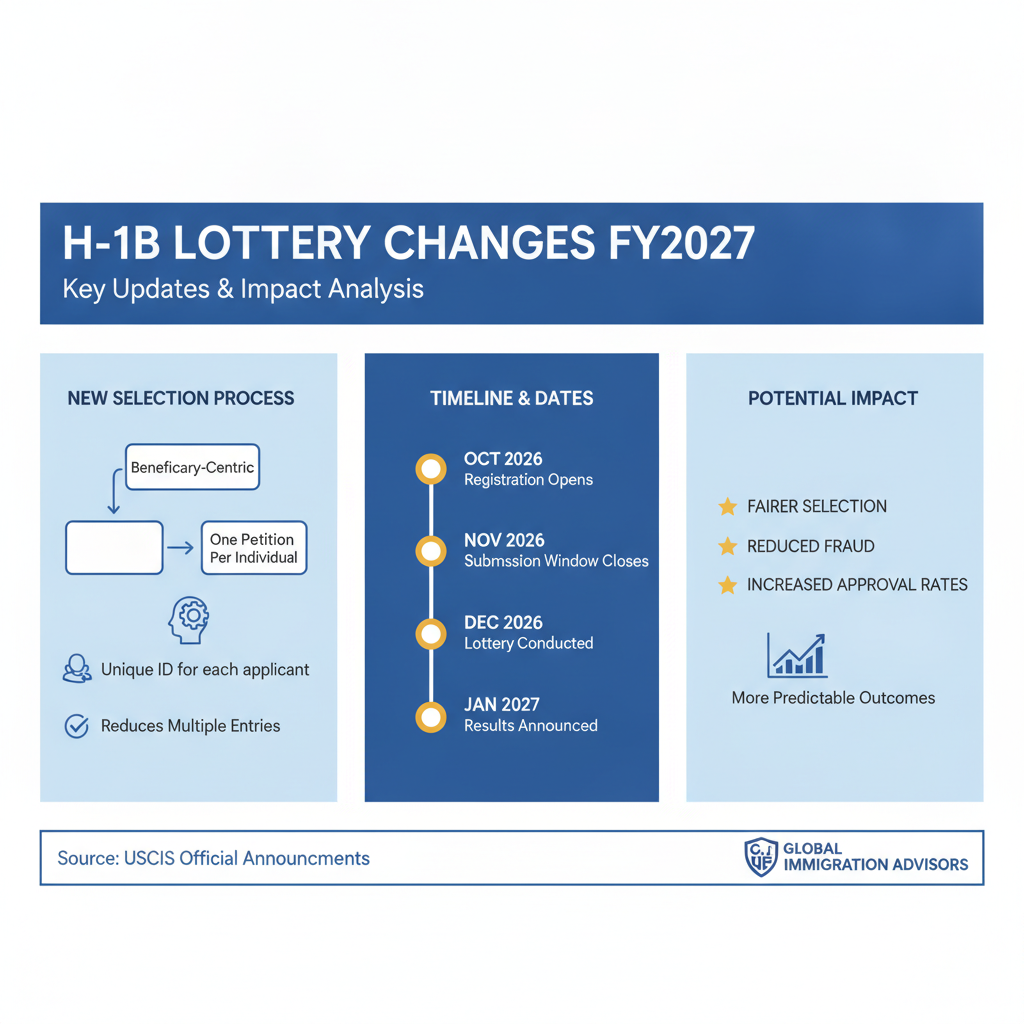
The reporting that sparked this guide: H-1B Visa Lottery Changes for FY2027 (Legal News)
Need Expert Guidance on the H-1B Lottery? The new FY2027 rules add layers of complexity. Our experienced Orlando immigration team is ready to assist. Call +1 786-791-3106 for a free consultation, or message us online. Se Habla Español.
What This News Means for Immigrants in Orlando and Across Florida
The H-1B visa lottery is a pivotal moment for thousands of individuals and businesses each year. The announced changes for FY2027 are not merely procedural tweaks; they represent a significant shift in how USCIS manages the selection process, aiming to enhance integrity, fairness, and potentially prioritize certain types of talent. For those living or planning to work in Orlando and throughout Florida, understanding these updates is paramount.
Why this news is showing up now
The United States government operates on a fiscal year that begins on October 1st. For the H-1B program, petitions for a given fiscal year (e.g., FY2027) are typically filed six months in advance. The annual H-1B cap registration period usually opens in early March for petitions seeking an October 1st start date. USCIS often announces significant policy changes, fee adjustments, or procedural updates in the preceding months to give stakeholders ample time to prepare. Given that today is September 11, 2026, it is precisely the time when the U.S. Citizenship and Immigration Services (USCIS) would be finalizing and announcing the operational details for the upcoming FY2027 H-1B cap season. These announcements are crucial because they dictate the strategy for employers and beneficiaries alike, well before the registration window opens in early 2027.
How it can affect Florida residents
Florida, particularly the Orlando metropolitan area, is a vibrant hub for tourism, technology, aerospace, healthcare, and advanced manufacturing. These industries frequently rely on H-1B visas to bring in specialized talent that fills critical skill gaps. The new H-1B lottery changes for FY2027 could have several direct impacts on Florida residents:
- For Prospective H-1B Beneficiaries Currently in Florida (e.g., on OPT/F-1 visas): If you are a recent graduate from a Florida university (like UCF, UF, USF) working on Optional Practical Training (OPT), these changes directly affect your chances of securing long-term employment and remaining in the U.S. The new rules, especially those related to beneficiary-centric selection and potential prioritization for U.S. STEM graduates, could either improve or complicate your path depending on your specific circumstances.
- For Florida Employers: Tech companies in Lake Nona, engineering firms in Brevard County, healthcare systems in Orlando, and theme park operators, all depend on the H-1B program. Stricter employer vetting, increased fees, and enhanced integrity measures mean that Florida businesses must be more diligent than ever in their H-1B sponsorship processes. The new rules might also influence their recruitment strategies.
- Increased Scrutiny for Multiple Petitions: While the beneficiary-centric model was introduced for FY2025, the FY2027 changes are expected to significantly strengthen integrity measures. This means that any attempt by multiple Florida employers to register the same beneficiary could lead to disqualification of *all* registrations for that individual, rather than just the duplicate ones. This requires greater coordination and transparency.
- Higher Costs: Increased registration and filing fees will directly impact the financial burden on Florida employers sponsoring H-1B workers. This could lead to some smaller businesses reconsidering their participation or passing on costs.
- Impact on Local Economy: A smoother, fairer H-1B process could attract more high-skilled talent to Florida, bolstering the local economy. Conversely, overly burdensome rules could deter talent, potentially slowing growth in key sectors along the I-4 corridor.
Understanding these impacts is the first step toward preparing effectively. Imigrar is here to guide both individuals and businesses through these complexities, ensuring compliance and maximizing chances of success.
What H-1B Visa Lottery Changes for FY2027 Is (and Why It Matters)
The H-1B visa is a non-immigrant visa that allows U.S. employers to temporarily employ foreign workers in specialty occupations. A "specialty occupation" generally requires a bachelor's degree or higher in a specific field. Due to annual caps on the number of H-1B visas available, USCIS often conducts a lottery to select petitions when demand exceeds supply.
A plain-English definition
The "H-1B Visa Lottery Changes for FY2027" refers to the new rules and procedures that USCIS will implement for the upcoming selection process for H-1B visas, which will become available on October 1, 2026 (the start of Fiscal Year 2027). Essentially, the government is updating the game rules for who gets a chance to apply for an H-1B visa, how employers register their potential employees, and what steps are taken to ensure fairness and prevent fraud. These changes are designed to make the lottery more equitable, reduce abuse, and streamline the process, albeit potentially making it more stringent for some.
Key terms you need to know
- H-1B Visa: A non-immigrant visa that permits U.S. employers to temporarily employ foreign workers in specialty occupations.
- Specialty Occupation: An occupation that requires theoretical and practical application of a body of highly specialized knowledge, and a bachelor's or higher degree in the specific specialty (or its equivalent) as a minimum for entry into the occupation in the United States.
- USCIS: U.S. Citizenship and Immigration Services, the federal agency that oversees lawful immigration to the United States.
- H-1B Cap: The annual statutory limit on the number of H-1B visas issued each fiscal year. Currently, the cap is 65,000 for the regular category and an additional 20,000 for those with a U.S. master's degree or higher (the "master's cap").
- H-1B Lottery (or Cap Lottery): The random selection process conducted by USCIS when the number of H-1B cap registrations exceeds the annual limit.
- Beneficiary: The foreign national worker for whom the H-1B visa is being sought.
- Petitioner: The U.S. employer sponsoring the H-1B visa for the beneficiary.
- LCA (Labor Condition Application): Form ETA-9035, a document that an employer must file with the U.S. Department of Labor before filing an H-1B petition with USCIS. It attests to prevailing wages and working conditions.
- Prevailing Wage: The average wage paid to similarly employed workers in a specific occupation in the area of intended employment. Employers must pay H-1B workers at least the prevailing wage or the actual wage paid to employees with similar experience and qualifications, whichever is higher.
- Cap-Exempt: Certain employers (e.g., institutions of higher education, non-profit research organizations) are exempt from the annual H-1B cap.
- Registration Period: The designated window during which employers must electronically register prospective H-1B beneficiaries for the lottery. For FY2027, this is expected in early March 2027.
- Selection Notice: The notification from USCIS to selected petitioners, indicating their registration has been chosen in the lottery and they can proceed to file a full H-1B petition.
Understanding these terms is crucial as we delve into the specifics of the new changes and how they impact the H-1B process.
Current Immigration Law: The Foundation
The H-1B visa program is governed primarily by the Immigration and Nationality Act (INA), specifically Section 101(a)(15)(H)(i)(b), codified at 8 U.S.C. § 1101(a)(15)(H)(i)(b). Regulations implementing the H-1B program are found at 8 CFR Part 214.2(h). These laws and regulations define who qualifies for an H-1B visa, the responsibilities of employers, and the procedures for application.
Federal requirements
To qualify for an H-1B visa, both the employer (petitioner) and the foreign worker (beneficiary) must meet specific federal requirements:
- For the Beneficiary:
- Must hold a bachelor's degree or its equivalent, or a higher degree in a specialty occupation field.
- Must possess a state license, if required, to practice the occupation.
- Must have authorization from the appropriate government agency to fully practice the occupation, if required.
- Must have work experience in a specialty occupation field equivalent to a bachelor's degree.
- The job offered must be a "specialty occupation."
- For the Petitioner (Employer):
- Must offer a job in a "specialty occupation."
- Must pay the H-1B worker at least the prevailing wage for the occupation in the geographic area of employment or the actual wage paid to other employees with similar experience and qualifications, whichever is higher.
- Must obtain a certified Labor Condition Application (LCA), Form ETA-9035, from the U.S. Department of Labor before filing the H-1B petition.
- Must agree to certain working conditions and not adversely affect the wages and working conditions of U.S. workers.
- Must notify USCIS of any material changes in employment.
The annual cap on H-1B visas and the lottery system are also established under federal law and regulations. USCIS continuously refines the lottery procedures to address concerns such as fraud and to improve efficiency.
Florida-specific considerations
While there are no Florida-specific immigration laws that directly impact the federal H-1B program, the state's economic landscape and regulatory environment can indirectly influence H-1B sponsorship:
- Industry Demand: Florida's growing tech sector, robust tourism and hospitality industries, and expanding healthcare networks create significant demand for H-1B workers. Employers in Orlando, Tampa, Miami, and other major Florida cities are frequent H-1B petitioners.
- State Licensing: For certain professions, such as healthcare (nurses, doctors), engineering, or architecture, Florida state licensing is required to practice. H-1B beneficiaries must ensure they meet these state-specific licensing requirements in addition to federal immigration criteria.
- Prevailing Wage Data: The prevailing wage determinations for specific occupations are localized. Florida employers must ensure they are using accurate wage data for their specific geographic region within the state (e.g., Orlando-Kissimmee-Sanford MSA) when filing the LCA.
- E-Verify Requirements: While not directly tied to H-1B, many Florida employers are subject to E-Verify requirements for new hires, which is an important compliance aspect for all employers.
For the latest official information and forms, always refer to the USCIS official website.
Don't Risk Your H-1B Application. The new FY2027 rules are complex. Let Imigrar's Orlando team ensure your petition is perfect. Call +1 786-791-3106 for a free consultation, or message us online. Se Habla Español.
How to Navigate the H-1B Lottery Changes for FY2027: A Complete Step-by-Step Guide
The H-1B visa process, particularly with the new FY2027 changes, requires meticulous attention to detail and strict adherence to timelines. This guide incorporates the anticipated modifications, focusing on enhanced integrity measures, increased fees, and a strengthened beneficiary-centric selection process. Remember, the H-1B petition is primarily an employer-sponsored process.
1) Employer Pre-Vetting and Labor Condition Application (LCA) Filing
Before any lottery registration can occur, the employer must establish its eligibility and the legitimacy of the offered position. For FY2027, USCIS is introducing a mandatory, light pre-vetting process for employers. This aims to prevent shell companies or fraudulent entities from participating in the lottery. Details on this pre-vetting will be released by USCIS, but it is expected to require basic company information, EIN verification, and a statement of intent regarding H-1B employment.
Once the employer is deemed eligible through this pre-vetting, the first formal step is to file the Labor Condition Application (LCA), Form ETA-9035, with the U.S. Department of Labor (DOL). This form attests that the employer will pay the H-1B worker at least the prevailing wage for the occupation in the area of intended employment, or the actual wage paid to other employees with similar qualifications, whichever is higher. It also attests to providing working conditions that will not adversely affect U.S. workers.
- Required Documents/Information for LCA:
- Employer's Federal Employer Identification Number (EIN).
- Employer's legal name and address.
- Beneficiary's job title, duties, and proposed wage.
- Prevailing wage determination for the specific occupation and geographic location (e.g., Orlando, FL).
- Start and end dates of employment.
- Worksite location(s).
- Timeline: LCA processing can take 7-10 business days. It must be certified by the DOL *before* the H-1B registration period opens. Employers in Central Florida should start this process well in advance, typically by late January 2027.
2) Electronic H-1B Cap Registration (Beneficiary-Centric Focus)
The H-1B cap registration period for FY2027 is expected to open in early March 2027. During this window, employers must electronically register each prospective H-1B beneficiary with USCIS. The FY2027 changes significantly strengthen the beneficiary-centric selection process introduced in FY2025. This means each unique beneficiary can only have *one* registration submitted on their behalf by *one* employer. USCIS will use the beneficiary's passport or travel document information to identify unique individuals.
Important: The new rules explicitly state that if USCIS finds that a beneficiary has been registered by multiple employers, *all* registrations for that beneficiary, regardless of who submitted them, will be invalidated and deemed improper. This is a critical departure from previous years where only duplicate entries by the same employer were problematic. This change requires unprecedented coordination between beneficiaries and potential employers, especially for those who may have multiple job offers.
- Required Information for Registration:
- Employer's name, address, and EIN.
- Beneficiary's full legal name, date of birth, country of birth, country of citizenship.
- Beneficiary's passport number or travel document number.
- Beneficiary's highest level of education and U.S. master's degree (if applicable).
- Employer's attorney or representative information (if applicable).
- Registration Fee: For FY2027, the registration fee is projected to increase significantly, potentially to $215 per beneficiary.
- Timeline: Typically a 2-week window in early March 2027.
3) Lottery Conducted and Selection Notices Issued
After the registration period closes, USCIS conducts the lottery. The master's cap lottery (for those with a U.S. master's degree or higher) is conducted first, and unselected beneficiaries are then entered into the regular cap lottery. For FY2027, USCIS may introduce a new weighting system or prioritization within the lottery, potentially favoring U.S. STEM graduates. Selected employers receive a "selection notice" through their USCIS online account.
- Timeline: Selection notices are typically issued by late March 2027.
4) Filing the H-1B Petition (Form I-129)
Only employers whose registrations have been selected in the lottery are eligible to file an H-1B petition on behalf of the selected beneficiary. The petition is filed using Form I-129, Petition for a Nonimmigrant Worker, along with all supporting documentation and the certified LCA. USCIS provides a specific filing window (usually 90 days) for selected petitions.
- Required Documents for Form I-129 (Petitioner):
- Certified LCA (Form ETA-9035).
- Copy of H-1B registration selection notice.
- Company incorporation documents, business licenses, tax returns.
- Copies of contracts, statements of work, or client letters (if applicable, for consulting firms).
- Detailed job description, organizational chart, and evidence of specialty occupation.
- Employer support letter explaining the job duties, salary, and why the position qualifies as a specialty occupation.
- Filing Fees: Expected to increase significantly for FY2027. This includes the base filing fee, ACWIA fee, Fraud Prevention and Detection fee, and Public Law 114-113 fee (for employers with 50+ employees and more than 50% H-1B/L-1 workers).
- Required Documents for Form I-129 (Beneficiary):
- Copies of educational degrees, transcripts, and evaluations of foreign degrees.
- Copies of professional licenses (if applicable for Florida).
- Resume/CV.
- Passport copies, visa stamps, I-94 records.
- Evidence of previous H-1B status (if applicable).
- Experience letters or affidavits from previous employers.
- Timeline: Typically a 90-day filing window, from April 1st to June 30th, 2027.
5) USCIS Processing and Request for Evidence (RFE)
Once the complete H-1B petition is filed, USCIS reviews it. Processing times can vary significantly based on the service center and caseload. During this stage, USCIS may issue a Request for Evidence (RFE) if they require additional documentation or clarification to determine the beneficiary's eligibility or the specialty occupation nature of the job. Responding to an RFE promptly and comprehensively is crucial.
Warning: For FY2027, expect increased scrutiny, especially regarding the employer-employee relationship and the specialty occupation nature of the role. USCIS is expected to conduct more site visits to verify information provided in petitions, particularly for new petitioners or those with a history of RFEs.
- Timeline: Processing times can range from several months to over a year. Premium processing (an additional fee for 15-day processing) is available for an even higher fee for FY2027, but may be temporarily suspended at certain times. Check USCIS Processing Times for current estimates.
6) Visa Stamping (Consular Processing) or Change of Status
If the H-1B petition is approved, the next step depends on the beneficiary's current location:
- For beneficiaries outside the U.S.: They must apply for an H-1B visa stamp at a U.S. embassy or consulate in their home country (consular processing). This involves a visa interview.
- For beneficiaries inside the U.S. (e.g., on F-1 OPT): If the petition requested a Change of Status (COS), the beneficiary's status automatically changes to H-1B on October 1, 2027, or the petition approval date, whichever is later. No visa stamp is needed unless they travel outside the U.S. and need to re-enter.
- Required Documents for Consular Processing:
- Passport valid for at least six months beyond the H-1B validity period.
- Form DS-160, Online Nonimmigrant Visa Application confirmation page.
- H-1B approval notice (Form I-797).
- LCA (Form ETA-9035).
- Petitioner's letter of support and other employment-related documents.
- Educational documents.
- Visa interview appointment confirmation.
- Visa application fee payment receipt.
- Timeline: Consular appointment wait times vary by country.
7) Commencement of H-1B Employment
Upon approval and either change of status or successful visa stamping, the beneficiary can commence employment with the H-1B sponsoring employer on the petition's effective date, typically October 1, 2027, for cap-subject petitions. It is crucial to maintain H-1B status by working only for the petitioning employer in the approved position and location.

Practical Steps You Can Take Today
Preparing for the H-1B lottery, especially with the FY2027 changes, requires proactive planning. Here's what you can do now:
- Consult an Experienced Immigration Attorney: This is the most crucial step. The new rules are complex. An attorney, like those at Imigrar, can assess your eligibility, advise your employer, and guide you through the entire process, ensuring compliance with all new regulations.
- Understand the New Beneficiary-Centric Rules: If you are a beneficiary, communicate clearly with any potential employers. Emphasize that only one employer can register you. If you have multiple job offers, you must choose which employer will submit your registration. This requires careful consideration and coordination to avoid disqualification of all your registrations.
- Start Document Preparation Early: Gather all necessary personal and educational documents (degrees, transcripts, evaluations, passport, previous visa stamps, I-94 records). For employers, compile company documents, detailed job descriptions, and evidence of the specialty occupation nature of the role.
- Verify Employer Legitimacy: For beneficiaries, ensure your potential employer is a legitimate business with a track record. The new pre-vetting process for employers will filter out some, but due diligence on your part is still wise.
- Budget for Increased Fees: Be aware that registration, filing, and premium processing fees are all expected to increase significantly for FY2027. Employers should factor these higher costs into their hiring budgets.
- Prepare for Potential RFEs and Site Visits: Assume USCIS will scrutinize your petition. Prepare comprehensive documentation from the outset. Employers should be ready for potential site visits and be able to clearly articulate the H-1B worker's role and the specialty occupation requirements.
- Monitor Official USCIS Announcements: Stay updated with official announcements from USCIS official website and the U.S. Department of State. Imigrar will also provide timely updates.
Document Preparation Guidance
- Educational Documents: Ensure all degrees and transcripts are official. If your degree is from outside the U.S., you will need a foreign credential evaluation to determine its U.S. equivalency.
- Employment Verification: Collect letters from previous employers detailing your job duties, dates of employment, and salary to demonstrate relevant experience.
- Passport & Visa History: Have clear copies of your current passport, all previous U.S. visas, entry stamps, and I-94 records (available at CBP I-94 website).
- Employer Support Letter: This letter from your employer is critical. It must clearly define the specialty occupation, your qualifications, and the terms of employment.
Timeline Expectations
- Late 2026 - Early 2027: Employer pre-vetting (new for FY2027) and LCA filing begins.
- Early March 2027 (e.g., March 1-15): H-1B electronic registration period opens and closes.
- Late March 2027: Lottery results announced, selection notices issued.
- April 1 - June 30, 2027: Filing window for selected H-1B petitions (Form I-129).
- April 2027 onwards: USCIS processes petitions, issues RFEs as needed.
- October 1, 20


