


The landscape of U.S. work visas is constantly evolving, and for those pursuing the highly sought-after H-1B visa, staying informed is not just helpful – it's crucial. At Imigrar, an immigration law firm based in Orlando, Florida, we understand the anxieties and complexities that come with these changes. Our mission is to "Keep Families Together" by providing clear, actionable guidance to immigrants and their families across the nation.
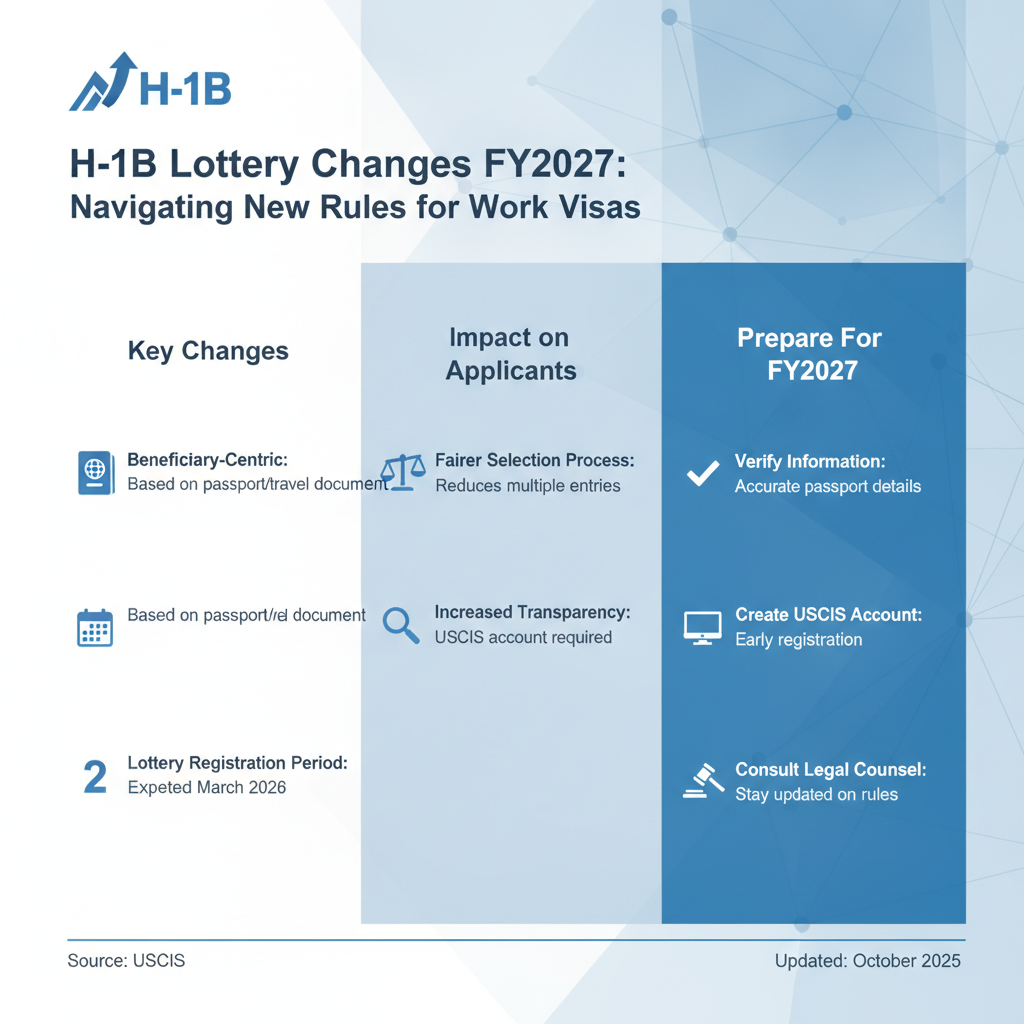
Today, we're diving deep into the H-1B visa lottery changes for Fiscal Year 2027 (FY2027), a development that has sent ripples through the immigrant community and among employers alike. These new rules, implemented by U.S. Citizenship and Immigration Services (USCIS), are designed to enhance the integrity of the lottery process and ensure a fairer chance for all eligible beneficiaries.
Whether you’re an employer in Orlando looking to sponsor talent, a skilled professional in Miami hoping for a work visa, or an international student in Gainesville planning your post-graduation career, these changes directly impact your future. Let’s break down what you need to know.
Navigating Complex H-1B Changes? Don't go it alone. Our Orlando immigration team is ready to assist you with the latest H-1B rules. Call +1 786-791-3106 for a free consultation, or message us online. Se Habla Español.
NEWS SOURCE REFERENCE SECTION
The reporting that sparked this guide: H-1B Visa Lottery Changes for FY2027 (Legal News)
What This News Means for Immigrants in Orlando and Across Florida
The recent announcements regarding the H-1B visa lottery for FY2027 represent a significant shift in how these coveted work visas are allocated. For anyone residing in or planning to work in Florida, understanding these changes is paramount. From the vibrant tech hubs in Orlando and Tampa to the bustling tourism industry across the state, Florida relies heavily on a diverse, skilled workforce, many of whom are H-1B visa holders or aspirants.
Why this news is showing up now
The U.S. government, through USCIS, regularly reviews and updates its immigration policies to address challenges, combat fraud, and streamline processes. For years, the H-1B lottery has faced scrutiny due to concerns over duplicate registrations and other practices that could skew the chances of genuine applicants. The H-1B lottery for FY2027 (which had its registration period in March 2026, with petitions filed starting April 1, 2026) was the first cycle to fully implement significant integrity measures, most notably the "beneficiary-centric" selection process.
This news is showing up now, in August 2026, because the initial impact of these changes on the FY2027 lottery results is being analyzed, lessons are being learned, and USCIS is likely continuing to refine its approach based on this cycle's experience. This ongoing evaluation leads to clarifications, new guidance, and sometimes further adjustments that will affect future cycles, including FY2028 and beyond. The goal is to ensure the H-1B program serves its intended purpose: to bring highly skilled foreign workers to U.S. companies where there is a demonstrated need.
How it can affect Florida residents
Florida, particularly Central Florida and the I-4 corridor, is a hub for innovation, technology, healthcare, and hospitality. Companies in Orlando, Tampa, and Miami frequently rely on the H-1B program to fill specialized roles that require specific expertise. For Florida residents, both employers and potential H-1B beneficiaries, these changes have several key implications:
- For H-1B Beneficiaries in Florida: If you are an international student graduating from a Florida university (like UCF, UF, or FIU), or a professional working in Florida on another visa and hoping to transition to H-1B, the new rules aim to level the playing field. Your chances are now tied directly to your unique identification, regardless of how many employers registered you. This means less competition from potentially fraudulent duplicate entries, but also emphasizes the importance of a strong, legitimate job offer.
- For Florida Employers: Companies across Florida, from theme parks to tech startups, must now ensure their H-1B registration processes are fully compliant with the new USCIS regulations. The focus on a single beneficiary entry means employers must verify the uniqueness of their prospective employees' registrations. This could lead to more stringent internal vetting processes and a greater reliance on experienced legal counsel to avoid penalties or denials.
- Increased Scrutiny: Expect USCIS to continue its enhanced scrutiny on petitions, especially those from employers with a history of multiple registrations or those that appear to lack a genuine employer-employee relationship. This affects businesses throughout the state, from Orange County to Broward County, ensuring that only bona fide positions receive H-1B visas.
- Preparation is Key: With a more integrity-focused system, early and meticulous preparation of all required documents and a thorough understanding of eligibility criteria are more critical than ever for Florida's workforce and businesses.
What H-1B Visa Lottery Changes for FY2027 Is (and Why It Matters)
The H-1B visa program is a nonimmigrant visa category that allows U.S. employers to temporarily employ foreign workers in specialty occupations. These occupations generally require a bachelor's degree or higher in a specific field. The program is crucial for many U.S. industries that face shortages of qualified American workers in specialized fields like technology, engineering, medicine, and research.
A plain-English definition
Imagine the H-1B visa as a special pass for skilled foreign professionals to work in the U.S. for a specific employer. Because demand for these passes far outweighs the supply, USCIS holds an annual lottery. For FY2027, the big news is that USCIS changed how this lottery works to make it fairer. Instead of counting each application an employer submits, they now count each individual person (the "beneficiary") only once. This means if three different companies register you for an H-1B, you still only get one "ticket" in the lottery. This change aims to stop companies from artificially boosting an individual's chances by submitting multiple registrations for the same person, which was seen as a way to game the system.
Why does this matter? It means the lottery is now more equitable. Everyone has the same chance, regardless of how many employers are willing to sponsor them. It also means employers and beneficiaries need to be even more diligent about the legitimacy of job offers and the accuracy of their submissions.
Key terms you need to know
Navigating immigration law requires understanding specific terminology. Here are key terms related to the H-1B visa and the recent changes:
- H-1B Visa: A nonimmigrant visa that permits U.S. employers to temporarily employ foreign workers in specialty occupations.
- Specialty Occupation: An occupation that requires theoretical and practical application of a body of highly specialized knowledge, and a bachelor's or higher degree in the specific specialty (or its equivalent) as a minimum for entry into the occupation in the United States.
- USCIS (U.S. Citizenship and Immigration Services): The government agency that administers the H-1B program, including the lottery and petition processing. Link: USCIS official website
- H-1B Cap: The annual numerical limit on the number of H-1B visas issued. Currently, Congress sets the annual cap at 65,000 for the regular cap and an additional 20,000 for the "Master's Cap" (for those with a U.S. master's degree or higher).
- Cap-Exempt: Certain employers (e.g., institutions of higher education, non-profit research organizations) are exempt from the annual H-1B cap.
- Beneficiary: The foreign national who will be employed under the H-1B visa. The FY2027 changes focus on the uniqueness of the beneficiary.
- Petitioner: The U.S. employer sponsoring the foreign national for the H-1B visa.
- LCA (Labor Condition Application): Form ETA-9035, certified by the U.S. Department of Labor (DOL), which attests that the employer will pay the H-1B worker at least the prevailing wage or the actual wage paid to similarly employed workers, whichever is higher, and provide working conditions that will not adversely affect other workers.
- Employer-Employee Relationship: A key requirement for H-1B petitions, demonstrating that the petitioning employer controls the H-1B worker's employment.
- Registration Period: The annual window, typically in March, during which employers must electronically register prospective H-1B beneficiaries for the lottery.
- Selection Process: The lottery conducted by USCIS to select enough registrations to meet the annual cap. For FY2027, this process became beneficiary-centric.
- Master's Cap: The additional 20,000 H-1B visas reserved for beneficiaries who have earned a U.S. master's degree or higher.
- Duplicate Registrations: Submitting more than one registration for the same beneficiary by the same employer, or multiple employers submitting registrations for the same beneficiary without a bona fide job offer from each. The FY2027 changes specifically target the latter type of manipulation.
- RFE (Request for Evidence): A notice from USCIS requesting additional documentation or information to support an immigration petition.
- Premium Processing: An expedited service offered by USCIS for certain petitions, including H-1B, for an additional fee, guaranteeing a response within 15 calendar days.
Current Immigration Law: The Foundation
The H-1B visa program is authorized under the Immigration and Nationality Act (INA), specifically Section 101(a)(15)(H)(i)(b) and Section 214(g). These statutes establish the legal framework for nonimmigrant workers in specialty occupations and set the annual numerical cap.
Federal requirements
At the federal level, the core requirements for an H-1B visa remain consistent. The employer (petitioner) must demonstrate:
- Specialty Occupation: The job must qualify as a specialty occupation, meaning it requires a bachelor's degree or higher in a specific field.
- Required Education/Experience: The beneficiary must possess the required degree or its equivalent in work experience.
- Employer-Employee Relationship: A valid employer-employee relationship must exist between the petitioner and the beneficiary. This is particularly scrutinized for third-party placements or consulting arrangements.
- LCA Certification: A certified Labor Condition Application (Form ETA-9035) from the Department of Labor must be on file, attesting to prevailing wages and working conditions.
- Wage Compliance: The employer must pay the H-1B worker at least the prevailing wage for the occupation in the area of intended employment, or the actual wage paid to other employees with similar experience and qualifications, whichever is higher.
The primary form used for an H-1B petition is Form I-129, Petition for a Nonimmigrant Worker. This form, along with supporting documentation, is filed with USCIS after a registration has been selected in the lottery. Other important forms include Form I-797, Notice of Action, which USCIS uses to communicate approvals, rejections, or requests for evidence.
For detailed information on these requirements, always refer to the USCIS official website.
Florida-specific considerations
While federal law governs the H-1B visa, its application has practical considerations for Florida residents and businesses. Florida's economy is diverse, with strong sectors in aerospace, defense, information technology, clean energy, life sciences, and tourism. These industries often rely on H-1B workers to fill highly skilled positions.
- Prevailing Wage Determinations: The prevailing wage for a specific occupation can vary significantly based on the geographic area. For example, the prevailing wage for a software engineer in Orlando (Orange County) might differ from that in Tampa or Jacksonville. Employers must ensure they are using the correct wage data for their specific Florida location.
- Local Talent Needs: Companies along the I-4 corridor, connecting Orlando and Tampa, frequently seek H-1B talent due to the growth of tech parks and research institutions. The availability of STEM graduates from Florida universities (like the University of Central Florida, University of Florida, Florida International University) also influences the H-1B landscape in the state.
- Orlando USCIS Field Office: While H-1B petitions are typically processed by specialized service centers, the Orlando USCIS Field Office may handle certain local inquiries or interviews, though direct H-1B petition filing is not done there. Knowing your local resources and understanding the broader federal process is key.
Confused by H-1B Regulations? Imigrar's experienced attorneys in Orlando provide clarity and strategic guidance for H-1B petitions. Call +1 786-791-3106 for a free consultation. Se Habla Español.

How to Navigate the H-1B Visa Lottery Changes for FY2027: A Complete Step-by-Step Guide
The FY2027 H-1B lottery introduced a significant shift to a beneficiary-centric selection process, aiming to prevent duplicate registrations and ensure fairness. This guide outlines the steps involved, incorporating these new rules and preparing for future cycles like FY2028 based on the lessons learned from FY2027.
1) Understand the New FY2027 H-1B Lottery Rules and Eligibility
Before any action, both employers and prospective beneficiaries must thoroughly understand the updated rules. The most impactful change for FY2027 was that USCIS now selects registrations based on unique beneficiaries, not on the number of registrations submitted on behalf of a beneficiary. This means:
- Single Beneficiary Entry: Each unique beneficiary is entered into the lottery only once, even if multiple employers submit registrations on their behalf.
- Fraud Prevention: USCIS has stated it will deny petitions where it finds multiple registrations for the same beneficiary by related entities or where there is no legitimate job offer.
- Employer Due Diligence: Employers must ensure they have a bona fide job offer and a genuine need for the H-1B worker.
Eligibility: The beneficiary must meet the definition of a specialty occupation worker, typically requiring a bachelor's degree or its equivalent in a specific field. The employer must be a U.S. entity with a valid Employer Identification Number (EIN).
Required Documents (for understanding eligibility):
- Beneficiary's educational degrees and transcripts (U.S. or evaluated foreign equivalents).
- Beneficiary's resume/CV highlighting relevant experience.
- Detailed job description from the employer to assess specialty occupation criteria.
- Employer's business license and EIN.
Important: Start this step early. Consulting with an immigration attorney at Imigrar can help clarify eligibility under the new rules.
2) Employer Pre-Registration and LCA Filing
Once eligibility is confirmed and a bona fide job offer is in place, the employer begins the formal process.
- Employer Registration Account: The employer must have or create an online registrant account with USCIS.
- LCA Filing (Form ETA-9035): The employer must prepare and file a Labor Condition Application (LCA) with the U.S. Department of Labor (DOL). This document specifies the job title, duties, wage, and work location. The LCA must be certified by the DOL before an H-1B petition can be filed. This process can take 7-10 business days.
Required Documents (for LCA):
- Employer's EIN.
- Detailed job description, including duties, minimum educational requirements, and experience.
- Proposed salary and benefits.
- Specific work location(s).
- Prevailing wage determination for the specific occupation and location.
Reminder: The LCA must accurately reflect the job offer and meet prevailing wage requirements to avoid issues later.
3) H-1B Cap Registration and Lottery Submission
This is the critical step for lottery entry, typically occurring in March for the fiscal year starting October 1st. For FY2027, this already happened in March 2026.
- Online Registration: During the designated registration period, the employer (or their authorized representative, like Imigrar) electronically registers the beneficiary with USCIS. Each registration requires a $10 non-refundable fee (this fee may increase in future cycles).
- Beneficiary Information: The registration includes basic information about the beneficiary (name, date of birth, country of birth, passport number) and the petitioning employer.
- Single Entry Per Beneficiary: Under the new rules, USCIS identifies unique beneficiaries using passport information. If multiple employers register the same beneficiary, only one entry for that beneficiary is placed into the lottery pool. If selected, any of the employers who registered that beneficiary may proceed with filing a petition.
- Selection Notification: USCIS announces the lottery results, typically by the end of March. Selected registrants receive a selection notice, which is valid for filing a petition during a specified window (usually 90 days).
Required Information (for Registration):
- Beneficiary's full legal name, date of birth, country of birth, country of citizenship, gender, and valid passport number.
- Employer's legal name, mailing address, and EIN.
- Attorney or representative contact information (if applicable).
Warning: Intentional misrepresentation or fraudulent statements in the registration can lead to severe penalties, including denial of current and future petitions.
4) Petition Preparation and Filing Upon Selection
If your registration is selected, the real work of preparing the full H-1B petition begins.
- Prepare Form I-129: Complete Form I-129, Petition for a Nonimmigrant Worker, along with all required supplements and addenda.
- Gather Supporting Documents: Collect all necessary evidence to support the petition, demonstrating the specialty occupation, the beneficiary's qualifications, the employer-employee relationship, and the certified LCA.
- Pay Filing Fees: Include all required filing fees, which can vary based on employer size and specific circumstances (e.g., base filing fee, ACWIA fee, fraud prevention and detection fee, public law fee, premium processing fee if requested).
- Mail Petition: File the complete petition package with the appropriate USCIS service center within the designated filing window (usually 90 days from the selection notice date).
Required Documents (for Petition Filing):
- Certified LCA (Form ETA-9035).
- Copy of H-1B Registration Selection Notice.
- Completed and signed Form I-129 and supplements.
- Beneficiary's educational documents (diplomas, transcripts, foreign degree evaluations).
- Beneficiary's resume/CV, letters of experience.
- Beneficiary's passport biographical page, previous visa stamps, I-94 records.
- Employer's business documents (articles of incorporation, financial statements, tax returns, office lease, client contracts if applicable).
- Detailed job offer letter and job description.
- Organizational charts, supervisor contact information (especially for third-party placements).
- Proof of payment for all USCIS fees.
5) Responding to RFEs and Visa Interview (if applicable)
After filing, USCIS may issue an RFE (Request for Evidence) if they need more information to make a decision. This is a common part of the process.
- Respond to RFE: If an RFE is issued, carefully review it with your attorney and gather the requested additional documentation. Respond thoroughly and accurately within the given deadline.
- Petition Approval: If the petition is approved, USCIS will send an I-797 Approval Notice.
- Change of Status vs. Consular Processing:
- If the beneficiary is already in the U.S. on another nonimmigrant visa (e.g., F-1 OPT) and the H-1B petition includes a request for change of status, they may begin working for the H-1B employer on October 1st (or the petition's start date).
- If the beneficiary is outside the U.S. or needs to travel, they will need to attend a visa interview at a U.S. embassy or consulate abroad to obtain the H-1B visa stamp in their passport. This typically requires a separate appointment and additional documents.
Required Documents (for RFE/Interview):
- All documents submitted with the original petition.
- Any additional evidence specifically requested in the RFE.
- For consular processing:


