


The landscape of U.S. immigration is constantly evolving, and for skilled foreign workers and the employers who seek their talent, few changes are as impactful as those affecting the H-1B visa program. As of April 3, 2026, the focus has shifted to the recently concluded FY2027 H-1B lottery, which introduced significant changes designed to streamline the process, combat fraud, and ensure fairness. At Imigrar, your trusted immigration law firm in Orlando, Florida, we understand the complexities these updates present and are here to guide you through every step.
Need Expert Guidance on H-1B Visa Changes? The new H-1B lottery rules can be challenging to navigate. Our experienced Orlando immigration team is ready to assist employers and beneficiaries nationwide. Call +1 786-791-3106 for a free consultation, or message us online. Se Habla Español.
NEWS SOURCE REFERENCE SECTION
The reporting that sparked this guide: H-1B Visa Lottery Changes for FY2027 (Legal News)
What This News Means for Immigrants in Orlando and Across Florida
The H-1B visa program is a cornerstone for many professionals seeking to build their careers in the United States, particularly in high-demand fields like technology, engineering, medicine, and research. For employers, it's a vital tool for attracting and retaining top global talent. The recent changes to the H-1B visa lottery for Fiscal Year 2027 represent a significant shift in how these opportunities are allocated, impacting both potential beneficiaries and sponsoring companies.
Why this news is showing up now
The U.S. government's fiscal year begins on October 1st. For the H-1B program, USCIS typically opens a registration period in March (of the calendar year prior to the fiscal year) for the upcoming fiscal year's cap-subject visas. For **Fiscal Year 2027 (FY2027)**, this means the electronic registration period concluded in March 2026, with selection notifications being sent out shortly thereafter, often in late March or early April 2026. This timing makes the news of rule changes highly relevant and immediate, as selected registrants must now prepare and file their petitions under these new guidelines.
The changes themselves stem from a final rule published by U.S. Citizenship and Immigration Services (USCIS) in early 2024, titled "Improving the H-1B Program and Strengthening Protections for H-1B Workers." While some elements of this rule were phased in, the **beneficiary-centric selection process** became effective for the FY2025 lottery and has been fully implemented and refined for subsequent lotteries, including FY2027. Additionally, new fee schedules, also finalized in early 2024, became effective on April 1, 2024, directly impacting the costs associated with filing H-1B petitions for FY2027 and beyond.
How it can affect Florida residents
Florida, with its booming technology sector, growing healthcare industry, and robust tourism and hospitality enterprises, is a significant hub for H-1B talent. Cities like Orlando, Tampa, and Miami attract thousands of skilled professionals each year. The changes to the H-1B lottery directly affect:
- Florida-based employers: Companies in the I-4 corridor, including those in Orlando's tech parks and medical cities, rely on H-1B visas to fill specialized roles. They must now navigate the new registration process, understand the increased filing fees, and ensure their petitions comply with updated regulations to secure top talent.
- International students graduating from Florida universities: Graduates from institutions like the University of Central Florida (UCF), University of Florida (UF), and Florida International University (FIU) often seek H-1B sponsorship. The beneficiary-centric selection process aims to give each individual a fairer chance, but the overall competition remains fierce.
- Skilled workers residing in Florida: Individuals currently in Florida on other nonimmigrant visas (like F-1 OPT or L-1) who wish to transition to H-1B status will be directly impacted by the new lottery mechanics and petition requirements.
- Families in Central Florida: The H-1B program is not just about individuals; it's about keeping families together. Successful H-1B petitions allow spouses and children to reside in the U.S. under H-4 status. Any change affecting the principal applicant's visa journey has ripple effects on their entire family unit in Orlando and across the state.
Understanding these changes is crucial for anyone involved in the H-1B process in Florida. Imigrar is deeply rooted in the Orlando community and serves clients nationwide, offering tailored advice to navigate these complex immigration pathways.
What H-1B Visa Lottery Changes Are (and Why They Matter)
The H-1B visa program allows U.S. employers to temporarily employ foreign workers in specialty occupations. A "specialty occupation" generally requires a bachelor's degree or higher in a specific field. Due to high demand, the number of H-1B visas available each fiscal year is capped by Congress. This cap is currently 65,000 visas, with an additional 20,000 for those with a U.S. master's degree or higher (the "master's cap"). When the number of registrations or petitions exceeds the annual cap, USCIS conducts a lottery to select eligible registrations.
A plain-English definition
For Fiscal Year 2027, the "H-1B visa lottery changes" refer primarily to two major updates:
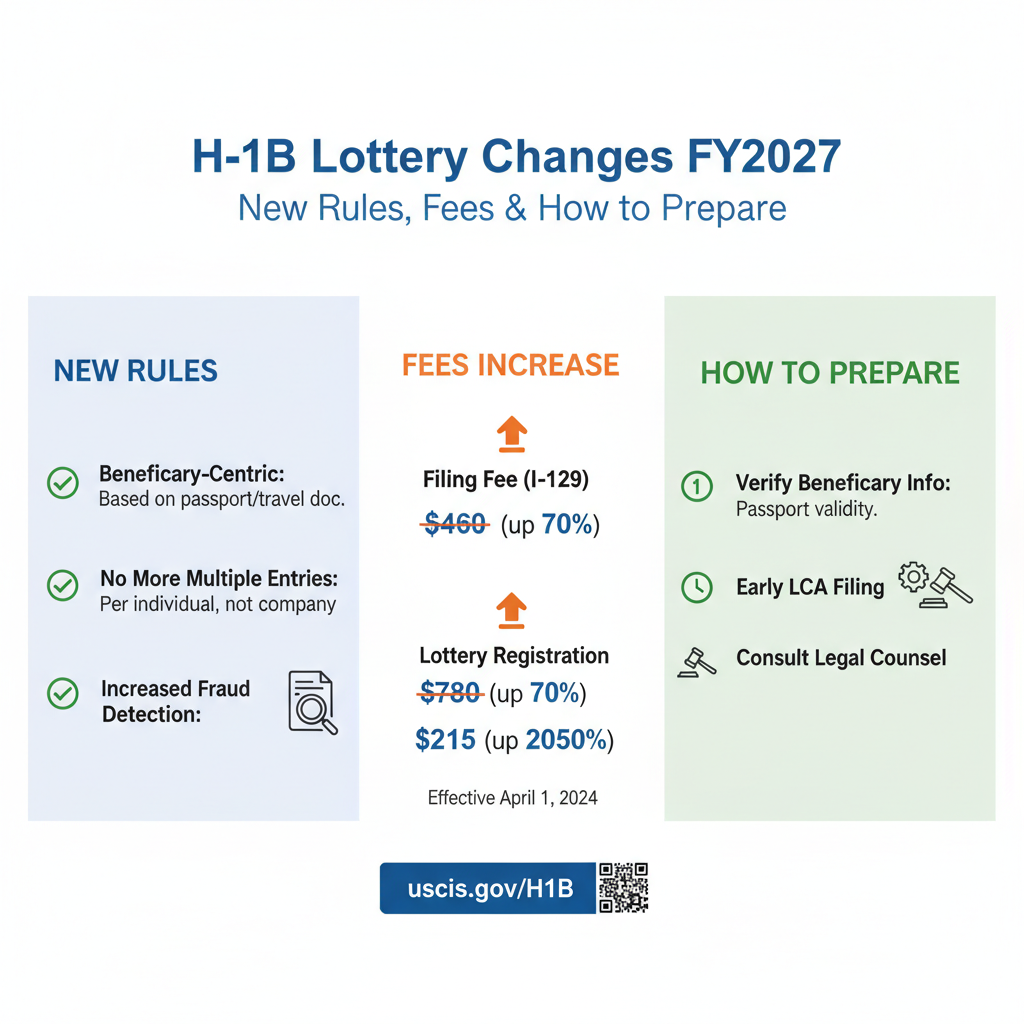
- **Beneficiary-Centric Selection:** Instead of prioritizing multiple registrations submitted by different employers for the same individual, the lottery now selects based on the unique beneficiary. This means that even if a single beneficiary has multiple employers register them, that individual only gets one "ticket" in the lottery pool. This change significantly reduces the incentive for employers to collaborate to submit multiple registrations for one person, which was a common tactic perceived as fraudulent.
- **Increased Fees:** USCIS has implemented a new fee schedule. While the registration fee for FY2025 remained at $10, it increased to $215 for FY2026 and future fiscal years, including FY2027. This, along with increases for the base Form I-129 petition fee and other associated costs, means the overall expense of the H-1B process has risen.
These changes matter because they aim to make the lottery process fairer, more equitable, and less susceptible to fraud. For beneficiaries, it means their individual qualifications, not the number of employers willing to register them, determine their lottery chances. For employers, it means a level playing field, where genuine demand for talent is the driving factor, not a strategy to game the system.
Key terms you need to know
- USCIS (U.S. Citizenship and Immigration Services): The government agency responsible for administering immigration and naturalization benefits. USCIS official website.
- H-1B Visa: A nonimmigrant visa that allows U.S. employers to temporarily employ foreign workers in specialty occupations.
- Cap-Subject H-1B: Refers to H-1B visas that are subject to the annual numerical limit (cap) set by Congress. Certain employers (e.g., universities, non-profit research organizations) are "cap-exempt."
- H-1B Electronic Registration Process: The online system where employers submit basic information about the prospective H-1B worker (beneficiary) and the job offer during a designated registration period.
- Beneficiary: The foreign worker who is the subject of the H-1B petition.
- Petitioner: The U.S. employer who files the H-1B petition on behalf of the beneficiary.
- LCA (Labor Condition Application): **Form ETA-9035**. An application filed with the U.S. Department of Labor (DOL) by the employer, attesting that they will pay the H-1B worker at least the prevailing wage or the actual wage, whichever is higher, and provide working conditions that will not adversely affect other workers.
- Selection Notice: The notification from USCIS to employers whose H-1B registrations have been selected in the lottery, granting them permission to file an H-1B petition.
- Form I-129, Petition for a Nonimmigrant Worker: The primary form filed by the employer with USCIS to request H-1B classification for the beneficiary.
- Premium Processing: An optional service offered by USCIS that guarantees processing of certain petitions (including H-1B) within a shorter timeframe (typically 15 calendar days) for an additional fee.
- Change of Status: Applying to change from one nonimmigrant visa status to another (e.g., from F-1 student to H-1B worker) while remaining in the U.S.
- Consular Processing: Applying for an H-1B visa stamp at a U.S. embassy or consulate abroad if the beneficiary is outside the U.S. or chooses to leave and re-enter.
Current Immigration Law: The Foundation of the H-1B Program
The H-1B visa program is authorized under the Immigration and Nationality Act (INA), specifically **INA § 101(a)(15)(H)(i)(b)**, and is further regulated by federal statutes and agency guidelines. Understanding these foundational laws is crucial for compliance.
Federal requirements
To qualify for an H-1B visa, both the employer and the beneficiary must meet specific criteria:
- Specialty Occupation: The job must qualify as a specialty occupation, meaning it requires theoretical and practical application of a body of highly specialized knowledge, and a bachelor's or higher degree in the specific specialty (or its equivalent) as a minimum for entry into the occupation in the U.S.
- Educational Requirements: The beneficiary must possess at least a bachelor's degree or its equivalent, or hold an unrestricted state license, or have work experience equivalent to a bachelor's degree.
- Employer-Employee Relationship: A valid employer-employee relationship must exist between the petitioning U.S. employer and the H-1B beneficiary.
- Labor Condition Application (LCA): The employer must file and have a certified LCA (**Form ETA-9035**) with the U.S. Department of Labor (DOL) before filing the H-1B petition. The LCA attests to several conditions, including:
- Payment of the required wage (the higher of the prevailing wage for the occupation in the area of employment or the actual wage paid to other employees with similar experience and qualifications).
- Provision of working conditions that will not adversely affect the working conditions of workers similarly employed.
- No strike or lockout in the occupational classification at the place of employment.
- Notification to bargaining representative (if any) or posting of notice to employees.
- Numerical Cap: Most H-1B visas are subject to an annual cap, currently 65,000, with an additional 20,000 for those holding a U.S. master's degree or higher.
Florida-specific considerations
While the H-1B program is governed by federal law, Florida's economic landscape and local conditions can influence certain aspects:
- Prevailing Wage Determinations: The U.S. Department of Labor issues prevailing wage data based on geographical areas. For employers in Orlando, Tampa, or other Florida cities, the prevailing wage for a specific occupation will be based on the local Florida wage data. This is a critical component of the LCA.
- Industry Demand: Florida's robust sectors, particularly in tourism, hospitality, healthcare, aerospace, and technology (especially around the I-4 corridor including Orlando and Melbourne), create specific demands for H-1B talent. Employers in these industries frequently sponsor H-1B visas.
- Academic Institutions: Florida is home to numerous universities and research institutions. These entities are often cap-exempt for H-1B purposes, meaning they can petition for H-1B workers at any time of the year, outside the lottery system.
Reminder: USCIS forms, such as **Form I-129**, are federal forms and are universally applicable. However, the specific details provided on these forms, like the employment location and corresponding prevailing wage, will be unique to Florida-based petitions.
For detailed information on forms and regulations, always refer to the USCIS official website and the Executive Office for Immigration Review for legal interpretations.
Confused by H-1B Regulations? Don't risk a denial due to non-compliance. Imigrar's legal team is well-versed in the latest H-1B laws and can ensure your petition meets all federal and Florida-specific requirements. Contact us today at +1 786-791-3106 for a free consultation. Se Habla Español.

How to Navigate the H-1B Visa Process Under the New Rules: A Complete Step-by-Step Guide
The H-1B visa process, especially with the recent changes, requires meticulous planning and execution. This guide outlines the typical steps for cap-subject H-1B visas, incorporating the new beneficiary-centric lottery and increased fees.
1) Employer Assessment, LCA Filing, and Prevailing Wage Determination
The process begins with the U.S. employer identifying a need for a foreign worker in a specialty occupation. The employer must first determine the appropriate prevailing wage for the position in the specific geographic area (e.g., Orlando, Florida) where the H-1B worker will be employed. This is typically done by requesting a Prevailing Wage Determination (PWD) from the Department of Labor (DOL) or using an acceptable private wage survey.
- Required Documents/Actions:
- Job description, duties, and minimum requirements for the position.
- Location of employment (e.g., Orlando, Orange County, FL).
- Employer's Federal Employer Identification Number (FEIN).
- **Form ETA-9035 (Labor Condition Application):** Filed with the DOL. This form requires attestations regarding wages and working conditions. The DOL typically processes LCAs within 7 business days.
2) H-1B Electronic Registration (Beneficiary-Centric)
Once the LCA is certified (or while awaiting certification), and during the designated registration period (typically in March), the employer must register the beneficiary electronically with USCIS. This step is crucial and where the new beneficiary-centric rule comes into play for FY2027.
- Key Action: The employer, or their authorized representative (like Imigrar), creates a USCIS online account and submits one registration per beneficiary, even if multiple employers are interested in that same beneficiary.
- Fee: A non-refundable **$215** H-1B registration fee per beneficiary (for FY2026 and future years like FY2027).
- Required Information for Registration:
- Employer's legal name, FEIN, and mailing address.
- Beneficiary's full name, date of birth, country of birth, country of citizenship, passport number.
- Beneficiary's gender.
- Beneficiary's highest degree attained.
- Indication of whether the beneficiary holds a U.S. master's or higher degree (for master's cap eligibility).
- Attorney or representative information (if applicable).
Important: Under the new rules, selection in the lottery is based on unique beneficiaries, not on the number of registrations submitted on their behalf. This aims to prevent fraud and give all beneficiaries an equal chance.
3) Lottery Selection and Notification
After the registration period closes, USCIS conducts the lottery. If selected, USCIS sends a selection notice to the employer's USCIS online account. This notice indicates that the employer is eligible to file an H-1B petition for the named beneficiary during a specific filing window.
- Timeline: Selections are typically announced by late March or early April.
- Action: Employers must monitor their USCIS online accounts for selection notifications.
4) Petition Preparation (Form I-129 and Supporting Documents)
Upon selection, the employer has a limited **90-day window** to prepare and file the complete H-1B petition package with USCIS. This step is extensive and requires careful attention to detail.
- Primary Form: **Form I-129, Petition for a Nonimmigrant Worker**, along with the H-1B supplement.
- Required Documents (Employer):
- Certified LCA (**Form ETA-9035**).
- Employer's federal tax ID number (FEIN).
- Articles of incorporation/business license.
- Financial statements/tax returns (to prove ability to pay wages).
- Job offer letter detailing duties, salary, and terms of employment.
- Organizational chart of the company.
- Detailed description of the specialty occupation and how it meets H-1B requirements.
- Contracts for projects (if applicable, especially for consulting companies).
- Required Documents (Beneficiary):
- Copies of all educational degrees, diplomas, and transcripts.
- Foreign degree evaluations (if applicable).
- Professional licenses (if applicable).
- Resume/CV.
- Passport copies (all pages).
- U.S. visa copies and **Form I-94** (Arrival/Departure Record).
- Previous H-1B approval notices (if any).
- Marriage certificate and children's birth certificates (for H-4 dependents, if applicable).
5) USCIS Petition Filing
The complete petition package, including **Form I-129** and all supporting documents, must be physically mailed to the correct USCIS service center within the designated filing window specified in the selection notice.
- Fees:
- **Form I-129** filing fee: **$780** (for employers with 26+ employees, effective 04/01/2024; lower for small employers/non-profits).
- American Competitiveness and Workforce Improvement Act (ACWIA) fee: **$1,500** (for employers with 26+ employees; **$750** for small employers).
- Fraud Prevention and Detection fee: **$500**.
- Public Law 114-113 fee (for employers with 50+ employees, 50% or more H-1B/L-1 workers): **$4,000**.
- Optional Premium Processing fee: **$2,805** (as of Feb 26, 2024).
- Action: Ensure all checks are payable to "U.S. Department of Homeland Security" and correctly reflect the new fee amounts.
6) Adjudication and Approval
USCIS reviews the petition. This process can take several months, or 15 calendar days if premium processing is elected. USCIS may issue a Request for Evidence (RFE) if they need more information. If approved, an **Form I-797, Notice of Action** (Approval Notice), is issued.
- Timeline: Processing times vary widely. Check USCIS Processing Times for current estimates.
- Potential Outcome: RFE, Approval, or Denial.
7) Visa Interview (if applicable) / Change of Status
If the beneficiary is currently outside the U.S. or needs to travel, they will need to attend a visa interview at a U.S. embassy or consulate abroad to obtain an H-1B visa stamp. If the beneficiary is already in the U.S. and the petition requested a change of status, the approval notice itself serves as proof of their new H-1B status, effective October 1st (for cap-subject petitions) or the approval date. If your case is in Orlando, the Orlando USCIS Field Office may handle certain follow-up actions, but initial H-1B petitions are processed at service centers.
- Required Documents for Interview:
- Passport valid for at least six months beyond the proposed stay.
- **Form I-797** H-1B approval notice.
- DS-160 confirmation page.
- Appointment confirmation page.
- Recent passport-style


